Grok Bot Starts Teaming Up to Get Things Done
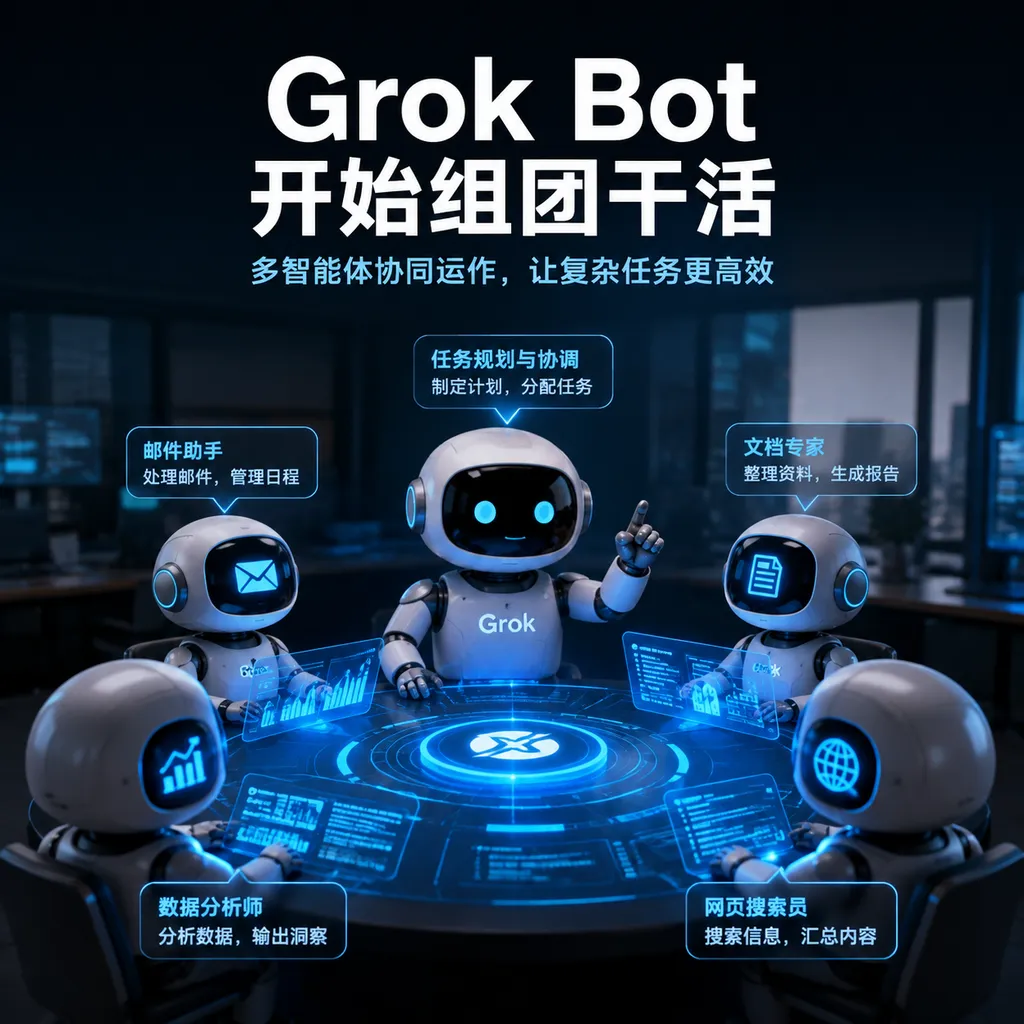
SpaceXAI has launched Grok Bot, enabling multiple persistent agents to collaborate across applications, remember workflows, and continuously execute tasks. It is more like a runtime for digital employees, but permissions, security, and reliability will ultimately determine its enterprise value.
SpaceXAI Moves AI Agents from the Chat Box into the Workflow
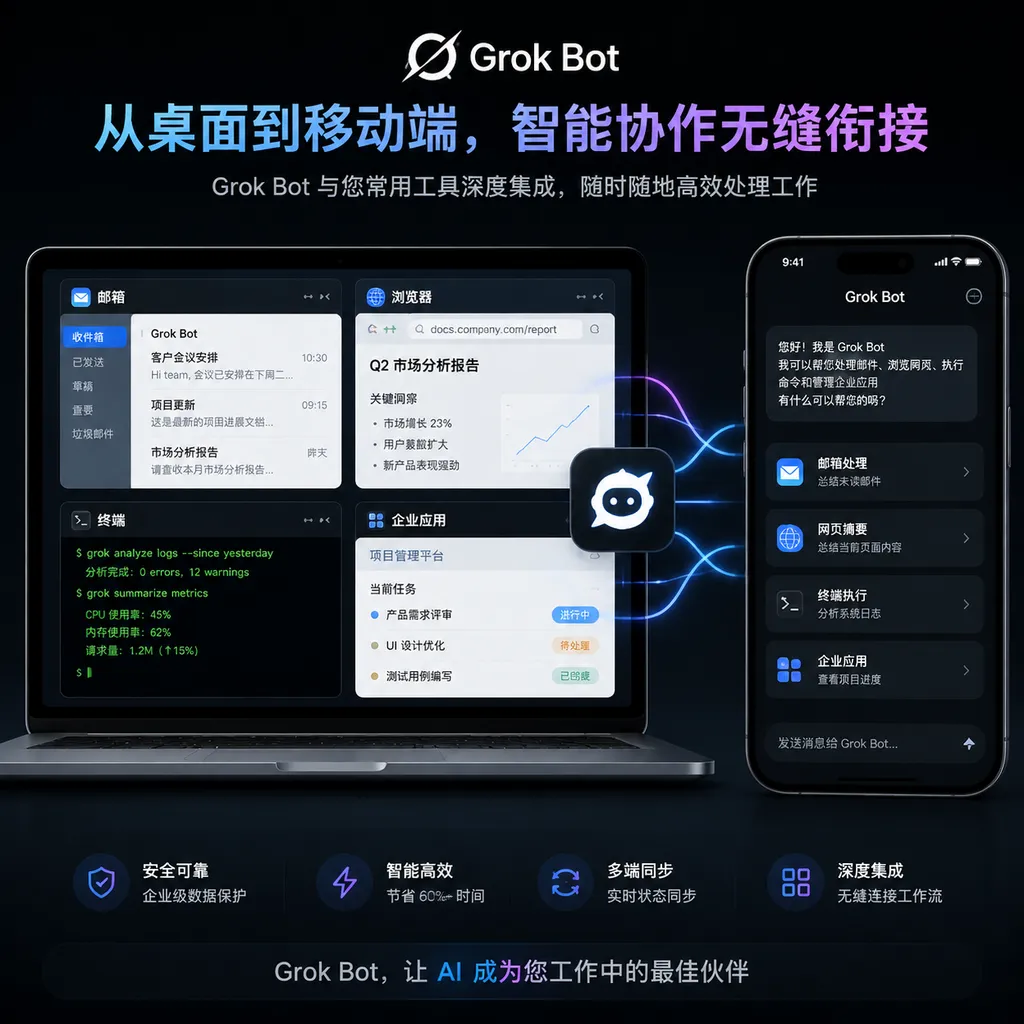
On August 11, Elon Musk’s SpaceXAI launched Grok Bot, an enterprise AI software product focused on multi-agent collaboration and cross-application execution. It does more than answer questions. It aims to function like a team of digital colleagues available around the clock: logging into email, websites, and internal tools; reading files; calling terminals; moving information between different systems; and continuously advancing tasks.
Grok Bot is currently in testing and has begun rolling out to SuperGrok Heavy, Cursor Ultra, and Cursor Teams subscribers on platforms including Windows and iOS. SpaceXAI says its internal engineering, growth, marketing, and operations teams are already using the product.
The focus of this launch is not how much the Grok model has improved its benchmark scores, but rather that SpaceXAI has begun filling in the most critical layer of agent products: putting models into enterprise software for real, preserving state over time, and enabling them to divide work and collaborate with other agents.
Every Bot Has a Continuously Running Cloud Computer
According to SpaceXAI’s published product documentation, a Bot in Grok Bot is an independent agent with a name and persistent existence. Users can assign it responsibilities, provide context, and grant the file or tool permissions it needs—much as they would message a colleague.
Its first major difference from an ordinary chatbot lies in its operating environment.
Each Bot has a persistent cloud virtual machine that includes a browser, file system, and terminal. For services with standard interfaces, it can connect through connectors or MCP. For legacy websites, back-office systems, and desktop-style web applications without clean APIs, it can use computer use to recognize the interface and operate the pages directly.
In other words, a traditional chat model is more like a consultant sitting in a conference room and offering advice. Grok Bot is trying to give itself a work computer and a temporary access badge so it can enter systems and get things done.
This distinction matters.
In the past, many so-called AI Agents would generate an email draft, SQL query, or operating recommendation, while the user still had to copy, paste, and execute it. Grok Bot aims to place the result directly into real tools: emails go into the drafts folder, receipts enter financial workflows, leads are written into sales systems, and code fixes are committed to repositories—rather than simply remaining in the chat window.
Multi-Agent Systems Are Not Just Multiple Chat Windows
The capability that makes Grok Bot especially noteworthy is that different Bots can message one another, share relevant context, and assign tasks. Users can place multiple Bots in the same conversation and let them collaborate on their own, rather than manually serving as an information relay.
For example, a task involving lead generation and sales outreach could be broken into several parallel chains:
- One Bot researches target companies, job postings, and recent business developments;
- One Bot identifies decision-makers based on company profiles and supplements their contact information;
- One Bot drafts personalized emails based on historical communication records;
- Another Bot checks compliance requirements, removes duplicates, and organizes the final list;
- The primary Bot consolidates the results and passes only the portions requiring human judgment to sales staff.
The internal use cases disclosed by SpaceXAI include finding new customer accounts overnight, automatically drafting outreach emails, extracting receipts from inboxes and assisting with financial processing, as well as marketing campaigns, office operations, and vulnerability remediation.
These examples are not new. Enterprises have previously been able to achieve similar results with RPA, workflow engines, and collections of scripts. Grok Bot’s difference is that it attempts to eliminate the need to draw the workflow in advance: users do not need to configure dozens of nodes and conditional branches first. Instead, they can describe the goal directly and then turn a successful execution into a reusable skill or a proactively running routine through feedback.
This is also the key battleground for current agent products—whoever can turn natural-language delegation into stable, auditable workflows may be able to evolve from a model provider into an enterprise software platform.
Remembering How to Work Matters More Than a Long Context Window
Grok Bot retains information from previous tasks and remembers users’ preferred ways of working. Users can initiate a task on a computer and continue the same collaboration later on a phone. They can also have the Bot follow along while demonstrating an operation, gradually teaching it exception-handling rules and output formats.
This kind of memory should not be understood simply as stuffing every chat record into an extremely long context window.
Effective memory in enterprise work generally includes at least four layers:
- Identity memory: What the Bot is and is not responsible for, and to whom it reports;
- Process memory: Which systems a task requires and which approval sequence must be followed;
- Preference memory: Email tone, spreadsheet formats, coding conventions, and reporting granularity;
- Event memory: Why a client rejected something last time, the processing status of a particular invoice, or the stage reached in fixing a specific vulnerability.
If this information is merely piled into the conversation history without organization, retrieval noise will increase as the number of tasks grows. A genuinely useful persistent agent needs to manage facts, preferences, processes, and temporary states separately, while clearly specifying which information can be accessed by other Bots.
SpaceXAI emphasizes that Bots will become more proactive as collaboration increases, including following up on unfinished items, pushing stalled handoffs forward, and taking on portions of the work before the user says anything. This sounds much like a digital employee, but it is also where the risks begin to grow: the more an agent remembers and the more proactively it acts, the greater the potential losses caused by faulty memories and unauthorized actions.
The Real Challenges Are Not Planning, but Permissions and Failure Recovery
Multi-agent collaboration can easily be made to look impressive in a demo: several roles take turns discussing an issue and eventually produce a seemingly complete report. But enterprises do not lack discussion. What they lack is reliable execution.
For Grok Bot to prove its usefulness, it must solve at least four problems.
1. Permission Boundaries
An agent that can log into email, CRM systems, financial back offices, and code repositories essentially has action capabilities close to those of an employee account. Enterprises need to know which identity it used, what data it accessed, which tools it called, and whether it can carry sensitive information from one system into another.
A simple authorization pop-up is not enough. A mature solution requires least-privilege access, short-lived credentials, granular tool allowlists, and execution environments isolated by task. Multi-Bot collaboration also introduces the issue of permission propagation: if Bot A can see certain information, could that information leak to Bot B, which has lower privileges, when the context is shared?
2. Observability and Auditability
When a task is completed by multiple Bots in parallel, the final result may involve dozens of web operations, tool calls, and internal messages. If the system displays only “Task completed,” administrators will have almost no way to locate errors.
Enterprises need a complete trail: Who proposed the plan? Which Bot performed each step? What inputs did it use? Which objects did it modify? How did it retry after a failure? High-risk actions such as sending emails, modifying code, or submitting payments also require clear approval checkpoints and rollback mechanisms.
3. Long-Running Task Stability
Cross-application tasks are often interrupted by CAPTCHAs, page redesigns, expired logins, API rate limits, and dirty data. How intelligent a model is determines only whether it can plan a route. Product reliability, however, depends on whether it can detect an anomaly, save its progress, and recover safely after a button moves on the third page.
Persistent cloud virtual machines give Grok Bot the foundation for continuous work, but they also bring higher operating costs and greater state-management complexity. A Bot cannot become stuck at one step and consume computing resources in an infinite background loop.
4. The Coordination Costs of Multiple Agents
Multiple agents are not inherently better than a single agent. If tasks are divided too finely, they generate extensive context synchronization, duplicate retrieval, and mutual confirmation, increasing token, inference, and virtual-machine costs. Even more troublesome, different Bots may simultaneously modify the same object based on inconsistent information.
Multi-agent systems are therefore best suited to tasks with relatively clear boundaries that can be run in parallel and whose results can be verified, such as lead research, code testing, document archiving, and bulk content review. For tasks that rely heavily on unified judgment, a more capable primary agent paired with deterministic tools may actually be more reliable.
What SpaceXAI Is Chasing Is the Enterprise Agent Entry Point
The launch of Grok Bot carries a clear sense of catch-up. Anthropic and OpenAI have already made agents, tool calling, computer use, and enterprise connectors central to their product strategies, while developers are building their own execution layers around MCP, browser operations, and persistent tasks. SpaceXAI’s previous strengths were concentrated more in the Grok model, real-time information, and the ecosystem of Musk-owned products; its complete enterprise agent offering had lagged behind.
In May this year, SpaceXAI launched its first coding agent, followed by Grok 4.5, which is geared toward coding and enterprise scenarios. Grok Bot now extends these capabilities beyond code editors into email, websites, operations systems, and financial workflows.
This move is also related to SpaceXAI’s commercial pressures. Consumer chat subscriptions are unlikely to shoulder the enormous costs of training and computing on their own, while enterprise agents can generate recurring revenue based on seats, task volume, tool connections, and computing resources. More importantly, once a Bot learns a company’s internal processes and accumulates long-term memory, the switching cost is far higher than that of replacing a chat model.
Models still matter, but enterprise customers ultimately buy task completion rates, auditability, and the labor hours saved—not a score on a leaderboard.
Assessment: The Direction Is Right, but “Digital Colleague” Remains a High-Risk Promise
Grok Bot is heading in the right direction. It does not limit its selling points to longer context or better conversation. Instead, it offers a persistent operating environment, cross-application operations, long-term memory, and multi-agent communication. Only when these four capabilities are combined does the product begin to resemble a functional Agent rather than a chatbot wrapped in role prompts.
Its greatest value to developers and enterprise teams is also not that “multiple AIs can hold a meeting together,” but that it lowers the barrier to orchestrating agents. Users need only delegate a task, while the system handles task decomposition, environment execution, and context transfer in the background. This is more realistic than requiring every company to first hire an Agent engineering team.
At this stage, however, it should not be treated directly as an unsupervised digital employee. Grok Bot is still in testing, and SpaceXAI has not yet fully disclosed specific metrics covering success rates, permission governance, data retention, audit logs, and approval processes for high-risk operations. Internal trial cases can show that people are willing to use the product, but they do not mean it is already reliable in complex enterprise environments.
A more appropriate deployment strategy would be to first assign it low-risk, reversible, and easily verifiable tasks: organizing materials, generating drafts, checking data, running tests, and archiving receipts. Only after the system proves that it can handle exceptions consistently should it gradually be granted permission to send external emails, modify production code, or operate financial systems.
Grok Bot illustrates a shift taking place in the agent market: the competition is no longer just about “who has the strongest individual model,” but about “who can organize a team of models and leave them to complete the work in the background.”
This will be a larger market than chatbots, but also a slower competition that depends more heavily on engineering details. SpaceXAI has finally secured its entry ticket. Whether it can catch up with OpenAI and Anthropic will be determined not by launch-event demos, but by whether, after running continuously for a week, its Bots can still reconcile the books, send the right emails, and modify the right code.
Sources
- ITHome: Multiple AI Agents Collaborate on Tasks as Musk’s SpaceXAI Launches Grok Bot — An overview of Grok Bot’s launch background, cross-application capabilities, internal use cases, and SpaceXAI’s broader agent business strategy.