NVIDIA Gives Agents a Lightning-Fast Engine
NVIDIA Open-Sources Nemotron 3.5 Lightning: 30B Total Parameters, 3B Activated per Token, Targeting High-Frequency, Low-Latency Execution Tasks in Multi-Agent Systems, with Up to 4× Faster Output, According to NVIDIA.
NVIDIA Open-Sources 30B MoE, New Model Does Not Aim to Be the “Smartest”
On August 11 local time, NVIDIA released and open-sourced Nemotron 3.5 Lightning 30B-A3B. It is a mixture-of-experts (MoE) model with 30 billion total parameters and approximately 3 billion parameters activated per inference step, primarily designed for large-scale multi-agent systems and agentic workflows that must remain online for extended periods and repeatedly invoke tools.
The model weights are now available on platforms including Hugging Face and ModelScope. NVIDIA has also released the related data and training recipes, allowing developers to continue fine-tuning the model for vertical tasks rather than being limited to an immutable cloud-based black box.
Its selling point is straightforward: speed.
According to NVIDIA, Nemotron 3.5 Lightning can deliver up to 4× faster output than comparable models while reducing the completion time of end-to-end agent tasks by approximately 30%. The model can be deployed on RTX PCs, DGX Spark, DGX Station, and Jetson, and can scale to RTX PRO workstations, edge devices, data centers, and the cloud.
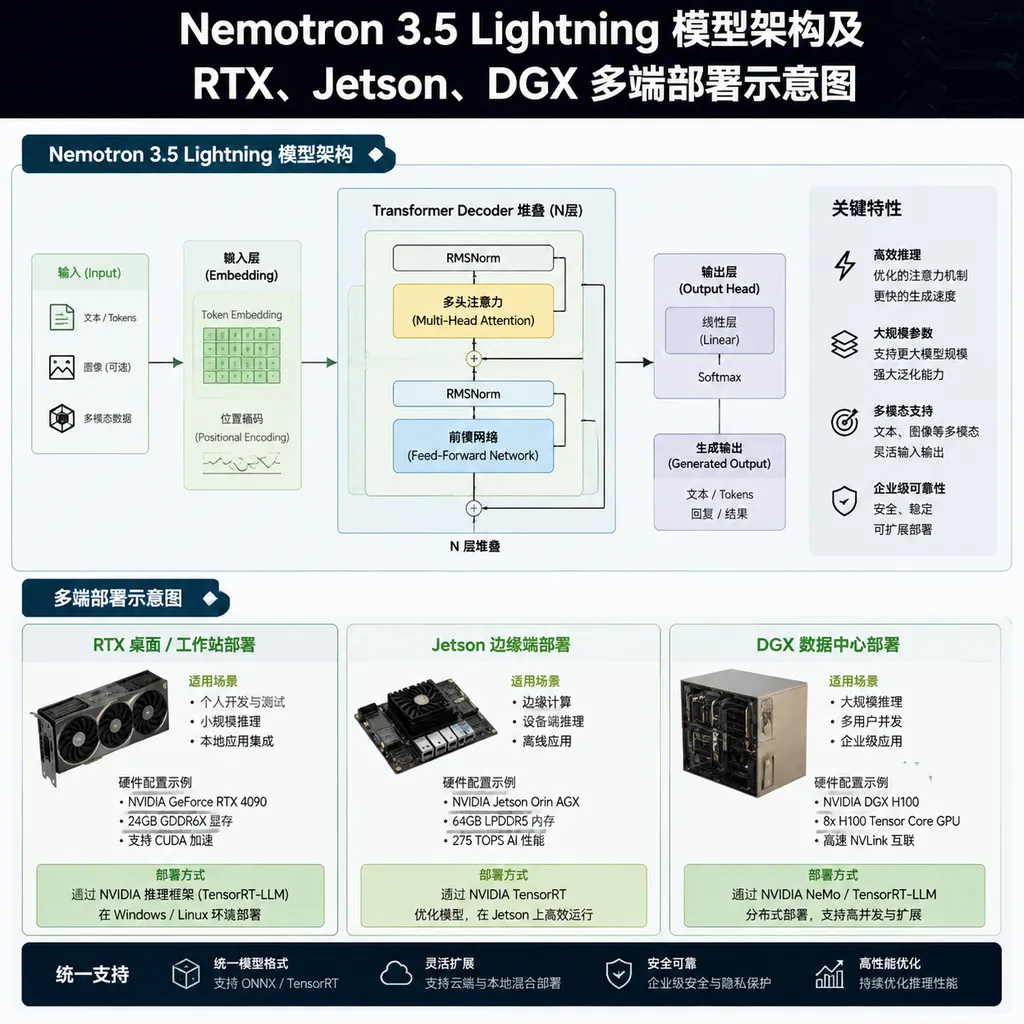
This is not another general-purpose model attempting to solve everything through sheer parameter count. Nemotron 3.5 Lightning is positioned more like a “high-speed execution layer” within an agent system: a more powerful but slower model can handle planning at the top, while Nemotron takes on high-volume, fragmented, latency-sensitive tasks such as classification, information extraction, format conversion, tool selection, state updates, and result validation.
This direction may not sound glamorous, but it is closer to addressing the real bottlenecks in deploying agent systems today than simply setting new leaderboard records.
30B Capacity, a 3B Compute Bill
Nemotron 3.5 Lightning uses an MoE architecture with 30 billion total parameters, but activates only about 3 billion parameters when processing each token. This is what “30B-A3B” in the model name means: 30B refers to total capacity, while A3B refers to the number of active parameters.
An MoE model can be compared to a company with multiple specialist teams. When a request arrives, the router does not call everyone into a meeting. Instead, it selects only a small number of experts based on the content of the current token. This preserves a large overall capacity for knowledge and capabilities while keeping the computation required at each step within a much smaller range.
Compared with dense models in which all parameters participate in computation, this design offers three primary advantages:
- Lower per-token compute requirements: In theory, this makes high-throughput, low-latency inference easier to achieve;
- Greater specialization: Different experts can learn different types of patterns and tasks;
- Partial decoupling of capacity and cost: The model can retain a total parameter capacity in the 30B range while keeping its primary computational burden close to that of a 3B model.
However, “activating only 3B parameters” does not mean that only 3B parameters need to fit in memory during deployment. The weights of all experts generally still need to reside in VRAM or unified memory; otherwise, frequent data transfers during expert switching will slow the model down. MoE primarily reduces computation—it does not reduce the model file size by the same proportion.
The Hugging Face repository name explicitly includes NVFP4, indicating that NVIDIA is also using low-precision weights to further reduce storage requirements and increase throughput. Based on a rough 4-bit estimate, the theoretical lower bound for the raw weights of a 30B-parameter model is approximately 15 GB. Actual operation, however, must also account for quantization metadata, routing and expert structures, the KV cache, runtime buffers, context length, and other overhead. Therefore, the claim that the model “can run on an RTX PC” does not mean that every consumer GPU can load it effortlessly, nor does it mean that VRAM will not overflow with long contexts or high concurrency.
For developers assessing whether the model can run locally, at least the following factors must also be considered:
- Whether the specific GPU architecture supports NVFP4 kernels;
- Whether the inference framework has optimized the model’s MoE routing and expert operators;
- The actual memory usage of the context window and KV cache;
- Whether single-request latency or batched throughput matters more;
- Whether expert weights can remain resident in VRAM or must be swapped between system memory and VRAM.
The real significance of Nemotron 3.5 Lightning, therefore, is not simply the claim that “a 30B model can run locally.” It is that NVIDIA is packaging the model architecture, low-precision format, and its own hardware into a complete inference pipeline.
Why It Specifically Targets Multi-Agent Systems
Over the past year, agent system architectures have been shifting away from having “one large model do everything” and toward role specialization across planning, execution, retrieval, verification, and memory. A user request may appear to involve only a single interaction in the interface, while triggering dozens or even hundreds of model calls behind the scenes.
For example, a multi-agent system that automates enterprise procurement might perform the following steps in sequence:
- Read emails and attachments;
- Extract suppliers, products, and quotes;
- Query internal inventory and historical contracts;
- Compare terms from multiple suppliers;
- Invoke approval, risk-control, and payment tools;
- Check whether the output conforms to a structured format;
- Correct parameters and retry after failures.
Only a handful of these steps may genuinely require a top-tier model to perform complex trade-offs. Most are stable, repetitive, and verifiable execution tasks. If every step invokes a flagship model, the system becomes not only expensive but also slow. If each stage adds just a few hundred milliseconds of waiting time, the cumulative latency across dozens of steps can reach tens of seconds or even several minutes.
Nemotron 3.5 Lightning is designed to address precisely this part of the problem. NVIDIA describes it as an execution model for always-on agents rather than a superbrain responsible for all complex planning. It is well suited to serving as a persistent node within a model-routing system: simple tasks can be completed locally, while genuinely difficult reasoning tasks are escalated to more powerful models.
This also explains an apparently contradictory set of figures: NVIDIA claims up to a 4× increase in token output speed, yet only a 30% reduction in end-to-end task completion time. Agent workflows involve more than model generation. They also include prompt preprocessing, network communication, database queries, tool execution, result validation, and orchestration among multiple agents. Making the model run four times faster does not make external APIs or browser automation four times faster.
Conversely, a 30% reduction in end-to-end time still indicates that model generation accounts for a substantial share of these workflows. For systems executing millions of short tasks every day, such an improvement will directly affect GPU requirements, queueing latency, and service costs.
The “Up to 4×” Claim Cannot Yet Be Judged by the Number Alone
The headline performance figures provided by NVIDIA are impressive, but they should still be interpreted cautiously.
First, tokens per second can vary significantly depending on which models are considered “comparable,” what hardware is used, the context length, output length, and batch size. MoE models can achieve high throughput under suitable batching conditions and with specialized kernels, but their advantage may narrow under low concurrency, uneven expert routing, or when weights cannot remain resident in VRAM.
Second, speed is not the only metric that matters for an agent model. The accuracy of tool-call parameters, the reliability of JSON output, continued adherence to constraints throughout long workflows, and the ability to recover correctly from failures are often more important than the subjective quality of a single response. If a model generates output four times faster but causes more tool-call failures and retries, its end-to-end cost may not actually be lower.
What is more worth waiting for now is third-party testing, particularly results in the following areas:
- Time to first token and output throughput at fixed hardware and precision;
- Throughput curves at different concurrency levels rather than a single peak figure;
- Success rates for tool use, structured output, and instruction following;
- VRAM usage and expert load balancing during extended operation;
- Apples-to-apples comparisons with comparable MoE models such as Qwen 30B-A3B;
- Performance levels achievable on RTX, Jetson, and data-center GPUs, respectively.
The 4× figure is therefore better treated as a signal that the model is worth benchmarking, rather than as a definitive conclusion about its performance.
NVIDIA Is Selling a Model—and Control Over Hardware Scheduling
The strategy behind the continued expansion of the Nemotron family is not difficult to understand. NVIDIA is no longer satisfied with merely supplying GPUs; it wants to define the models, quantization formats, inference engines, agent frameworks, and deployment hardware as an integrated whole.
Nemotron 3.5 Lightning supports environments ranging from Jetson and RTX PCs to DGX systems and the cloud. On the surface, this emphasizes deployment flexibility. In practice, it establishes a migration path centered on NVIDIA’s hardware and software stack. Developers can validate the model on local devices and then migrate to workstations or data centers without completely replacing the model or rethinking their optimization approach.
NVFP4 is equally important. Low precision is not simply a matter of shrinking weight files; it requires coordination among hardware compute capabilities, kernel implementations, and model training. By directly releasing an optimized open model, NVIDIA is effectively providing a working reference implementation for the new precision format while encouraging developers to keep their inference workloads within its hardware ecosystem.
This is what distinguishes Nemotron from many ordinary open-model releases: the model itself is both a product and a demonstration of the hardware’s capabilities.
From a competitive perspective, Nemotron is up against more than other open 30B-class models. It also competes with smaller dense models, distilled models, and inexpensive cloud APIs. Enterprises will not choose it simply because it has “more parameters.” They will compare how much it costs to complete 10,000 tool calls, how many failures occur, whether it can be deployed privately, and whether operational complexity remains manageable.
Who Should Try It—and Who Does Not Need to Migrate Yet
Nemotron 3.5 Lightning is particularly well suited to the following scenarios:
- Large volumes of short requests requiring high-throughput classification, extraction, and formatting;
- Multi-agent workflows with clearly separated planning and execution model layers;
- Open-weight deployments where data cannot leave local systems or the corporate intranet;
- Existing use of NVIDIA GPUs, with a desire to take full advantage of low precision and specialized inference optimizations;
- A need for further fine-tuning around internal tools, terminology, and workflows.
It may not be suitable for migrating every task at once. If a business primarily depends on complex mathematics, open-ended research, long-horizon planning, or highly challenging code generation, larger reasoning models may still be more reliable. For teams with low request volumes, the cost of deploying and maintaining a self-hosted 30B MoE model may also exceed that of simply using a hosted API.
A more sensible approach is to integrate it into a model router: let Nemotron 3.5 Lightning handle high-frequency, well-defined, and verifiable tasks; when confidence is low, tools repeatedly fail, or task complexity increases, switch to a more powerful model. OpenAI-compatible model aggregation platforms such as OpenAI Hub are also inherently suitable as cross-model routing gateways, but whether they support this model should still be determined by its actual availability on the platform.
Conclusion: Not the Most Powerful Model, but Potentially a More Practical Component
The value of Nemotron 3.5 Lightning does not lie in proving that a 30B model can defeat every flagship model. Rather, it reflects a practical reality: most steps in an agent system do not require the smartest model. What they need is an executor that is accurate enough, inexpensive enough, always available, and highly responsive.
Its 30B total parameters provide capacity, its 3B active parameters keep compute costs under control, NVFP4 further lowers the deployment barrier, and the open weights, data, and recipes leave room for enterprise customization. This combination is more closely aligned with the engineering requirements of multi-agent systems than simply increasing parameter count.
Whether it can become a true “always-on agent engine,” however, will depend on three factors beyond NVIDIA’s official figures: independent quality evaluations, real-world throughput across different hardware platforms, and the long-term reliability of tool use.
NVIDIA has already played the speed card. What developers now need to determine is whether this bolt of lightning is merely a benchmark peak—or whether it can keep the entire workflow illuminated.
References
- ITHome: NVIDIA Launches 30B Open-Source AI Model Nemotron 3.5 Lightning — A Chinese-language summary of the release, including the model’s positioning, official performance figures, and supported devices.
- Hugging Face: NVIDIA Nemotron 3.5 Lightning 30B-A3B-NVFP4 — The page containing the model weights, configuration, and deployment-related materials.