
Emergent launches Wingman: Command AI to work inside WhatsApp
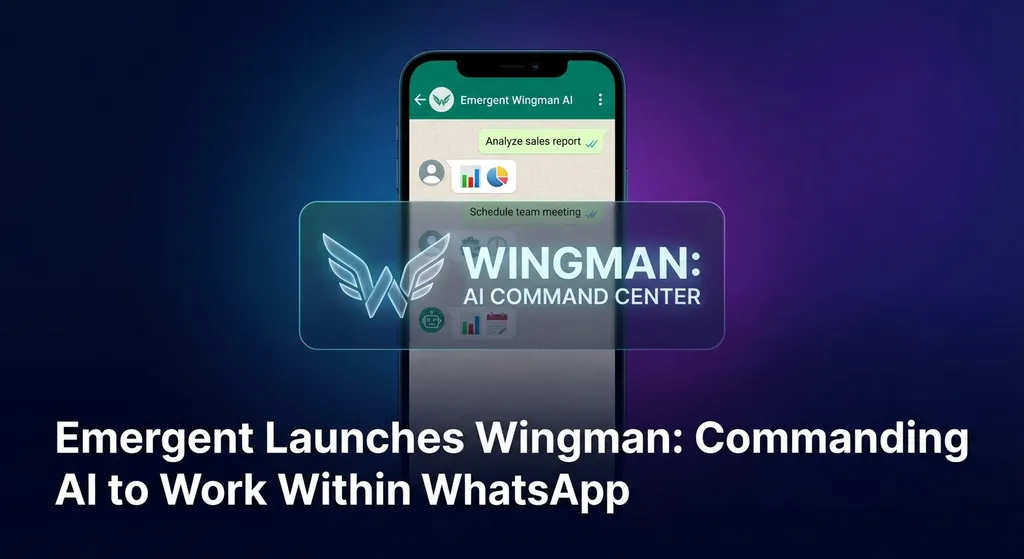
India's vibe-coding star startup **Emergent** has officially entered the AI Agent track, launching the **Wingman** product. It enables users to manage and automate daily tasks directly in WhatsApp and Telegram through natural language conversations, positioning itself against mainstream Agent platforms such as **OpenClaw**.
From Writing Code to Doing Work for You: Emergent’s Ambition Has Changed
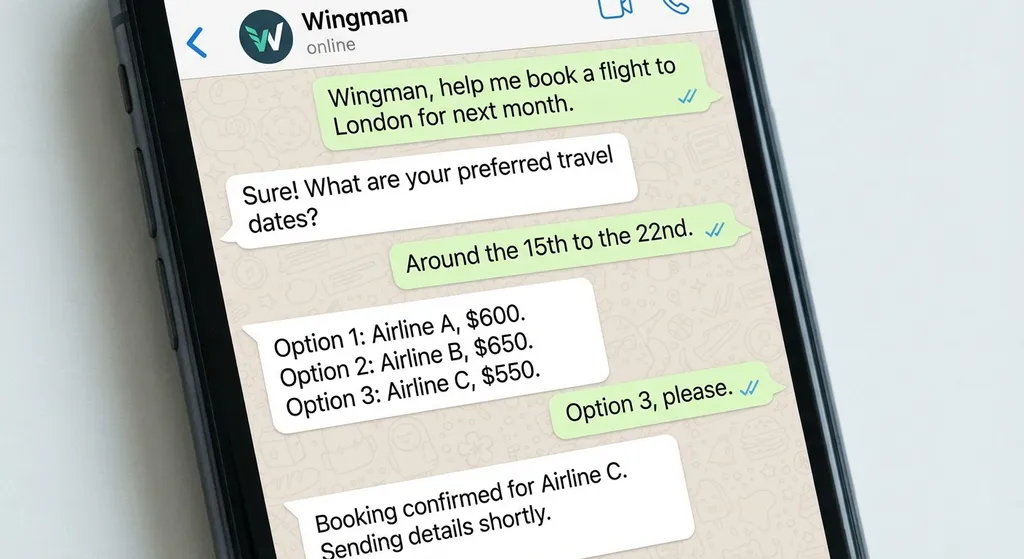
Indian startup Emergent today announced the launch of Wingman—an AI Agent product that runs directly inside WhatsApp and Telegram. Users don’t need to download a new app or learn a new interface: by simply typing a natural language command in the chat window, Wingman can handle task scheduling, information queries, workflow automation, and a range of other operations.
Emergent originally made its name with vibe-coding tools and earned a solid reputation among India’s developer community. Now entering the AI Agent field, TechCrunch describes it as “OpenClaw-like”—meaning Emergent isn’t aiming to build just a chatbot, but rather an intelligent agent capable of executing real multi-step tasks.
This is worth discussing, because it reflects several key shifts happening in the AI Agent arena.
What Exactly Can Wingman Do
Let’s start with the product itself.
Wingman’s core selling point is “putting an AI Agent into the chat tools you already use.” Specifically:
- Chat directly with Wingman in WhatsApp or Telegram
- Give natural-language instructions such as “Reschedule next Monday’s meeting to Wednesday at 3 p.m.” or “Check last month’s sales summary and send it to me”
- Wingman breaks down tasks in the background, calls external tools and APIs, executes actions, and returns results
- Supports multi-step task orchestration, not just simple Q&A
This idea isn’t new. But Emergent’s choice of WhatsApp and Telegram as entry points has real significance in the Indian and Southeast Asian markets—WhatsApp has over 500 million monthly active users in India, and Telegram is highly popular among tech communities. For these users, “use it directly on WhatsApp” converts far better than “register for a new platform.”
Technically, Wingman is a standard LLM Agent framework: a large language model acts as the core controller, responsible for intent understanding and task planning; a memory module maintains context and user preferences; and a tools module connects calendars, email, databases, and third‑party APIs. This architecture has been thoroughly validated since AutoGPT’s open‑sourcing in 2023. Emergent’s differentiation lies not in architecture, but in its implementation approach.
Why Now—and Why India
India’s AI startup ecosystem has visibly transformed over the past year.
One major backdrop: in March this year, OpenAI appointed former JioStar CEO Kiran Mani to lead its Asia expansion strategy, naming India as its second‑largest global market (by weekly active users) with over 100 million ChatGPT users per week. Tata Group has also partnered with OpenAI to jointly build industry AI services and data centers.
What does this mean? India’s AI infrastructure is rapidly maturing; model‑call costs are dropping; developer ecosystems are expanding; and user adoption of AI tools has passed the education phase. Launching an Agent product at this moment is well‑timed for Emergent.
Another notable trend: globally, the AI Agent space is moving from “tech demo” to “product deployment.” Between 2023 and 2024, most Agent products were “cool but hardly usable”—unstable success rates, poor multi‑step execution, high costs. But by 2025 H2 and 2026, with improvements in base‑model capabilities (especially in function calling and tool use), Agent reliability has made a qualitative leap.
Emergent’s transition from vibe‑coding to Agent development also makes sense technically. Vibe‑coding is inherently a “natural‑language‑driven code generation” paradigm, very similar to an Agent’s “natural‑language‑driven task execution.” The tech stacks overlap heavily. The team already has experience in prompt engineering, task decomposition, and tool integration, so the transition has a relatively low technical barrier.
Benchmarking OpenClaw: The Competitive Landscape in the Agent Space
TechCrunch described Wingman as “OpenClaw-like.” OpenClaw is currently one of the leading players in the AI Agent field, focusing on general task automation with capabilities in browser operations, API calls, and file handling.
But Wingman and OpenClaw pursue distinct paths:
| Dimension | OpenClaw | Wingman | |------------|-----------|----------| | Entry point | Independent platform / browser plugin | WhatsApp / Telegram | | Target users | Developers, tech users | Broader general users | | Core scenarios | Browser automation, code execution | Daily task management, workflow automation | | Market focus | North America / Europe | India / Southeast Asia | | Interaction mode | Web UI + command line | Chat dialogue |
This difference matters. OpenClaw provides a “universal tool for tech professionals,” while Wingman offers an Agent for ordinary users in familiar environments. They’re not necessarily direct competitors—more like parallel explorations targeting different user groups and markets.
Commercially, Wingman’s approach may achieve Product‑Market Fit (PMF) more easily. The reason is simple: WhatsApp is India’s “super app gateway.” Adding Agent capabilities here yields extremely low customer‑acquisition and learning costs. In contrast, asking users to register on a new platform and learn new interaction modes creates too much friction in a market like India.
The challenges, however, are also clear. WhatsApp and Telegram Bot APIs have capability ceilings—limited message formats, constrained interaction modes, no complex UI rendering. If Wingman wants to handle more advanced tasks (like spreadsheet operations or generating visual reports), a pure chat interface may fall short. That’s a trade‑off in product design.
The Real Challenges of Deploying Agents
Frankly, technology is no longer the biggest bottleneck in the AI Agent race. The real hurdles are threefold:
-
Reliability. If an Agent reschedules your meeting incorrectly three times out of ten, you’ll stop using it. Unlike chatbots—where an incorrect answer can be forgiven—an Agent performing the wrong action may cause actual loss. Wingman must prove its reliability here.
-
Trust. Allowing an AI Agent to manipulate your calendar, email, or even payments requires extremely high trust. In India, where data‑privacy awareness is growing fast, Emergent needs to excel at data security and transparency.
-
Ecosystem. An Agent’s value depends on how many external services it can connect to. If Wingman only covers a few fixed scenarios, it’s just an advanced chatbot; if it integrates dozens of commonly used tools and services, then it’s a true Agent. This demands extensive API integrations and partnerships.
Developer Perspective: How to Build a Similar Agent
For developers interested in Agent building, products like Wingman aren’t technically mysterious. The core flow is: Messaging platform Bot API → LLM intent understanding and task planning → Tool calls → Result return.
You can quickly prototype one using an OpenAI‑compatible API for intent understanding and task planning. Here’s a simplified example showing how an LLM can decompose tasks:
import openai

client = openai.OpenAI(
    api_key="your-api-key",
    base_url="https://api.openai-hub.net/v1"  # OpenAI Hub aggregator endpoint
)

# Define available tools
tools = [
    {
        "type": "function",
        "function": {
            "name": "reschedule_meeting",
            "description": "Reschedule meeting time",
            "parameters": {
                "type": "object",
                "properties": {
                    "meeting_id": {"type": "string", "description": "Meeting ID"},
                    "new_time": {"type": "string", "description": "New time, ISO 8601 format"}
                },
                "required": ["meeting_id", "new_time"]
            }
        }
    },
    {
        "type": "function",
        "function": {
            "name": "query_sales_data",
            "description": "Query sales data summary",
            "parameters": {
                "type": "object",
                "properties": {
                    "period": {"type": "string", "description": "Query period, e.g. last_month"},
                    "format": {"type": "string", "description": "Return format: summary or detailed"}
                },
                "required": ["period"]
            }
        }
    }
]

# Simulate a WhatsApp user message
user_message = "Reschedule tomorrow afternoon’s product review meeting to Friday 10 a.m., and also check last month’s sales summary."

response = client.chat.completions.create(
    model="gpt-4o",  # via OpenAI Hub can switch to claude/gemini/deepseek etc.
    messages=[
        {
            "role": "system",
            "content": "You are a task execution assistant. Break down the user's natural-language commands and call appropriate tools."
        },
        {"role": "user", "content": user_message}
    ],
    tools=tools,
    tool_choice="auto"
)

# Agent automatically decomposes into multiple tool calls
for tool_call in response.choices[0].message.tool_calls:
    print(f"Tool call: {tool_call.function.name}")
    print(f"Arguments: {tool_call.function.arguments}")
This snippet demonstrates the core mechanism: after understanding the user’s intent, the LLM automatically breaks it into multiple tool calls. In a real product, you’d also need conversation‑memory management, a tool‑execution engine, error‑retry logic, and integration layers for the WhatsApp Business API.
Using an aggregator platform like OpenAI Hub, developers can switch easily among GPT‑4o, Claude, Gemini, DeepSeek, and others with the same codebase—selecting the most cost‑effective models for each scenario (lightweight models for simple intent recognition, flagship models for complex multi‑step planning).
The Bigger Picture: The Battle for Agent Entry Points
Wingman’s launch is actually a microcosm of a larger industry trend—the battle over Agent entry points.
Currently, Agent products enter through several channels:
- Independent apps/platforms (e.g. OpenClaw, various Agent builders)
- Browser plugins (e.g. Browser Agents)
- Operating‑system integration (e.g. Apple Intelligence, Google Gemini on Android)
- Instant‑messaging platforms (e.g. Wingman on WhatsApp/Telegram)
- IDE embedding (e.g. coding agents)
Each entry point has pros and cons: independent platforms offer full functionality but hard user acquisition; OS‑level integration covers huge user bases but only giants can do it; messaging platforms have the easiest acquisition but limited interaction capability.
Emergent’s choice of messaging platforms is a bet—that for ordinary users, Agent value lies not in doing complex things, but in saving effort in the most natural usage context. You shouldn’t need a dedicated Agent app or new workflow; if you already open WhatsApp dozens of times a day, just send one more message.
Whether that bet succeeds depends on whether Wingman can deliver good task‑execution experiences within chat‑interface constraints. If it can, it may carve out a unique growth curve in India and Southeast Asia; if not, it’ll fade into “another interesting but seldom‑used Bot.”
Implications for Chinese Developers
Finally, a few observations for developers in China.
Wingman’s concept—embedding Agents into instant‑messaging platforms—has natural potential domestically. WeChat has over 1.3 billion monthly active users; WeCom is widely used on the enterprise side; and DingTalk and Feishu both have mature Bot ecosystems. Teams interested in similar products arguably have an even better infrastructure environment than India does.
But the challenges differ. WeChat’s Bot restrictions are far stricter than WhatsApp’s; WeCom’s API openness is limited; and Chinese users have high expectations for “in‑chat operations,” shaped by rich mini‑programs—they don’t accept plain text replies and expect richer interactions.
From a technical standpoint, the core Agent capabilities—function calling and tool use—are already well supported by mainstream models. GPT‑4o, Claude 3.5/4, Gemini 2.5, and DeepSeek‑V3 each have strengths in this area. For developers wanting to validate Agent ideas quickly, using an aggregator API platform is the most efficient way—no need to integrate models separately and easy A/B testing to find the model best suited to each scenario.
Regardless of Emergent’s eventual success or failure, its move signals one clear thing: the AI Agent battlefield is spreading from Silicon Valley to the rest of the world, and every market will develop products suited to its own environment. India has WhatsApp, China has WeChat, Southeast Asia has Line and Grab—the future of Agents won’t take a single universal form, but will embed diversely into each region’s digital life.
References:
(Note: Core information derived from TechCrunch’s April 15 2026 report “India's vibe‑coding startup Emergent enters OpenClaw‑like AI agent space.” Link omitted due to domain access restrictions in China. Additional background drawn from publicly available sources.)


