AI Agents Are Starting to Cost Less Than Outsourcing

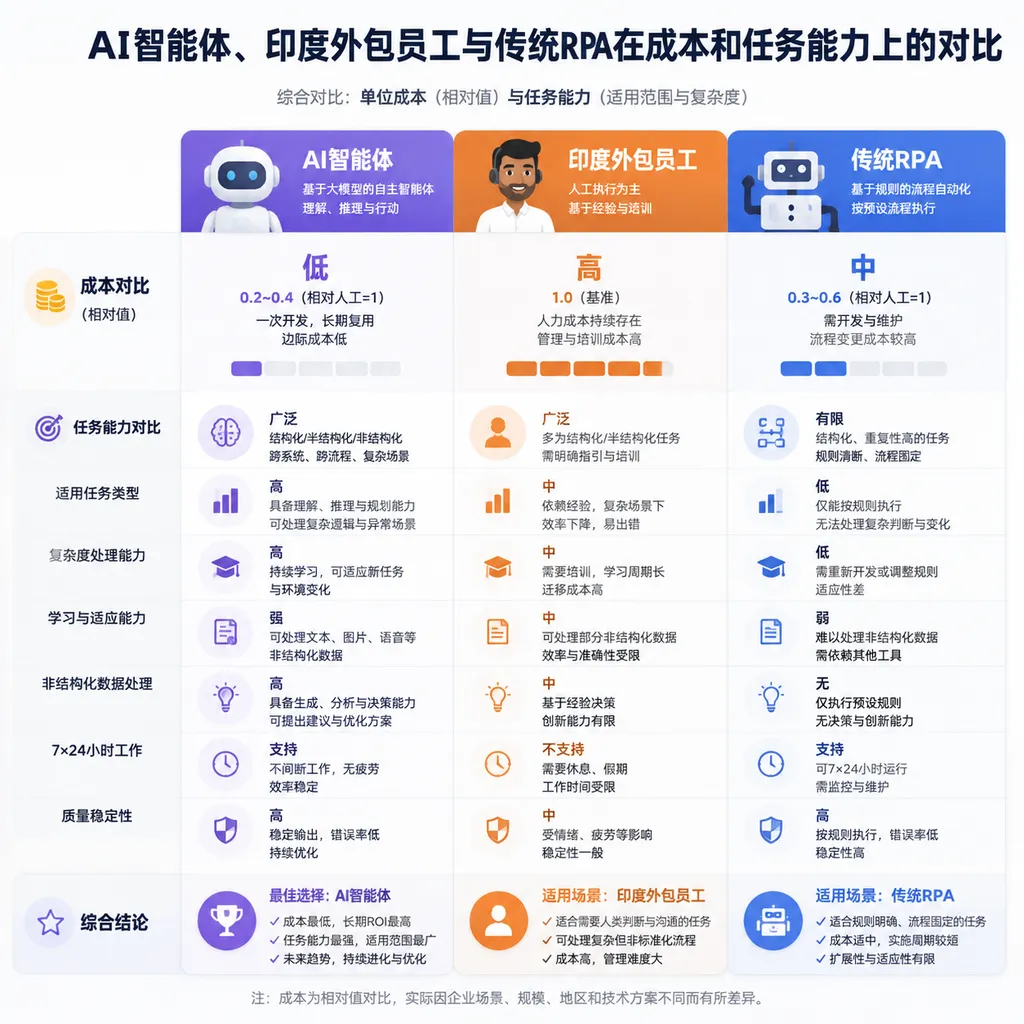
According to a16z’s latest report, the fully loaded cost of Computer Use agents has fallen to $6–$8 per hour, lower than offshore outsourcing in India. The real change is not just the price, but that they can now work reliably in real-world business systems.
AI Agents Have Crossed a Critical Cost Threshold
AI agents have finally reached a metric more worthy of attention than benchmark scores: their cost per unit of work has fallen below that of Indian offshore outsourcing.
On August 10, a16z partner Fabrizio Serafini published a report stating that the current fully loaded cost of Computer Use agents is approximately $6–$8 per hour, compared with about $10 per hour for Indian offshore BPO employees. Two days later, those figures have quickly sparked discussion because they mean that the rationale for enterprise adoption of agents is shifting from “trying a new technology” to a business case that can be calculated directly.
These are not demo products that can merely open webpages and click buttons. They are production-grade agents capable of reading screenshots, understanding interfaces, filling out forms, handling pop-ups, and attempting to recover after an operation fails. They are beginning to take over repetitive work such as CRM updates, data entry in insurance portals, retail order processing, contract workflows, data collection, and IT ticket handling.
Put more directly, AI agents are moving into territory previously covered by BPO and RPA.
From 42% to 85%: Computer Use Is No Longer Just a Demo
Citing OSWorld-Verified benchmark data, the report states that at the beginning of 2025, the strongest computer-use models could complete only about 42% of desktop tasks. By June 2026, the leading model, Claude Fable 5, had achieved a task completion rate of 85%, surpassing the roughly 72% level achieved by human testers.
OSWorld-Verified does not test the ability to answer knowledge questions. Instead, it evaluates workflows carried out in real desktop environments such as Ubuntu, Windows, and macOS. Tasks may involve opening multiple applications, locating specific information, modifying files, filling out webpages, and then submitting the results to another system.
Therefore, the 85% figure should not simply be interpreted as “the model is smarter than humans.” It is closer to the following conclusion: out of 100 clearly defined everyday tasks that can be completed through a graphical interface, an agent can complete approximately 85.
This change is critical.
Earlier Computer Use models often got stuck on issues that humans would consider trivial: a slight change in a button’s position would make the entry point impossible to find; a webpage loading a few seconds more slowly would trigger repeated clicks; a pop-up obscuring the main interface would prevent further progress; or an input-format error would occur, and the model would not know how to return to the previous step and correct it. Models performed well in carefully prepared demonstrations, but once deployed in real systems, errors accumulated step by step.
Now, simultaneous improvements in screenshot understanding, visual localization, long-horizon planning, and error recovery are enabling agents to actually “finish the job.” What enterprises are really buying is not a single correct click, but an end-to-end task completion rate.
However, 85% still does not mean that human teams can be eliminated. If the remaining 15% of failures are randomly distributed across high-risk tasks—such as payments, insurance approvals, contract revisions, or account permission configurations—the cost of errors may far exceed the labor savings. Benchmark results demonstrate the upper limit of capability, but production readiness still depends on task risk, the distribution of exceptions, and review mechanisms.
Why $6–$8 per Hour Is a Turning Point
“Cheaper than Indian outsourcing” sounds like a simple price comparison, but the reality is more complicated.
The $10-per-hour figure for Indian BPO workers is generally a fully loaded cost, not the employee’s take-home pay. It may include expenses such as recruitment, training, office space, management, equipment, night shifts, employee turnover, and quality control. Likewise, the $6–$8 cost of an agent is not limited to model token fees. It should also include inference, browser or virtual machine environments, task orchestration, logging, retries, human review, and the cost of the operating platform.
A more reasonable unit of comparison is not cost per hour, but cost per successful task:
True cost per task = Agent operating cost ÷ first-attempt success rate + retry cost + human takeover cost + losses from errors
Suppose an agent costs $7 per hour and can process 20 standard tickets. On the surface, each ticket costs only $0.35. But if 15% of them require retries, 5% must be taken over by a human, and quality sampling is also required, the final cost may rise significantly.
Conversely, agents also offer advantages that traditional outsourcing struggles to provide. They can operate around the clock without requiring shift-based capacity expansion. When business volume suddenly increases, enterprises can add concurrent instances instead of recruiting and training another group of employees. Their entire operational process can also be recorded for auditing and replay.
Therefore, $6–$8 is not an absolute price threshold that applies to every enterprise. It is more of a signal: in scenarios where tasks are sufficiently standardized and exceptions can be isolated, agents now have a chance to undercut low-cost human labor on total cost.
This is the true dividing line between AI-agent demonstrations and real deployments. A model scoring 80 points is not enough. Procurement departments will seriously consider replacing existing processes only when success rates, throughput, and cost all enter a range acceptable to the enterprise.
Not All White-Collar Work Will Be Transformed First
The tasks best suited to current Computer Use agents share one characteristic: the processes are clearly defined, but the system interfaces are poor.
Typical scenarios include:
- Logging into government, insurance, or supplier portals to query and enter data;
- Updating customer status, contacts, and follow-up records in a CRM;
- Extracting information from databases, regulatory websites, or retail portals;
- Processing orders, contracts, and standardized application forms;
- Classifying, updating, and closing IT tickets in systems such as ServiceNow;
- Performing quality checks on fixed processes and escalating exceptions to humans;
- Synchronizing interview results to an applicant tracking system after a recruitment interview.
These tasks have long been difficult to automate fully. They often lack stable APIs, or enterprises do not have permission to modify legacy systems. Traditional RPA relies on coordinates, DOM selectors, and prewritten rules. If an interface button moves or a field name changes, the entire workflow may fail.
Computer Use agents take a different approach: they look at the screen as a human would, then determine the next action based on the current interface. They do not require the target system to expose interfaces specifically for automation, allowing them to cover a large number of legacy applications.
This does not mean agents will replace APIs. When an API is available, it remains faster, more stable, and less expensive. The value of Computer Use lies in handling long-tail systems where there is no API, the API is incomplete, or the cost of integration exceeds the cost of manual operation.
Developers can think of the two as highways and off-road vehicles: structured APIs are highways and offer the highest efficiency; Computer Use is an off-road vehicle that may not be as fast but can reach places that previous automation systems could not.
Production Use Cases Are Already Showing Economies of Scale
The report mentions a consumer-goods data platform that performs approximately 15 million to 20 million automated portal interactions each month. Rather than having agents directly replace all of its web scrapers, the company placed agents behind traditional automation as a self-healing and fallback layer.
When a retailer changes its portal, existing scrapers may fail because element paths have changed. The agent identifies the new interface, diagnoses the problem, and repairs the automated workflow, keeping data flowing before engineers intervene. After deployment, the company cut the engineering team dedicated to scraper maintenance in half and reassigned those employees to other workflows.
This is a more mature application than simply having “AI operate a webpage by itself.”
Agents do not need to replace all deterministic code from day one. They can begin by handling the most expensive parts of traditional automation: exceptions, page changes, and workflow recovery. Rule-based programs handle the normal path, agents handle uncertain paths, and humans take over only high-risk exceptions. This three-layer structure is generally more stable than a purely agent-based solution and makes it easier to calculate return on investment.
Another case comes from a global systems integrator. The organization already has 27 computer-agent workflows in production, processing approximately 1,500 to 2,100 IT tickets per day. Its goal is to redeploy 20%–25% of the workforce involved in low-margin managed-services contracts.
Note that the term used here is “redeploy,” which does not necessarily mean direct layoffs. A more realistic approach for large service providers is to reduce human input in low-margin contracts and shift employees to architecture, customer communications, exception handling, and new project delivery. For the outsourcing industry, this is already enough to create pressure: the central competitive question may no longer be who has more low-cost agents at service desks, but who can use fewer people to manage more AI agents.
The Impact on Indian BPO Will Begin with Contract Structures
Indian outsourcing will not disappear immediately because of a $2–$4 difference in hourly cost.
The value accumulated by the BPO industry over decades lies not only in labor, but also in process management, compliance certifications, multilingual services, customer relationships, and cross-regional delivery capabilities. Many enterprises will also be unwilling to hand sensitive data directly to an unsupervised agent.
However, AI will first change how outsourcing contracts are priced.
In the past, service providers generally charged based on headcount, working hours, or seats. As agents take on more standardized tasks, customers will demand pricing based on tickets, outcomes, or service levels. If service providers continue to fulfill contracts simply by adding more people, their margins will rapidly be compressed by competitors capable of deploying agents.
Therefore, the real threat is not that “AI employees are cheaper than Indian employees,” but that an AI-native service provider can use 20 people and hundreds of agents to deliver a project that previously required 100 people. If traditional outsourcing providers cannot convert the cost advantages of agents into their own delivery capabilities, they will face both price cuts and shrinking contract sizes.
When Deploying Agents, Enterprises Should Not Focus Only on Model Leaderboards
Development teams evaluating Computer Use agents need to monitor at least five metrics.
1. Task Success Rate, Not Single-Step Accuracy
If an agent performs 20 consecutive steps, each with a 98% success rate, the success rate of the complete workflow is only about 67%. Production testing must use end-to-end completion as the standard rather than merely counting whether the correct buttons were clicked.
2. Exception-Recovery Capabilities
Real webpages time out, present CAPTCHAs, require users to log in again, or contain missing fields. A good agent must not only recognize errors, but also know when to retry, when to take a different path, and when to stop and hand the task over to a human.
3. Human Takeover Rate
If an agent asks for human confirmation once every ten tasks, it may simply have transformed an operations role into a monitoring role. The human takeover rate must be evaluated together with task risk and included in the cost per task.
4. Permissions and Auditing
Agents should not be granted global administrator privileges directly. Enterprises need to use least-privilege accounts, isolated browser environments, short-lived credentials, and action allowlists, while retaining screenshots and logs of inputs, clicks, and decisions. Approval checkpoints are essential, especially for actions involving payments, deletions, or permission changes.
5. Business Cost of Failure
A 15% failure rate means very different things when scraping publicly available prices versus modifying insurance records. Low-risk tasks can be retried automatically, while high-risk tasks should use an “agent prepares, human confirms” model.
A pragmatic deployment path usually begins with tasks that are clearly defined, high-volume, and reversible. The agent should first run in shadow mode, proposing actions without actually submitting them. After enough failure cases have been collected, write permissions can be granted gradually. Do not allow agents to operate core production accounts from the outset.
The Essence of This Shift Is That Software Can Finally Operate Software
For the past two decades, the fundamental prerequisite for enterprise automation has been that systems expose interfaces. Without APIs, engineers had to write web scrapers or RPA scripts—or companies simply had to hire people to operate the interfaces.
Computer Use agents change that assumption. They turn the graphical interface itself into a universal interface: as long as a human can understand and operate it, a model can theoretically attempt to do the same.
This will unlock an enormous but long-overlooked market: tasks with substantial business value that have not justified custom integrations because the systems are outdated, the interfaces are closed, or the processes are fragmented.
However, the most credible direction today is not a “fully autonomous digital employee,” but a bounded task executor. It requires explicit protocols, controlled environments, permission restrictions, and human backstops. Those who treat it as an all-powerful employee are likely to pay the price in exceptions and security incidents. Those who treat it as a more adaptable automation component are more likely to generate real returns.
At $6–$8 per hour, AI agents have, for the first time, achieved a cost structure compelling enough to appear in procurement spreadsheets. The next phase of competition will not be limited to model capabilities. It will also involve browser infrastructure, task orchestration, evaluation systems, access controls, and exception handling.
Computer Use has moved beyond the demo-only stage, but it still has some distance to go before becoming truly unattended.
A more accurate assessment today is that it will not replace an entire outsourcing team all at once. Instead, it will first absorb the 20% of work that is most standardized, repetitive, and easy to audit. For low-margin BPO operations, that 20% is already enough to rewrite the cost model.
References
- ITHome: Challenging Indian Outsourcing, AI Agents Not Only Perform Well but Also Cost Less — Summarizes the progress of Computer Use benchmarks, enterprise deployment cases, and cost comparisons between agents and Indian offshore outsourcing discussed in the a16z report.