Manus 1.6 is free until August 25.
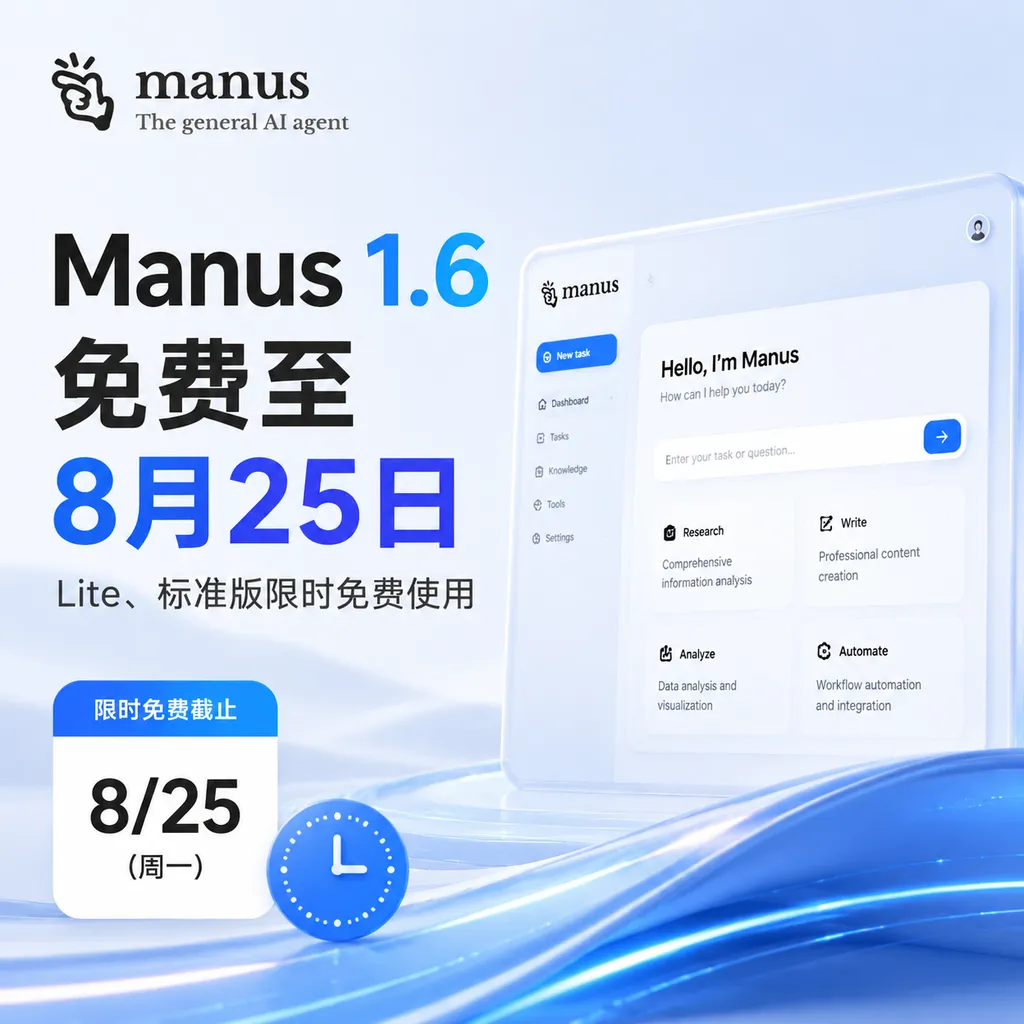
Manus is offering users worldwide free daily quotas for 1.6 Lite and 1.6 for a limited time, through August 25 at 11:59 PM. Free access does not mean unlimited use; Max, generation quotas, and third-party features remain subject to separate rules.
Manus Adds Two Agent Tiers to Its Free Pool
On August 12, Manus announced a limited-time global free-access campaign. From now until 11:59 PM on August 25, 2026, both free and paid users can use Manus 1.6 Lite and Manus 1.6 without spending credits, within their daily promotional allowance.
The most noteworthy aspect of this campaign is not the word “free,” but the fact that Manus has also included its standard Agent tier in the trial. Users are not limited to a stripped-down Lite option; they can use Manus 1.6 to run multi-step tasks such as research, content organization, web development, and spreadsheet processing.
But the boundaries should be made clear upfront: this is neither unlimited access nor a free offering across the entire Manus product line. Manus is waiving the standard credit consumption for eligible modes within the daily promotional allowance. Daily allowances, dynamic queues, generation limits, and anti-abuse mechanisms still apply. The flagship Manus 1.6 Max is not included in the campaign.

How Extensive Is the Free Access?
The campaign rules can be summarized in the following table:
| Item | Free Users | Paid Users | | --- | --- | --- | | Manus 1.6 Lite | No standard credits charged within the daily promotional allowance | No standard credits charged within the daily promotional allowance | | Manus 1.6 | No standard credits charged within the daily promotional allowance | No standard credits charged within the daily promotional allowance | | Manus 1.6 Max | Not free | Available under existing eligibility and credit rules | | Queue priority | Standard dynamic queue | Priority queue | | Daily image generation | Up to 20 images | Up to 200 images | | Daily video generation | Up to 1 video | Up to 10 videos | | Purchasing additional credits | Temporarily unavailable | Still available, subject to what is shown on the product page |
The most easily overlooked detail is that the Agent promotional allowance is calculated separately from image and video generation allowances.
For example, if a free user still has some Agent promotional allowance remaining that day but has already generated 20 images, image generation will still be suspended. The user cannot continue generating images by using the remaining Agent allowance or credits in the account. The same logic applies to video generation. Final usage counts, restriction status, and reset times are determined by system records and notifications in the product interface.
Manus has not specified a single fixed number of daily tasks for all users in this announcement. Therefore, the campaign should not be interpreted as having a predetermined number of free tasks available each day. Complex Agent tasks vary greatly in resource consumption: retrieving ten webpages and compiling summaries is clearly not in the same computational category as searching hundreds of sources in parallel, generating a presentation, and building an application. For users, the product page remains the authoritative source for their actual remaining allowance.
Paid Users Are Paying for Priority, Not a Queue-Free Experience
The most direct side effect of the free campaign is increased load. Manus has explicitly stated that both 1.6 Lite and 1.6 may be placed in dynamic queues. Paid users receive higher resource-allocation priority, but this does not mean their tasks will always begin immediately.
Actual wait times still depend on real-time system load and the estimate shown in the interface. In other words, paid users get the equivalent of an airport priority lane—not exclusive use of the entire runway.
This distinction is especially important for Agent products. Ordinary chat models can quickly free up inference resources by shortening outputs or limiting context, whereas general-purpose Agents often need sustained access to browsers, code execution environments, file systems, and external tools. A single task may run for several minutes or longer, moving through planning, retrieval, execution, validation, and rework. When large numbers of free users submit tasks simultaneously, the resulting system load is far greater than that of ordinary one-off questions and answers.
Manus has therefore implemented several layers of rate limiting:
- A daily promotional allowance to control each account’s overall resource consumption;
- Dynamic queuing to regulate task startup speed based on real-time load;
- Separate image and video limits to prevent expensive generation tasks from consuming Agent resources;
- A priority queue for paid users to preserve the membership experience and commercial value;
- Anti-abuse mechanisms to address unusual behavior such as bulk account registration and automated task farming.
If the system detects suspicious activity, relevant features may be temporarily restricted for several hours. The specific restrictions and reset times are not governed by a fixed set of publicly disclosed rules; users must refer to notifications in the product interface. This means developers should not treat the campaign as a stable source of free compute, and it is particularly unsuitable as the basis for automated batch-processing workflows.
Keeping Max Behind the Paywall Is a Deliberate Product Boundary
The campaign covers 1.6 Lite and 1.6 but explicitly excludes 1.6 Max. This is not an insignificant caveat; it reflects how Manus distinguishes between its trial experience and its highest-value capabilities.
Manus 1.6 previously updated its core Agent architecture and expanded the product’s capabilities into mobile application development and Design View. The latter offers an interactive canvas closer to conventional design software, allowing users to edit specific parts of images, modify text within images, and combine multiple images. Max, meanwhile, emphasizes a higher success rate on complex tasks, more mature planning capabilities, parallel deep research, and spreadsheet processing.
From a product-design perspective, Lite is intended for low-cost, rapid execution; the standard version demonstrates the complete Agent experience; and Max represents the upper limit of the product’s capabilities and drives paid conversions. Making the first two tiers free during the campaign is already enough for users to determine whether Manus fits their workflows. Excluding Max prevents the highest-cost tier from becoming overwhelmed by the surge in traffic.
If 1.6 Lite or 1.6 is queued, users who are eligible for Max and have enough credits in their accounts can switch to Max. However, once they switch, the task will no longer qualify for the campaign’s free access and will instead be subject to Max’s existing eligibility and credit rules.
The design is straightforward: users can trade time for free access, or credits for speed and stronger execution capabilities.
This Campaign Is More Like a Large-Scale Stress Test
Agent products have long faced an awkward problem: demo videos usually look smooth, but users cannot determine from a demo alone whether an Agent can truly handle their own tasks. Research reports, competitor analysis, financial spreadsheets, and website creation may all appear to fall under “office work,” but in practice they require entirely different tools, data sources, levels of fault tolerance, and degrees of human oversight.
Limited-time free access reduces the cost of evaluation while giving Manus a rare opportunity to run a real-world load test. The tasks submitted over these two weeks will be far more complex than internal benchmarks, involving vague requirements, poorly formatted files, broken webpages, login walls, anti-scraping restrictions, and user requirements that continually change during execution. Such data is more valuable for improving task decomposition, tool selection, error recovery, and resource scheduling than simply expanding model evaluation datasets.
From a commercial perspective, this is also a fairly typical conversion funnel:
- Use free Lite and standard-tier allowances to attract new users and encourage them to submit real tasks;
- Control the cost per user experience through daily allowances and queueing mechanisms;
- Let frequent users experience the value of the priority queue;
- Preserve the paid boundary around Max for complex, high-value tasks;
- Convert users who have already established workflows into subscribers after the campaign ends.
In other words, Manus is not suddenly abandoning its credit system. It is exchanging limited, schedulable compute capacity for user growth and product data.
Worth Trying, but Don’t Interpret “Free” as “Production-Ready”
For users who have never tried a general-purpose Agent, this campaign offers genuine value. It is particularly well suited to testing tasks such as:
- Comparing competitors’ features and pricing using multiple public sources;
- Cleaning a poorly structured spreadsheet and producing analytical conclusions;
- Generating an interactive web prototype from a set of requirements;
- Organizing fragmented materials into a report, presentation, or action checklist;
- Testing whether a mobile app idea can be broken down into a runnable project;
- Trying localized image editing, text replacement, and asset compositing in Design View.
However, users should not judge a test solely by whether the final page “looks finished.” Instead, they should focus on three questions.
First, are the sources reliable? An Agent can search and summarize automatically, but automation does not eliminate hallucinations, outdated information, or incorrect citations. Human review of original sources is still required for high-risk decisions involving markets, law, medicine, finance, and similar fields.
Second, is the execution process recoverable? An Agent that can genuinely enter production workflows must do more than succeed occasionally. When a webpage becomes unavailable, a tool returns an error, or a file format is abnormal, it should provide an understandable status and allow users to resume from an intermediate step rather than rerunning the entire task from scratch.
Third, are the costs predictable? The campaign’s credit waiver will temporarily obscure the true cost. Users considering long-term adoption should track task types, average completion times, the number of retries, and credit consumption after the campaign ends, then compare those figures with manual processing or competing Agent products.
Developers should also pay particular attention to data boundaries. Internal code, customer lists, non-public financial data, access tokens, and production credentials should not be handed directly to a cloud-based Agent simply because the service is temporarily free. Teams should first review whether uploads are permitted, what tools the Agent can execute, and what data external websites may receive, in accordance with their security policies.
Manus Is Free, but Its Most Powerful Tier Still Costs Money
Overall, the campaign’s strongest point is that the standard 1.6 tier—not just Lite—is included in the free offering. Its limitations are concentrated in daily allowances, dynamic queues, separate generation caps, and the paid Max tier. For ordinary users, it is sufficient to conduct a fairly comprehensive evaluation of Manus’s Agent capabilities.
However, Manus defines “free” very conservatively. What is free is the standard credit consumption for specific Agent modes—not every tool, third-party service, or generation resource. Nor does it mean unlimited tasks or zero wait times. Using it only for chat during the campaign would offer little value. A more sensible approach is to choose a familiar multi-step task that previously took one to several hours to complete, observe how far Manus can get on its own, and identify the points at which human intervention is still required.
The campaign ends at 11:59 PM on August 25. Given that increased free traffic may lengthen queues during peak periods, users who want to test complex tasks should not wait until the final few days.
References
- ITHome: Manus Launches Limited-Time Free Campaign, Offering Global Free Access to Manus 1.6/Lite Through August 25 — Details on the campaign period, free-access scope, queueing mechanisms, and image and video allowances.
- Zhihu: Industry Discussion of the Limited-Time Free Access to Manus 1.6 and 1.6 Lite — Additional background on the free-access campaign and Manus’s recent product developments.