Grok 4.6 Released: Taking On Long-Running Tasks
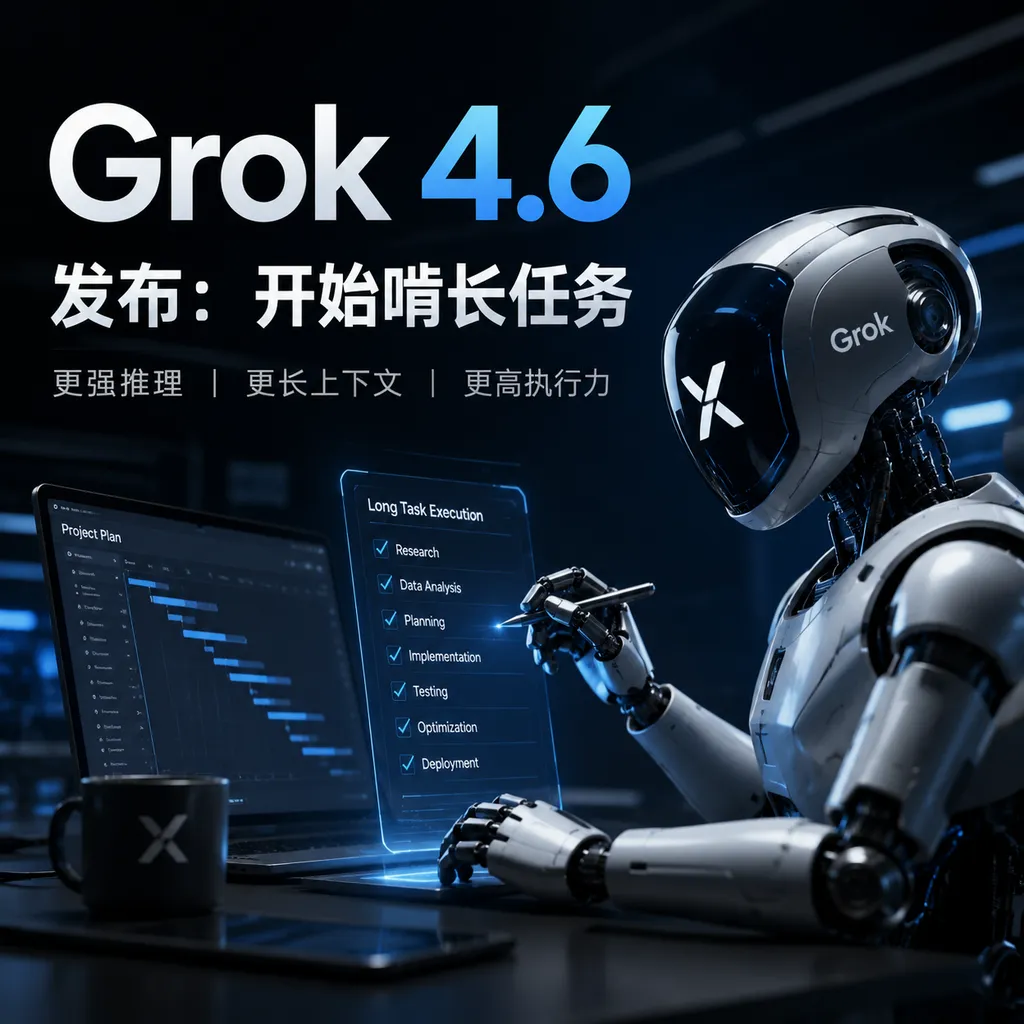
SpaceXAI has released Grok 4.6, with major upgrades to long-horizon agents, complex software engineering, and visual interaction. It tied with GPT-5.6 Sol on a composite benchmark, but its real-world usability will still depend on cost, stability, and API availability.
Grok 4.6 Released: Taking On Long-Horizon Tasks
On the evening of August 12, Beijing time, SpaceXAI officially released Grok 4.6. Rather than a routine update to reasoning and coding capabilities, this release signals that SpaceXAI is shifting its model optimization target from “answering a question” to “independently completing a body of work.”
The new model continues the direction established by Grok 4.5 for coding, agents, and knowledge work, while further strengthening its ability to handle long-running, multi-step tasks and product development involving interfaces, images, and interaction logic. Typical scenarios cited by the company include research, information analysis, working with large codebases, and taking a broad product concept through application planning, coding, testing, and iteration.
Grok 4.6 has initially launched on Cursor and Grok Build. During the first week after release, both services will provide users with twice the included usage allowance. However, as of the announcement, SpaceXAI had not yet disclosed full public API pricing, context window size, or detailed model specifications. For developers preparing to deploy the model in production, this information is no less important than leaderboard results.
The Focus of This Upgrade Is Not Simply Answering a Few More Questions Correctly
Over the past year, competition among frontier models has clearly shifted its focus. Single-turn question answering and olympiad-style reasoning remain important, but vendors are increasingly eager to prove that their models can work continuously in real software environments.
These are not the same capabilities.
To answer a benchmark question correctly, a model usually only needs to find the right path within a limited context. In an agent task that runs for dozens of minutes or even longer, however, it must simultaneously handle task decomposition, tool calls, file modifications, state persistence, error recovery, and result validation. A mistake at any stage can send all subsequent steps increasingly far in the wrong direction.
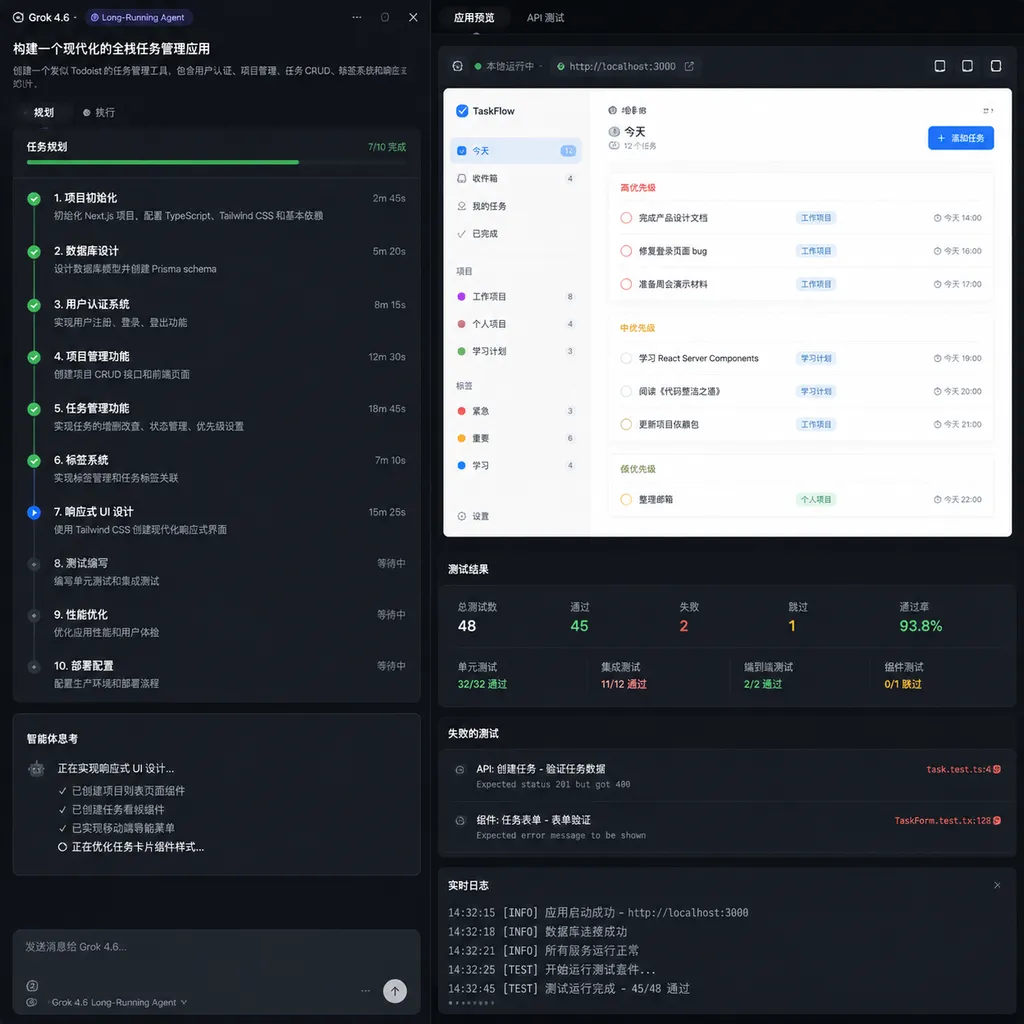
Grok 4.6 is aimed precisely at this kind of work, where errors accumulate. According to the release information, the new model exhibits more autonomous testing and validation behavior during longer workflows. After completing one stage, it checks the result before deciding whether to proceed, rather than generating continuously until the end.
This may sound like nothing more than an extra check, but in practice it is the dividing line between an agent that can be deployed and one that cannot. A model that can write code but does not run tests is like an engineer who submits code without checking CI. A model that can detect a failed build, identify the cause, and continue fixing it is beginning to resemble a digital collaborator to which work can actually be delegated.
From Product Idea to Working Prototype Is Grok 4.6’s Clearest Selling Point
One of SpaceXAI’s key tests for Grok 4.6 is turning vague product requirements into a runnable first version of an application.
For example, if the user provides only a broad direction such as “build a subscription revenue dashboard for independent developers,” the model must make multiple layers of decisions on its own:
- Research which metrics the target users need;
- Design the page structure and data model;
- Choose the front-end and back-end technology stacks;
- Implement charts, filters, and interaction states;
- Run the project and check for errors;
- Adjust the visuals and functionality based on subsequent user feedback.
Traditional coding models are good at completing one isolated step, such as generating a React component or completing a SQL query. Grok 4.6 aims to solve the handoff between steps. It must not only write the component, but also understand why the component exists, where the data comes from, whether the interactions align with the product goals, and whether changing one file has broken other parts of the application.
According to the company, the new model can research unfamiliar domains, plan application architecture, implement core interactions, and continuously improve the result over multiple rounds of feedback. When given a reasonably clear product concept, the first version generated by Grok 4.6 also outperforms Grok 4.5 in its basic structure and visual language.
Here, “visual” should not be understood simply as better image recognition. For a development agent, visual capability also means being able to inspect the actual rendered output in a browser, understand misaligned layouts, obscured buttons, color hierarchy, and responsive breakpoints, and then return to the code to make changes. The model is no longer processing only source files, but a closed loop formed by “code–runtime output–visual feedback.”
This is far harder than generating an attractive static page. In a real application, a seemingly simple spacing issue may originate from CSS specificity, component nesting, browser default styles, or state transitions. If Grok 4.6 can handle such problems reliably, its value will be more direct than merely improving code completion accuracy.
Training Was Reorganized Around Agents
Grok 4.6 underwent a longer period of additional training than Grok 4.5. Its training data included filtered model-generated reasoning data, advanced technical concept data, and high-quality engineering data. It also used improved optimizers and training methods to lay the groundwork for supervised fine-tuning and reinforcement learning.
One noteworthy detail is that the training team used Grok 4.5 to regenerate supervised fine-tuning trajectories. These trajectories covered different levels of reasoning intensity, different agent runtime frameworks, and domains including STEM, software engineering, and knowledge work. Model-based checks were then used to remove trajectories with obvious problems.
A “trajectory” can be understood as the complete record of how a model performs a task. It includes not only the final answer, but also intermediate plans, tool calls, file operations, and correction steps. Training a long-horizon agent requires far more than a collection of correct answers. The model must also learn how to reach those answers and how to recover after taking a wrong turn.
During reinforcement learning, Grok 4.6 was given tasks spanning knowledge work, general-purpose programming, kernel optimization, web development, and computer-aided design. This scope is closer to real engineering than conventional coding-problem training. Kernel optimization requires attention to performance and low-level constraints, web development involves visuals and interaction, and CAD requires spatial reasoning and tool use.
Judging by the training design, SpaceXAI is not simply adding an “agent mode” to Grok. Instead, it is making the task execution process itself a core training target. This is also a common direction among today’s frontier closed-source models: the foundation model is responsible for understanding and reasoning, while the agent framework provides tools, but the boundary between the two is becoming increasingly blurred.
Tied With GPT-5.6 Sol, but It Is Too Early to Declare a Winner
In Artificial Analysis’s Intelligence Index, which aggregates nine benchmarks, Grok 4.6 achieved the same score as GPT-5.6 Sol. SpaceXAI also says the new model reached frontier-level performance on multiple agentic coding and knowledge-work evaluations.
The tie indicates that Grok 4.6 has entered the top tier, but it is not enough to prove that the model can replace GPT-5.6 Sol in every scenario.
First, a composite index compresses multiple tests into a single score. Two models with the same overall score may have very different capability profiles. One may be better at modifying code repositories, while the other may be more reliable in tool use, factual accuracy, or long-form text analysis. For developers, the success rate on specific tasks is often more useful than an average score.
Second, evaluations of long-horizon agents are highly susceptible to external factors. Tool stability, network availability, sandbox permissions, and how the framework compresses context can all affect the final result. A model completing a task in the vendor’s own environment does not mean it will perform identically when connected to a third-party agent framework.
More importantly, there is the issue of cost. Long-running tasks continuously consume input, output, and tool-call tokens, and a failed retry can multiply the bill severalfold. If Grok 4.6 improves task success rates by 10% but doubles inference costs or waiting time, its production advantage must be recalculated.
A more reasonable assessment of Grok 4.6 is therefore that its capabilities on paper are now aligned with top-tier closed-source models, and it demonstrates a clearer agent-oriented product direction. Whether it is truly better suited to development teams should be judged only after API pricing, context specifications, rate limits, and third-party test results have all been published.
How Developers Should Test It
If you plan to evaluate Grok 4.6, do not limit the test to generating a few algorithmic functions. A more valuable approach is to give it a real, rollback-capable repository with clear acceptance criteria, such as:
- Complete a cross-directory refactor in a medium-sized project while keeping all tests passing;
- Reproduce a front-end bug from an issue, verify it with screenshots, and submit a fix;
- Read an unfamiliar codebase and add a complete feature involving both the database and UI;
- Analyze a collection of source materials and produce a structured report with evidence mapping;
- Run continuously for several hours and check whether it forgets the initial constraints;
- Deliberately introduce tool timeouts, test failures, and dependency conflicts to evaluate recovery capabilities.
The evaluation metrics should not be limited to whether the task was ultimately completed. At minimum, teams should record task completion rate, the number of human interventions, error recovery rate, total token consumption, end-to-end completion time, and the proportion of unrelated files modified by the model.
For long-horizon agents, the greatest danger is not an explicit error message, but a model that appears to keep working while continuously consuming resources in the wrong direction. Development teams should therefore also cap the budget for each task, configure file permissions and confirmation requirements for high-risk operations, and retain complete tool-call logs.
API Calls: Confirm the Actual Model ID First
Grok 4.6 is a closed-source model. When accessing it through an OpenAI-compatible aggregation service such as OpenAI Hub, developers can continue using their existing SDKs, reducing the need to modify clients separately for different providers. Note that the model ID, supported regions, and billing details should be based on the configuration actually available in the console. The example below uses grok-4.6.
from openai import OpenAI

client = OpenAI(
    api_key="YOUR_OPENAI_HUB_KEY",
    base_url="https://api.openai-hub.com/v1"
)

response = client.chat.completions.create(
    model="grok-4.6",
    messages=[
        {
            "role": "system",
            "content": "You are a senior software engineering agent. Create a plan before executing the task; at the end of each stage, run tests and verify the results."
        },
        {
            "role": "user",
            "content": "Analyze this project's authentication module, identify potential concurrency issues, and provide an actionable refactoring plan."
        }
    ],
    temperature=0.2
)

print(response.choices[0].message.content)
This code only demonstrates the model invocation entry point; it cannot reproduce the complete agent capabilities on its own. To enable the model to work with large codebases, the application layer must also provide filesystem, terminal, browser, search, and version-control tools, with permission boundaries, timeout mechanisms, and failure-retry strategies designed for each one.
In other words, the model is the engine, while the agent framework is the entire vehicle. Grok 4.6 claims to have improved the engine’s stability over long journeys, but whether the vehicle can reach its destination safely still depends on how developers build the tools and guardrails around it.
Security Protections Must Scale With Permissions
SpaceXAI says Grok 4.6 underwent its largest safety evaluation to date, covering pre-deployment capability testing, safeguard calibration, and post-deployment and third-party testing. The safety system focuses on legitimate use cases such as vulnerability remediation, engineering design, and AI research, with the goal of improving utility while controlling the risk of misuse.
This is not merely boilerplate in the release announcement. The more autonomously a model can use terminals, browsers, and code repositories, the greater the impact of mistakes or malicious actions. When a chat model outputs a dangerous command, the user can choose not to execute it. If an agent has sufficient permissions, it may run commands, modify configurations, or even access production credentials directly.
Enterprises cannot rely entirely on the model’s own judgment for security when deploying it. A more robust approach is to use least-privilege credentials, isolated execution environments, human approval for sensitive operations, and explicit allowlists for network access and file writes. The model’s safety training provides one layer of protection, but it is by no means a substitute for a permissions system.
Grok 4.6’s Real Test Is How Much Reliability Remains After Sustained Work
Grok 4.6 is moving in the right direction, and its focus is closer to developers’ actual needs than simply setting new reasoning benchmark records. Today’s coding models are not lacking in the ability to generate functions. What remains scarce is the ability to maintain a consistent objective and deliver verifiable results after crossing multiple steps, tools, and rounds of feedback.
Long-horizon tasks, however, are also the capabilities most easily obscured by polished demonstrations. An edited product video can omit failed retries and human prompting, while composite leaderboards struggle to fully reflect cost, latency, and environmental differences. Whether Grok 4.6 can become a reliable engineering agent will not depend on its ability to occasionally produce an impressive application. It will depend on how many times it can complete a task within budget across one hundred consecutive runs—and how often humans must clean up afterward.
Based on the currently available information, Grok 4.6 has brought SpaceXAI to the main table of agent-model competition and demonstrated stronger product awareness in visual interaction and end-to-end application development. However, API pricing, context window size, and full specifications were still unavailable on launch day, so developers do not need to rush to migrate production traffic.
Stress-test it on real repositories before discussing replacement. For a model positioned around long-running autonomous work, that is a fairer test than any single leaderboard.
References
- ITHome: Targeting GPT-5.6 Sol, SpaceXAI Releases Grok 4.6—An overview of the Grok 4.6 release, training methods, benchmark performance, launch channels, and safety evaluations.
- Zhihu: Grok 4.5 Has Been Released—and It Is a Pleasant Surprise—Background on Grok 4.5’s positioning in coding, agents, and knowledge work.