Solar Pro 4: Bargain-Priced Long Context
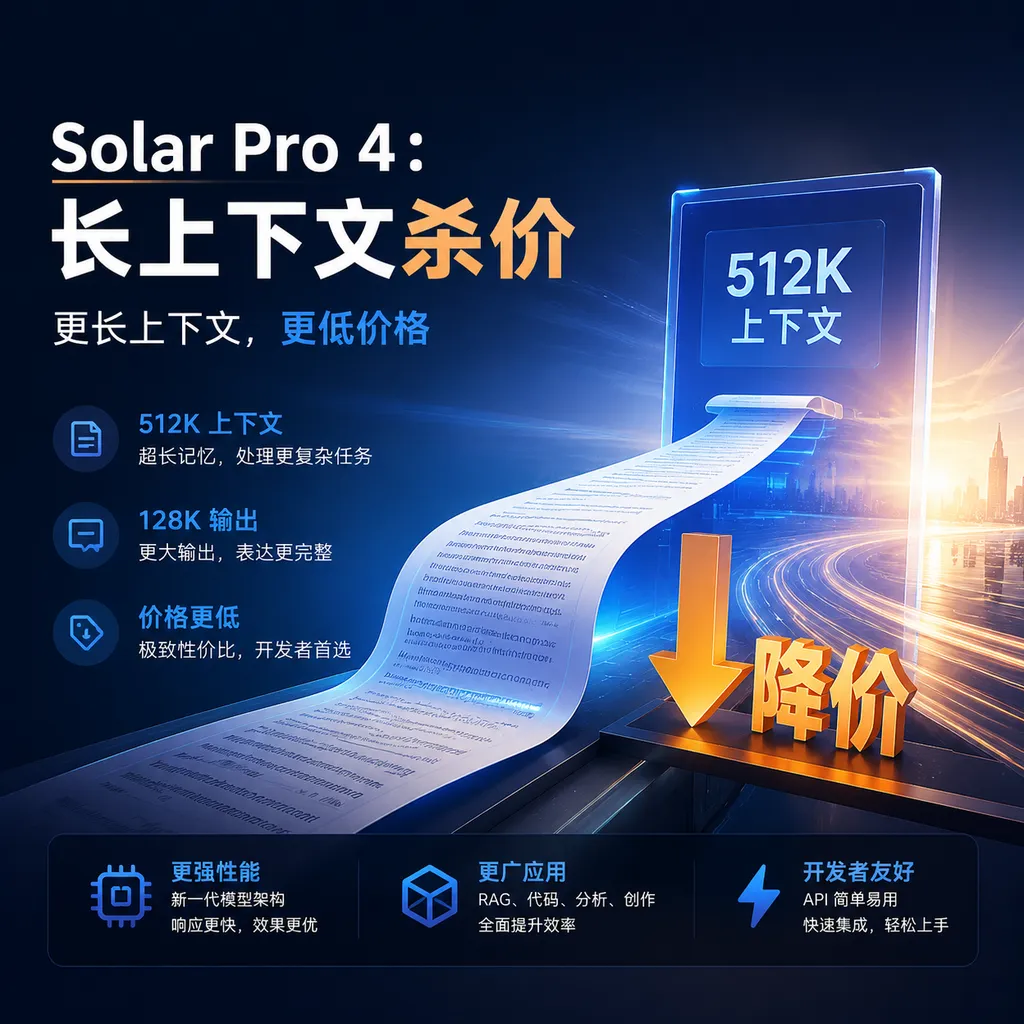
Upstage launches Solar Pro 4, targeting the agent market with a 512K context window, a maximum output of 128K tokens, and a price of $0.30 per million input tokens. But its No. 44 ranking on Agent Arena suggests it is primarily a cost-focused contender rather than a new benchmark for capability.
512K Context, With Pricing Already at Rock Bottom
South Korean AI lab Upstage officially released its commercial large language model, Solar Pro 4, on August 13. Designed for complex agentic tasks, the new model offers a 512K-token context window and up to 128K tokens of output, with standard input priced at just $0.30 per million tokens.
These specifications are likely to attract developers’ attention: the model can ingest multiple contracts, reports, and data files in a single request, while its output capacity is sufficient to generate complete reports, codebases, or structured deliverables. More importantly, rather than charging the steep premium typically associated with long-context models, Upstage has pushed the price down into small-model territory.
The pricing is as follows:
| Billing Item | Price per Million Tokens | Approx. RMB | | --- | ---: | ---: | | Standard input | $0.30 | Approx. ¥2 | | Cached input | $0.06 | Approx. ¥0.41 | | Output | $1.20 | Approx. ¥8.10 |
Based on the listed prices, processing 512K tokens of new input would cost approximately $0.154. If the content is served from cache, reading the same volume would cost about $0.031. Generating 128K output tokens alone would also theoretically cost around $0.154. Whether a single request can simultaneously use the full 512K input and 128K output limits depends on how the service calculates total context, so the two advertised maximums should not simply be added together and interpreted as a 640K-token capacity.
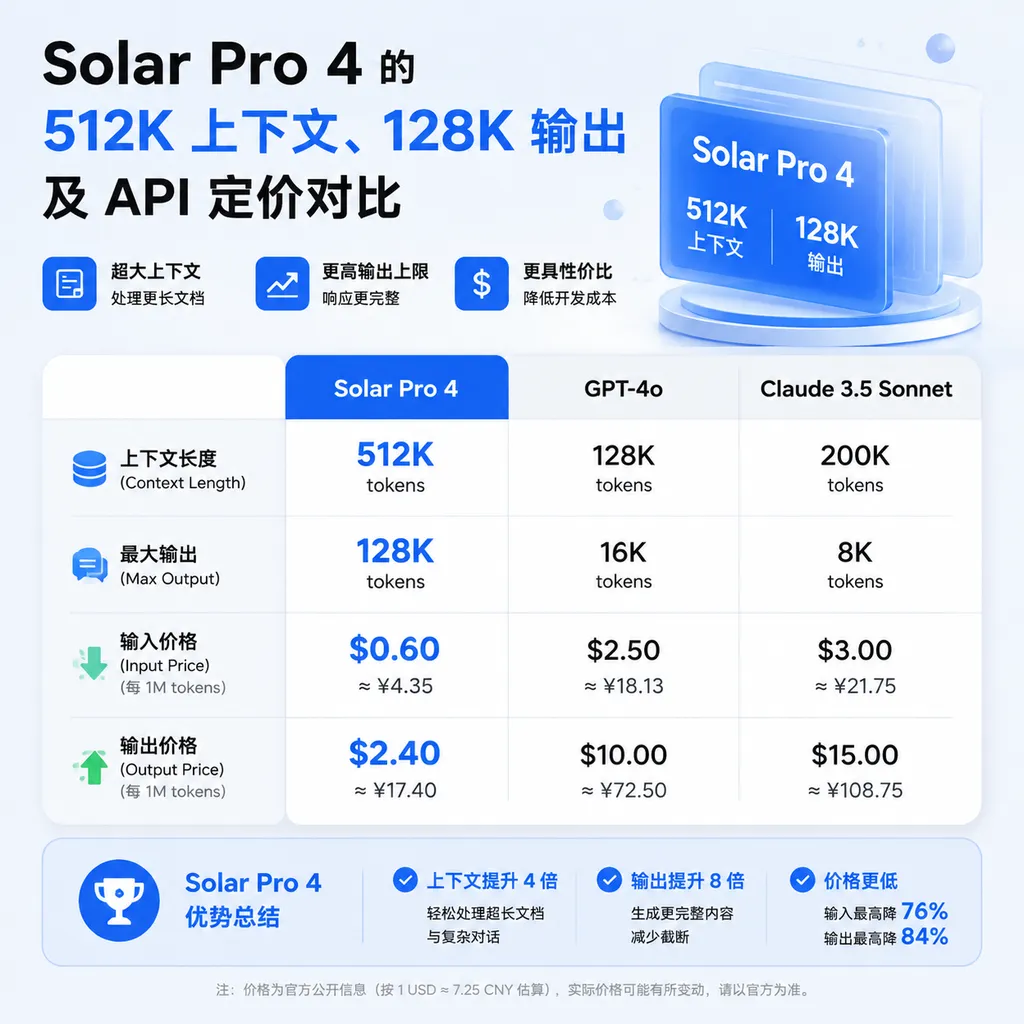
Judged purely on price, Solar Pro 4 is highly aggressive. It is not merely expanding the context window; it is attempting to make long context a foundational capability that can be used repeatedly. For agents that need to process product manuals, corporate policies, historical support tickets, and database results together, input costs are often more critical than in chat applications. Pricing cached input at $0.06 per million tokens clearly targets workflows that frequently reuse system prompts and fixed knowledge.
However, a low price does not guarantee effective reasoning at the same scale. The fact that a model can “fit” 512K tokens only means that its API accepts content of that length. Whether it can reliably retrieve details from earlier passages, establish relationships across files, and avoid mismatching evidence determines whether those 512K tokens are genuinely useful.
What It Is Selling Is Not Chat, but Deliverables
Upstage’s positioning for Solar Pro 4 is clear: it is not building yet another general-purpose assistant that chats with users, but a model that can complete workflows resembling real work across terminals, files, and tools.
The official demonstration used a fictional coffee brand called Solarbean Coffee. The model was asked to analyze ten candidate locations based on one store-opening policy document and six market-data files. With three prompts, Solar Pro 4 completed the policy-based screening and generated, in sequence:
- An Excel workbook containing the analysis data;
- A written report for review;
- A slide deck for presentation.
This demonstration is more informative than “summarize a 300-page PDF.” Real enterprise agents do not merely output a block of text. They must read heterogeneous files, apply rules, preserve intermediate results, and then translate the same set of conclusions into spreadsheets, reports, and presentations. Any inconsistency in data definitions at any stage can cause the final deliverables to contradict one another.
In this context, the 512K context window is more like a sufficiently large desk on which policies, market data, and activity logs can all be spread out. But a larger desk does not guarantee a reliable analyst. Stable tool use, traceable spreadsheet figures, and recovery from failures still depend on both the agent framework and the model.
Solar Pro 4’s maximum output of 128K tokens is equally noteworthy, but everyday applications should not necessarily use it in full. A 128K-token output is already enough to generate a short book. In agentic scenarios, a more sensible use is to accommodate code, logs, and structured results produced during long-running tasks. If developers fail to define stopping conditions and output budgets, ultra-long outputs may also lead to redundant content, endless retries, and higher tail latency.
Strong Results on Three Agent Benchmarks, but Not Enough to Claim It Punches Above Its Weight
Upstage published three headline scores:
- Terminal-Bench v2.1: 57
- τ³-Banking: 23
- AA-LCR: 71
These three benchmarks cover terminal operations, multi-turn banking interactions, and long-context agent capabilities, respectively, making them closer to production environments than traditional multiple-choice benchmarks. Terminal-Bench, in particular, tests a model’s ability to execute tasks continuously in a command-line environment: the model must not only know the commands, but also observe results, correct its approach, and handle exceptions. For coding agents, this kind of closed-loop execution is generally more important than solving a single algorithm problem in one turn.
However, Upstage only provided Solar Pro 4’s individual scores. Its launch materials did not include sufficiently comprehensive comparisons under equivalent conditions, including reasoning budgets, tool configurations, sampling counts, timeout policies, and whether additional scaffolding was used. Agent benchmarks are highly sensitive to the runtime environment. The same base model can produce substantially different scores with different prompts or retry mechanisms. These results therefore demonstrate that Solar Pro 4 has the foundational capabilities needed for agentic workflows, but they are not sufficient on their own to prove that it has surpassed leading models.
A more direct signal comes from Arena.ai’s Agent Arena. Solar Pro 4 has already entered the leaderboard, debuting at No. 44, close to MiniMax M2.7. Agent Arena uses blind head-to-head comparisons by human users and an Elo-style rating system, making it harder for vendors to package results by selectively choosing favorable tasks.
A No. 44 ranking is not poor, especially for a new commercial model from a South Korean lab. It means Solar Pro 4 can already compete directly with established models on the market. But the ranking also tempers the launch-day specifications: Solar Pro 4 currently looks more like a cost-effective, long-context agent model than a new frontier leader.
This distinction matters. Leading models compete on success rates for the hardest tasks, while Solar Pro 4 may instead compete on being “good enough for 80% of tasks at a fraction of the cost.” For teams processing tens of thousands of documents every day, the latter can sometimes deliver greater commercial value.
Parameter Count Undisclosed, With Several Missing Pieces Before Procurement
Upstage has not disclosed Solar Pro 4’s parameter count. Nor has it provided detailed public information about the model architecture, training-data scale, or performance degradation at different context lengths. As a result, developers currently cannot determine whether its low price comes from a smaller dense model, a mixture-of-experts architecture, inference-side optimizations, or deliberate vendor subsidies.
Parameter count does not directly equate to capability, but it affects deployment costs, throughput, and long-term pricing stability. For a closed-source API, users should focus more on the following questions:
- Is the 512K context window available to all accounts and regions, or does it require a separate application?
- What are the time to first token and total request latency with long inputs?
- What are the success rates for structured output, function calling, and parallel tool calls?
- What are the cache-hit rules, retention periods, and tenant-isolation mechanisms?
- Is customer data used for training, and how long can logs be retained?
- Does 128K output have separate rate limits or timeout constraints?
- Will tool-calling behavior remain compatible after model version upgrades?
Cache pricing deserves particular attention. At $0.06 per million tokens, it looks extremely inexpensive, but the actual savings depend on cache granularity. If a cache hit requires a completely identical long prefix, then a timestamp, user ID, or misplaced dynamic field in the prompt could invalidate the entire cache. Developers should place stable content in the prefix and dynamic variables later in the prompt, then verify actual cache-hit rates through request logs.
For Developers, the Right Approach Is Model Tiering, Not Wholesale Replacement
The most practical use cases for Solar Pro 4 include preliminary contract screening, financial-document archiving, enterprise knowledge-base Q&A, customer-support ticket analysis, code-repository inspection, and back-office agents that need to generate multiple file types. Its core advantage is the combination of a large context window and low input costs, not a No. 1 ranking on any particular reasoning benchmark.
A safer engineering strategy is therefore to use a tiered model architecture:
- Use Solar Pro 4 for high-volume file ingestion, filtering, and preliminary structuring;
- Send high-risk conclusions to a more capable model for verification;
- Use Prompt Cache for fixed policies, schemas, and tool instructions;
- Store source citations, calculations, and tool outputs in intermediate state;
- Set explicit token limits for outputs rather than leaving them uncapped simply because the model supports 128K.
For example, a contract-review system could first use Solar Pro 4 to extract clauses from hundreds of pages, identify conflicts, and generate a risk list, then submit the small number of high-risk clauses to a more capable model for a second review. This approach takes advantage of its low cost for reading long documents without staking final legal judgments entirely on a new model that currently ranks in the middle of the Agent Arena leaderboard.
OpenAI-Compatible API Example
Solar Pro 4 is a proprietary commercial model offered through an API. For projects already using the OpenAI SDK, connecting through an aggregation gateway typically requires changing only the base_url, API key, and model identifier. OpenAI Hub supports the OpenAI-compatible API format. The actual model ID is subject to availability in the dashboard; the identifier below is illustrative:
import os
from openai import OpenAI

client = OpenAI(
    api_key=os.environ["OPENAI_HUB_API_KEY"],
    base_url="https://api.openai-hub.com/v1"
)

response = client.chat.completions.create(
    model="upstage/solar-pro-4",  # Illustrative name; use the actual ID shown in the dashboard
    messages=[
        {
            "role": "system",
            "content": "You are an enterprise document-review agent. Every conclusion must cite the file name and the location of the original text."
        },
        {
            "role": "user",
            "content": "Compare these contracts against the company’s procurement policies and output the risks, supporting evidence, and recommended actions."
        }
    ],
    max_tokens=4096,
    temperature=0.2
)

print(response.choices[0].message.content)
Even though the model supports 128K-token outputs, it is advisable to start with a budget of 4K or 8K and increase it gradually according to the type of deliverable. Long tasks are best divided into three stages—extraction, verification, and generation—rather than asking the model to ingest all materials and produce the final answer in a single request. Observability, checkpoint recovery, and evidence trails are generally more important than the advertised maximum output length.
A Model Worth Testing, but Not Buying Based on Specifications Alone
The release of Solar Pro 4 shows that the long-context market is shifting from “who can fit more” to “who can repeatedly process real-world files at lower cost.” Its 512K context window, 128K output limit, and $0.30-per-million-token input pricing make it clearly attractive for document-intensive agent scenarios. Its cache pricing may prove even more important for batch workflows.
But the available evidence is equally clear: its No. 44 ranking in Agent Arena means that it has not yet entered the top tier, while disclosure around its parameters and long-context performance remains insufficient. Developers should evaluate it with real-world data, but they should not replace production models solely on the strength of its context-window numbers.
Ultimately, determining whether Solar Pro 4 is cost-effective requires looking beyond “how cheap it is per million tokens.” What matters is how many retries and how much human review are required to complete a task—and whether the final deliverables are genuinely usable. A low unit price is only the cost of admission; the true bill is the cost per successful task.
References
- ITHome: South Korean AI Model Solar Pro 4 Debuts in Agent Arena—Summarizes Upstage’s August 13 launch announcement, model specifications, pricing, official demonstration, benchmark results, and Agent Arena ranking.