Sign Language Input Has Finally Arrived on Smartphones
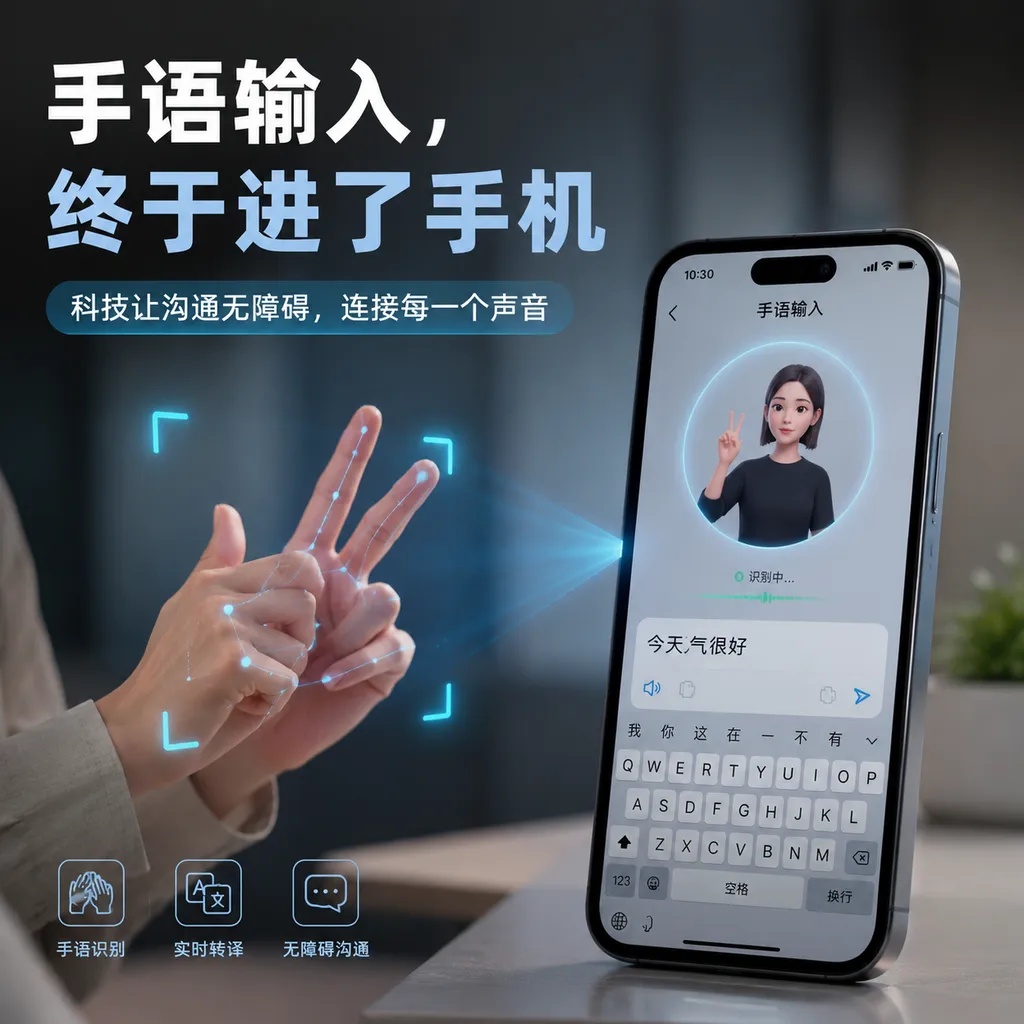
Google DeepMind has released SL2T, a multilingual sign language-to-text model, debuting first on the Pixel 11. It bypasses traditional sign language labels and directly translates human movements into text, though the initial release still only supports American Sign Language.
Sign Language Input Has Finally Arrived on Phones
On August 12 local time, Google DeepMind released SL2T, a large-scale multilingual sign language-to-text model, and integrated it into Gboard and Live Transcribe on the Pixel 11 series. Users can sign in front of their phone’s camera, and the system translates their movements directly into text. For the first time, sign language AI has truly entered mainstream consumer electronics rather than remaining a laboratory demonstration or a separately deployed accessibility tool.
The initial rollout remains limited: it currently supports only American Sign Language (ASL) to English and is restricted to the Pixel 11 series. Google says support for more sign languages and devices will follow.
Even so, this is a significant real-world product launch. Mobile input has traditionally revolved around keyboards, voice, and touch, often requiring sign language users to first convert their thoughts into written language and then type them out word by word. SL2T aims to provide the world’s approximately 70 million sign language users with a “typing alternative” similar to voice input. Google’s testing shows that some ASL users can enter text faster and more naturally by signing than by typing on an English keyboard.
It Is Not Just “Recognizing a Few Gestures”
The easiest way to underestimate sign language recognition is to think of it as an enhanced form of gesture control.
Traditional gesture recognition usually only needs to answer a classification question: Is the user signaling “pause,” “back,” or “like”? The number of actions is limited, and inputs correspond almost one-to-one with outputs. Sign language is entirely different. It is neither spoken language encoded as movements nor a system in which each English word is replaced by a fixed gesture. It is a natural language with its own vocabulary, grammar, and conventions of expression.
This means the model cannot simply recognize signs one after another from left to right, as though scanning subtitles, and then concatenate the labels into a sentence.
In real communication, meaning may be distributed across multiple parts of the body at the same time:
- The shape, orientation, position, and movement trajectory of both hands;
- The spatial relationship between signs in three dimensions;
- Facial expressions, eyebrow movements, and mouth movements;
- Head tilt, gaze, and upper-body posture;
- Continuous changes and context across successive movements.
For example, the same set of hand movements combined with different eyebrow shapes, body tilts, or directions of motion may convey a statement, a question, or an entirely different referential relationship. The model must process not “what a hand looks like,” but how multiple visual signals combine over time to form a sentence.
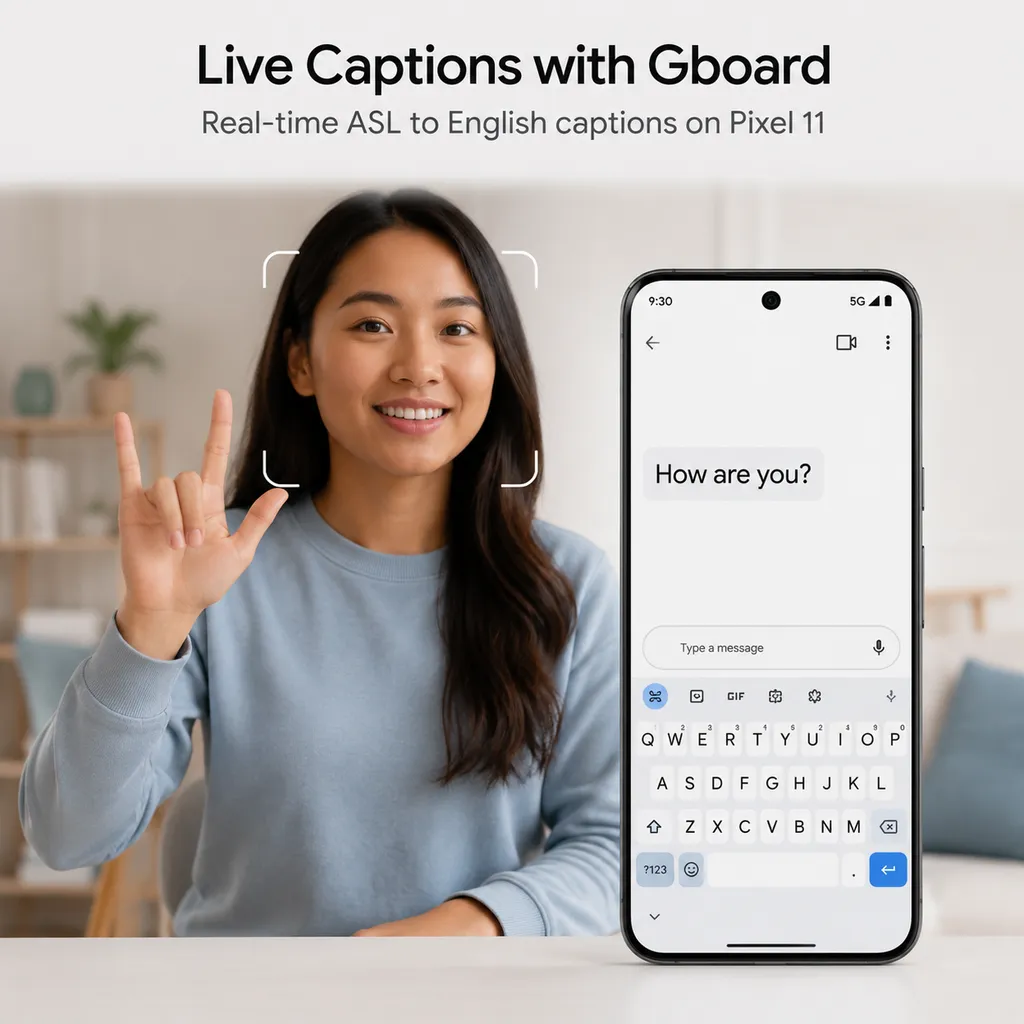
At its core, SL2T is closer to “video understanding plus machine translation” than to single-frame image classification.
Removing Intermediate Annotations Is the Most Important Technical Change in This Release
Many previous sign language translation systems introduced an intermediate representation, typically called a gloss, which can be roughly understood as a sequence of standardized labels assigned to continuous signing. The system first converts “video to labels,” then “labels to text.”
This pipeline makes the task easier to break down and allows for straightforward manual verification, but its drawbacks are equally clear: the intermediate labels themselves create an information bottleneck. Facial expressions, spatial positions, the intensity of movements, and the semantics between continuous actions are difficult to preserve fully using a limited set of labels. Once information is lost in the first stage, even the strongest language model cannot recover it later.
This time, DeepMind has chosen to bypass that layer of intermediate annotation, allowing SL2T to generate target text directly from spatial movement representations. The shift can be compared to machine translation’s evolution from the early approach of “looking up words in a dictionary and then reordering them” to end-to-end neural machine translation. The model is no longer constrained by a fixed vocabulary and hand-crafted rules, but instead learns mappings among visual movements, context, and text from large-scale data.
According to Google, SL2T was trained on approximately 100,000 hours of data spanning more than 50 sign languages. The significance of this scale goes beyond allowing the model to “see more movements.” Different sign languages are not dialects of one another, but multilingual training may still enable the model to learn transferable foundational capabilities such as hand tracking, body-pose modeling, temporal alignment, and referential relationship recognition.
This is similar to the approach taken by multilingual speech models: French and Japanese do not share vocabulary, but joint training can improve a model’s general ability to represent human vocalization, rhythm, and context. SL2T attempts to reproduce this scaling effect for visual language.
However, a distinction must be made between a “multilingual model” and a “multilingual product.” The fact that SL2T was trained on data from more than 50 sign languages does not mean that the Pixel 11 can translate 50 sign languages at launch. The consumer-facing version currently supports only ASL-to-English translation, and Google has not yet provided a complete timeline for other languages or disclosed whether their accuracy will reach a practical level.
Not Uploading Raw Video Matters More Than Simply Improving Accuracy
The camera is an unavoidable sensor for sign language input—and the most sensitive part of this kind of product.
If every input required users to upload clear images of their faces, their home environments, and complete video footage to a server, the barrier to real-world adoption would remain high even if the translation quality were good enough. This is especially true for a system-level input method such as Gboard, which may be used in chats, healthcare, payments, and workplace communication—all contexts in which the input itself can be highly sensitive.
Google’s approach is to convert video into pose landmarks on the device: coordinate representations showing how key positions on the hands, face, and body change over time. The model processes or transmits this abstracted movement data rather than the raw video stream, so the original footage does not need to be sent to a server.
This is a pragmatic engineering compromise:
- Reduced privacy exposure. Coordinate sequences generally do not contain complete facial textures, room backgrounds, or other visual information;
- Smaller input size. Landmark data is far smaller than continuous high-definition video, making it better suited to mobile networks and real-time processing;
- Less visual interference. Background objects, clothing textures, and lighting are partially filtered out, allowing the model to focus its computing resources on movement;
- Easier cross-device expansion. As long as the front end can reliably extract a consistent pose representation, the back-end translation model does not need to adapt to every level of camera quality.
Of course, “not uploading video” does not mean absolute anonymity. Continuous poses, movement habits, and body proportions may still constitute sensitive information. Developers need to consider whether landmark data leaves the device, how long it is retained, whether it can be linked to an account, and whether error logs contain information that could be reconstructed. Google currently emphasizes that raw video is not uploaded, but the complete data lifecycle still warrants further scrutiny.
The Real Challenge Lies in Real-World Environments, Not Demo Videos
SL2T still faces several major obstacles on the path from model release to everyday usability.
The first is occlusion. Signing often involves hands overlapping, hands passing in front of the face, or movements extending beyond the camera frame. A phone’s two-dimensional camera cannot reliably capture depth information, and once landmarks drift, the meaning may change along with them.
The second is speed and continuity. Real signing does not consist of completing one sign, pausing, and then beginning the next. Signs flow into and transform one another, much like reduced or elided sounds in spoken language. The system must output text as early as possible without segmenting too aggressively and mistranslating relationships between preceding and subsequent signs.
The third is variation within a language. More than 200 sign languages exist worldwide, and even the same sign language may vary by region, age group, and individual style. A large training dataset does not mean that every language, region, and community is represented equally.
Moreover, sign language translation has a lower tolerance for errors than ordinary voice input. If speech transcription produces the wrong homophone, users can usually correct it quickly. But if the system misinterprets negation, questions, time, or references to people, the meaning of the entire sentence may be reversed. In healthcare, legal, and emergency communication, this is not merely a “user experience issue” but a reliability issue.
For that reason, SL2T’s practical usability cannot be judged solely by a single overall accuracy score. More meaningful metrics should include:
- Performance across different skin tones, hand shapes, and clothing conditions;
- Stability in low light, backlighting, and complex backgrounds;
- Error rates for rapid signing, overlapping hands, and movements outside the camera frame;
- Coverage of regional variants and nonstandard expressions;
- End-to-end latency, power consumption, and offline availability;
- Translation quality for negation, numbers, proper nouns, and referential relationships.
Google has disclosed the scale of the training data and the product entry points, but it has not yet released comprehensive public benchmarks, per-language results, or details of resource consumption on mobile devices. These figures will determine whether SL2T is merely “demo-ready” or capable of serving as a reliable input method.
Why Pixel and Gboard Rather Than a Standalone App?
The smartest aspect of this release may not be the model architecture, but the product entry point.
Accessibility AI has often faced the same dilemma: a research paper produces impressive results, but the final technology is packaged into a standalone tool that users must actively find, install, and learn. Because the feature is disconnected from everyday workflows, usage struggles to grow.
By placing SL2T in Gboard and Live Transcribe, Google is integrating it directly into Android’s input and transcription pipelines. In supported contexts, sign language can become a system input method alongside keyboards and voice, rather than requiring users to translate in a separate app and then copy and paste the result into a chat box.
Gboard handles “sign language as an input method,” while Live Transcribe is better suited to face-to-face communication and real-time captions. Together, they cover two common scenarios: active expression and conversational transcription. This system-level integration is what gives the claim of “first entering a consumer product” real weight.
The Pixel 11 launch also aligns with Google’s usual strategy: start with its own hardware to control the camera, chip, operating system, and application stack, reducing the difficulty of end-to-end optimization, and then expand to more Android devices depending on the results. For a model that requires continuous video processing, device performance, heat dissipation, and power consumption are all significant concerns. Releasing it immediately across the fragmented Android ecosystem could instead undermine first impressions if the experience proves unstable on lower-end devices.
For Developers, This Is More of a Product Signal Than a Ready-Made API
It should be noted that this SL2T release is centered on bringing a consumer feature to the Pixel 11. Google has not described it as a general-purpose cloud API that third parties can call directly. What developers should pay closer attention to for now is the new interaction pipeline it validates:
Camera video → on-device pose extraction → temporal visual encoding → cross-language translation → system text input.
This pipeline is applicable not only to accessibility input, but potentially to education, remote meetings, customer service, public-service terminals, and sign language content retrieval. However, third parties cannot reproduce it simply by connecting a general-purpose vision model. Product-grade performance requires data licensing, participation from sign language communities, high-quality on-device landmark extraction, low-latency decoding, and translation evaluation. None of these elements can be omitted.
SignGemma, announced in 2025, had already demonstrated DeepMind’s exploration of sign language translation models. SL2T goes a step further by embedding the capability into a system input method. The clearest change between the two is that the evaluation standard has shifted from “Can the model translate?” to “Will ordinary people want to use it every day?”
This Is Not a Feature Patch, but an Expansion of the Input Paradigm
SL2T’s current limitations are clear: it supports few languages, works on a narrow range of devices, and lacks comprehensive public evaluation data. In its launch state, it is still far from being a universal translator for sign language users worldwide.
But it has already crossed the most difficult threshold—getting the operating system to treat sign language not as a collection of special movements captured by a camera, but as a complete language that can be entered directly as text.
Keyboard input requires users to adapt to written language. Voice input requires users to be able to speak and to be in an environment where speaking is appropriate. Sign language input offers a third path, and for some users it is not merely a nice-to-have feature, but their most natural and efficient means of expression.
Our assessment is that SL2T’s short-term value primarily belongs to Pixel users and the ASL community, so its current reach remains limited. Its long-term significance lies in advancing sign language translation from an “AI for social good” project into a foundational operating-system capability. What ultimately determines its success will not be whether the model continues to grow in parameter count, but whether Google can rapidly expand language coverage, publish more transparent disaggregated evaluations, and bring the capability from Pixel to a broader range of Android devices.
If these issues are resolved, sign language input could follow the path of voice input more than a decade ago, evolving from a novelty into a standard way of interacting with phones.
References
- ITHome: Sign Language AI Enters Consumer Products for the First Time as Google DeepMind Launches Sign Language-to-Text Model — Covers SL2T’s release date, training data scale, initial availability on the Pixel 11, privacy safeguards, and plans for future expansion.