
OpenAI Agents SDK Update: Enhanced Enterprise-Level Security and Capabilities
OpenAI updated the Agents SDK today, introducing enterprise-grade security controls and capability extension mechanisms. It optimizes context management through progressive disclosure and forms a complementary ecosystem with MCP.
OpenAI Agents SDK Update: Dual Upgrade in Enterprise Security and Capability
Today (April 15), OpenAI updated the Agents SDK, focusing on strengthening enterprise-grade security controls and expanding the Agent capability extension mechanism. This update isn’t just a pile of new features—it’s a systematic solution to two of the biggest pain points in Agent deployment: how to make Agents both powerful and controllable, and how to extend capabilities without blowing up the context window.
Core Update: The Agent Skills Mechanism
The star of this update is Agent Skills—a capability extension mechanism based on Progressive Disclosure. Simply put, it lets the Agent see a “catalog” of capabilities first and only loads full content when needed, instead of dumping all documentation into the context window at once.
Traditionally, developers preload all tool docs, API specs, and usage examples into the System Prompt. In enterprise scenarios, tool documentation alone can take tens of thousands of tokens. Agent Skills breaks this process into three layers:
Layer 1: Metadata
Contains only the skill name, short description, and applicable scenarios. The Agent can quickly see what skills are available and roughly when to use them. This layer usually takes only a few hundred tokens.
Layer 2: Instructions
Loaded only when the Agent decides to use a skill. Includes usage methods, parameter explanations, and precautions—this is the actual “user manual.”
Layer 3: Scripts & References
Code examples, configuration templates, and detailed documentation. Loaded only when explicitly needed, for instance, when debugging an error.
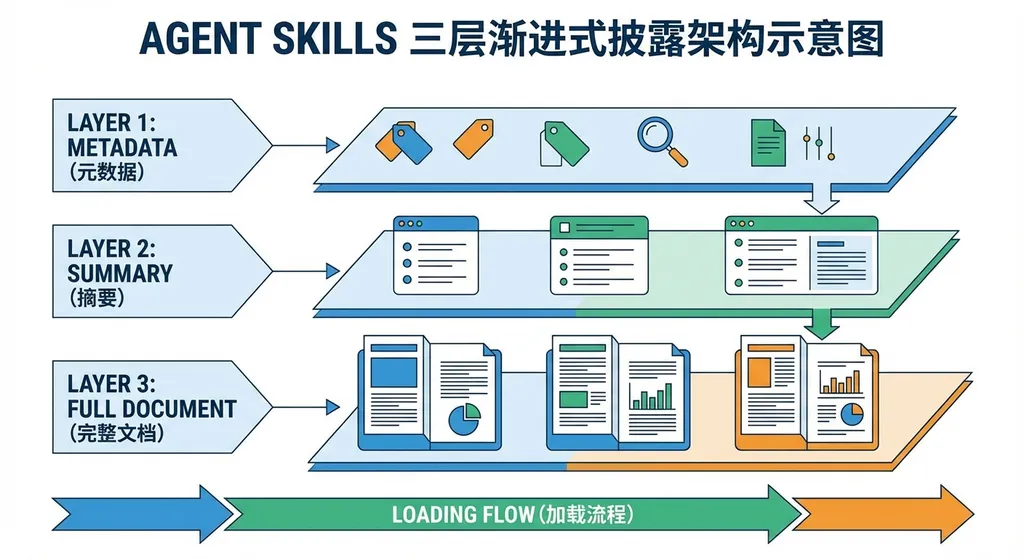
The effect is significant. According to OpenAI, the same set of capabilities that requires 16K tokens using the traditional approach only needs about 500 tokens with the Skills mechanism. For enterprise Agents integrating dozens of tools, this isn’t optimization—it’s a lifesaver.
Enterprise-Grade Security Enhancements
Beyond capability extension, this update also upgrades security controls. At the SDK level, OpenAI adds several key safeguards:
Determinism First Principle
The philosophy behind Agent Skills is “determinism first.” Each skill must have clearly defined triggers, execution boundaries, and failure handling. Unlike some Agent frameworks that let LLMs decide when to use which tools, the Skills mechanism requires explicit declarations from developers.
This may seem to limit flexibility, but in enterprise settings, it’s essential. You don’t want a customer service Agent deleting a database because it “misunderstood” a user request.
Modularity and Single Responsibility
Each Skill does one thing—and does it well. This is not just good engineering practice but also a way to define security boundaries. If one Skill fails, its impact is contained.
Auditing and Traceability
The SDK includes comprehensive logging. Every Skill invocation, parameter pass, and return result is recorded—making it easy to trace where and why an error occurred.
Skills vs MCP: Complementary, Not Competing
Many compare Agent Skills to Anthropic’s MCP (Model Context Protocol). Both address Agent capability extension, but their design philosophies differ entirely.
MCP uses eager loading. It initializes all connections and loads complete tool information into context at startup. Advantage: low latency during use and full visibility into available capabilities. Trade-off: large context overhead and slower startup.
Agent Skills use lazy loading. Only metadata is loaded at startup; full content loads on demand. Advantage: efficient context usage and fast startup. Trade-off: some delay when a skill is called for the first time.
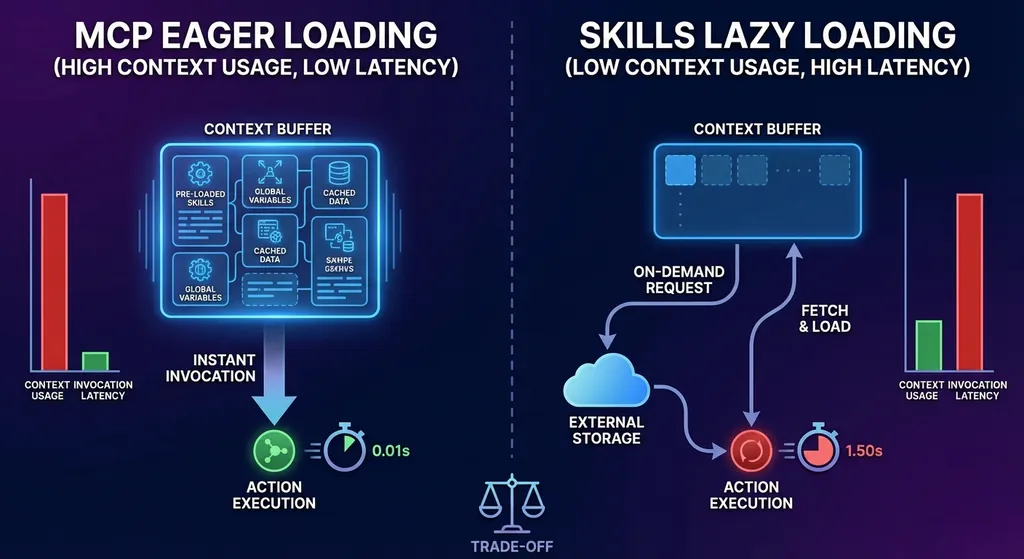
In practice, they complement each other. MCP suits interactive scenarios demanding low latency—like coding assistants in IDEs. Skills suit enterprise workflows that involve many tools but use only a few per task.
Many teams now use a hybrid setup: core high-frequency tools via MCP, specialized long-tail tools wrapped as Skills. OpenAI’s update now natively supports MCP, allowing developers to mix and match as needed.
In Practice: Writing a High-Quality Skill
The heart of a Skill is the skill.md file—a structured capability declaration.
Example: a MySQL data analysis Skill.
---
name: mysql_employee_analysis
description: Analyze employee database to generate statistical reports
version: 1.0.0
author: your-team
---

# MySQL Employee Data Analysis

## Applicable Scenarios
- Need to query basic employee statistics
- Need to generate departmental distribution reports
- Need to analyze salary trends

## Usage

### Connect to Database
Use connection info from environment variables:
- `MYSQL_HOST`
- `MYSQL_USER`
- `MYSQL_PASSWORD`
- `MYSQL_DATABASE`

### Query Examples

**Department headcount distribution:**
```sql
SELECT department, COUNT(*) as count
FROM employees
GROUP BY department;
Average salary:
SELECT AVG(salary) as avg_salary
FROM employees;
Notes
- Only SELECT queries allowed; no INSERT/UPDATE/DELETE
- Max 1000 rows returned
- Sensitive fields (e.g., ID numbers) will be masked automatically
Error Handling
- Connection failed: check environment configuration
- Query timeout: optimize SQL or add index
- Insufficient privileges: contact DBA for authorization
Key points:

1. **Precise metadata** – The `description` should clearly state what the Skill does and when to use it. Don’t write “database tool”; write “analyzes employee database to generate statistical reports.”
2. **Concrete use cases** – Describe scenarios, not features. When a user says, “Show me each department’s headcount,” the Agent can instantly match this Skill.
3. **Complete instructions** – Include setup, parameters, examples. Think “operation manual,” not “API doc.”
4. **Clear boundaries** – Define what can and cannot be done. This is your first security barrier.
5. **Practical error handling** – Instead of listing error codes, tell the Agent what to do when common issues occur.

## Using Skills in Code

The OpenAI Agents SDK API design is very simple. If you use OpenAI Hub, the code is nearly identical—just change `base_url`:

```python
from openai import OpenAI

# Using OpenAI Hub
client = OpenAI(
    api_key="your-openai-hub-key",
    base_url="https://api.openai-hub.net/v1"
)

# Create Agent and load Skills
response = client.chat.completions.create(
    model="gpt-4",
    messages=[
        {
            "role": "system",
            "content": "You are a data analysis assistant."
        },
        {
            "role": "user",
            "content": "Help me analyze departmental headcount distribution."
        }
    ],
    tools=[
        {
            "type": "skill",
            "skill": {
                "name": "mysql_employee_analysis",
                "path": "./skills/mysql_employee_analysis"
            }
        }
    ]
)

print(response.choices[0].message.content)
The Agent automatically handles loading and calling the Skill. Behind the scenes it:
- Reads Skill metadata and checks applicability
- Loads full instructions after deciding to use it
- Builds the SQL query per instructions
- Executes the query and processes the result
- Checks error-handling instructions if issues arise
- Returns the final analysis result
To the developer, the process is transparent. Just define the Skill—SDK handles the rest.
Ecosystem Evolution: The Drive Toward Standardization
Agent Skills aren’t OpenAI’s patent. Anthropic has MCP, Google has Vertex AI Extensions—everyone’s building their own extension mechanism. But the industry is moving toward standardization.
The reason is simple: fragmentation benefits no one. Developers don’t want to write separate integration code for every platform; enterprises don’t want vendor lock-in; model providers want a thriving shared ecosystem.
Both Skills and MCP are open by design. OpenAI publishes the Skills specification on GitHub, and Anthropic’s MCP protocol is also open. The community is already building cross-platform Skill repositories—one Skill definition can work across multiple frameworks.
This trend is great for developers. Your Skill investment won’t be wasted when switching models or platforms; it’s reusable.
Challenges and Limitations
Agent Skills are not a silver bullet. Several clear limitations exist:
Learning Curve
Writing a good Skill requires deep understanding of how Agents work—what belongs in metadata, instructions, or references. Experience matters.
Debug Complexity
Progressive loading is efficient but harder to debug. Why didn’t the Agent choose a Skill—unclear metadata or matching logic issue? These aren’t as easy to trace as conventional code bugs.
Performance Overhead
Lazy loading introduces first-call latency. For real-time systems, this could be an issue. Preloading helps but reintroduces context overhead.
Security Boundaries
No matter how strict, Skill definitions can’t stop LLM “creative interpretation.” Agents might combine Skills in unexpected ways, causing side effects. Additional system-level security controls are needed beyond Skill definitions.
Recommendations for Developers
If you’re building enterprise-level Agents, this update deserves your attention. Practical advice:
Start Small
Don’t convert everything to Skills at once. Start with a few high-frequency, standalone capabilities, gain experience, then expand.
Prioritize Metadata Quality
Metadata drives Agent decision-making. Polishing descriptions and scenario texts is more important than writing long docs.
Build a Skill Library
Store reusable, general-purpose Skills—database queries, file operations, API calls—as team assets.
Monitor and Iterate
After deployment, monitor usage. Which Skills are frequently called? Which never used? What’s the failure rate? Let data guide optimization.
Mix MCP and Skills
No need to choose one. Use MCP for core performance-critical tools, Skills for large, seldom-used toolsets. Choose per scenario.
OpenAI’s timing is interesting. A few months ago, Anthropic launched MCP to great attention. OpenAI’s response isn’t just imitation—it offers an alternative design and native MCP support. This “competitive cooperation” bodes well for the Agent ecosystem.
Agent technology is evolving from “it runs” to “it works well.” Capability expansion and security control are the two key challenges. OpenAI’s update offers a systematic solution—not perfect, but clearly in the right direction.
References
- OpenAI Agents SDK GitHub Repository – Official Agent Skills specification and example code
- Agent Skills vs MCP Comparative Analysis – In-depth review of design philosophies and use cases
- AI Agent Development Practical Guide – From protocol integration to enterprise-level Agent deployment


