DYNA-2 Feeds Human Videos to Robots
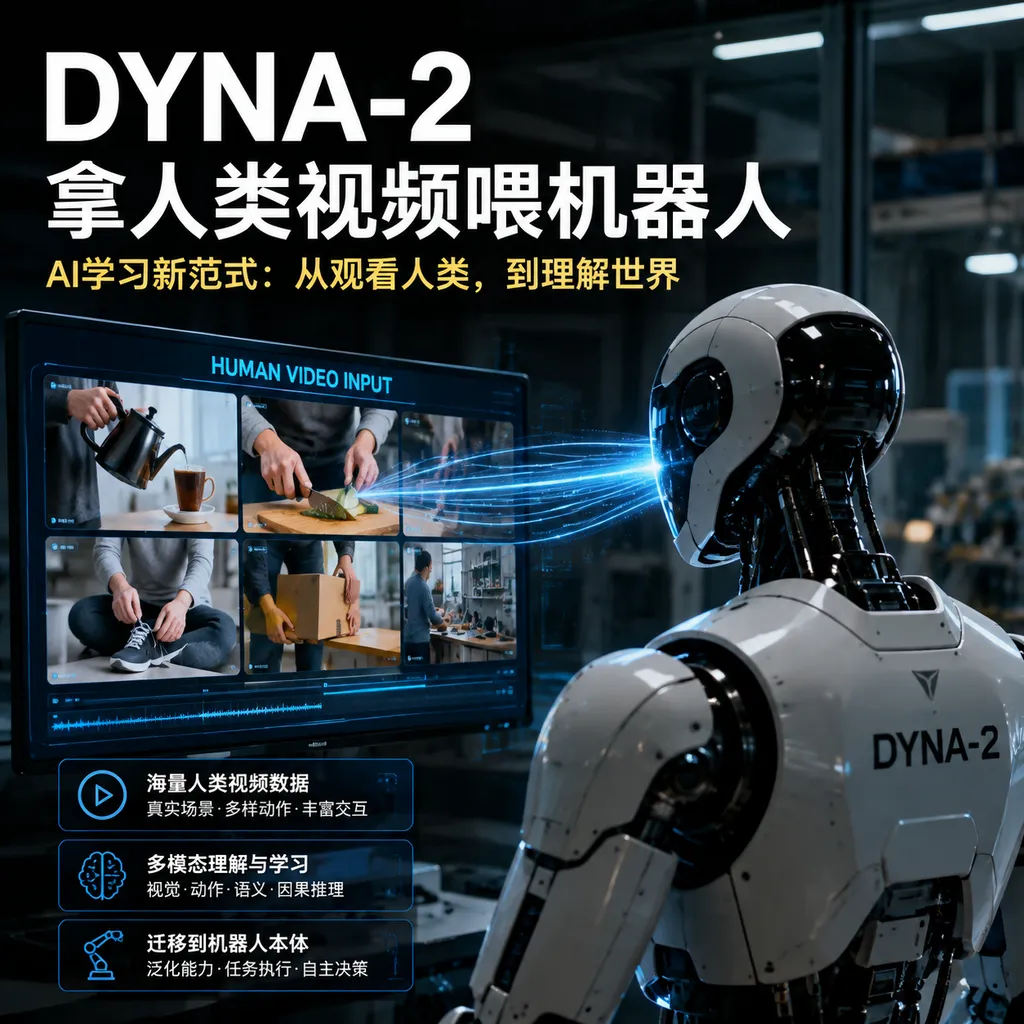
Dyna Robotics has released DYNA-2, a world action model pretrained on over 1 million hours of first-person human video. What truly deserves attention is not its success rate of up to 90%, but the possibility that robot training has found a scalable path that does not rely on massive amounts of teleoperation data.
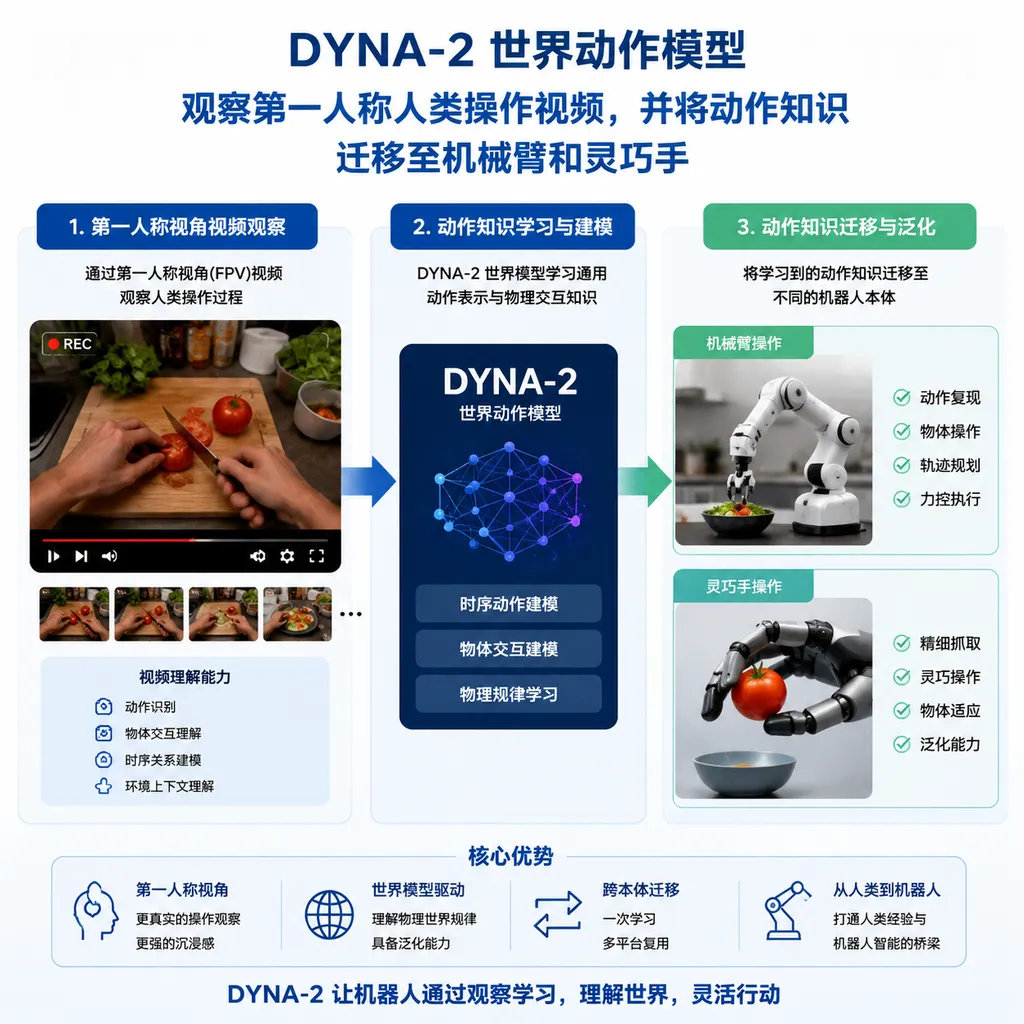
Dyna Robotics released its next-generation robot foundation model, DYNA-2, this week. Rather than relying on expensive robot teleoperation data during pretraining, it directly watched more than 1 million hours of first-person human video to learn how hands move, how objects make contact, and how an action changes the physical world that follows.
Dyna calls it a “World Action Model.” Results published by the company show that, with post-training data held constant, scaling up pretraining on human video can raise the success rate of certain manufacturing tasks from about 20% to 80%–90%. In one customer deployment, DYNA-2 achieved an 87% quality pass rate, compared with 46% for the previous-generation DYNA-1.
But do not rush to interpret “90%” as proof that general-purpose robotics has been solved. That figure comes from specific tasks and test conditions, and is far from a guarantee that robots can enter arbitrary homes and work reliably. What truly matters about DYNA-2 is its attempt to answer a more fundamental question for the embodied intelligence industry: Can robot capabilities continue to improve by scaling general-purpose data, much like large language models?
Bypassing the Most Expensive Step in Robotics
One key reason large language models can scale rapidly is that text data is abundant and easy to replicate. Robotics is different.
To teach a robotic arm to unscrew a bottle cap, fold clothes, or organize tableware, the industry commonly has operators repeatedly teleoperate the robot using controllers, motion-capture equipment, or master-slave robotic arms. Each data sample includes not only images but also synchronized records of joint angles, end-effector poses, gripper states, and control commands.
This data is high-quality, but its production resembles a manual workshop:
- Each robot typically requires corresponding hardware and an operator;
- Data collection is constrained by real-world time and cannot scale in parallel like web crawling;
- Hardware failures, collisions, and environment resets all increase costs;
- When the robotic arm, gripper, or camera layout changes, old data may not be directly reusable;
- There are many long-tail tasks, making it impractical to collect sufficient data separately for every task.
This is the data bottleneck that robot foundation models have long faced. The internet contains enormous amounts of video showing “how humans do things,” but it lacks action labels precisely aligned with specific robot control interfaces.
DYNA-2’s approach is to separate the two: it watches humans during pretraining, then adapts to deployment using a small amount of robot data.
Its pretraining dataset contains more than 1 million hours of primarily first-person manipulation videos covering activities such as cooking, organizing items, folding clothes, and assembling objects. According to Dyna, this is equivalent to roughly 170 years of waking human experience. The first-person perspective is particularly important because it is closer to a robot’s viewpoint than movies or surveillance footage: the hands appear in the foreground, while occlusion, contact, and object movement are captured more completely.
This does not mean the training process requires no data engineering. Raw video still needs to be cleaned, filtered, validated, and processed to extract hand movements. Some data is also used to generate 3D hand-motion information, which is then converted into pseudo-action supervision for training. Compared with precisely recording the movement of every joint on every robot, the advantage of this approach is not that the data is “free,” but that it can scale more easily across tasks, scenarios, and hardware platforms.
Not Just Recognizing a Scene, but Predicting How the World Will Move Next
Conventional vision-language models are good at answering “what is in the image” and can also infer broadly what should be done from an instruction. But for a robot executing a task, recognizing objects is only the starting point.
It must also know:
- From which direction the hand should approach a bottle cap to avoid knocking over the bottle;
- How flexible packaging will deform after the gripper applies force;
- What structural constraints govern the trajectory of a drawer as it is pulled open;
- Where the other end of a piece of fabric will move after one corner is pinched;
- Whether two objects will slide, rotate, or become stuck after making contact.
These capabilities are difficult to learn from static image-text pairs alone. A vision-language model may tell a robot, “This is a bottle cap,” without truly understanding the contact relationships and continuous motion involved in twisting it.
DYNA-2 uses two complementary training objectives: predicting the next video frame and predicting the action that should be taken next.
The former forces the model to learn how the world evolves. The latter requires it to connect visual changes with actions. One way to understand this is that, before acting, the model rapidly “imagines” the next second internally: If the hand turns left, will the cap loosen? If it presses downward, will the object slide away?
This type of architecture adds a layer of physical prediction beyond a simple instruction-to-action mapping. Dyna argues that it can provide the spatial reasoning and contact-physics capabilities that conventional vision-language models tend to lack, while transferring intuition learned from human actions to fixed robotic arms, dexterous hands, and even other robot embodiments.
However, a “world model” does not mean the model has mastered the complete laws of physics. Video prediction can learn a vast number of statistical patterns, but when it encounters materials, lighting, tools, or fine-grained force conditions outside its training distribution, it may still make judgments that appear plausible but are actually wrong. For a robot, such an error does not merely produce incorrect text—it can directly lead to dropped objects, collisions, and equipment damage.
What Does Learning to Unscrew a Bottle Cap in 13 Minutes Tell Us?
In one experiment published by Dyna, two five-fingered robotic hands learned to unscrew bottle caps using only 13 minutes of robot-specific data.
This result can easily be misinterpreted as “the robot acquired dexterous manipulation skills after only 13 minutes of training.” More precisely, the model had already undergone large-scale pretraining on 1 million hours of human video. The 13 minutes of data merely aligned its existing action knowledge with the specific hardware.
This resembles the relationship between pretraining and fine-tuning in large models. The fact that a language model can adapt to an industry using only a small number of samples does not negate the general-purpose pretraining data consumed beforehand. Similarly, DYNA-2’s value does not lie in completely eliminating the need for specialized robot data, but in attempting to reduce that data from the primary training fuel to a form of “interface calibration.”
If this approach works, robotics companies will not need to spend weeks collecting data from scratch every time they deploy new hardware. Human video can teach the model “how things are usually done,” while a small amount of embodiment-specific data tells it “how this particular machine’s hand can actually move.”
This is also the core of cross-embodiment transfer. Human hands, five-fingered dexterous hands, and two-fingered grippers have different structures, but they interact with the same physical world. Bottle caps still need to be rotated, fabric still folds, and objects are still subject to friction and gravity. The model must preserve hardware-independent action knowledge and then translate it into the current robot’s control space.
More Important Than 90% Is That “the Curve Is Still Rising”
Dyna trained models of different scales using between 1,000 and 1 million hours of human video and evaluated their predictive capabilities on held-out data. According to the company, multiple continuous error metrics and discrete accuracy metrics consistently improved as the amount of data increased, with no clear plateau.
Across 15 robot benchmark tasks, real-world task performance also improved as more human-video pretraining data was added. Dyna calls this phenomenon a “human-to-robot scaling law”: as the volume of human video increases, robot performance can improve in a relatively smooth and predictable manner.
This has greater industry significance than achieving 90% on a single task.
If DYNA-2 merely uses engineering and parameter tuning to raise the success rate on a fixed production line, it remains only a better specialized system. It can become a foundational approach analogous to data scaling for language models only if performance genuinely continues to rise consistently across tasks and embodiments as the volume of human video grows.
At this stage, however, it should still be viewed as an early pattern supported by the company’s own experiments, not as a law broadly validated across the industry. At least several questions remain to be answered:
- Will performance continue to scale without plateauing on more complex tasks? Grasping and rotating objects are not equivalent in difficulty to long-horizon assembly or mobile manipulation.
- Can video quality keep pace with quantity? First-person video is abundant, but camera occlusion, motion blur, and repetitive task distributions can dilute the useful information.
- Will offline metrics and real-world control improve in tandem? More accurate next-frame prediction does not necessarily translate into more stable closed-loop control.
- Where are the limits of cross-embodiment transfer? Whether experience from human hands can transfer effectively to wheeled robots, bipedal humanoids, or specialized industrial grippers still requires broader validation.
- How will safety-critical failures be handled? In real-world environments, robots cannot optimize solely for average success rates; they must also control low-probability, high-cost errors.
Customer Deployment Data Is More Valuable Than Demo Videos
Dyna disclosed that DYNA-2 achieved an 87% quality pass rate in one customer deployment, compared with 46% for DYNA-1. On tasks requiring different actions to be selected based on user instructions, video co-training improved the score by 133%. The previous-generation system has already been deployed in real-world environments including hotels, restaurants, and laundry facilities.
At the very least, these figures indicate that Dyna is doing more than showcasing curated clips of successful laboratory trials. Real-world deployments must contend with changes in object placement, fluctuations in lighting, human interference, and mechanical errors caused by continuous operation—all of which are far more demanding than a one-off demonstration on a fixed tabletop.
However, an 87% pass rate has entirely different implications for different businesses.
In a tableware-sorting scenario where human backup is available and failures can be retried at low cost, 87% may already generate economic value. In precision assembly, food safety, or close-proximity human-robot collaboration, a 13% failure rate remains far too high. DYNA-2 therefore cannot be evaluated solely by a single overall success rate. It is also necessary to examine whether failures can be detected and recovered from, as well as the cost of human intervention.
For developers and robotics teams, the metrics that truly deserve attention include:
- Success rates after several hours of continuous operation, rather than in a single-round test;
- Generalization performance on new objects, scenarios, and instructions;
- How much performance improvement is gained from each additional hour of embodiment-specific data;
- Whether failure detection and automatic retries can form a closed loop;
- Whether inference latency meets real-time control requirements;
- How much of the control stack must be modified when adapting to different hardware.
This Approach Could Rewrite the Economics of Robotics Data
Historically, the data capabilities of embodied intelligence companies have often been directly tied to the number of robots they operate: the more robots they own, the more operators they employ, and the longer the robots run, the deeper their data moat becomes. DYNA-2 proposes another possibility: companies could first use human-activity videos available at a far larger scale to establish general physical priors, then concentrate their limited robot data on last-mile adaptation.
If this approach is ultimately validated, industry competition will change in two ways.
First, the competitive advantage will shift partly from “who has more robots” to “who has higher-quality videos of human manipulation, along with better methods for action extraction and cross-embodiment alignment.” Video-data licensing, privacy protection, task coverage, and annotation pipelines will become new forms of infrastructure.
Second, the cost of iterating on robot hardware may decline. In the past, replacing a robotic arm or end effector often required collecting large amounts of new data. If a pretrained model can retain embodiment-independent physical intuition, new hardware may be integrated using only a small amount of calibration data.
Dyna has said that it plans to extend the same approach to 10 million hours of video. The key question is not whether another zero can be added to the dataset size, but whether the performance curve will continue to rise steadily—and whether those gains can extend from short manipulation sequences to tasks lasting dozens of steps, several minutes, or even longer.
Assessment: The Direction Matters More Than the Scorecard
DYNA-2 is not yet a “GPT moment for robotics.” It has not demonstrated that general-purpose robots have arrived, nor has it eliminated the need for real-world data, closed-loop control, and safety validation. The company’s reported peak success rate of 90% also cannot be compared directly across systems without considering the specific tasks involved.
But it does address the most practical contradiction in embodied intelligence: robot-action data is scarce, while human-behavior video is abundant.
Rather than continuing to expand teleoperation teams, DYNA-2 offers an approach that more closely follows the logic of modern foundation models—first learn general capabilities from massive amounts of inexpensive but imperfectly aligned data, then use a small amount of expensive data for alignment. The idea is not flashy, but it may have a greater impact on the industry than any single demonstration.
Over the next year, the most important thing to watch will not be whether Dyna can produce another impressive video of a robot unscrewing a bottle cap, but three more demanding outcomes: whether scaling from 1 million to 10 million hours continues to deliver consistent gains, whether limited post-training can adapt the model to more robot embodiments, and whether performance improvements at real customer sites can translate into lower human-intervention costs.
If all three hold true, DYNA-2 will represent more than just a new model—it will have identified a genuinely scalable data-production path for the robotics industry.
References
- ITHome: DYNA-2 Robot AI Model Debuts, Trained on More Than 1 Million Hours of Human Video — Summarizes DYNA-2’s training approach, benchmark performance, customer deployment results, and official technical claims.