XiaoAi 2.0 starts working for you
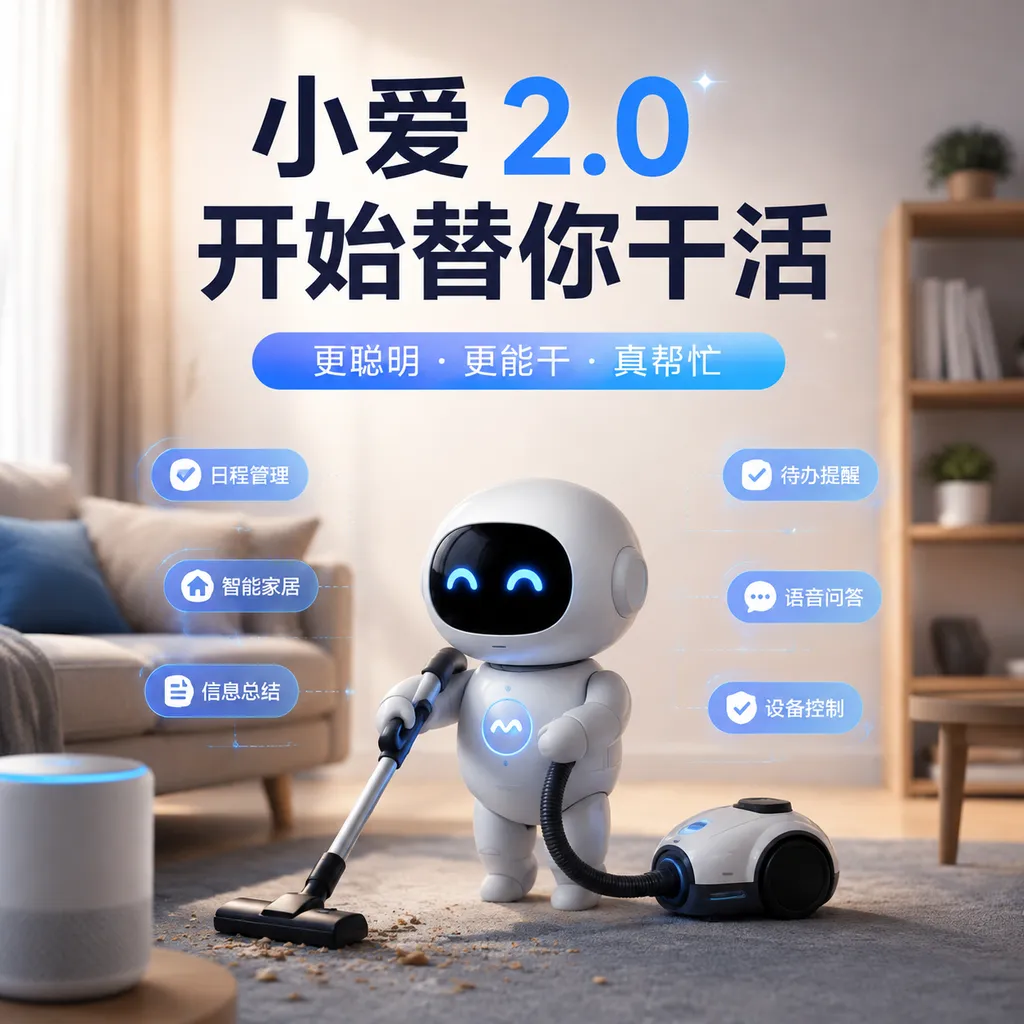
Xiaomi Super XiaoAI 2.0 integrates the MiMo model and gains cross-app, cross-device task orchestration capabilities through its “Expert Mode.” The real highlight is not that it is better at conversation, but that Xiaomi is beginning to turn AI into the operating system’s execution layer.
Xiaomi Super XiaoAI 2.0 Starts Getting Things Done for You
On August 13, Xiaomi launched Super XiaoAI 2.0 alongside HyperOS 4 and introduced “Expert Mode.” The focus of this upgrade is not to give the voice assistant a larger conversational model, but to equip it with task planning, system app invocation, cross-device coordination, and scheduled execution capabilities. Users state their goals, and Super XiaoAI breaks them down into steps and carries them out.
Super XiaoAI 2.0’s core model has been replaced with Xiaomi’s self-developed Xiaomi MiMo. Xiaomi has also retained its dynamic routing mechanism: depending on the task type, model performance, and server load, some requests may be assigned to a more suitable mainstream model. In other words, MiMo provides the primary foundation for Xiaomi’s AI assistant, but “Expert Mode” does not mean that every task is completed exclusively by a single model.
This also marks a clear shift for XiaoAI from a “voice controller” to a “system-level agent.”
From Answering Questions to Breaking Down and Executing Tasks
Traditional voice assistants operate much like a command mapping table: when a user says, “Open the gallery,” the system launches the gallery; when they say, “Set the air conditioner to 26°C,” the system looks for the corresponding device and control interface. This may save a few taps, but it cannot truly handle tasks whose goals are ambiguous or whose steps are not fixed.
Super XiaoAI 2.0’s “Expert Mode” is intended to change that.
Take Xiaomi’s example of finding a photo of an ID card. Previously, users had to open the gallery, enter search, type in keywords, and then locate the right image among the results. Now, they only need to say, “Find the photo of my ID card on my phone.” Super XiaoAI can then understand the goal, select the gallery’s capabilities, perform the search, and return the result.
On the surface, this merely compresses three or four taps into a single sentence. Technically, however, it spans several layers of capability:
- Intent understanding: Determining that the user wants to find a file rather than ask for information about ID cards.
- Task planning: Deciding to invoke gallery search rather than a browser or notes app.
- Tool invocation: Converting natural language into parameters that a system app can execute.
- Result validation: Determining whether the search result matches and returning it to the user.
- Permission control: Confirming what the assistant is allowed to access when photos, files, and personal information are involved.
What truly matters about Expert Mode, therefore, is not how elegantly MiMo can phrase an answer, but whether the model can reliably translate intent into a sequence of executable actions. If a chatbot occasionally gives a wrong answer, the user can simply ask again. If an agent selects the wrong photo, alters a calendar event by mistake, or incorrectly controls a home appliance, the consequences are clearly more serious.
Initial Capabilities Cover System Apps—and Are Expanding Beyond the Phone
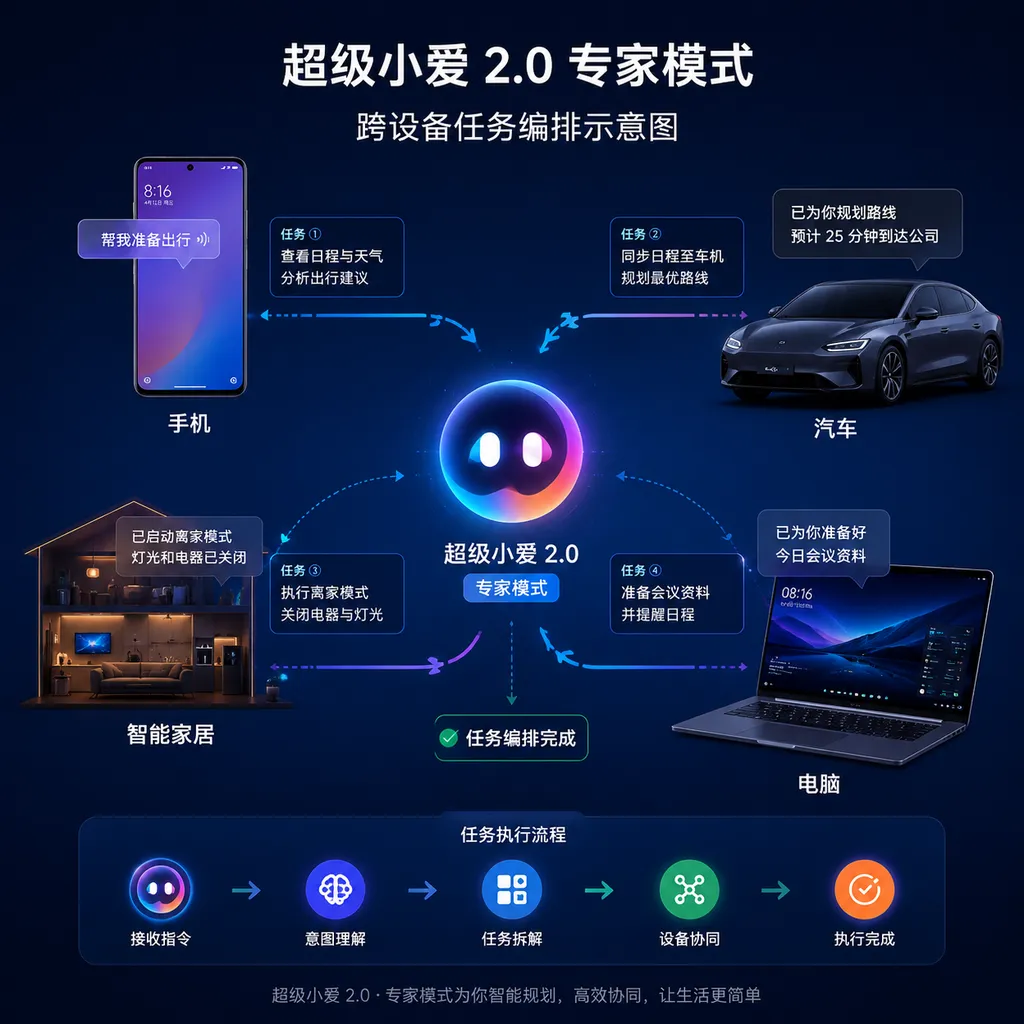
Expert Mode currently integrates with system apps including Calendar, Gallery, Notes, and Recorder, while also supporting Xiaomi ecosystem devices such as cars and smart home products. With a single natural-language instruction, users can prepare their vehicle, adjust home settings, or create calendar events without opening each app and device page individually.
It also supports scheduled tasks. Users can describe a recurring need once and have the system continue executing it at fixed times. Compared with traditional automation tools, this approach has a lower barrier to entry: previously, users had to manually configure trigger conditions, actions, and device states; now, the model can convert natural language into an automated workflow.
Typical scenarios may include:
- Turning on the car’s air conditioning before leaving home on each workday;
- Switching the living room’s lighting and air-conditioning modes at a fixed time every evening;
- Compiling a summary of the day’s meetings from recordings and notes;
- Summarizing project schedules in the calendar before a specified date;
- Periodically generating weekly reports or to-do lists from personal materials.
However, Xiaomi currently lists scheduled tasks in Expert Mode as a paid subscription benefit. In other words, the fact that Expert Mode technically supports this capability does not mean all free users can use it without limits. For those who genuinely want to use it as an automation tool, the subscription threshold will appear sooner than it does for ordinary Q&A.
Cross-device support is another key change. “Xiaomi Interconnect Service” on Windows and macOS will integrate with Expert Mode. As long as the computer is not asleep, users will be able to initiate a search from their phone, find files on the computer, and transfer them to the phone.
This feature may seem less impressive than generating a PowerPoint presentation, but it could prove more practical. Many “all-purpose AI assistants” can only process files uploaded to the cloud. Xiaomi, however, controls the phone operating system, interconnect services, and device communication channels, allowing the model to directly coordinate resources distributed across different endpoints. For operating system vendors, the real moat often lies not in model parameters, but in how many devices, applications, and private data sources the model can access.
PDF and PowerPoint Generation Targets a Closed Loop for Light Office Work
Super XiaoAI 2.0 also integrates with a cloud-based office suite and can generate documents such as PDFs and PowerPoint presentations. In Xiaomi’s example, a user asks it to create a research report. The assistant retrieves information from memory, notes, and other historical content, compiles it into a report, and then turns it into a presentation.
The product logic here is not simply to add a “Generate PowerPoint” button, but to connect personal information retrieval, content organization, and file generation into a complete workflow:
Find personal materials → Extract relevant content → Organize the report structure → Generate the body text → Output the document.
Compared with copying multiple pieces of information into a chatbot, repeatedly adjusting prompts, and then pasting the results into office software, a system-level assistant can indeed eliminate many unnecessary steps. The value is especially direct for relatively standardized tasks such as meeting minutes, weekly project reports, and organizing study materials.
However, “can generate” and “ready to deliver” are still two different things. Research reports require reliable citations, PowerPoint presentations need consistent formatting, and personal notes may contain outdated or contradictory information. If Expert Mode merely packages model-generated content into files, it is only a more convenient document generator. It becomes a genuine productivity tool only when retrieval sources are traceable, results are editable, and errors can be rolled back.
1,000 Free Credits Translate to Roughly 50–80 Ordinary Tasks
Following the launch of Super XiaoAI 2.0, it is divided into two modes: “Fast” and “Expert.”
| Mode | Primary Uses | Credit Consumption | | --- | --- | --- | | Fast Mode | Everyday Q&A, smart home control, cross-device execution, photo editing, etc. | No credits consumed | | Expert Mode | Complex task planning, cross-app orchestration, document generation, etc. | Credits consumed per task |
Each user receives 1,000 free credits per month, which are deducted only in Expert Mode. According to Xiaomi’s internal estimates, ordinary conversational tasks consume approximately 12–20 credits each, equivalent to around 50–80 tasks per month. Light office tasks such as generating PDFs and PowerPoint presentations consume roughly 100–300 credits each, meaning the free allowance can complete approximately 3–10 complex document tasks.
Actual consumption varies with task length and complexity. In essence, this pricing model converts costs that users may find difficult to understand—such as tokens, the number of model calls, tool execution costs, and cloud computing resources—into a unified product credit system.
Xiaomi also offers three paid plans:
- Entry tier: RMB 29/month, or RMB 19/month with recurring billing, including 4,000 credits;
- Standard tier: RMB 59/month, or RMB 39/month with recurring billing, including 10,000 credits;
- Enhanced tier: RMB 149/month, or RMB 99/month with recurring billing, including 34,000 credits.
Paid users also receive benefits including priority queues during peak hours, scheduled tasks in Expert Mode, and HD video generation. Xiaomi has not indicated that the free and paid versions use different models for basic tasks; the main differences are the credit allowance and additional benefits.
The pricing is not particularly aggressive. The 1,000 free monthly credits are enough for ordinary users to determine whether task orchestration is genuinely useful, while the RMB 19 recurring monthly plan lowers the entry point for light users to the range of common internet subscriptions. Xiaomi clearly does not want to lock all AI capabilities behind a subscription wall from the outset. Instead, it is using the free allowance to cultivate usage habits before charging for high-frequency use, automation, and video generation.
Controversy will follow. In the past, users assumed that phone system features were included in the price of the hardware. Now that calendars, photo galleries, and device controls are orchestrated through large models, some system capabilities are beginning to carry monthly fees. Xiaomi will need to demonstrate that users are truly paying for ongoing cloud inference and generation costs, rather than for previously free shortcuts repackaged as subscription features.
Xiaomi’s Advantage Is Not Just MiMo, but Its Access to More “Hands and Feet”
Phone manufacturers are all upgrading their AI assistants into agents. The competition has shifted from “who can respond most like a human” to “who can get more things done.” Xiaomi has a practical advantage in this race: it owns a hardware ecosystem spanning phones, tablets, computer connectivity, televisions, wearables, smart home devices, and cars.
A general-purpose conversational model is like an intelligent brain, but without app interfaces, system permissions, and device protocols, it lacks the hands and feet needed to actually execute tasks. Xiaomi can modify HyperOS directly and register the gallery, calendar, voice recorder, and device controls as tools the model can invoke. This level of integration is difficult to achieve with a standalone third-party AI app.
According to the roadmap announced for HyperOS 4, “One-Step Access” will support 80 commonly used apps and more than 1,000 capabilities by the end of September. If Xiaomi delivers on this figure, Super XiaoAI 2.0’s scope of use will expand significantly. But the number of capabilities is not the only factor determining the user experience: 50 stable, confirmable, and reversible high-frequency workflows are more valuable than 1,000 operations that fail from time to time.
At this stage, Super XiaoAI 2.0 faces three major tests:
- Success rate: If a multi-step task fails halfway through, can it identify the error and continue rather than start over?
- Permission boundaries: When reading ID card photos, personal notes, and computer files, can users clearly understand what data is being accessed and whether it is uploaded to the cloud?
- Controllability: For high-risk operations such as sending messages, modifying calendar events, or controlling a vehicle, does it provide secondary confirmation, execution logs, and an undo mechanism?
Privacy concerns in particular cannot be brushed aside with the phrase “system-level capabilities.” Xiaomi’s demonstration of searching for an ID card photo shows precisely that the agent will come into contact with highly sensitive data. Whether the model receives only the search results, whether original images are uploaded, and what context third-party routing models can access all require more transparent explanations than would be expected from an ordinary chatbot.
This Upgrade Is Useful, but It Is Still Far from “Fully Automated”
From a product-direction perspective, Super XiaoAI 2.0 offers more value than simply adding another chat interface. Rather than focusing solely on copy generation and knowledge-based Q&A, it attempts to take over system operations, personal information, and cross-device workflows. For users with numerous Xiaomi devices, vehicle preparation, smart home coordination, file searches, and calendar management could indeed become high-frequency use cases.
But it is still too early to call it a mature “AI assistant for the entire ecosystem.” Expert Mode has only just entered beta alongside HyperOS 4, and its app coverage, task stability, permission design, and credit consumption all require validation by real users. This is especially true for long cross-app workflows: if just one interface changes or one permission becomes invalid, the entire process may be interrupted.
The greater significance of Xiaomi’s move is that it brings AI commercialization and operating system architecture reform to the forefront at the same time. Fast Mode continues to handle free, low-latency basic interactions, while Expert Mode handles costly inference and complex execution, using credit-based subscriptions to cover cloud costs. This aligns more closely with the cost structure of a system-level agent than simply selling a chatbot subscription.
Ultimately, the success or failure of Super XiaoAI 2.0 will not be determined by MiMo’s score on a particular benchmark, but by whether it can reliably and safely finish the job after the user gives a single instruction.
If it can, XiaoAI will have truly progressed from “I heard you” to “It’s done.”
References
- ITHome: Xiaomi Super XiaoAI 2.0 “Expert Mode” Credit-Based Subscription Plans Go Live — Covers Expert Mode’s task orchestration, cross-device coordination, document generation, credit consumption, and subscription model.