SSI’s First Model Unveiled: Betting on Continual Learning
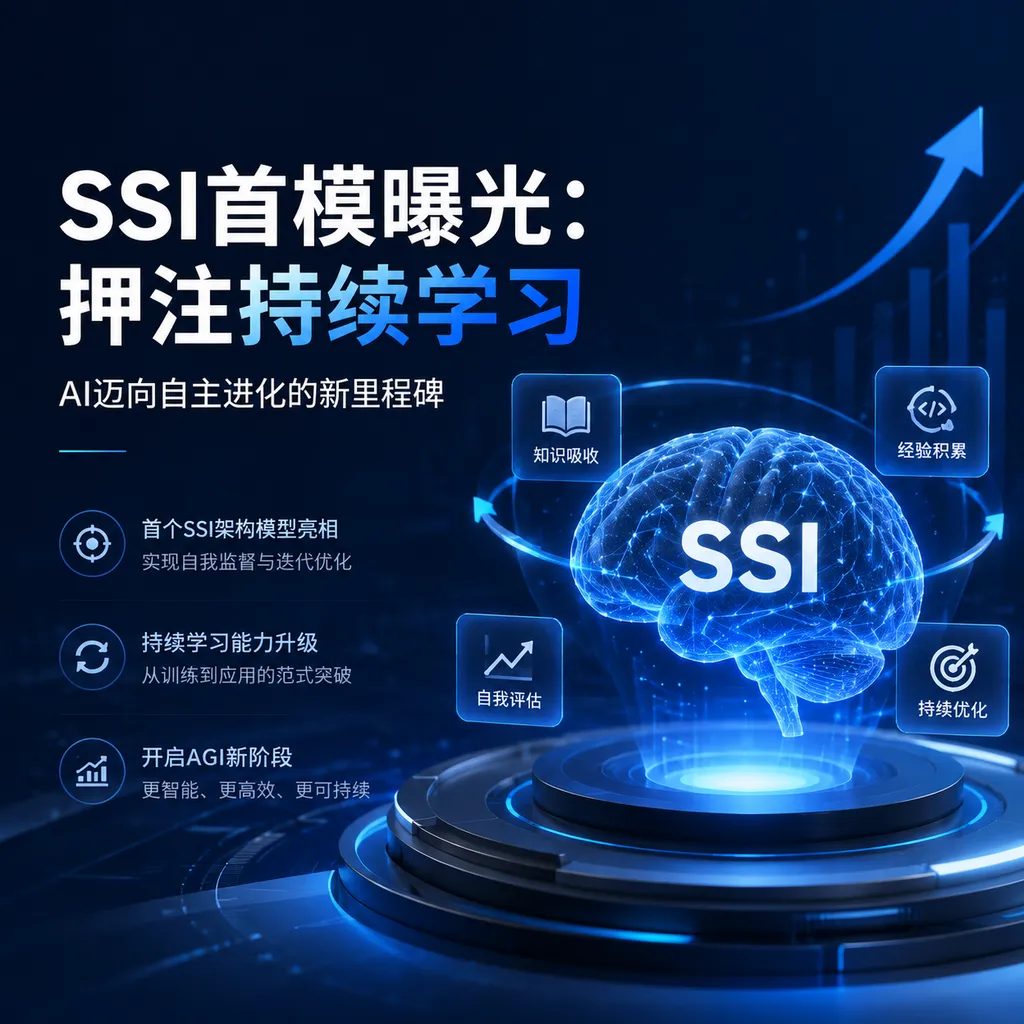
SSI is reportedly set to launch its first model in August. Its core technical approach is not to keep piling on more data, but to enable the model to learn continuously and efficiently after entering real-world environments. This could prove more important than yet another increase in parameter count, though official specifications and verifiable results are still lacking.
SSI’s First Model Emerges: Betting on Continual Learning
Safe Superintelligence’s (SSI) first model is finally beginning to take shape.
As of August 13, multiple sources point to the same development: Ilya Sutskever’s SSI plans to showcase its first model this month. Its most noteworthy technical direction is not adding another digit to the context-window length or setting new records on yet another static benchmark, but rather continual learning and sample-efficient learning.
First, the limits of what is known should be made clear: this does not yet amount to a full official release. SSI has not disclosed the model’s name, parameter count, training data, architecture, pricing, API, model card, or third-party evaluation results. What the public has seen so far consists mainly of timelines and technical clues shared by investors and industry insiders. More precisely, the “reveal of SSI’s first model” means that the company’s first major technical bet is beginning to surface—not that developers can obtain an API key and start using it today.
Even so, this clue is significant enough to warrant attention.
Over the past few years, the basic formula for competing at the frontier has been to feed more data, more GPUs, and more training time into the same furnace. SSI, by contrast, wants to solve a harder problem: after a model completes pretraining, can it continue learning like a human, rather than having to return to the furnace every time it needs to acquire a new capability?
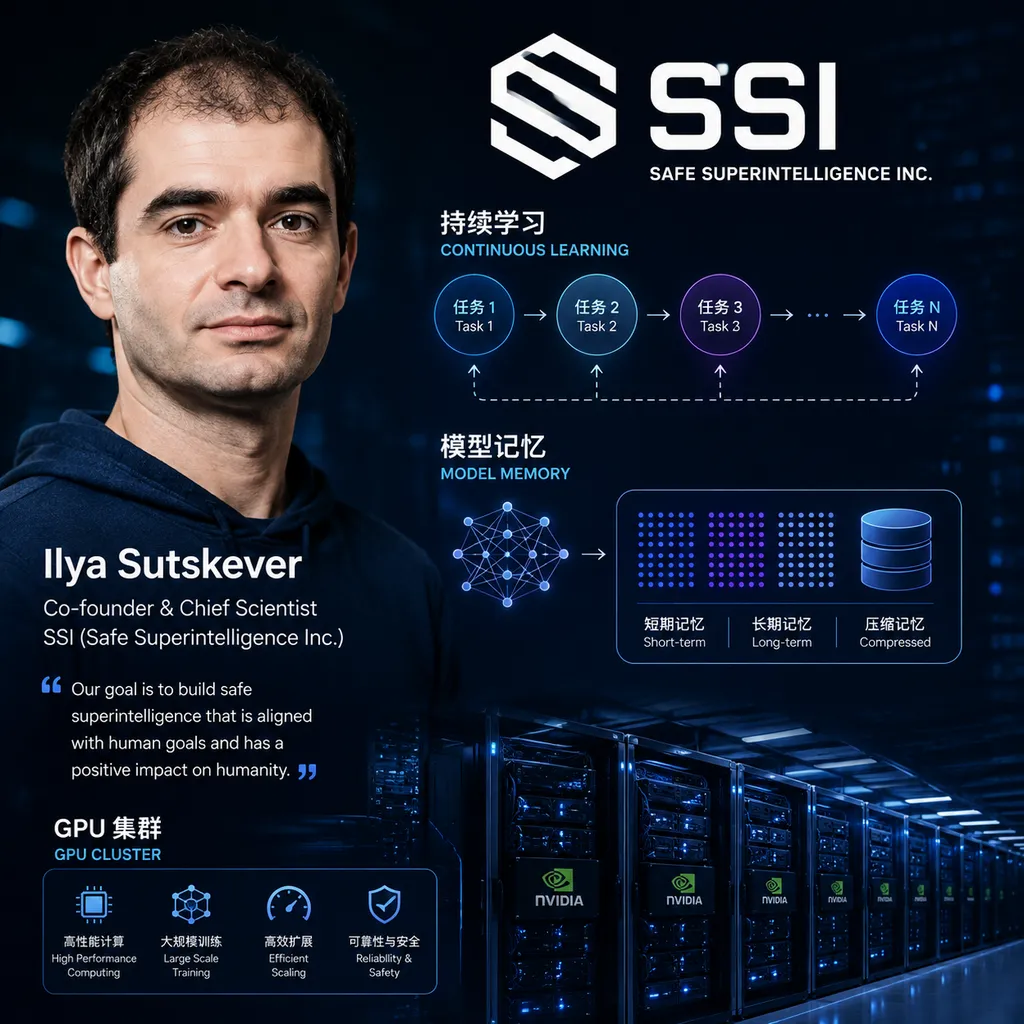
Why SSI’s First Strike Targets Continual Learning
Today’s large models appear highly knowledgeable, but in practice they are more like students who read the entire internet before an exam and are no longer allowed to attend class after handing in their papers.
Models absorb enormous numbers of tokens during pretraining, but once their weights are frozen, the real world keeps changing: codebases are upgraded, corporate policies are revised, new papers are published, and user preferences evolve. Models generally have only a few ways to acquire this new knowledge:
- Use RAG to temporarily insert the latest material into the context;
- Encode some new capabilities through fine-tuning or post-training;
- Wait for the lab to retrain the next generation of foundation models;
- Bypass weight updates through external memory, tools, and agentic workflows.
All of these methods are useful, but strictly speaking, none constitutes full continual learning. RAG is an “open-book lookup”; it does not mean the model has truly learned the material. In-context memory disappears when the session ends. Frequent fine-tuning is expensive and may damage existing capabilities. Retraining from scratch is an even more costly overhaul.
Continual learning aims for a different state: after deployment, a model can continue updating reliably based on new data, feedback, and tasks, while transferring experience to future tasks. Ideally, it would not need to consume tens or even hundreds of trillions of tokens each time, nor would it have to retrain the entire model in response to a localized change.
This aligns closely with a view Ilya has repeatedly emphasized in recent years: the “scaling era,” in which large models achieve predictable gains by increasing parameters, data, and compute, is running into a data wall and diminishing returns. High-quality internet text is not an infinite resource. As training sets grow from trillions to hundreds of trillions of tokens, the share of duplicated, synthetic, and low-quality content in the additional data will only increase.
If the world available for training cannot keep expanding, the only alternative is to extract more value from every observation.
It Is Not as Simple as “Automated Fine-Tuning”
Continual learning is often misunderstood as allowing a model to collect conversations online and periodically run a LoRA fine-tune. The real problem is far more difficult.
The first challenge is catastrophic forgetting. When a neural network learns a new task, parameter updates may overwrite old knowledge. A model might learn a new framework version today, only to forget how to migrate from the old version tomorrow; after learning one company’s coding standards, its general programming ability might actually decline. That is not acceptable continual learning—it is learning and forgetting at the same time.
The second challenge is feedback quality. Signals from real-world environments are extremely noisy. A user may click “like” simply because the answer’s tone was pleasant, not because it was factually correct. An agent may complete a task successfully only because it happened to follow a dangerous path that worked by chance. If a model treats every interaction as a reliable training sample, it will quickly be led astray by incorrect feedback, prompt injection, and malicious data.
The third challenge is the boundary between capability and memory. A model must determine which information should be incorporated into long-term weights, which should remain in user-level memory, and which belongs only in temporary context. Writing one employee’s operational habits into the global model could both contaminate its capabilities and cause severe data leakage.
A genuinely usable continual-learning system must address at least the following issues:
- Balancing stability and plasticity: Learning new knowledge without damaging existing capabilities;
- Experience selection: Identifying high-value, low-risk training signals from large volumes of interactions;
- Memory hierarchy: Distinguishing among contextual memory, external databases, user memory, and model weights;
- Learning schedule: Deciding whether to update in real time, in batches, or only after offline validation;
- Safe rollback: Identifying and reversing updates that cause capability degradation or behavioral drift;
- Continuous evaluation: Monitoring changes after every learning cycle rather than running benchmarks only once before release.
Therefore, if SSI truly intends to deliver a “continually learning model,” the key question is not whether it can remember conversations. It is whether SSI can demonstrate that the model acquires stable new capabilities from fewer samples—without forgetting, leaking data, overfitting, or allowing attackers to covertly rewrite it through interactions.
That is far harder to evaluate than a single run on a mathematics benchmark.
Sample Efficiency May Be the More Disruptive Element
Another keyword appearing alongside continual learning is sample-efficient learning.
A human programmer can often master a new version of a framework after reading a few pages of migration documentation and fixing two or three errors. A large model, by contrast, may require thousands or tens of thousands of synthetic trajectories and multiple rounds of reinforcement learning to acquire a similar capability reliably. The difference is not merely the amount of knowledge involved, but the efficiency with which rules are abstracted from limited experience.
In discussing SSI, investor Gavin Baker offered a notable comparison: early models were trained on roughly 20 billion tokens, while frontier training runs today may reach 300 trillion tokens. If future models could complete foundation pretraining with only around 10 trillion tokens and then enter real-world environments to learn autonomously and efficiently, the way foundation models are produced would be rewritten.
That does not mean compute demand would immediately collapse.
Continual learning itself still requires inference, data filtering, reinforcement learning, simulated environments, validation, and periodic updates. Rising model usage could also consume the efficiency gains through the Jevons paradox: when each learning cycle becomes cheaper, companies may deploy more models and generate more training trajectories. A more realistic shift is that compute would gradually move away from a small number of massive pretraining runs toward continuously occurring inference and post-training workloads.
At the end of July, SSI announced a long-term partnership with NVIDIA under which it will use Vera Rubin systems to increase its computing capacity by an order of magnitude. This also shows that SSI is not telling a “no more GPUs” story. Rather, it appears to be trying to change how GPUs are used: less blind repetition of pretraining and more learning and validation grounded in real-world tasks.
For Developers, the Value Is Not in Topping the Leaderboard
If SSI’s approach works, the earliest beneficiaries may not be chatbots, but long-running agents.
For example, after connecting to an enterprise repository, a coding agent would not merely retrieve the README each time; it could gradually learn the internal module boundaries, testing conventions, and failure modes. A customer-service agent could update its policies from reviewed case records without requiring a new fine-tuning dataset every week. A scientific research agent could retain lessons from failed experiments across successive trials, avoiding the need to start from scratch with every task.
Today’s agents are more like “amnesiac contractors with tool-calling capabilities”: they perform well within the current context, but the business must be explained all over again in the next session. If continual learning works, agents could finally evolve from one-off tools into long-term systems that accumulate experience.
However, this would also introduce a new set of challenges for the engineering stack:
- Model versions would no longer be represented by a fixed hash and could continually fork;
- Models with the same name could gradually develop different capabilities across tenants;
- Regression testing would need to cover states before and after learning, not merely before and after model upgrades;
- Audit systems would need to record what the model learned and from which data;
- Enterprises would need to specify which feedback may be used across users and which must remain permanently isolated.
For API developers, this could even change the contract of “model as a service.” Today, when calling a closed-source model, users generally assume that a given version will remain broadly stable. A continual-learning model, by contrast, may be inherently stateful. Reproducing an output, pinning a capability snapshot, and migrating learning histories would all become new API design challenges.
What SSI Really Needs to Prove Is Its “Learning Algorithm,” Not Its Scale
Ilya’s track record gives the market reason to extend extraordinary patience to SSI. As a contributor to foundational work including AlexNet and the GPT series, he was both one of the architects of the scaling path and one of the first prominent figures to publicly argue that it would eventually hit a bottleneck.
SSI has indeed received treatment entirely unlike that of an ordinary startup. Despite having no product or revenue for an extended period, the company has already reached a valuation of approximately $32 billion. At its founding, it publicly stated that it would build no other products before achieving safe superintelligence and would not allow conventional product cycles to dictate its research direction.
The question now is whether its first model represents a revision to that commitment.
If the model unveiled in August is merely a conventional chatbot wrapped in long-term memory, RAG, and automated fine-tuning, it will struggle to justify the capital and expectations SSI has attracted. OpenAI, Anthropic, Google, and numerous agent startups are already developing similar capabilities.
SSI must produce more concrete results, such as:
- Mastering a category of tasks with significantly fewer new samples;
- Learning multiple tasks sequentially without a meaningful decline in performance on earlier tasks;
- Transferring learned capabilities across environments rather than memorizing fixed answers;
- Maintaining a stable learning process when exposed to incorrect feedback and malicious input;
- Requiring substantially less compute per unit of new capability than retraining or conventional post-training.
In other words, the core metric for evaluating SSI’s first model should not simply be whether it scores a few points higher than GPT or Claude. It should be whether the model can improve after deployment, and how much data and compute that improvement costs.
Assessment: The Direction Is Right, but It Is Too Early to Call It a “New Paradigm”
Continual learning is indeed one of the most important problems facing large models today. It simultaneously addresses four pain points: data exhaustion, agent amnesia, the high cost of enterprise customization, and inadequate model generalization. Compared with building yet another larger static model, this path is closer to the capabilities that next-generation AI systems genuinely need.
But it is also a problem the research community has discussed for many years. Catastrophic forgetting, data poisoning, bias in online feedback, and safety auditing cannot be solved merely by expanding the context window. SSI’s mystique and Ilya’s reputation can help the company secure funding and compute, but they cannot substitute for reproducible experiments.
The most appropriate response to this “reveal,” then, is neither to crown SSI prematurely nor to ignore it simply because there is no API yet.
SSI’s first strike is now clearly aimed at continual learning. This could unsettle the one-dimensional “more tokens plus more GPUs” path that has dominated the past few years, or it could ultimately demonstrate that continual learning still depends on complex external memory and post-training pipelines. The answer will remain uncertain until SSI publishes a model card, evaluation methodology, practical demonstrations, and a means of developer access.
At least as of August 13, what has truly been revealed is not yet a usable model, but Ilya’s view of the next stage of AI competition: models should not merely be trained on more—they should learn faster and continue learning after entering the world.
References
Due to restrictions on the range of permitted link domains, the following section retains directly accessible public discussions and model search portals. Facts from SSI’s official announcements and media reports have been distinguished in the article from information provided by external sources.
- Reddit: Discussions related to Safe Superintelligence and continual learning — A collection of public community discussions about SSI’s first model, its continual-learning strategy, and its potential industry impact.
- Hugging Face: Search for models related to Safe Superintelligence — Used to verify whether SSI has released model weights, a model card, or community reproduction projects; as of publication, no official first model is available for download.