Claude Cracks the Order-2000 Hadamard Matrix

Claude is reported to have filled the known gaps for Hadamard matrices of orders below 2,000. Compared with solving a single competition problem, this kind of verifiable new construction is closer to genuine mathematical research, but the data must still be made public and independently verified.
Claude Pushed a Mathematical Open-Problem Checklist to Order 2000
As of August 13, Claude’s latest advance in mathematical research is not another competition gold medal, but a reported completion of the remaining gaps in Hadamard matrix constructions below order 2000.
Simply put, among the orders satisfying the necessary conditions, there were still some for which no corresponding matrix had been found. Search and reasoning work involving Claude produced new candidate constructions, temporarily leaving no blanks in the table below order 2000.
This deserves more attention than “a model solved a very difficult problem.”
Competition problems usually have standard answers and often appear in training data or adjacent bodies of knowledge. Constructing Hadamard matrices is more like a genuine research task: the answer is not an elegant passage of text, but a mathematical object potentially containing millions of elements and open to entry-by-entry verification. The model must not only propose an approach, but actually construct the object and subject it to exact computational verification.
However, “clearing everything below order 2000” is a claim that headlines can easily exaggerate. It does not mean the Hadamard conjecture has been solved, much less that Claude has proved the existence of a Hadamard matrix for every order divisible by 4. More precisely, this is a construction record within a finite range: if the relevant matrices, generation methods, and verification results are all made public and independently reviewed, then the known gaps below 2000 have been filled. The general problem over an infinite range remains open.
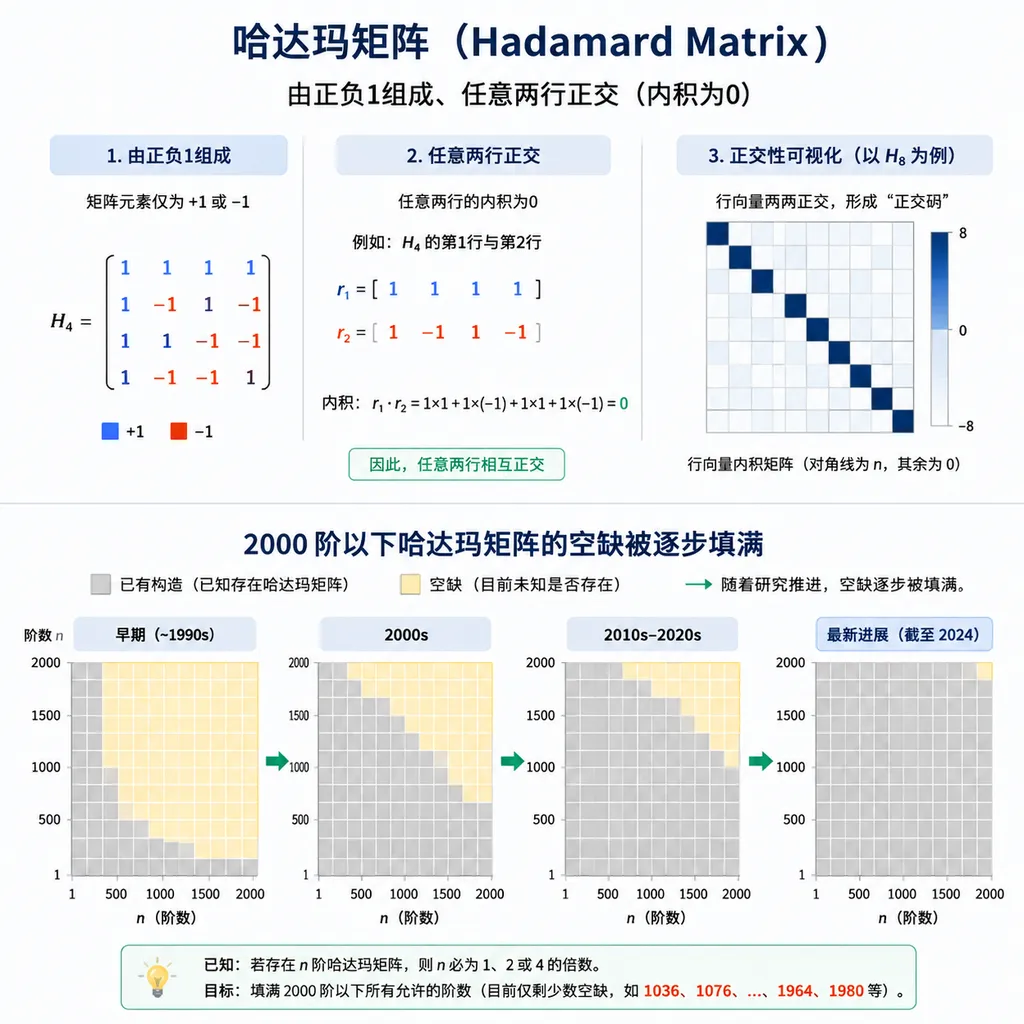
What Exactly Did It Clear?
A Hadamard matrix of order $n$ is a square matrix $H$ whose entries can only be $+1$ or $-1$, satisfying:
$$H H^T = nI_n$$
This means that the inner product of any two distinct rows is 0, while the inner product of each row with itself is $n$. In plain language, every row in the matrix behaves like one of a set of binary signals that do not interfere with one another at all.
Apart from orders 1 and 2, the order of a Hadamard matrix must be divisible by 4. The famous Hadamard conjecture goes further, stating that a Hadamard matrix exists for every positive integer order divisible by 4.
The problem is that a “necessary condition” is not the same as “we already know how to construct one.” Mathematicians have developed a large toolbox of constructions, including the Paley construction, Kronecker products, Williamson-type constructions, and various methods derived from difference sets, symmetric designs, and complementary designs. But these tools do not cover every order the way a single universal formula would.
Accordingly, what researchers have maintained over the years is not simply an “exists or does not exist” table, but something more like an engineering compatibility list:
- Some orders are covered directly by classical theorems;
- Some can be scaled up from lower-order matrices through tensor products;
- Some require special circulant, block-structured, or difference-set constructions;
- For a small number of orders, the necessary conditions are satisfied, yet no verifiable instance has been found.
Claude’s purported “clearance” targets precisely this last category of gaps. It did not recompute every number from 1 to 2000. Instead, it focused on the difficult orders not directly covered by classical methods and still missing from databases, then combined the new results with constructions already known to humans.
This also explains why “order 2000” should not be interpreted simply as the model outputting an exceptionally large table. The real difficulty is usually not writing down four million $+1$s and $-1$s, but finding a sufficiently compact structure so that the matrix can be generated, verified, and shown not to be a hallucination caused by floating-point error.
Searching Is Hard; Verifying the Answer Is Relatively Easy
Hadamard matrices are well suited to evaluating AI’s mathematical capabilities because they have a property researchers greatly appreciate: they are hard to find but straightforward to verify.
Given a candidate matrix, the checks are not mysterious:
- Confirm that the matrix has dimensions $n\times n$;
- Confirm that every entry is strictly in ${-1,+1}$;
- Compute the inner product of every pair of rows;
- Check that the diagonal entries are $n$ and all off-diagonal entries are 0.
Direct matrix multiplication is not cheap, but it is deterministic. With optimizations such as bit packing, XOR operations, and population counts, the orthogonality of binary row vectors can be verified quite efficiently. Unlike natural-language proofs, there is no room here for something that “reads smoothly” while quietly skipping three steps in the middle.
The search process is another matter.
If every entry is treated as an independent positive-or-negative choice, an $n$th-order matrix has $2^{n^2}$ possibilities. Even after exploiting symmetries such as row and column negation and permutation to merge large numbers of equivalent cases, the search space remains enormous. At order 2000, brute-force enumeration is meaningless in practice.
The viable approach is usually to search for structure first, rather than searching directly for a matrix. For example, one might express a large matrix as a collection of circulant blocks and require the sequences corresponding to those blocks to satisfy particular correlation conditions. Alternatively, the problem can be transformed into a difference-set, graph, Boolean-constraint, or integer-constraint problem and handed to a SAT solver, constraint-programming system, or custom search program.
This is precisely where a large language model may be useful. It may not outperform a specialized solver at low-level enumeration, but it can perform three tasks at a higher level:
- Transfer conditions across a large body of construction literature and look for combinations that have not previously been tried;
- Modify the parameterization in response to failed results rather than continuing to search blindly within a fixed space;
- Write and debug search programs, linking conjectures, experiments, counterexamples, and renewed searches into a closed loop.
From this perspective, Claude is more like a research agent responsible for devising search strategies, invoking tools, and organizing evidence than a mathematical oracle that produces an answer in a single flash of “mental inspiration.”
The Real Dividing Line Is Not Reasoning Length, but a Closed Loop
Over the past two years, model vendors have grown accustomed to using mathematics competition scores as evidence of reasoning ability. The problem is that competition benchmarks increasingly resemble training and evaluation engineering: whether the problems leaked, how many samples were used, whether external tools were allowed, and whether answers were filtered can all significantly affect the final score.
Hadamard matrix construction offers a harder form of evaluation.
First, the result is a new mathematical object, not merely an accuracy score on multiple-choice questions. Second, third parties can check the object using independent code. Third, failure is also informative—if no solution can be found within a particular structure, that can at least help researchers revise their assumptions and narrow the search space.
The most important aspect of this advance, therefore, is not how much Claude’s “mathematical IQ” has increased, but that AI is beginning to form a closed research loop:
Read existing results → propose a structural hypothesis → write a search program → inspect failure cases → revise the construction → output a verifiable object.
This process is closer to real mathematical research and more useful than merely lengthening the chain of thought. A model that writes 100,000 words of reasoning without providing checkable evidence may have less research value than a system that writes only two pages of explanation but also delivers the matrix, generator, and verification script.
Claude has also recently drawn attention for attempting the Riemann hypothesis and reportedly improving a related lower bound on the proportion of zeros in the course of failing to solve it. The common thread between the two cases is not that the model has suddenly “solved mathematics,” but that models are beginning to be deployed on open problems and to produce partial results even when the primary objective remains unmet.
The difficulty of verification, however, differs between the two. A new proof in analytic number theory requires line-by-line expert review and may even need assistance from a formal proof system. An explicit Hadamard matrix construction is closer to an executable certificate. The latter is better suited to establishing credibility quickly and to enabling fair comparisons among different models and agent frameworks.
Do Not Rush to Turn “Construction Succeeded” Into “Conjecture Solved”
For reports of this kind, at least three levels must be distinguished.
Level One: A Candidate Matrix Has Been Found
The search system has produced a result, but software bugs, truncated data, indexing errors, or numerical-computation errors have not yet been ruled out. The “success” described in a press release usually occurs first at this level.
Level Two: The Candidate Matrix Passes Independent Exact Verification
Starting from the raw matrix or deterministic generation parameters, verifiers must use integer arithmetic to check that $HH^T=nI$. Ideally, different teams should cross-check it using different languages and independent implementations, rather than merely rerunning the authors’ own scripts.
Level Three: The Result Is Incorporated Into the Public Mathematical Record
This requires publication of the specific orders, construction methods, data files, verification hashes, validators, and necessary theoretical explanations. If only screenshots or verbal conclusions are shown, outsiders cannot determine which gaps were actually filled or confirm that the work does not duplicate an existing result that was never indexed.
Our assessment of this advance is therefore: the direction is important, and the result is likely valuable, but “clearing the open-problem list” must rest on downloadable, reproducible, and independently checkable materials.
The advantage of matrix constructions is precisely that they are easy to verify. If all that ultimately remains is a screenshot of a conversation with the model, that would introduce ambiguity in exactly the place where there should be none.
A proper public release should include at least:
- Every newly covered order and its historical status;
- Explicit data for each matrix or a deterministic generation algorithm;
- File hashes and a standardized data format;
- Verification software that does not rely on floating-point arithmetic;
- The constraints, random seeds, and computational resources used in the search;
- An explanation of how the results were deduplicated against the existing literature and databases;
- Review conclusions from human researchers or independent teams.
Only after these steps have been completed will the work move from an exciting AI demonstration to a result that the mathematical community can cite over the long term.
For Developers, It Is More Like an Agent-Engineering Record
Developers do not need to understand every type of combinatorial design to recognize the product trend revealed by this event: competition among frontier models is shifting from “answering questions” to “managing the research process.”
A system capable of completing this kind of task typically needs more than a foundation model. It also requires long-running task orchestration, context compression, code execution, failure recovery, result deduplication, and validator isolation. The model may propose hundreds of incorrect directions in succession. What truly matters is whether the system can preserve useful intermediate artifacts instead of starting over after every failure.
This closely resembles complex development work in production environments. Fixing a cross-repository bug, migrating a large database, optimizing a compiler, or finding a protocol vulnerability is not a single-turn question-and-answer task. After dozens or even hundreds of tool calls, the model must still know which hypotheses have been falsified, which experiments are worth reusing, and whether the final evidence is sufficient for delivery.
Hadamard matrices are therefore also a good agent benchmark: the task is open-ended, but the result can be machine-verified; the search may take a long time, but correctness need not be entrusted entirely to subjective scoring. Compared with asking a model to automatically generate a PDF that “looks like a research report,” this kind of benchmark is harder to game and closer to real-world value.
Mathematicians Will Not Bet on Just One Model
The saying “good mathematicians are not picky about AI models” is especially apt here.
What researchers truly need is not brand loyalty to a particular chat product, but the ability to place different systems in suitable roles: one model reads the literature and proposes constructions, another reviews the code, specialized solvers execute the search, Lean, Coq, or other formal tools check the proof, and humans finally determine whether the result is novel.
The future of mathematical AI is likely not a single model working alone, but a hybrid pipeline. Large language models will leap through conceptual space, conventional programs will perform exact calculations, formal systems will enforce the baseline of correctness, and humans will decide which questions are worth computing and which results are worth publishing.
If Claude’s completion of the Hadamard matrix constructions below order 2000 passes public review, it will certainly be an impressive record. But its greater significance lies in demonstrating a more mature form of collaboration than “AI solving problems”: let the model propose, let humans question, let machines verify, and then return the result to the community.
This will not immediately clear mathematics’ list of open problems. On the contrary, it may first bring a large number of problems that were previously shelved because search costs were too high back onto researchers’ desks.
And when answers can be verified exactly, AI’s most valuable capability is not persuasion, but producing the evidence.
References
- Zhihu: Discussion of Claude’s new mathematical record — Used to provide background on Claude’s recent involvement in open mathematical problems and the controversy surrounding their verification. This source discusses developments related to the Riemann hypothesis, not the original proof of the Hadamard matrix constructions themselves.