Apple Retrains AI for China, With Alibaba Providing More Than Just Models
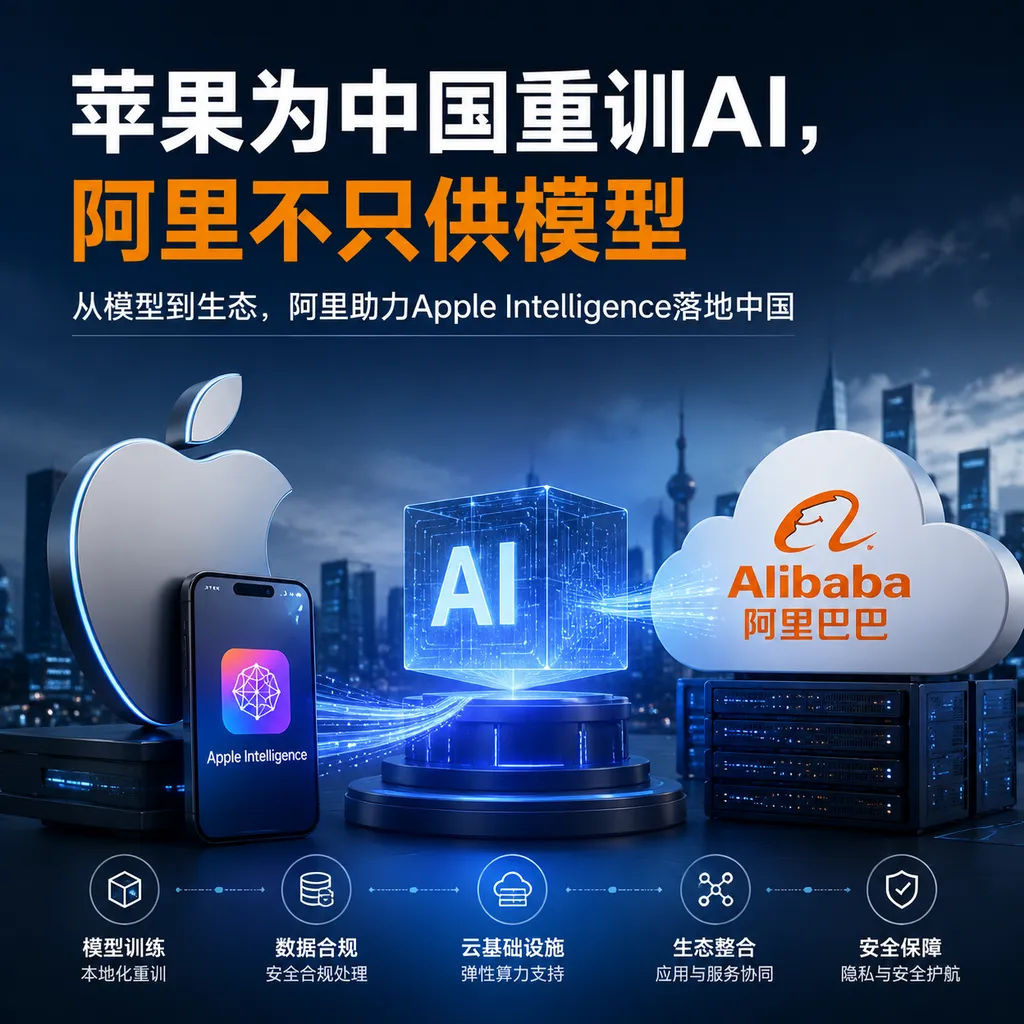
Apple has reportedly partnered with Alibaba to train a large language model for the Chinese market, with Apple Intelligence expected to roll out via a system update in the coming months. Rather than simply integrating Qwen, this appears to be a localized AI stack in which Apple controls the user experience while Alibaba provides the model and compliance support.
According to Reuters, citing three people familiar with the matter, Apple has trained a large language model specifically for the Chinese market, with support from Alibaba during the training process. Following subsequent iOS updates, Apple Intelligence is expected to launch for users in China within the next few months.
The most noteworthy aspect of this news is not that Apple is finally bringing AI to devices sold in mainland China, nor is it merely that “Apple Intelligence is integrating Qwen.” The real change is that Apple appears not to have settled for simply connecting an off-the-shelf third-party model to Siri. Instead, with Alibaba’s support, it has trained a model specifically for China.
If Apple ultimately confirms the report, it would mean that its China AI strategy has progressed beyond “using a local provider” toward “jointly building a local model stack.” Alibaba may be providing not just a model API, but a complete set of capabilities encompassing foundation models, training infrastructure, Chinese-language corpus processing, safety alignment, and compliance engineering.
From Integrating Qwen to Training a China-Specific Model
The partnership between Apple and Alibaba did not come out of nowhere.
In early 2025, Alibaba co-founder and chairman Joe Tsai publicly confirmed that, after approaching several Chinese AI companies, Apple had selected Alibaba to provide AI capabilities for iPhones in the Chinese market. By July 2026, regulators had released a new batch of registration records for on-device generative AI services, with “Apple Intelligence” among them. Alibaba subsequently confirmed that Qwen would be integrated into Apple Intelligence as an AI capability across iOS, iPadOS, macOS, and visionOS.
In August, a support page titled Use Qwen with Apple Intelligence on Mac briefly appeared in the Simplified Chinese version of the Mac User Guide on Apple’s China website, explicitly describing how Apple Intelligence and Qwen would work together. Although the document was later removed, it at least indicates that the relevant products and documentation had entered the final preparatory stage before launch.
The new information is that Apple and Alibaba may have jointly taken a deeper step: retraining a model specifically for the Chinese market.
Three concepts need to be distinguished here:
- Direct integration with Qwen: Complex requests are handed off to Alibaba’s general-purpose model, similar to how the international version of Apple Intelligence calls external large language models.
- Customization or fine-tuning based on Qwen: Alibaba’s foundation model is further trained for Chinese-language expression, safety policies, and Apple-specific use cases.
- Training a China-specific Apple model: Apple defines the capability boundaries and product behavior, while Alibaba provides the foundation model, computing resources, data engineering, or training support. The resulting model serves Apple Intelligence rather than appearing as a standalone Qwen product.
Public reports have not disclosed the model’s size, underlying architecture, training data, deployment location, or the exact work undertaken by Alibaba, so it is not yet possible to conclude that this is “a new model pretrained by Apple from scratch.” A more reasonable assessment is that it is highly likely to be built on Alibaba’s existing models and infrastructure, then customized and safety-aligned for system-level Apple Intelligence tasks.
In other words, this may not be a building constructed from the foundations up. It is more likely a deep renovation of Alibaba’s mature model foundation, carried out according to Apple’s own specifications and delivery standards.
Why Apple Cannot Simply Replicate Its Overseas Approach
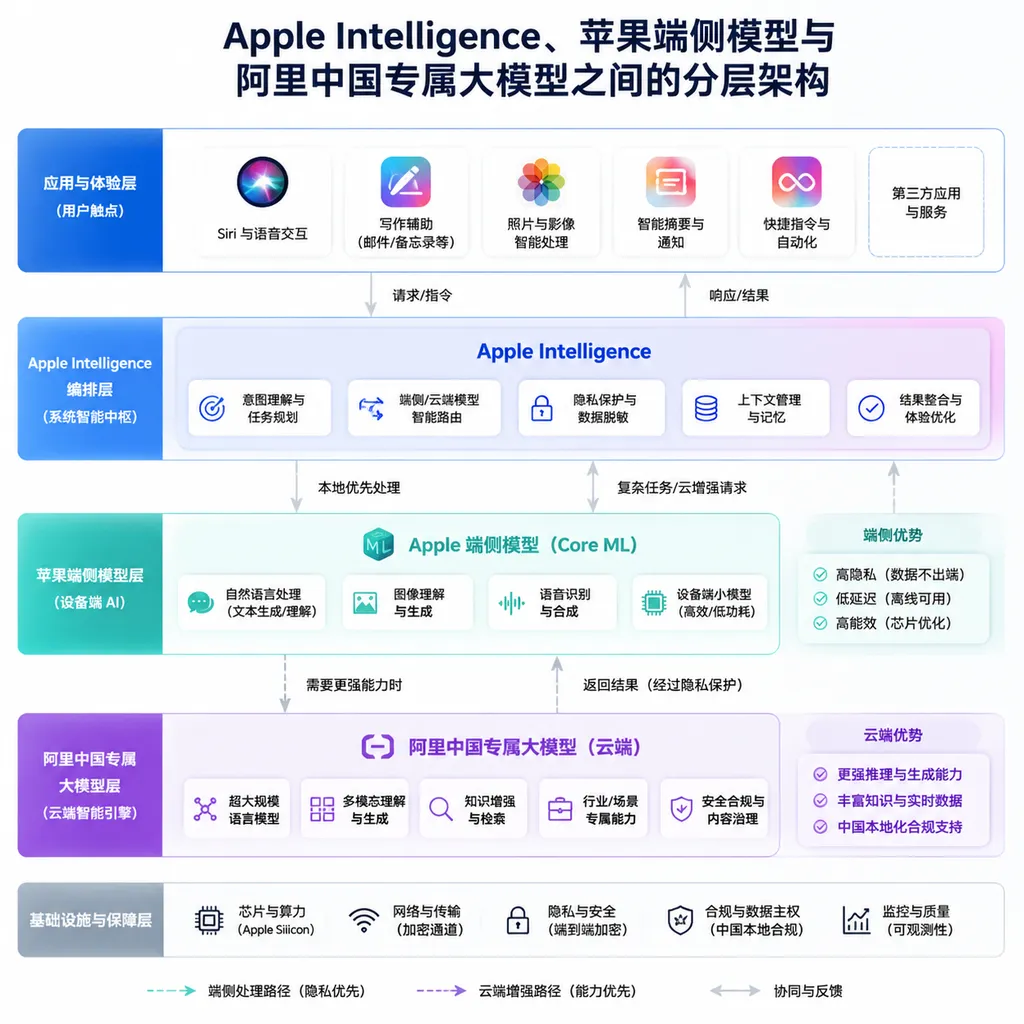
Apple Intelligence uses a layered architecture in global markets: simple, sensitive tasks suitable for local execution are handled by on-device models; more complex requests are sent to Apple’s cloud computing system; and when the system’s own capabilities are insufficient, external models are called.
In China, this architecture cannot continue operating merely by pointing the overseas model to a different domain name.
First comes compliance. Generative AI services are subject to a series of requirements involving model registration, training data governance, content safety, personal information processing, and cross-border data transfers. For a system-level AI capable of accessing context from photos, emails, calendars, notifications, and documents, compliance is far more difficult than it is for an ordinary chat application. Apple needs more than a model that “can answer questions.” It also needs a local service pipeline that is auditable, controllable, and continuously updatable.
Second are the Chinese language and local knowledge. A general-purpose multilingual model being able to speak Chinese does not mean it is suitable for Chinese users. Forms of address for contacts, address parsing, public holidays, the local app ecosystem, Chinese long-form text summarization, and omitted words and references in colloquial speech can all directly affect Siri’s usability. When a system-level assistant misinterprets intent, the result is not merely a slightly worse answer; it might set the wrong reminder, send a message to the wrong person, or invoke the wrong app.
Finally, there is the pace of product development. Foundation models evolve far faster than operating systems. Apple has traditionally refined features on an annual OS release cycle, but large language models can gain major capabilities within weeks. By jointly training or customizing models with Alibaba, Apple can leave underlying iteration to the local model supply chain while continuing to control system entry points, permissions, and interactions itself.
Apple Still Wants to Control the Experience, Not Top the Model Leaderboards
Apple has no need to build a system-preinstalled version of the Qwen app for China.
For Apple Intelligence, a large language model is merely one inference component within the system. What truly matters is whether it can understand the current screen, draw on personal context, and connect to apps and system capabilities after obtaining authorization. Users may never see the model’s name. They will simply notice that Siri understands a sentence more accurately, Writing Tools can rewrite an email, or Photos search can recognize more natural Chinese descriptions.
The Chinese version of Apple Intelligence is still expected to use a similar layered capability structure:
- On-device models handle low-latency tasks such as text rewriting, notification summaries, and basic image understanding;
- Local cloud models handle complex reasoning, long-form text, and more computationally expensive generation tasks;
- Search or knowledge service providers supplement queries requiring real-time information;
- The iOS permissions and orchestration layer determines which data can be accessed, when external capabilities can be invoked, and how results are returned to apps.
This also explains why Qwen and a “China-specific model” are not contradictory. Qwen can serve as the source of foundational capabilities, while the China-specific model can be the deliverable adapted to Apple’s use cases. At the same time, certain features may continue to call other partners, such as providers of search, maps, or real-time information services.
Apple’s core advantage has never been training the model with the most parameters. It lies in owning the hardware, operating system, and user entry points. What Apple really wants is to make external models as controllable as components in its chip supply chain: suppliers provide the capabilities, Apple defines the interfaces and experience, and what users ultimately perceive is still Apple Intelligence.
What This Means for Developers
In the short term, this partnership will not immediately provide ordinary developers with an “Apple–Alibaba jointly developed model API.” Apple Intelligence will still focus first on Apple’s own features, including Siri, Writing Tools, notification processing, image generation, and cross-app intent understanding.
Once the system-level entry point launches, however, developers will need to focus on three more practical issues.
1. Whether the System Can Correctly Understand the App
Future competition will involve more than App Store search rankings. It will also depend on whether an app’s features can be discovered by Siri and system intelligence. If a flight app provides only a collection of pages without clear App Intents, deep links, and structured parameters, it will be difficult for the system to complete searches and navigation on the user’s behalf.
2. The Chinese and Overseas Versions May Behave Differently
The same request might be processed overseas by an Apple model or an external international model, while in China it could be handed off to a local model. These models may not make exactly the same judgments when extracting parameters, interpreting time expressions, or selecting tools. Cross-region apps cannot assume that Apple Intelligence will behave identically everywhere. Chinese-language expressions and local system versions will need to be tested separately.
3. Data Boundaries Will Become Part of Product Design
When AI can access app content, developers must consider not only whether integration is possible, but also which data may enter the system context, which actions require a second confirmation, and which content should not be used for model inference. For financial, medical, and enterprise collaboration apps, this will directly affect permissions design and auditing procedures.
Rather than speculating about model parameters, developers should therefore focus now on organizing their system interfaces: completing App Intents, standardizing deep links, providing stable structured output, and retaining explicit confirmation steps for high-risk actions such as payments, sending, and deletion.
Not Early, but Still Critical
From a competitive standpoint, Apple Intelligence is clearly arriving late in China. Huawei, Xiaomi, OPPO, vivo, and other manufacturers have long integrated generative AI into system search, call summaries, image editing, document processing, and cross-app operations. The absence of AI features on Apple devices sold in mainland China over the past two years is no longer merely a missing keynote selling point; it has become a weakness in the operating-system experience of Apple’s flagship devices.
Even if the Chinese version of Apple Intelligence launches successfully in the next few months, its first iteration is unlikely to establish an immediate lead. Apple must simultaneously address model quality, service stability, device compatibility, and privacy disclosures, while the jointly trained model will also need to withstand the long tail of real users’ Chinese-language expressions.
Nevertheless, this remains important because Apple has finally established the basic framework of a local AI supply chain.
Once on-device models, local cloud inference, third-party knowledge services, and system orchestration are all functioning, subsequent capability upgrades will no longer need to start from scratch. Apple can also replace model providers in different markets while maintaining a consistent global product framework. The significance of this architecture may ultimately be greater than adding a few more summarization or writing features to the initial release.
Key Questions Still Awaiting Answers
At least several important details have yet to be disclosed:
- Whether the China-specific model is further trained from Qwen or uses Apple’s own architecture;
- Whether the model primarily runs on-device, on Alibaba Cloud, or on local cloud infrastructure operated by Apple in China;
- Whether the system will request confirmation and authorization each time a user invokes an external model;
- Which iPhone, iPad, and Mac models will be supported initially, and whether older devices can access some features through the cloud;
- What specific roles other partners, including Baidu, will play in search and Siri upgrades;
- The official launch date for Apple Intelligence and whether it will be rolled out as part of a specific iOS release.
Until Apple makes a formal announcement, “launching in the next few months” should still be treated as a plan rather than a confirmed date. The appearance and subsequent removal of support documentation from Apple’s website also suggests that the company is still coordinating its product, compliance, and release schedules.
Conclusion: Apple Is Replicating a New AI Supply Chain
This is not an ordinary model integration, but a regional adaptation of Apple’s global AI architecture.
Overseas, Apple can hand complex requests off to international model providers. In China, it needs local registration, local training support, and a local service pipeline. What Alibaba gains is not merely a preinstalled entry point, but an opportunity to enter the core AI layer of iOS. Compared with a standalone chat application, this position offers higher usage frequency and is closer to users’ real-world tasks.
However, a supplier entering the underlying system does not mean it takes control of the product. Apple will continue to tightly control permissions, interactions, hardware, and model routing. Alibaba provides the engine; Apple decides when to start it, where the vehicle goes, and how much information about the engine users can see.
For users in China, the most important issue is not which model’s logo appears when Siri responds, but that iPhones sold in mainland China may finally gain the system-level AI they have long lacked. For Apple, this looks more like a belated effort to catch up: the direction is now clear, and model registration and development are gradually falling into place. What will truly determine success or failure is the quality of the experience after launch.
References
- ITHome: Apple Reportedly Trained an AI Model Specifically for the Chinese Market with Support from Alibaba — Summarizes information from Reuters sources familiar with the matter and reviews the latest developments regarding Apple Intelligence’s registration and Apple’s Qwen support documentation.