Music3 Released: Up to 5 Minutes Long

MiniMax released Music 3 today, using an 8B global model and a 0.6B local model in tandem to generate songs up to five minutes long. What truly deserves attention is not the duration, but how it handles complete song structures and long-range coherence.
MiniMax-Music3 Released, Generates Complete Songs up to 5 Minutes Long in a Single Pass
MiniMax today (August 14) released its next-generation music generation model, MiniMax-Music3. After users provide lyrics and a music description, the model can generate a complete song up to five minutes long in a single pass, outputting 32kHz, 16-bit stereo WAV audio.
The most immediately noticeable change in this update is the duration. MiniMax’s music-01, released in 2024, could initially generate only up to 60 seconds of audio, with a later goal of extending that to 180 seconds. Music3 now raises the single-generation limit to five minutes, covering the typical length of most pop songs, commercial jingles, game character songs, and short-film theme songs.
But five minutes is not the most important metric in itself.
It is not particularly difficult for an AI music model to keep generating audio for five minutes. The hard part is remembering what it is singing throughout those five minutes: the verses and choruses must relate to one another, the singer’s timbre cannot suddenly change midway through, the beat cannot gradually drift, and the second chorus must add layers to the arrangement while preserving the core theme. Music3’s key improvements focus precisely on this kind of long-range consistency.
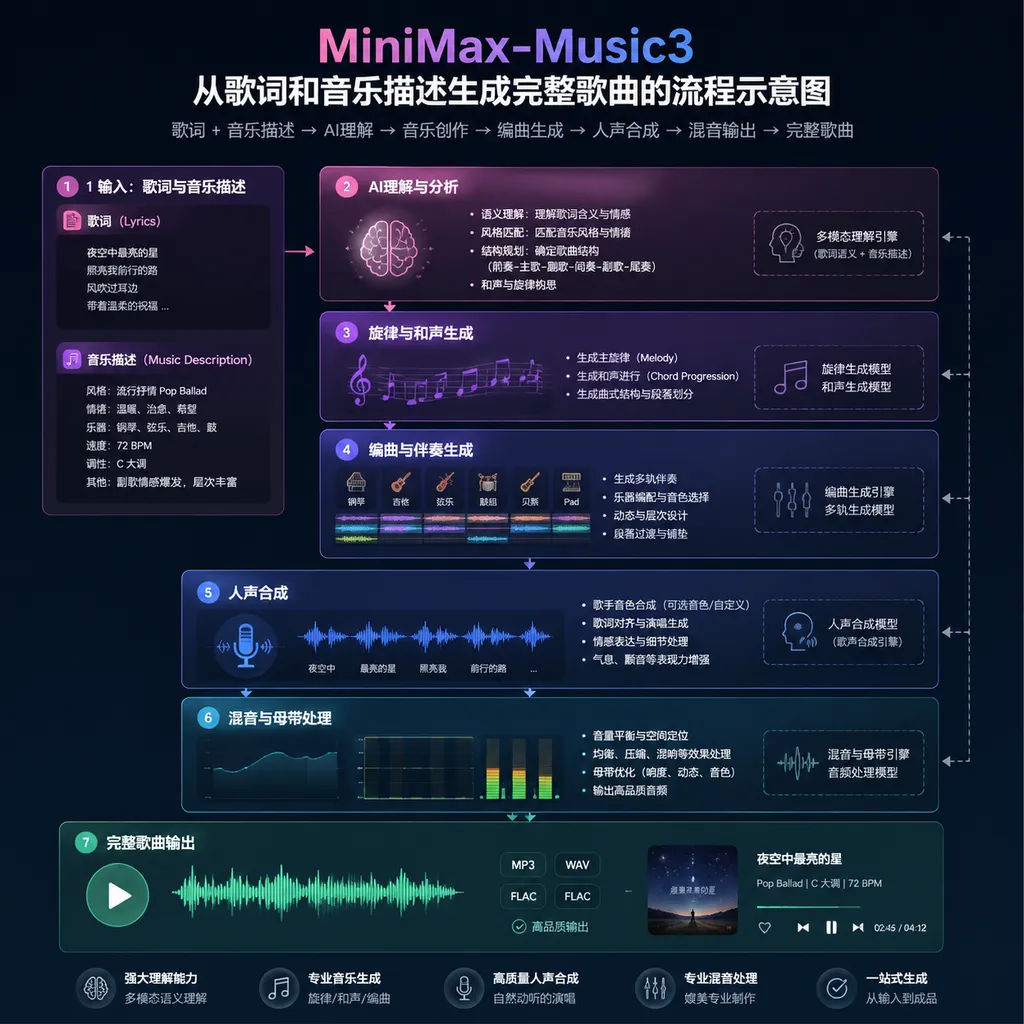
Two Models Divide the Work: One Handles the Whole Song, the Other Handles Sonic Details
MiniMax-Music3 uses a hierarchical autoregressive architecture in which two language models of different sizes jointly process music tokens:
| Module | Parameter Count | Primary Responsibility | | --- | ---: | --- | | Global LLM | 8B | Predicts the first RVQ codebook for each frame, modeling the song’s themes, sections, and long-term structure | | Local LLM | 0.6B | Predicts the remaining acoustic codebooks within the same frame, reconstructing vocals, instruments, and timbral details |
This design can be understood as writing the “full score” first, then filling in the “performance details.”
The Global LLM determines where the song is going: when to enter the chorus, when to repeat a melodic theme, whether the bridge should introduce a turn, and how the outro should resolve. The Local LLM then turns that structure into audible sound, including the singer’s vocal texture, drum transients, guitar textures, spatial reverb, and stereo details.
The two models do not simply divide the task by time; they divide it by information hierarchy. This distinction is critical.
Why RVQ Is Well Suited to This Division of Labor
Music3 uses RVQ, or residual vector quantization, to compress continuous audio into multiple layers of discrete codebooks. The first layer typically carries coarser-grained content with a greater amount of information, while subsequent codebooks progressively add details that the preceding layers did not represent.
It can be compared to an image that loads progressively:
- The first codebook provides the main outlines and approximate color blocks;
- Subsequent codebooks add texture, edges, lighting, and shadows;
- Only when all codebook layers are combined is the complete audio reconstructed.
Music3 has the 8B Global LLM predict the first RVQ codebook frame by frame, effectively allowing the larger model to control the entire song’s “low-frequency backbone.” The 0.6B Local LLM then predicts the remaining acoustic codebooks to complete the local high-fidelity reconstruction.
This is more pragmatic than having a single large model handle every codebook prediction from beginning to end. Although the latter architecture is simpler, it would expend substantial computation on local acoustic details and incur higher costs when generating long sequences. The hierarchical approach reserves expensive global reasoning for the parts that genuinely require memory, while using a smaller model to process local information at high frequency.
This optimization does not come for free: whether semantic and acoustic information become disconnected between the two levels still depends on the quality of joint training. At least from an architectural perspective, however, MiniMax is not relying solely on a larger context window to brute-force five minutes of audio.
Starting from Qwen3-8B, but No Longer an Ordinary Language Model
The Global LLM is initialized from Qwen3-8B. During training, MiniMax first adapts the embedding and output layers for music semantic tokens, then has the Global LLM and Local LLM jointly model all RVQ codebooks.
“Based on Qwen3-8B” should not be interpreted as directly using a chat model to generate music. The distributions of text tokens and music tokens differ substantially: the former represent discrete linguistic symbols, while the latter must express rhythm, pitch, timbre, and temporal continuity. The primary value of reusing language model weights lies in inheriting autoregressive modeling capabilities and mature training infrastructure; the input and output spaces still need to be adapted specifically for music.
The two-stage training process also has practical significance.
If the global and local models were trained to learn all codebooks simultaneously from the outset, the larger model would have to adapt to entirely new music tokens while also coordinating with the local model, making it easy for the optimization objectives to interfere with one another. Training the Global LLM on the music semantic space first, followed by joint training, is more like teaching a composer to read music before having them rehearse with a band.
However, 8B plus 0.6B does not mean the complete deployment cost is limited to 8.6 billion parameters. Actual inference also requires an audio encoder, decoder, sampling, and post-processing components, while the sequence length corresponding to five minutes of audio is far greater than that of ordinary short text. Developers evaluating local deployment cannot estimate VRAM requirements and latency based solely on the language models’ parameter counts.
The Significance of Five Minutes Is That We Can Finally Discuss “Arrangement Progression”
According to MiniMax, Music3 can maintain musical themes, rhythm, vocal identity, and arrangement progression throughout long audio while supporting the following structures:
- Intro;
- Verse;
- Pre-chorus;
- Chorus;
- Bridge;
- Instrumental break;
- Outro.
These structural labels may look like standard selling points on a product page, but in practice, they are precisely where long-form music generation is most likely to reveal problems.
With a music sample as short as 20 seconds, capturing a single timbre and melodic motif is often enough to create a strong first impression. Once the duration extends to three to five minutes, however, problems begin to accumulate: the chorus and verse may not be clearly differentiated, the same melody may loop mechanically, the drum kit may suddenly shift spatial position, the vocal identity may drift, or the song may lack an outro and simply be cut off at an arbitrary point.
Therefore, determining whether Music3 has genuinely improved requires listening to more than the carefully selected excerpts featured by MiniMax. The entire song must be evaluated:
- Whether the second chorus preserves the core melody while introducing a reasonable dynamic lift;
- Whether the bridge provides a structural transition rather than inserting a random piece of new music;
- Whether the voice still sounds like the same singer in high, low, and breathy registers;
- Whether the lyrics and syllables remain aligned throughout, especially with polyphonic Chinese characters and lyrically dense passages;
- Whether the outro resolves the harmony naturally rather than simply fading out or ending with a hard cut.
From this perspective, five minutes is more like a stress test. Duration is merely the outcome; sustained memory and structural control are the true measures of the model’s capabilities.
32kHz WAV Is Sufficient for Delivery, but It Is Not Yet Mastering-Grade
Music3 outputs 32kHz, 16-bit stereo WAV files. Compared with compressed audio, WAV makes it easier for developers to perform further vocal separation, equalization, compression, loudness adjustment, and video packaging, while also avoiding the additional distortion introduced by lossy encoding.
However, a 32kHz sampling rate corresponds to a theoretical maximum frequency of approximately 16kHz. This is generally sufficient for ordinary smartphone playback, short-form video soundtracks, demo production, and in-game assets. For professional releases, mastering, or material that requires extensive time-stretching in post-production, however, it still falls short of the commonly used 44.1kHz and 48kHz production workflows.
In other words, Music3’s output specification is closer to “ready to listen to and ready for further production,” but it cannot simply be equated with a studio’s final delivery format.
The 16-bit depth is not an obvious weakness either. More common issues in AI-generated audio currently include sibilance, reverb tails, muddiness when complex instruments overlap, and localized vocal artifacts—not insufficient quantization bit depth. Simply changing the specification to 24-bit would not automatically restore acoustic information that the model never generated.
For Developers, Controllability Matters More Than Impressive Samples
Music3 accepts two types of input—lyrics and music descriptions—allowing applications to control “what to sing” separately from “how to sing it.” Typical use cases include:
- Batch-generating game character songs based on storylines and character profiles;
- Generating theme songs of fixed lengths for short dramas, podcasts, and branded content;
- Generating versions of the same lyrics in different styles for creative selection;
- Generating complete songs for virtual singers and combining them with digital humans or video models;
- Generating editable demos with intros, instrumental breaks, and outros rather than looped background music.
What truly determines production viability is whether the model can reliably understand the constraints in a description. For example, “female vocals, lower register, restrained delivery, add strings in the second chorus, and do not fade out at the end” contains four categories of requirements: timbre, singing style, arrangement timing, and ending method. If the model can only capture “female-vocal pop,” its product value is fundamentally no different from drawing at random.
The currently available information focuses on structure and duration, but several capabilities that are equally important to developers still require further verification:
- Whether fixed random seeds and reproducible results are supported;
- Whether BPM, key, time signature, and exact duration can be specified;
- Whether local regeneration is supported without regenerating the entire song;
- Whether vocals, drums, bass, and other stems can be exported separately;
- How much VRAM, processing time, and peak memory are required to generate five minutes of audio;
- What licensing boundaries apply to commercial use, voice imitation, and training data.
MiniMax positions Music3 as an open-weight model, but open weights do not mean unrestricted commercial use, nor do they mean that the training data, inference code, and complete production pipeline are all open. Before integrating the model, teams should still review the model license, licenses for dependent components, and terms governing generated content item by item.
It Addresses Part of What Makes a Song “Complete,” but Not Everything Needed to Make It “Controllable”
MiniMax-Music3 is moving in the right direction: music models should no longer focus on generating shorter snippets that merely “sound like songs.” They should advance toward complete structures, editability, and deliverable output.
The division of labor between the 8B Global LLM and the 0.6B Local LLM is also more technically substantive than merely promoting parameter counts. The former remembers where the song came from and where it is going, while the latter ensures that every second sounds like a real recording. This architecture directly addresses the central conflict in long-form music generation: global consistency requires a large model, but the large model should not also have to handle every local acoustic detail individually.
However, it is still too early to call this a “production-grade music model.” Official samples can demonstrate the upper limit of its capabilities, but they do not establish its reliability across different languages, styles, and lyrical densities. Complete songs also involve precise editing, stem export, copyright review, vocal identity authorization, and production-scale throughput—none of which can be solved merely by extending generation time from three minutes to five.
Our assessment is that the most commendable aspect of Music3 is not that it extends the progress bar by two minutes, but that it begins modeling music as a work with long-term structure. If independent testing confirms that it can reliably maintain themes, vocal identity, and sectional progression over five minutes, it will be closer to real production requirements than the many models that excel only at producing impressive excerpts.
As for whether it can truly enter developers’ workflows, the next things to examine are not more curated audio samples, but licensing, inference costs, reproducibility, and local editing capabilities.
References
- ITHome: MiniMax-Music3 Music Model Released, AI Generates Songs up to 5 Minutes Long — Includes information on the model’s release date, hierarchical autoregressive architecture, parameter counts, division of labor between RVQ codebooks, and output specifications.