
MiniMax M2.7: Performance catches up with Claude, but its license regresses from MIT to non-commercial use only
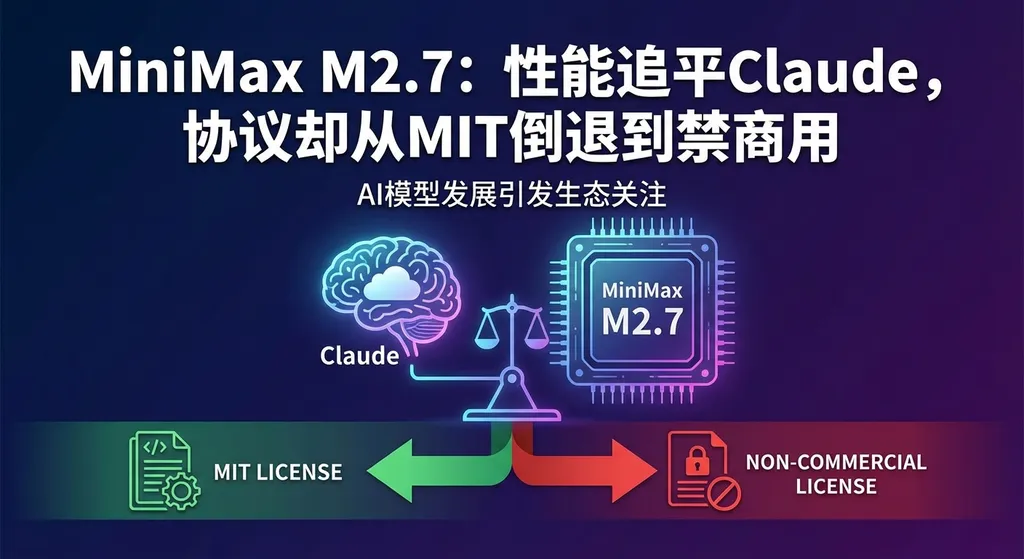
MiniMax’s latest open-source model, M2.7, approaches Claude Opus on the SWE-Pro benchmark, but its license has abruptly changed from the previous MIT to a non-commercial “Modified-MIT.” The developer community is in an uproar, questioning whether this is a carefully packaged case of “pseudo open source.”
The Model Is Powerful, the License Is Puzzling
Last week MiniMax (Xiyu Technology) released its new generation of open-source model, M2.7. Judging purely by performance metrics, it’s a release worth serious attention — a 56.22% score on the SWE-Pro programming benchmark, almost at the level of Anthropic’s Claude Opus, placing it firmly in the top tier among Chinese open-source models.
But developers didn’t focus on the benchmark numbers at all. Everyone’s eyes were on one thing: the license file in the Hugging Face repository.
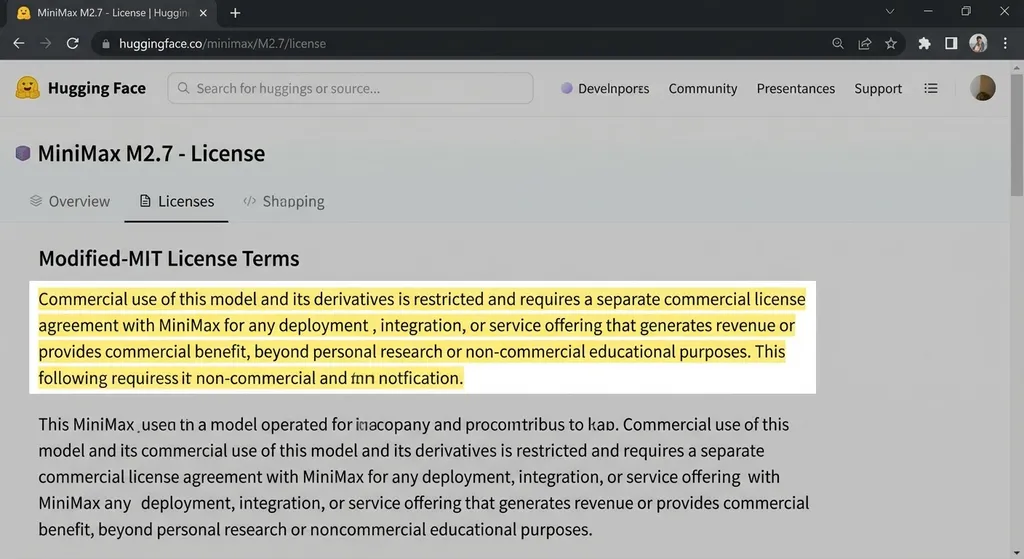
MiniMax had changed its license from MIT to something called “Modified-MIT.” The change is simple but critical: commercial use now requires prior written authorization from MiniMax; otherwise, it is prohibited.
The previous M2.5 series used the standard MIT license — one of the most permissive in the open-source world. You could sell, modify, redistribute it privately, as long as you retained the copyright notice. Now, M2.7’s license closes the door on commercial use and adds a lock that can only be opened with written approval.
The community’s reaction was blunt: is this even still open source?
“Modified-MIT”: A Carefully Designed Restriction Clause
Looking closely at the license, it keeps the basic framework of MIT — allowing copying, modification, and distribution — but adds three layers of restrictions on commercial use:
- Commercial use requires written authorization: any use “primarily intended for financial gain or commercial benefit” must be pre-approved in writing by MiniMax.
- The definition of ‘commercial’ is extremely broad: charging third parties, providing commercial API services, or fine-tuning for profit all count as commercial.
- Mandatory branding: if authorized, you must prominently label “Built with MiniMax M2.7” on your site, interface, or documentation.
The second restriction is what makes developers uncomfortable. Under this definition, if you’re a startup fine-tuning M2.7 for a specific domain and deploying it in your product — sorry, that counts as commercial use, and you’ll have to email MiniMax first.
It’s similar to Meta’s Llama license, but Llama at least defines a clear threshold (free for companies under 700M monthly active users). MiniMax’s terms have no such metrics — whether your use counts as commercial depends entirely on MiniMax’s approval, leaving developers in uncertainty.
Another concern is the name itself. Calling it “Modified-MIT” is misleading. Developers associate MIT with “use it freely.” Adding a “Modified” prefix makes it easy for someone to assume the restrictions are minor. The community is already calling it “a bait-and-switch license.”
MiniMax’s Dilemma: Burned by “Crippled Versions”
If you stop reading here, MiniMax looks like a “fake open-source scammer.” But their response deserves attention.
Ryan Lee, MiniMax’s head of developer relations, posted a long explanation on social media. His main argument: the unrestricted openness of M2.5 cost MiniMax dearly.
After M2.5’s release, many third-party API providers started hosting MiniMax’s models. That should have been good news — evidence of market demand — but the quality of those services varied wildly:
- Some over-quantized the model (e.g., compressing FP16 to INT4), severely degrading accuracy.
- Some used incorrect prompt templates, reducing output quality.
- Most egregiously, some platforms advertised MiniMax but actually ran cheaper models underneath.
Users blamed MiniMax when they encountered “defective” service, unaware that intermediaries were at fault.
“Poor user experience led people to think MiniMax was mediocre — we took the reputational hit. With a fully permissive license, we were powerless to act.”
— Ryan Lee
This problem is real and not unique to MiniMax. In the open-source model ecosystem, “repackaged” and “downscaled” deployments are widespread. On certain API aggregation platforms, you can never be sure what’s actually running behind a given model name.
From that perspective, MiniMax’s anxiety is legitimate. But the question remains: is restricting license use the right tool for brand protection?
The Essence of the “Pseudo-Open Source” Debate
Developers aren’t just angry about losing free commercial rights. The deeper issue is this: MiniMax enjoys the reputation benefits of being open source while denying the actual freedoms open source entails.
This touches a growing tension in the AI industry.
According to OSI (Open Source Initiative) standards, genuine open-source licenses cannot restrict fields of use or commercial usage. Measured by that, M2.7’s Modified-MIT is not open source. It’s closer to a “source-available” license — you can see the code and weights but can’t freely use them.
But “open source” has always been loosely defined in AI. Meta’s Llama has commercial restrictions and still calls itself open source; Google’s Gemma also does, yet publicly brands itself as such. MiniMax just pushed that industry norm further.
What truly irks developers is the reversal of direction. Going from MIT to Modified-MIT isn’t a cautious license choice for a new project — it’s tightening restrictions on a project that already built expectations of openness. It’s like a restaurant offering free samples to attract customers, then suddenly charging regular prices — even if the fee is justified, the shift feels bad.
Moreover, the way MiniMax handled this made things worse. The license change wasn’t highlighted in the release notes; many developers discovered it only during deployment. That “quiet switch” deepened distrust. Media headlines on Sohu even used the phrase “quietly locked down,” showing just how negative the perception has become.
Brand Protection vs. Open-Source Freedom — Is There a Better Way?
Let’s revisit MiniMax’s core issue: how to prevent degraded third-party deployments that harm its brand. It’s legitimate, but restricting commercial use isn’t the only — or best — solution.
The industry already has more mature approaches:
- Trademark protection: keep the MIT license but register “MiniMax” as a trademark. Others can freely use the model, but only those meeting quality standards can use the MiniMax name. This is how Mozilla/Firefox operates.
- Certification system: create an official certification process so that only verified deployments can carry a “MiniMax Certified” mark — similar to Kubernetes conformance tests.
- Technical techniques: embed watermarks or fingerprints inside models to trace unauthorized modifications or misrepresentations.
These all protect brand integrity without restricting usage. A restrictive license is a more blunt, heavy-handed measure — it works, but at the cost of community trust.
Practical Implications for Developers
So what does M2.7’s license change mean for you?
Personal and academic use are unaffected. According to Ryan Lee, self-hosting for personal coding assistance “is absolutely allowed.” Running it locally as a programmer’s helper or for research is fine.
Commercial use requires approval. If you plan to integrate M2.7 into a commercial product, you must get written authorization from MiniMax. The application process — whether there’s a fee, how long it takes — remains unclear. That uncertainty itself is expensive.
Fine-tuned models are also restricted. This one matters — even if you fine-tune heavily on top of M2.7, the resulting model remains under Modified-MIT. You can’t “wash off” the license restriction through fine-tuning.
For production use, calling MiniMax models via API might be the simpler choice. You avoid license issues and quality degradation. OpenAI Hub already supports MiniMax among its API models, using OpenAI’s request format, directly accessible within China — convenient and compliant.
To quickly test M2.7’s coding capabilities, you can call it via API:
from openai import OpenAI

client = OpenAI(
    api_key="your-openai-hub-key",
    base_url="https://api.openai-hub.net/v1"
)

response = client.chat.completions.create(
    model="minimax-m2.7",
    messages=[
        {"role": "system", "content": "You are a senior software engineer."},
        {"role": "user", "content": "Write me a Python decorator that automatically retries a function call, with a maximum retry count and exponential backoff."}
    ],
    temperature=0.7
)

print(response.choices[0].message.content)
The Bigger Picture: AI Open Source Is Fragmenting
The MiniMax M2.7 license incident isn’t isolated — it reflects a growing divide over open source in AI.
On one side is the “true open-source” camp, represented by Mistral and Allen AI, sticking with Apache 2.0 and similar licenses — no limits on commercial use. On the other side, increasingly many companies push “quasi-open” models — weights public, code visible, but commercial restrictions attached.
Meta’s Llama is the archetype. Its license allows free commercial use for companies under 700M monthly active users; only giants need permission. In contrast, MiniMax’s Modified-MIT requires approval for every commercial use — far more restrictive.
The logic behind this trend is clear. Training a frontier model can cost tens or even hundreds of millions of dollars. Companies must recover that investment. Full open source enables competitors to take your work freely; full closed source forfeits ecosystem and brand benefits. So everyone invents in-between “source-available” models.
But as every company creates its own license, developer compliance costs balloon. Using five open models might mean obeying five unique license sets. For small teams, that’s a serious burden.
My Take
Here’s my view.
MiniMax’s brand protection problem is real, and Ryan Lee’s explanation was candid. But using a restrictive license to solve it is a short-sighted move.
Because: the true strength of open-source models lies not in the model itself, but in the developer ecosystem built around it. Restricting commercial use directly discourages those developers — especially startups and commercial contributors who grow that ecosystem. You protect your brand but risk losing your community.
And practically speaking, license restrictions don’t stop shady platforms from doing low-quality rehosting — those who’d violate the rules won’t care anyway. Only the law-abiding developers get constrained.
A better approach is to keep open licenses while protecting the brand through trademarks, certification, and technical means. It’s harder and costlier, but leads to a healthier long-term outcome.
Technically, M2.7 is impressive — a 56.22% SWE-Pro score shows MiniMax has serious chops. But in open source, technical excellence and community trust are equally vital. Hopefully MiniMax listens to feedback and finds a better balance next time.
After all, open source isn’t just about exposing weights — it’s about giving developers real freedom.
References
- MiniMax M2.7 License Sparks Controversy: Commercial Use Forbidden, Developers Call It “Pseudo-Open Source” — Discussion thread on Linux.do, including license analysis and community feedback


