SpaceX Acquires Cursor, Reshaping the AI Coding Landscape
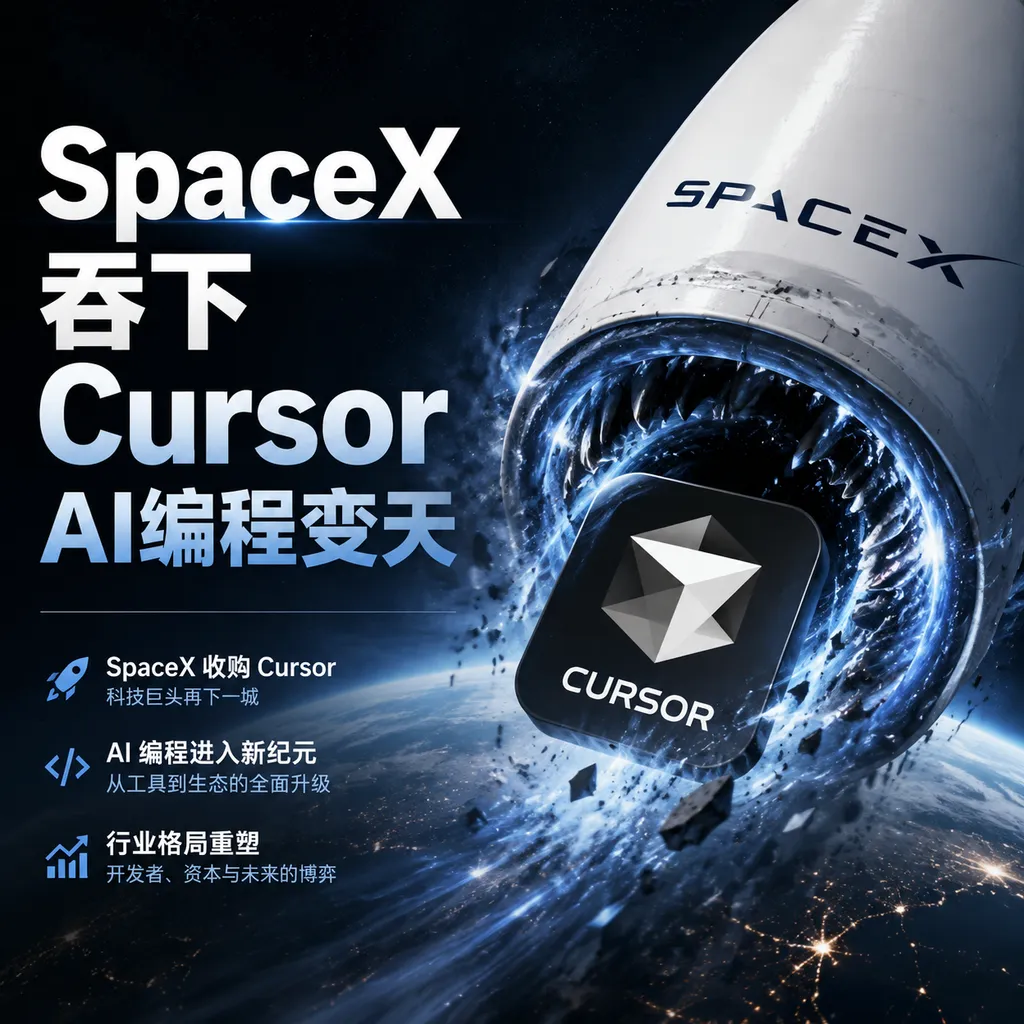
SpaceX has completed its $60 billion acquisition of Anysphere, Cursor’s parent company. Competition in AI coding has officially shifted from a battle over standalone tools to the integrated consolidation of computing power, models, agents, and developer entry points.
$60 Billion Deal Officially Takes Effect
SpaceX’s acquisition of Cursor has been completed.
According to regulatory filings that took effect on August 14 local time, SpaceX completed its $60 billion acquisition of Anysphere, Cursor’s parent company—approximately RMB 405.4 billion at current exchange rates. The two parties announced the agreement two months ago, and the deal has now officially closed.
This is not only the largest acquisition to date in the AI coding sector, but also one of the largest in the history of the technology industry. By comparison, Anysphere was valued at approximately $29.3 billion when it raised funding in November 2025. In less than a year, SpaceX doubled that valuation.
Based on the previously disclosed annualized enterprise revenue of approximately $2.6 billion, the $60 billion price represents a multiple of more than 23 times annualized revenue. That figure clearly cannot be explained merely by “selling a code editor.”
SpaceX is not buying an editor skin, but four far more important assets: a gateway to developers, Agent workflows, real-world software engineering feedback, and a product system that converts model capabilities into paid revenue.
Cursor’s Real Value Is Not Code Completion
Cursor launched in 2023, and its early form could easily be understood as “VS Code with a built-in large language model.” Over the past three years, however, AI coding products have rapidly progressed through several stages beyond autocomplete:
- Completing a line or function based on context;
- Modifying multiple files through natural-language instructions;
- Understanding code repositories, running tests, and fixing errors;
- Automatically breaking down tasks, invoking tools, executing commands, and committing code;
- Having multiple Agents handle requirements, testing, security reviews, and deployment in parallel.
The last two stages are where the real commercial value lies.
Traditional coding assistants sell “typing a few dozen fewer characters per minute.” Agents sell “handing off a Jira ticket and receiving a reviewable Pull Request some time later.” The former is a productivity plugin; the latter is beginning to tap into software teams’ labor budgets.
Cursor’s advantage in this transition is not merely model performance. It occupies the workspace where developers spend most of their day and can connect repository retrieval, context organization, model routing, terminal access, test execution, and version control into a closed loop.
That loop continuously generates high-quality feedback:
- Which generated code engineers accept;
- Which changes are reverted or rewritten;
- Which tasks require multiple attempts;
- Which types of errors can be caught through testing;
- Which models are best suited to planning, coding, or review;
- Exactly where Agents fail in real repositories.
Public code can teach a model “how code is usually written,” but real development workflows can teach it “what code teams ultimately merge.” The data value of the two is on entirely different levels.
The premium paid by SpaceX is therefore, in essence, the price of acquiring a continuously operating engineering feedback system.
What SpaceX Lacks Is Precisely a Product Gateway
Musk’s ecosystem has never lacked computing power or ambition in AI models, but it has lacked a sufficiently strong product gateway into the enterprise AI market.
OpenAI has ChatGPT, Codex, and a complete API ecosystem. Anthropic has established recognition among professional developers through Claude Code. Google can embed Gemini across cloud services, Android, Workspace, and developer toolchains. By comparison, SpaceXAI previously relied more heavily on Grok’s brand visibility and the scale of its infrastructure, while its penetration into internal enterprise procurement, developer workflows, and software team collaboration remained limited.
Cursor fills that gap perfectly.
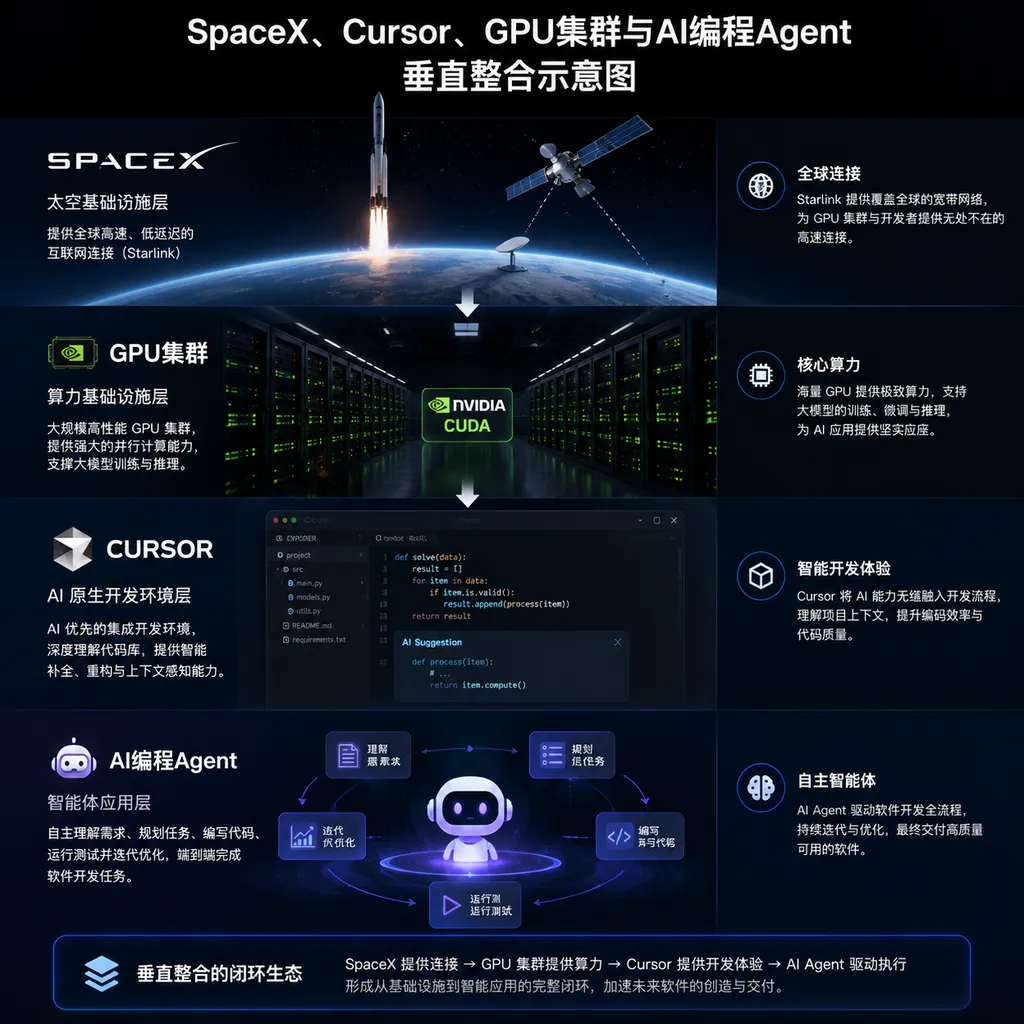
Following the acquisition, SpaceXAI gains not only a mature client application, but also a distribution channel targeting experienced engineers, an enterprise sales organization, and a proven methodology for Agent products. Cursor, meanwhile, gains access to massive GPU clusters and no longer has to compete for compute against several trillion-dollar platforms at the fundraising pace of a startup.
In its acquisition announcement, the Cursor team said it would use the world’s largest GPU clusters to develop more capable models with lower operating costs. Previously disclosed information indicates that the Colossus training cluster within the SpaceX ecosystem has compute capacity equivalent to approximately one million H100 GPUs. Even after accounting for the difference between “equivalent compute” and training resources actually available for use, this remains infrastructure that ordinary AI application companies cannot match.
This creates a fairly direct cycle:
More compute → stronger coding models → a better Cursor experience → more developers and task data → higher-quality training and reinforcement feedback → stronger models.
AI coding companies have generally relied on upstream model APIs, collecting subscription fees from users while paying model providers for inference. The faster their businesses grow, the higher their compute bills become. After being acquired by an infrastructure owner, Cursor can shift from being a “bearer of model costs” to becoming part of the compute orchestration system itself.
This may be the deal’s most practical synergy—not merely the “technology integration” described in the press release.
The Two Sides Already Completed a Trial Run
Integration did not begin only after the acquisition closed.
In July, SpaceX and Cursor jointly launched Grok 4.5, with an emphasis on high-value knowledge work such as coding, finance, and law. Grok Bot followed, using a group of AI Agents to continuously receive and execute tasks. The upgraded Grok 4.6 arrived soon afterward.
Judging by the product rollout, the cooperation between the two sides over the preceding months looked more like large-scale due diligence: instead of merely having finance personnel verify the statements, they actually connected the models, compute, and client application to determine whether they could form a viable product.
SpaceX initially obtained an option to acquire the company. If it ultimately chose not to proceed with the acquisition, it could have been required to pay a $10 billion partnership fee. This structure effectively amounted to “integrate first, buy out later”: SpaceX used the jointly developed model to test the efficiency of the collaboration, while Cursor used the compute resources to determine whether its in-house models could scale.
Now that the $60 billion transaction has officially taken effect, SpaceX evidently believes the results of that trial run were worth the remaining premium.
AI Coding Enters an Era of Super-Platform Consolidation
Over the past two years, the central question in AI coding has been: Who can build better code completion and repository understanding?
The next question will be: Who can simultaneously control compute, foundation models, Agent runtime environments, and the developer gateway?
This is a clear shift in the competitive paradigm.
Comparing model benchmarks in isolation can no longer adequately explain differences between actual products. Whether a coding Agent can complete a task depends on the entire chain:
- Whether the model can plan correctly;
- Whether context can be retrieved precisely instead of indiscriminately filling the context window;
- Whether it has permission to access terminals, browsers, databases, and internal services;
- Whether the testing environment is stable;
- Whether it can roll back and try again after failure;
- Whether inference costs permit the Agent to run continuously for dozens of minutes;
- Whether enterprises can audit the data it accessed and the commands it executed.
The model is only the engine. An Agent product also needs a transmission, chassis, dashboard, and maintenance system. Cursor’s value lies in having already assembled these components into a product that developers are willing to use and pay for.
SpaceX’s approach is to bring the engine factory, energy supply, and vehicle distribution channels under the same company. This resembles Microsoft’s integration of GitHub, Azure, and model services; Google’s connection of Gemini, Cloud, and Workspace; and Amazon’s use of AWS to advance developer Agents. The difference is that SpaceX has used a massive acquisition to rapidly make up for lost time.
This also means the window for independent AI coding companies is narrowing.
They must now prove at least one thing: that the products, data, or user relationships they control are strong enough to offset upstream platforms’ advantages in model pricing, compute supply, and channel bundling. Simply wrapping a third-party model in an editor interface is no longer enough to sustain a long-term moat.
Will Cursor’s “Model Neutrality” Disappear?
For developers, the key question after the deal is not whether Cursor will immediately change its name, but whether it can preserve openness in model selection.
One of Cursor’s core advantages has been allowing users to switch among models from OpenAI, Anthropic, Google, and its in-house Composer. For professional developers, this is not an optional drop-down menu: different models perform differently in large-scale refactoring, front-end generation, error localization, long-context understanding, and tool use. Teams also need to route requests based on cost, latency, and compliance requirements.
After being acquired by SpaceX, Cursor has strong economic incentives to prioritize Grok and its in-house models, including:
- Shifting the default model toward Grok;
- Optimizing new Agent capabilities for its own models first;
- Setting higher prices or lower usage quotas for third-party models;
- Using deep integration to create features that standard APIs cannot replace;
- Gradually migrating enterprise customers to SpaceXAI’s cloud and compute ecosystem.
This may not happen immediately. Much of Cursor’s user base stems from its model flexibility, and abruptly shutting out third-party models would only push customers toward competitors. A more likely approach is to retain multi-model options while giving Grok structural advantages in pricing, speed, context caching, and Agent tool use.
In other words, the platform may remain open on the surface while the default path becomes increasingly vertically integrated.
Enterprise customers must also ask more specific questions: Is code used for training? How is telemetry data isolated? Where are model requests sent? Can third-party providers see the context? How is Agent command execution audited? Will future contracts permit unilateral changes to model availability?
A $60 billion acquisition will not automatically resolve these issues. On the contrary, it will make data boundaries more complex.
What This Means for Developers and Enterprises
In the short term, the deal is likely to bring three direct changes for Cursor users.
1. Agents Will Run Longer, Potentially at Lower Prices
With compute brought in-house, Cursor can afford more testing, rollbacks, and multi-round inference. Background Agents that were previously too expensive to be anything more than demonstrations may become everyday features. The two companies have already emphasized that their jointly developed models cost less to use than competing products, and the price war will likely continue.
2. Knowledge Work Beyond Coding Will Rapidly Move Into the Same Interface
Grok 4.5 already covers financial and legal tasks, indicating that Cursor will not remain limited to code forever. Contract review, data analysis, operations troubleshooting, technical research, and internal process automation could all be packaged as continuously running Agents.
Cursor may ultimately evolve from an IDE into an enterprise task gateway. Code is simply one of the first types of work to be automated—and one of the easiest to validate.
3. Platform Lock-In Risks Will Increase
When the code editor, models, cloud execution environment, and enterprise data connectors all belong to the same platform, migration is no longer as simple as changing an API endpoint. Agent rules, memory, tool permissions, evaluation data, and execution history may all become new layers of lock-in.
Enterprises should preserve the portability of model routing, task logs, and evaluation sets now rather than waiting until prices or terms change. For teams that need simultaneous access to models such as GPT, Claude, Gemini, and DeepSeek, using an aggregation layer compatible with the OpenAI API format still has practical value, as it can prevent business logic from becoming tied to a single model provider. OpenAI Hub currently supports this kind of unified multi-model access, but whether to use an aggregation layer should ultimately be determined by latency, data compliance, and cost structure.
The Deal Is Expensive, but Not Irrational
$60 billion is certainly expensive. Based on current revenue, SpaceX is buying a market position that may take years to materialize, not today’s cash flow. If AI coding ultimately becomes a feature bundled for free with foundation models, this deal will become a textbook acquisition at the top of the cycle.
But if Agents can gradually take over the software delivery pipeline, Cursor is not “just another code editor.” It is the operating system for software production in the AI era. Software development is also one of the forms of knowledge work best suited to Agent adoption: inputs and outputs are digital, processes are traceable, results can be validated through compilation and testing, and customers have a strong ability to pay.
From this perspective, SpaceX’s judgment is clear: instead of slowly building distribution in the enterprise AI market, it is better to directly acquire the most mature developer gateway, then use compute and models to drive down unit costs.
It is a major gamble, but not one without industrial logic.
More importantly, it draws a dividing line across the entire AI coding industry. The startup story used to be that a small team could call the strongest model and rapidly build a great product. From now on, competition will increasingly depend on the coordination of tens of billions of dollars in compute, model development, enterprise distribution, and product gateways.
AI coding Agents have not eliminated opportunities for startups, but the era of “model wrappers plus editors” is essentially over. In the next phase, the real competitors will no longer be a handful of plugins, but entire super-platforms.
References
- ITHome: One of the Largest Acquisitions in Tech History—SpaceX Spends $60 Billion to Acquire AI Coding Company Cursor—Reports that the transaction officially took effect on August 14 local time and summarizes the two companies’ jointly developed models, compute partnership, and subsequent integration plans.