Qwen3.8-27B Goes Open Source, Runs on Consumer GPUs
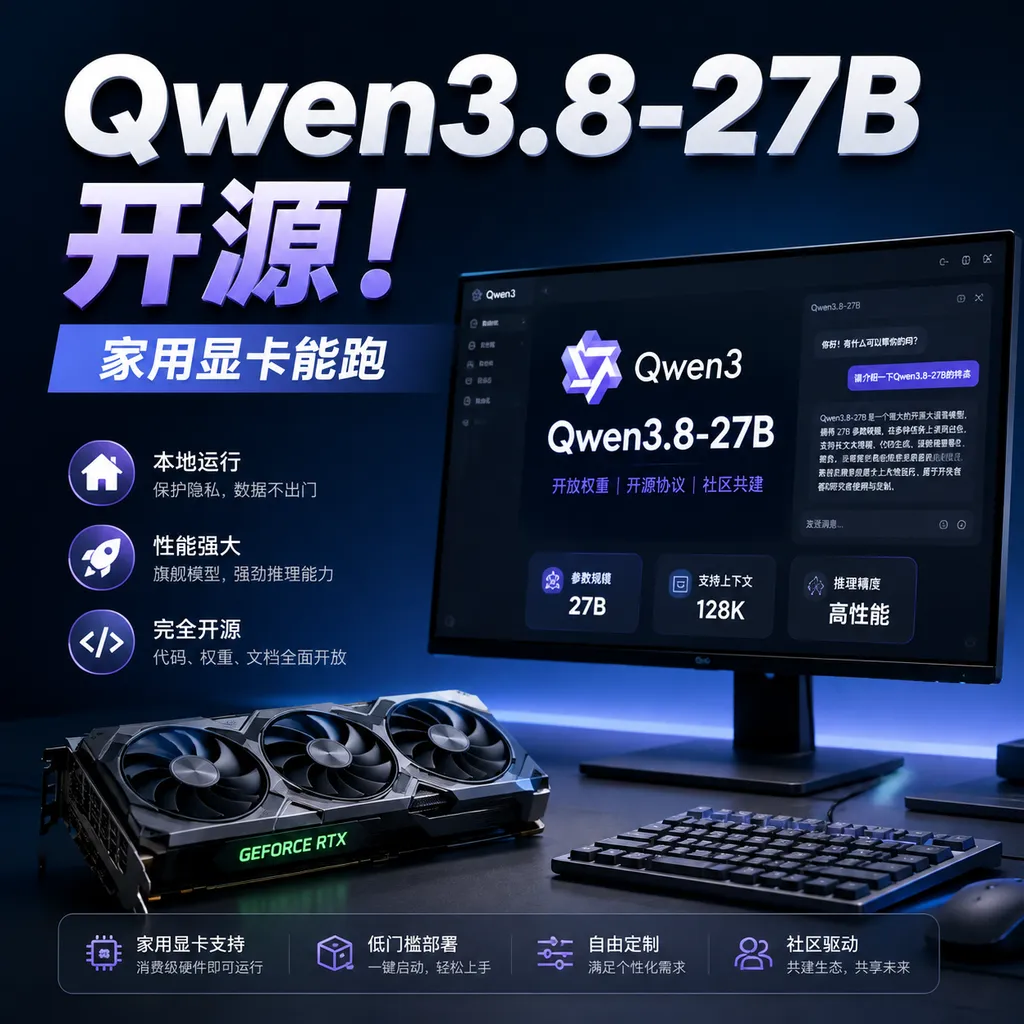
Alibaba has open-sourced Qwen3.8-27B, making it free for individuals and businesses to download, deploy, and use commercially. With 27B parameters, it strikes a balance between performance, VRAM requirements, and fine-tuning costs that is better suited to local development.
The 27B Version Officially Arrives, With Local Deployment as the Main Focus
On August 14, Alibaba officially open-sourced Qwen3.8-27B. The model weights are available to individual developers and enterprises for free download, private deployment, and commercial use.
Compared with Qwen3.8-Max, which has 2.4 trillion total parameters and activates 95 billion parameters per inference, the 27B version is clearly not intended to set another record for how large a foundation model can be. Instead, it targets a more practical group of users: developers who want to run the model on workstations, high-end consumer GPUs, or small servers while retaining room for fine-tuning, quantization, and further development.
That is where the real significance of Qwen3.8-27B lies.
Over the past two years, the capabilities of flagship cloud models have grown rapidly, but developers’ expectations for local models have also changed. Conversational ability alone is no longer enough. Models must also be able to write code, call tools, handle long-running tasks, and avoid a noticeable loss of intelligence after quantization. At 27B parameters, the model occupies a subtle sweet spot: it has a higher capability ceiling than 7B- or 8B-class models, yet unlike flagship models with more than 10 billion active parameters, it does not automatically turn deployment into a multi-GPU server project.
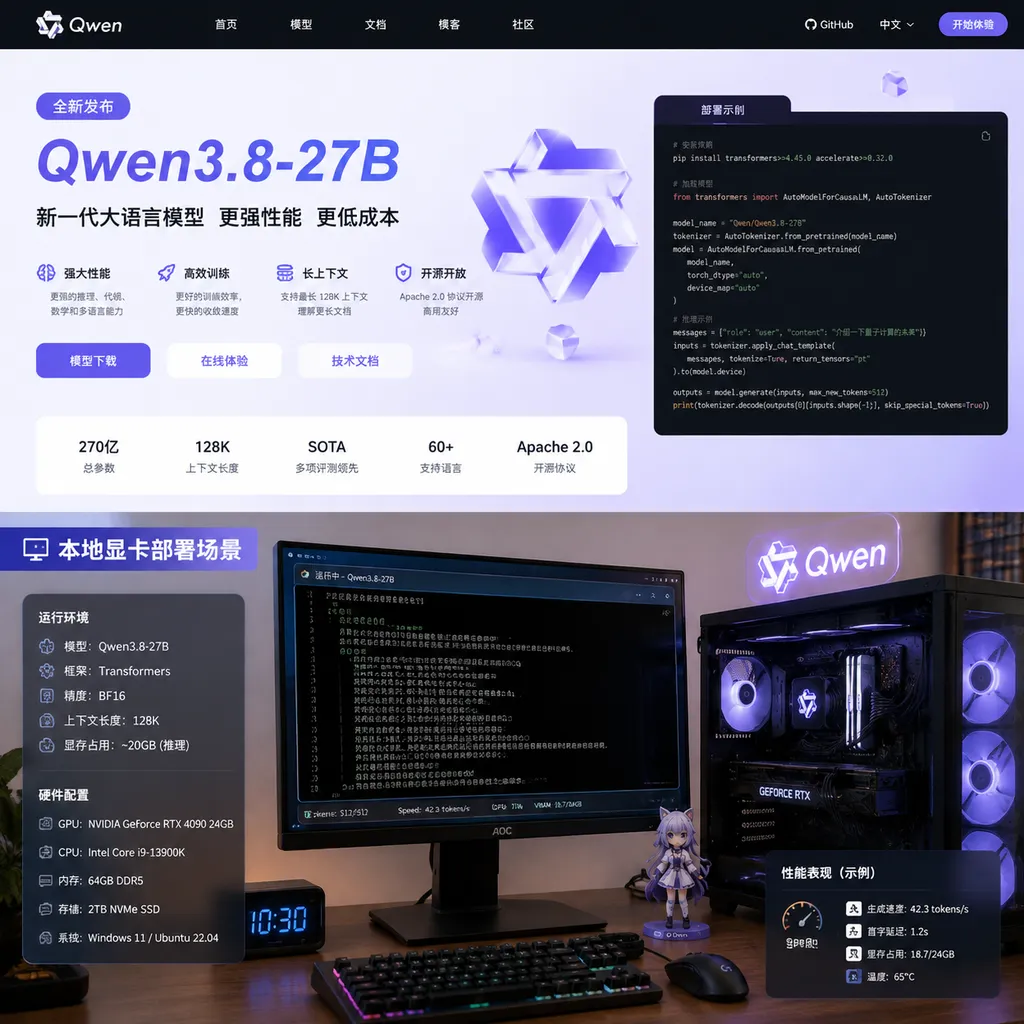
“It Runs on a Consumer GPU”—Provided It Is Quantized
First, let us clarify the statement most likely to cause confusion: the fact that a 27B model can run on a consumer GPU does not mean that its full-precision weights can fit comfortably on just any consumer card.
Based solely on model parameters, without accounting for the KV cache, runtime buffers, or inference framework overhead, a 27B model requires approximately:
- FP16 or BF16: about 54 GB of VRAM;
- INT8: about 27 GB of VRAM;
- INT4: about 13.5 GB of VRAM;
- Lower-bit quantization can reduce usage further, but capability loss and framework compatibility must be evaluated separately.
Therefore, “runs on a consumer GPU” usually means 4-bit quantization, hybrid CPU-GPU offloading, or parallel execution across multiple consumer GPUs—not effortless single-GPU operation with the original half-precision weights.
For users with a GPU offering 24 GB of VRAM, a 4-bit version will generally be the most practical starting point. In addition to the weights themselves, this leaves some capacity for the KV cache and inference framework. A 16 GB card is not entirely out of the question, but the available context length, batch size, and inference speed will be more constrained, and some layers may need to be offloaded to system memory. As for 8 GB or 12 GB cards, rather than fixating on “successfully loading” the model, users would be better served by choosing a smaller model. Being able to launch a model and being able to complete tasks reliably are two different things.
Another frequently overlooked variable is context length. The longer the context, the more memory the KV cache consumes. A model fitting into VRAM during a short conversation does not mean it will maintain the same memory footprint when processing a large code repository, hundreds of pages of documents, or a multi-turn agent task. In real-world deployments, developers must monitor weights, context, concurrency, and cache precision together rather than looking only at the “27B” in the model name.
That is also our assessment of the claim that it “runs on a consumer GPU”: it is broadly true, but a more precise formulation would be that, with appropriate quantization and inference settings, Qwen3.8-27B falls within the practical range of high-end consumer hardware.
Why 27B Instead of Continuing the Race at 7B
The greatest advantages of small models are their low cost and high speed, but their capability ceilings are equally apparent.
For single-turn tasks such as summarization, classification, and basic information extraction, 7B or 8B models are often sufficient. But once tasks involve cross-file code changes, complex tool use, multi-step reasoning, and long-running agent workflows, stable context comprehension, instruction following, and error recovery become much more important. When a model lacks sufficient parameters, the usual problem is not that it cannot perform the task at all, but that it begins to drift halfway through: it may provide incorrect tool parameters, forget prior constraints, modify file A while overlooking file B, or produce code that looks complete but cannot actually run.
The significance of 27B is that it trades higher “intelligence density” for a more reliable task-completion rate without raising the hardware threshold to data-center levels. For local AI, this is often more important than simply maximizing tokens generated per second. A fast model that requires repeated rework is not necessarily cheaper than a somewhat slower model that gets the job done on the first attempt.
Qwen previously released Qwen3.6-27B for agentic coding. By choosing the same parameter tier again for Qwen3.8-27B, Qwen is signaling that 27B is becoming a core specification in its local deployment strategy rather than a one-off transitional product.
It broadly addresses three categories of demand:
- A general-purpose assistant on a personal workstation: For code generation, document processing, knowledge-base Q&A, and lightweight agents;
- Private deployment within enterprise networks: Keeping sensitive code, contracts, and financial data within the local environment;
- Vertical-domain fine-tuning: Training industry-specific variants with methods such as LoRA and QLoRA rather than bearing the enormous cost of full-parameter training.
Compared with cloud APIs, local models may not always have a lower total cost. If usage is low and traffic fluctuates significantly, APIs remain more convenient. However, when tasks run continuously, data cannot leave the organization’s environment, or teams need to modify weights and pin model versions, the value of open weights increases rapidly.
Commercial Availability Matters More Than “Free Download”
Downloadable model weights solve only the problem of access. Whether commercial use is permitted determines whether the model can enter real products and business systems.
According to the release information, both individual developers and enterprises may download, deploy, and commercially use Qwen3.8-27B free of charge. This means developers can build internal tools, industry applications, or commercial services around the model without sending every request to an external API.
However, “commercial use permitted” does not mean “no conditions apply.” Before a production launch, enterprises should still review the latest license text in the model repository, paying particular attention to the permitted scope of use, redistribution requirements, attribution obligations, limitations of liability, and treatment of derivative model versions. Licenses for open-weight models are not all equivalent to Apache 2.0, and promotional language on an official website cannot replace legal review.
Moreover, strictly speaking, the term “open-source model” is often used in the industry to mean that the weights are available—not that the training data, complete training code, and data-processing pipeline have all been made public. The actual degree of openness of Qwen3.8-27B should be assessed based on the weights, configurations, inference code, technical reports, and license provided in the model repository.
This is not mere hair-splitting. For researchers, the ability to reproduce the training process is important. For application developers, what matters more is whether the weights can be downloaded, quantized, fine-tuned, and legally used commercially. The two groups naturally evaluate “open source” by somewhat different standards.
Developers Need to Look Beyond the Leaderboards
Benchmark scores usually attract the most attention when a new model is released, but whether Qwen3.8-27B can become a mainstay of local deployment will require several rounds of community validation.
The first issue is capability retention after quantization. No matter how strong the original-precision results are, if 4-bit quantization causes noticeable degradation in coding, mathematics, or tool-use tasks, the model’s value to single-GPU users will diminish. Different quantization methods should not be treated as interchangeable: quantization algorithms, calibration data, group size, and inference backends all affect the final results.
The second issue is the inference ecosystem. Developers need to see how quickly mainstream frameworks can support the model architecture, attention implementation, and tool-calling templates, including server deployment, desktop execution, and high-performance batch inference. The fact that a model can generate text in a sample script does not mean it is ready for production.
The third issue is agent stability. The Qwen3.8 series emphasizes capabilities in coding, office productivity, scientific research, and long-running tasks, but the size of the gap between the 27B version and the flagship Max model cannot be inferred solely from the fact that they belong to the same family. Meaningful tests should include:
- Completing code changes across multiple files and passing tests;
- Calling tools such as search, terminals, and browsers in sequence;
- Maintaining consistent goals and constraints throughout long-running tasks;
- Identifying errors in execution results and correcting them proactively;
- Remaining stable when handling Chinese documents, spreadsheets, and mixed-language code.
The final considerations are throughput and latency. Consumer-GPU deployments often serve a single user, in which case time to first token and interactive speed matter more than batch throughput. Enterprise services, meanwhile, must account for concurrency, VRAM fragmentation, prefix caching, and continuous batching. The optimal configuration for the same model may differ completely between these two scenarios.
Local Models and Cloud Flagships Are Not an Either-Or Choice
Qwen3.8-27B will not replace Qwen3.8-Max, nor is it likely to match the 2.4-trillion-parameter flagship across every complex task. The two are better understood as different tools within the same product line: Max defines the upper limit of capability, while 27B provides controllable deployment and bounded costs.
A more practical architecture is tiered model routing. Enterprises can assign high-frequency, sensitive, and relatively standardized tasks to the local 27B model, such as code explanation, document summarization, internal search, and format conversion. They can then switch to a flagship cloud model for difficult reasoning, extremely long contexts, or infrequent complex tasks. This approach can both reduce average usage costs and limit the external transmission of sensitive data.
For teams that use GPT, Claude, Gemini, DeepSeek, and Qwen together, standardizing on an OpenAI-compatible format remains a common way to reduce migration costs. The Qwen3.8 series’ cloud APIs can also be accessed through aggregation platforms, and OpenAI Hub already supports unified-key access to mainstream models. However, the core selling point of this Qwen3.8-27B release is still that users hold the weights themselves—not that they have gained another API endpoint.
This May Be More Practical Than Releasing the Max Weights
Qwen3.8-Max is certainly more powerful and more likely to generate headlines. But even if its weights were released, the storage, VRAM, and engineering complexity associated with 2.4 trillion total parameters and 95 billion active parameters would still mean that it primarily belongs to large institutions, cloud providers, and specialized inference clusters.
The 27B model is different.
It gives individual developers an opportunity to validate complete products on a single workstation, allows small and medium-sized teams to conduct private-deployment experiments without purchasing large clusters, and enables enterprises to establish internal model services at a relatively manageable cost. It may not be the most capable model in the Qwen3.8 family, but it could become the most widely deployed.
More importantly, 27B models are narrowing the gap between “can run locally” and “can actually get work done.” Early local models were often merely more private but barely adequate substitutes. Now, open models are beginning to enter the core of software development, office automation, and agent workflows. Developers may choose local deployment not only because internet access is unavailable, but also because they need lower marginal costs, more stable versions, and more complete control.
Of course, the final verdict will depend on the community. The key question is not whether the model can successfully generate a single “Hello” on a particular GPU, but whether, after quantization, it can reliably implement a complete feature, execute a sequence of tool calls, process a long document, and remain dependable after working continuously for several hours.
If the answers to those questions are yes, Qwen3.8-27B will carry more weight than an ordinary new open model: it could become the new benchmark for local AI workstations in the second half of 2026.
References
- Qwen3.8-27B Hugging Face Model Page: The official model release page, where users can view the weights, configuration, license, and subsequent model card updates.
- Qwen3.8-Max: Major Advances in Coding and Office Productivity: Official Qwen release information introducing the Qwen3.8 series’ architectural scale, capability focus, and open-source plans.