GPT-5.6-Sol Solves a 22-Year-Old Mathematical Conjecture
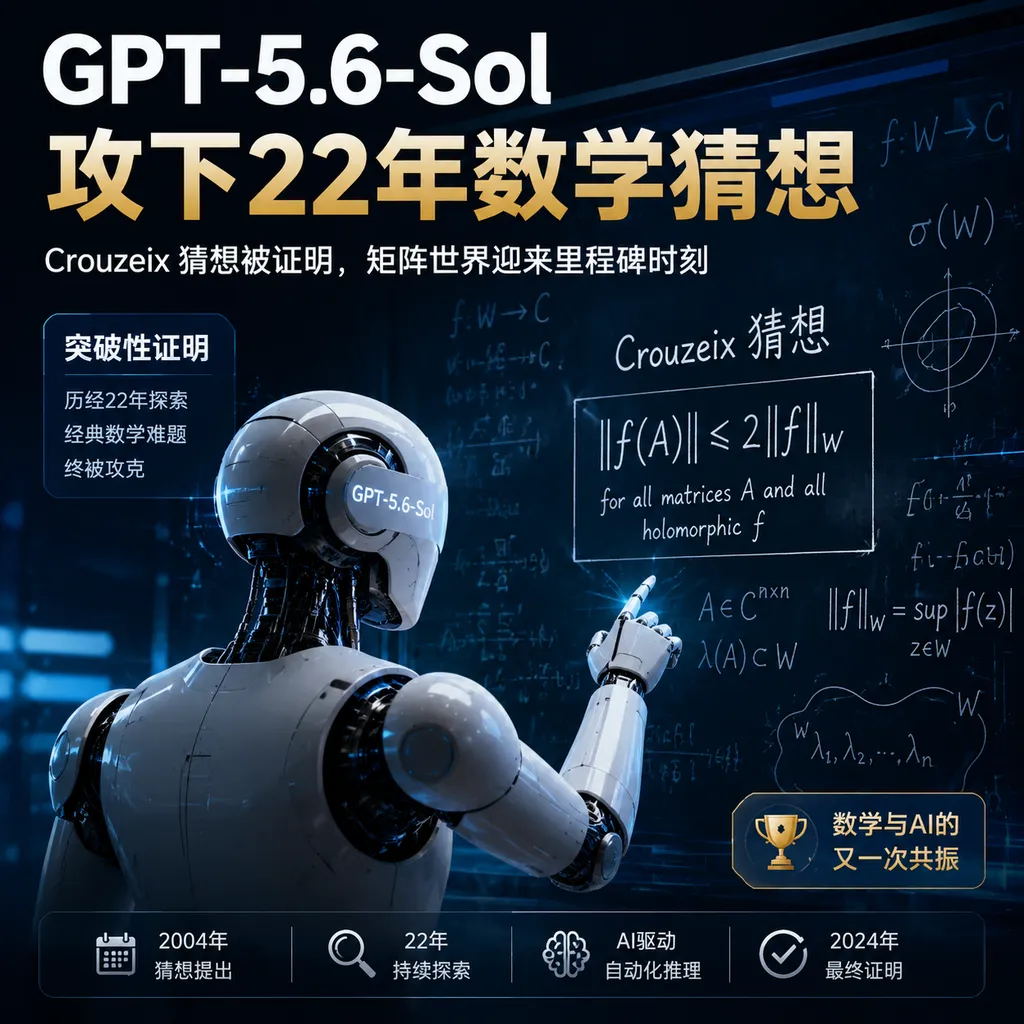
A neurosurgeon used GPT-5.6-Sol to reason continuously for approximately 16 hours, completing a proof of the Crouzeix conjecture. Three experts have confirmed that the manuscript is correct, but formal academic review is still ongoing.
GPT-5.6-Sol Cracks a 22-Year-Old Mathematical Conjecture
GPT-5.6-Sol has delivered another result that goes far beyond conventional benchmarks.
According to information disclosed on August 14, Jin Shanmu, a postdoctoral researcher and resident physician in neurosurgery at Peking Union Medical College Hospital, used OpenAI’s GPT-5.6-Sol in ChatGPT Work mode to complete a proof of the Crouzeix conjecture after running it continuously for about 16 hours. This problem in numerical linear algebra was proposed by French mathematician Michel Crouzeix in 2004 and had remained without a complete solution for 22 years.
Cornell University mathematician Alex Townsend, University of Washington professor Anne Greenbaum, and Crouzeix himself have all reviewed the manuscript and judged the proof to be correct.
This was not a model scoring highly on an Olympiad problem set, nor was it simply recombining existing papers into an answer. At least based on the information currently available, it tackled a long-standing open problem for which no generally accepted proof previously existed and produced a complete argument that experts in the field could inspect line by line.
However, “confirmed as correct by three experts” and “fully peer-reviewed and formally accepted by the mathematical community” are still two different things. A more precise statement would be that the proof generated by GPT-5.6-Sol has passed an initial—and highly authoritative—round of human review. Broader verification and dissemination are still needed before a final verdict can be reached.
What Makes This Conjecture So Difficult?
The Crouzeix conjecture is not difficult to state.
For any square matrix A, define its numerical range as:
W(A) = {x*Ax: x is a unit vector}
The conjecture asserts that, for any polynomial p:
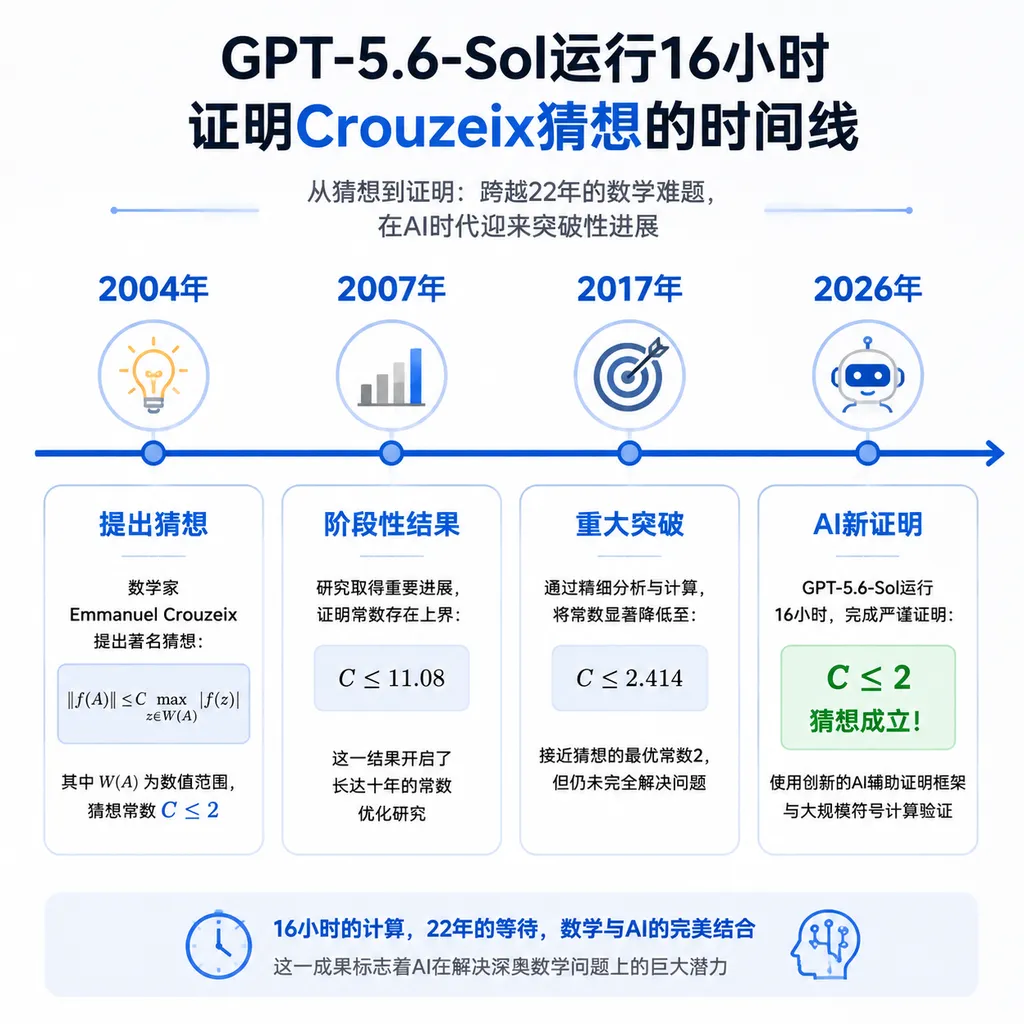
‖p(A)‖ ≤ 2 × max{|p(z)|: z belongs to W(A)}
Intuitively, it seeks to use the behavior of matrix A within the two-dimensional region defined by its numerical range to control how much applying a polynomial to the entire matrix can amplify it.
If A is a normal matrix, the problem is relatively easy because the matrix’s behavior can be described fairly well by its eigenvalues. But many matrices encountered in practice are nonnormal: their eigenvalues may appear benign, yet they can exhibit substantial amplification after a function is applied. The numerical range contains more information than the set of eigenvalues, but proving that it can uniformly constrain every matrix and every polynomial with a constant of 2 is extremely difficult.
The significance of this kind of problem extends beyond pure mathematics. Similar norm estimates arise in matrix functions, numerical stability, discretization of partial differential equations, control theory, and the analysis of iterative algorithms. Reducing the constant from 2.414 to 2 may look like a difference of only 0.414, but in reality, it represents the final barrier between the known upper bound and the optimal structure predicted by the conjecture.
Progress has always been slow:
- In 2004, Michel Crouzeix proposed the conjecture;
- In 2007, Crouzeix proved that a constant of approximately 11.08 works;
- Around 2017, related work improved the universal constant to 1 + √2, approximately 2.414;
- For years afterward, the target constant of 2 remained out of reach.
Open problems in mathematics often look like this: the statement is only one line long, and previous results seem to have come within a small distance of the answer, yet that final gap can hold up an entire field for more than a decade.
It Was Not Simply a Matter of a Doctor “Asking a Question” and the Model Producing the Answer
The easiest way to misinterpret this event is to summarize it as “a non-mathematician casually asked ChatGPT a question, and 16 hours later it solved a world-class problem.” The actual process was far more complex than that headline suggests.
Jin Shanmu did not choose the Crouzeix conjecture out of nowhere. He studied geology as an undergraduate before moving into clinical medicine and neurosurgery. In transcranial ultrasound research, ultrasonic waves must pass through the skull, which has a complex structure and inhomogeneous composition, and the associated modeling and computation involve matrix analysis. This led him to study the field independently and eventually encounter the Crouzeix conjecture.
In other words, the choice of problem arose from a genuine research question rather than a random draw.
Even more important were the prompt and task orchestration. According to reports, Jin drew on a strategy previously used to apply GPT-5.6-Sol to the Cycle Double Cover conjecture and imposed several explicit constraints on the model:
- Eliminate dependence on external search: The model was not allowed to repackage old arguments found through search as a new answer. It had to proceed from available definitions, theorems, and derivations;
- Explore multiple approaches in parallel: This prevented all sub-agents from converging too early on the same approach—one that might seem convenient but contain a hidden gap;
- Introduce adversarial auditing: Some agents were assigned to construct the proof, while others were tasked specifically with finding counterexamples, hidden assumptions, and circular reasoning;
- Reject partial results: The task was allowed to stop only after a complete proof had been produced and internally checked;
- Provide ample test-time compute: Rather than answering within minutes, the model worked continuously for about 16 hours.
According to public accounts, there was no ongoing human intervention after the task began. During its extended run, the model repeatedly generated candidate lemmas, attempted proofs, searched for flaws, discarded or repaired approaches, and ultimately produced a manuscript at the level of an academic paper.
The truly noteworthy point, therefore, is not the number “16 hours” itself, but that the model has begun to demonstrate a rudimentary yet usable closed-loop research process: proposing approaches, decomposing the problem, challenging its own work, eliminating failed strategies, and integrating the results into a proof.
Traditional chat models are more like fast-reacting problem solvers; in this case, GPT-5.6-Sol was more like a research team capable of working through the night.
Multi-Agent Systems Are Not Simply “Opening More Windows”
Over the past few months, GPT-5.6-Sol’s performance on mathematical problems has repeatedly been linked to parallel test-time compute. Put simply, test-time compute means allocating additional computational resources to a specific problem after the model’s parameters have already been trained.
Conventional reasoning models typically proceed along one or a small number of reasoning paths. If they choose the wrong route, much of the subsequent compute may be wasted in the wrong direction. A multi-agent approach is more like a parallel search: different sub-agents explore different tools, with some attempting operator theory, some checking boundary cases, some breaking the proof into smaller lemmas, and others specifically attacking the existing conclusions.
Its value lies not only in reducing wall-clock time, but also in lowering the probability that the system will collectively make the same mistake.
Parallelism, however, does not automatically produce correctness. If all agents share the same faulty prior assumptions, 64 agents may simply repeat the same flaw 64 times. Effective orchestration must ensure diversity among approaches and give sufficient weight to counterexample searches and reviewer roles. This is why the prompt’s emphasis on “rejecting premature convergence” and “adversarial auditing” mattered more than simply increasing the number of agents.
In a previously disclosed case, GPT-5.6-Sol Ultra used 64 sub-agents to address a problem related to the Cycle Double Cover conjecture in less than an hour. The roughly 16-hour run for the Crouzeix conjecture should not be interpreted simply as a regression: the two problems differ completely in structure, proof length, availability of reusable tools, and difficulty of verification. Wall-clock time is not, by itself, a cross-task measure of capability.
This Result Is More Persuasive Than a Benchmark, but It Is Not the Final Word
Model providers often demonstrate reasoning capabilities through mathematics competitions, coding evaluations, and PhD-level question-answering datasets. These leaderboards are certainly valuable, but they also suffer from several familiar problems: training-data contamination, formulaic problem types, scoring based only on final answers, and the possibility that a model may arrive at the correct result through faulty reasoning.
Open mathematical problems are different.
First, there is no standard answer to memorize. Second, a mathematical proof must expose its intermediate steps, and humans can attack every key lemma line by line. Finally, experts in the field can identify precisely where a proof succeeds or fails rather than relying on vague subjective scores.
Crouzeix’s participation in the review is especially important. The person who proposed a conjecture does not necessarily have the final authority over it, but he is deeply familiar with the problem’s history, common pitfalls, and central difficulties. Combined with the reviews by Townsend and Greenbaum, this gives the proof greater credibility than an ordinary AI mathematics demonstration.
Three issues nevertheless require continued scrutiny:
1. Whether the Manuscript Can Withstand Broader Review
The history of mathematics contains many cases in which experts initially judged a proof correct, only for a gap to be discovered months later. The more important the problem, the more necessary it is for researchers from different backgrounds to reproduce the argument independently and check whether it tacitly uses a result equivalent to the original conjecture or omits conditions in extreme matrices, degenerate cases, or limiting steps.
2. Whether the Proof Is Interpretable and Transferable
If the proof is merely an extremely long and fragile chain of derivations, it still has academic value, but it may offer limited insight into other problems. A more ideal outcome would be to extract new lemmas, structures, or methods from it, allowing mathematicians to understand “why the constant is exactly 2” rather than merely confirming that the inequality ultimately holds.
3. How Human Contributions Should Be Defined
The model generating the core proof does not mean that the human role disappears. Selecting the problem, designing the prompt, allocating the compute budget, setting acceptance criteria, and mapping a genuine research need onto a tractable mathematical problem are all forms of research work. Clearer standards will be needed in the future for authorship, tool disclosure, and contribution statements.
For Developers, the Key Question Is “When Is It Worth Letting the Model Think for 16 Hours?”
GPT-5.6-Sol’s drawbacks are also straightforward: it is slow and expensive.
For ordinary code reviews, format conversion, or routine question answering, running high-reasoning modes and multiple sub-agents for extended periods is usually not economical. Latencies of just a few dozen seconds can already harm the user experience, let alone 16 hours. This is not a general-purpose setting that should replace every model by default, but a compute mode designed for high-value, difficult problems.
Suitable tasks generally share several characteristics:
- Errors are costly enough to justify multiple rounds of verification;
- The search space is large, making a single reasoning chain likely to go astray;
- The result can be verified through tests, proof assistants, or experts;
- The value of one correct result greatly exceeds the additional reasoning cost;
- The task can be completed asynchronously and does not require an immediate response.
In engineering, this could apply to diagnosing complex concurrency failures, auditing protocol security, verifying chips, designing algorithms, performing long-chain code migrations, or conducting research that requires consistent conclusions to be established across large collections of documents.
What developers should learn from this case is not simply to issue an instruction such as “think for at least eight hours,” but to adopt the underlying system design: separate generators from auditors, have different agents pursue different approaches, define explicit elimination criteria for failed attempts, and constrain final outputs with external verifiers.
Long-running reasoning without a closed verification loop is merely a more expensive hallucination.
The Bottleneck in AI Research Is Shifting From “Generation” to “Validation”
This event sends a clear signal: in verifiable fields such as mathematics, frontier models are no longer limited to assisting with literature searches, polishing papers, or completing calculations. They are beginning to take on the primary role in generating candidate proofs.
But this does not mean mathematicians are about to become obsolete. Quite the opposite: when models can generate large numbers of seemingly plausible proofs at extremely low marginal cost, the scarcity of human expertise shifts from “coming up with an approach” to “determining which approach is actually valid.”
Future research systems may develop a new pipeline:
Humans define important problems → Multi-agent systems search in parallel → Models conduct internal adversarial audits → Formal tools perform checks → Domain experts review the results → The community conducts peer review
If any one of these stages is missing, the result may remain no more than a demonstration.
The significance of the Crouzeix conjecture, therefore, is not merely that GPT-5.6-Sol has scored another victory. It shows that when model capability, extended test-time compute, multi-agent orchestration, and high-level human verification are all in place, AI has an opportunity to reach the genuine frontier of knowledge.
This is powerful evidence of complex reasoning, but it is not proof that “AGI has solved mathematics.” The harder questions ahead are whether the model is reliable, whether the proof can be reproduced, whether the cost can be reduced, and whether the method can transfer to fields such as biomedicine and the social sciences, where clear standards of verification are often lacking.
At least on the rigorously verifiable battlefield of mathematics, GPT-5.6-Sol has pushed the boundary forward by one more step.
References
- ITHome: Chinese Doctor Uses GPT-5.6 to Solve a 22-Year-Old Mathematical Problem, With Crouzeix Himself Confirming the Proof Is Correct — Discloses information about Jin Shanmu, the expert reviews, and the historical background of the Crouzeix conjecture.
- Zhihu: GPT-5.6 Solves a 50-Year-Old Mathematical Conjecture in One Hour, Using a 700-Word Prompt to Orchestrate 64 Sub-Agents — Introduces GPT-5.6-Sol Ultra’s multi-agent orchestration, parallel test-time compute, and prompting strategy.