Qwen Opens Its AI Glasses to Developers
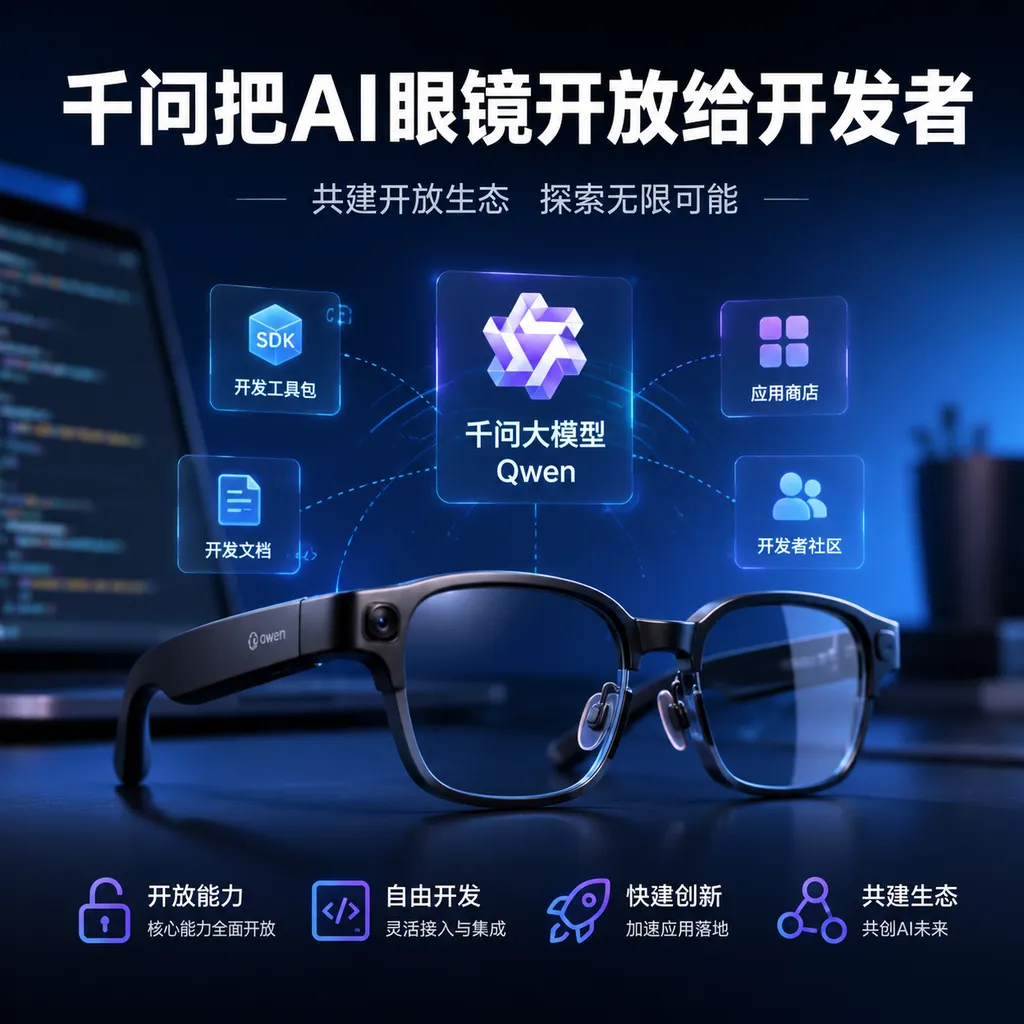
Qwen opens its AI glasses Skill ecosystem, allowing developers to access capabilities such as photography and voice interaction to build their own tour guides, coaches, and inspection assistants. The real test lies not in the number of Skills, but in real-time performance, reliability, and the depth of access to device capabilities.
AI Glasses Can Finally Run More Than Just Manufacturer-Preinstalled Features
August 15 — Alibaba’s Qwen recently disclosed further details about its open platform for AI glasses: developers can access capabilities such as taking photos and voice interaction, create Skills by describing requirements in natural language, and customize inspection assistants for industries such as manufacturing and retail.
The Qwen Open Platform launched on August 10 and supports apps, PCs, and AI glasses. The glasses offering is divided into two parts: a Skill platform for general developers and an industry customization module for enterprise customers.
The former is more like an application platform for AI glasses. Rather than handling hardware interfaces such as cameras, microphones, and voice output from scratch, developers can build scenario-specific logic on top of the capabilities provided by Qwen. For example, they can:
- Use the “take a photo with the glasses” capability to create a “What’s Around Me” Skill for visually impaired users, identifying steps and obstacles and providing voice alerts;
- Create an attraction guide Skill that provides background information and stories when users look at a building;
- Build a recipe expert that provides step-by-step guidance during ingredient preparation, cooking, and plating;
- Develop a coaching Skill for exercise scenarios that offers training advice based on the user’s surroundings and input;
- Integrate enterprise inspection standards to create inspection assistants for equipment, shelves, or stores.
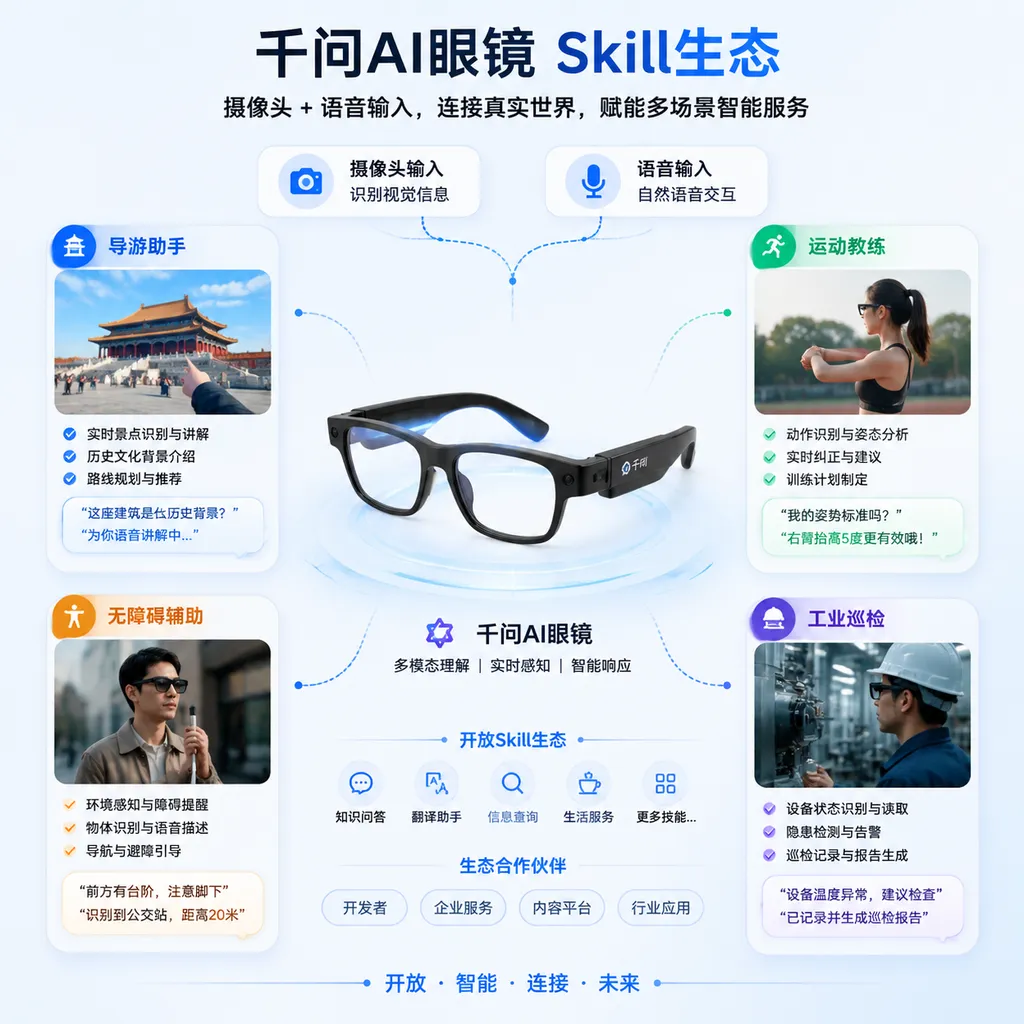
The key point of this update is not that Qwen has added a few more demos, but that Alibaba has begun transforming AI glasses from closed hardware into a computing device that developers can help extend.
A Skill Is Essentially an On-Site Workflow Built Around a Multimodal Model
From a development perspective, AI glasses Skills are not mysterious. They can be understood as workflows consisting of hardware perception, model understanding, external knowledge, and result delivery: the glasses capture first-person images and voice input; the model determines the user’s intent and interprets the scene; it then accesses a knowledge base or business rules; and finally, it returns the result to the user through voice output or a display module.
This resembles agent-based applications on smartphones, but glasses introduce two key variables.
First, the input is continuous, first-person, and highly dependent on the environment. Smartphone applications usually wait for users to take a photo, upload a file, or enter a question. Glasses, by contrast, naturally operate in a “look and ask” mode. If a user says, “How do I operate this?”, the model must know which device or button in the field of view “this” refers to. The accuracy of this contextual binding directly determines whether a Skill is usable.
Second, the interaction window is extremely short. When users are cooking, sightseeing, or conducting inspections while wearing glasses, they will not patiently listen to a two-minute model analysis. The system must provide answers that are sufficiently brief and clear at the right moment. Compared with generating fluent text, glasses place greater importance on response latency, interruption handling, reference resolution, and error recovery.
Qwen’s ability to let developers create Skills by describing requirements in natural language lowers the barrier to building workflows, but it does not reduce development to “say one sentence and go live.” A truly usable Skill still needs to handle trigger conditions, tool invocation, knowledge sources, permission boundaries, exception branches, and output formats.
For example, a recipe assistant cannot merely recognize that “there are eggs in the pan.” It must also know which step the user is performing, whether the previous step has been completed, whether the current heat level is appropriate, and whether it should continue providing operational guidance if a recognition error occurs. Otherwise, it is merely a visual question-answering tool installed in a pair of glasses, not a cooking assistant.
Tour Guides Are Easier to Demonstrate, but Inspection May Make Money First
From a product marketing perspective, attraction guides and sports coaches make it easiest for consumers to understand the value of AI glasses. A user looks at a building and the system automatically explains it; while the user is running, the glasses offer advice based on their condition. These scenarios are intuitive and well suited to demonstrations.
From a commercial deployment perspective, however, industrial and retail inspection may deserve more attention.
The pain point of traditional inspection is not that “employees cannot see the equipment,” but that inspection standards are complex, record-keeping is cumbersome, and expertise is difficult to replicate. Employees must verify items one by one against a checklist, take photos, enter results, and report anomalies. If AI glasses can combine enterprise SOPs, equipment documentation, and visual recognition, they may be able to compress the entire process into a single on-site workflow:
- Automatically identify the equipment or shelf being inspected;
- Retrieve the corresponding inspection items and historical records;
- Remind workers to check areas that are easily overlooked;
- Identify obvious anomalies and request manual verification;
- Record results by voice and generate structured inspection data.
The value of this model is easier to quantify than that of general-purpose question answering. Enterprises can directly compare inspection time, missed-detection rates, training cycles, and issue-resolution speed, and are more willing to pay for stable solutions.
However, inspection is also precisely the type of scenario that can least afford to let models “improvise.” An inaccurate account of a building’s history in a consumer tour guide may hurt the experience; missing a faulty valve during an industrial inspection could have entirely different consequences. Industry-oriented Skills must incorporate deterministic rules, human confirmation, and audit logs. Large-model output cannot be treated directly as an inspection conclusion.
In other words, the competitiveness of Qwen’s industry customization module will ultimately depend not only on model parameters, but also on whether the platform can genuinely integrate enterprise knowledge bases, inspection standards, permission systems, and business software.
Accessibility Assistance Is Valuable, but It Must Not Be Marketed as a Safety Guarantee
The official “What’s Around Me” Skill is one of the examples with the clearest social value in this platform opening. Developers can use the glasses’ photo-taking capability to identify steps and obstacles ahead, then provide voice alerts to visually impaired users.
First-person devices are indeed well suited to this type of assistive scenario: they leave the user’s hands free, and the camera generally follows the direction of the user’s field of view. However, turning a demo into a reliable product is far from easy.
A single photo cannot fully capture rapidly approaching vehicles, low-lying obstacles, transparent glass, or hazards outside the field of view. Cloud-based recognition may also be affected by network conditions, upload latency, and low-light environments. If feedback arrives even one second late, the warning itself may become meaningless.
Such Skills are therefore better defined as “environmental information aids” rather than replacements for navigation or obstacle-avoidance systems. The platform must also clearly define capability boundaries and provide explicit notices when confidence is low, the network is disconnected, or the image is unusable. Developers, meanwhile, must evaluate not only recognition accuracy but also end-to-end latency, false-positive frequency, and degradation under different environmental conditions.
This is an important distinction between the AI glasses ecosystem and the conventional chatbot ecosystem: when the latter gives an incorrect answer, users can usually ask again; when the former enters a real-world chain of action, errors can directly affect the user’s next move.
How Much Hardware Context Is Available Determines What “Looking At Something” Really Means
The official description says that an attraction guide Skill can provide an introduction when a user looks at a building. But developers must ask a more specific question: does “looking at” refer to the camera’s field of view, the direction of the user’s head, or precise eye tracking?
The three correspond to entirely different product capabilities.
If the system receives only a first-person photo, it may be able to identify the main subject in the image, but not necessarily determine whether the user is actually focused on the statue to the left or the building in the distance. If it can access head pose and spatial positioning, the system may be able to maintain stable scene anchors. If eye-tracking data is also available, a Skill can understand the object of the user’s gaze more accurately—but this introduces more sensitive privacy concerns.
The information Qwen has released so far focuses mainly on photo capture, voice interaction, and natural-language Skill creation. It has not yet provided detailed disclosures regarding API granularity, review mechanisms, device-cloud workload allocation, data retention policies, or the distribution model for third-party Skills. These details will determine whether this becomes an ecosystem capable of producing standalone applications or merely a Skill marketplace based primarily on template configuration.
For professional developers, the most important question is not whether they can “create a tour guide with zero code,” but rather the following:
- Whether stable event, session, and device-state APIs are available;
- Whether Skills can call external APIs, private knowledge bases, and enterprise systems;
- Whether image and voice data is processed on-device or uploaded to the cloud by default;
- How third-party Skills are installed, updated, monetized, and granted user authorization;
- How resource usage and trigger conflicts are handled when multiple Skills monitor the environment simultaneously;
- Whether the platform provides physical-device debugging, log replay, and latency monitoring tools;
- How review responsibilities are divided for health, accessibility, and industrial safety applications.
Without this infrastructure, the number of Skills may grow rapidly, but high-quality applications will be difficult to maintain over the long term.
The Next Stage’s Potential Lies in 3D Displays and Health Sensing
Qwen has said that the open platform will gradually provide access to capabilities including spatial 3D stereoscopic displays and exercise and health status sensing.
If these two capabilities are genuinely opened to developers, they will significantly raise the ceiling for AI glasses applications.
Spatial displays mean feedback will no longer be limited to voice. A maintenance assistant could place step annotations near the corresponding components, an attraction guide could overlay historical information on buildings, and a navigation Skill could use directional cues instead of lengthy voice prompts. However, spatial applications require continuous positioning, stable tracking, and low-latency rendering, making them far more complex to develop than simply calling a photo-capture plugin once.
Health status sensing could allow sports coaches to move from “general advice” to real-time, personalized feedback. If the system can access heart rate, activity status, or other sensor data, it can adjust the pace of training based on both movement and physical condition. Health data, however, is highly sensitive. Permissions should be separated by capability and revocable by users at any time. The platform must also prevent Skills from presenting health recommendations as medical diagnoses.
This also shows that the photo and voice capabilities currently opened by Qwen are only the first layer. What will truly differentiate AI glasses is whether spatial positioning, continuous video, motion sensors, display systems, and on-device computing power can gradually be added to the developer toolkit.
This Is a Ticket to Enter the Market, Not Yet a Mature Ecosystem
Qwen is moving in the right direction by opening AI glasses Skills.
A problem with many previous AI glasses products was that they showcased translation, photography, question answering, and other features at launch, but gave third-party developers almost no opportunity to participate. Manufacturers determined the available features, leaving use cases confined to a handful of general-purpose entry points. By opening Skills, Qwen allows vertical developers and industry service providers with more specific needs to enter the market, giving AI glasses a chance to evolve from “a model client worn on the face” into a new application platform.
But the viability of the platform cannot be judged solely by how many tour guides and coaches can be created. AI glasses applications depend more heavily on real-time perception than smartphone applications and are more likely to encounter privacy and safety boundaries. Developers need more than natural-language orchestration: they also need a stable SDK, device simulators, a permission system, data governance, application distribution, and monetization capabilities.
In the short term, clearly defined and controllable scenarios such as enterprise inspection, store operations, and training assistance are more likely to become viable first. Tour guides, recipe assistants, and sports coaches for the mass market will instead serve to educate users and showcase the ecosystem. Accessibility assistance deserves investment, but safety boundaries must be built into product design rather than merely featured in promotional examples.
Qwen has opened the door a crack. What remains to be seen is whether developers can gain access to a sufficiently complete set of hardware capabilities—and whether these Skills can evolve from demos created in a few minutes into products that users are willing to wear and use over the long term.
References
- ITHome: Alibaba Qwen Opens Its AI Glasses Ecosystem, Supporting Custom Tour Guide, Coach, Inspection, and Other Skills — Covers the launch date of the Qwen Open Platform, its capabilities for glasses, Skill examples, and plans to open additional capabilities.