Yinchao Opens Its API for Free, Taking Direct Aim at Suno
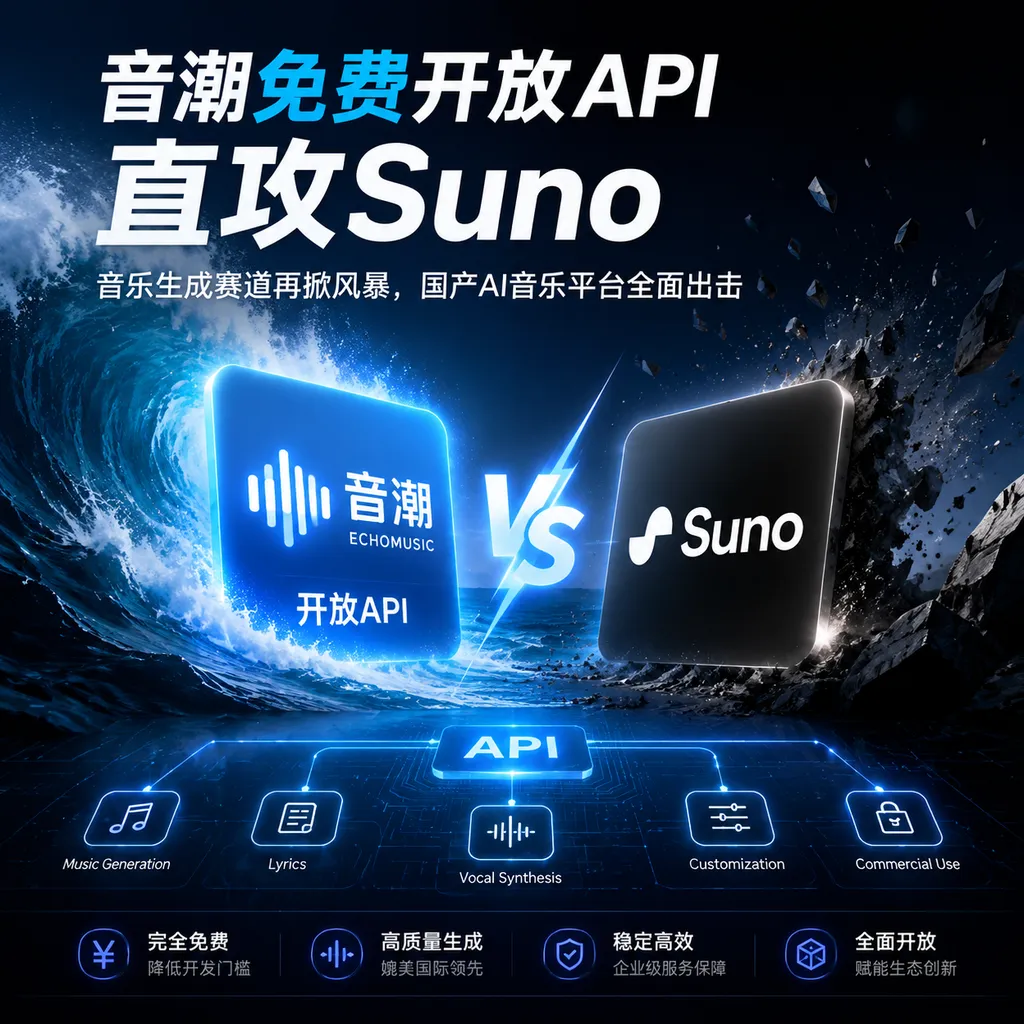
The homegrown music model Yinchao recently made its API available for free for a limited time, seeking to compete with Suno for the AI music app ecosystem by focusing on Chinese-language vocals, generation controls, and developer access. But free access is merely the price of admission; stability, copyright safeguards, and production-grade engineering will determine whether it can truly be deployed in production environments.
Yinchao Opens Its API for Free as Chinese AI Music Takes Direct Aim at Suno
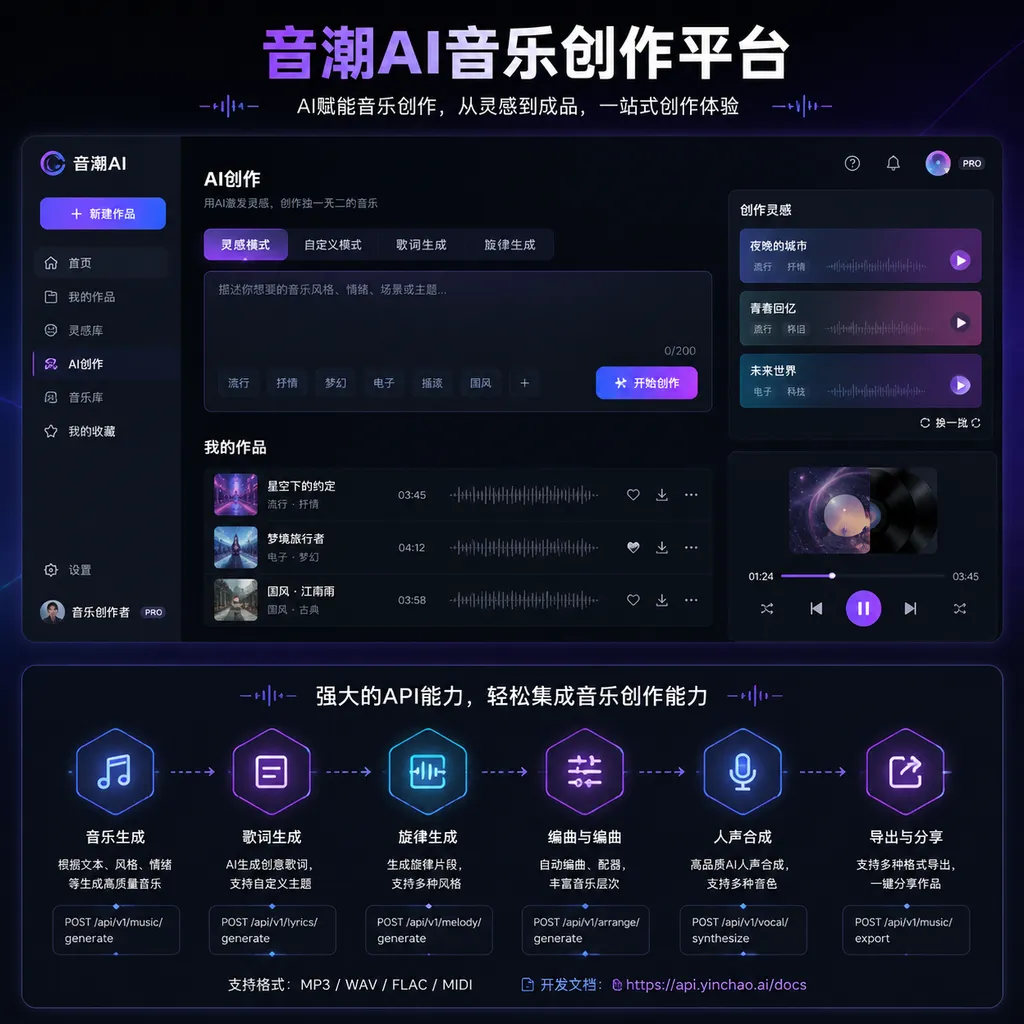
Chinese AI music platform Yinchao recently announced that it is opening access to its music model API for free for a limited time. Developers can apply to integrate its music generation capabilities, covering multimodal generation, voice cloning, music continuation, stem separation, music understanding, intelligent mixing and mastering, copyright detection, and more.
This is not just another AI music toy where users enter a prompt on a web page and wait for a song to emerge. What Yinchao really wants to capture is the model capability layer: enabling short-video platforms, game developers, advertising tools, interactive entertainment products, and even digital audio workstations to embed music generation directly into their workflows.
As of August 15, 2026, Yinchao has not fully disclosed on its public pages when the limited-time free offer will end, its usage quotas, concurrency limits, or official commercial pricing. At this stage, the initiative looks more like a concentrated developer acquisition campaign and stress test than a long-term, unrestricted, unlimited free service. Teams preparing to integrate it should first confirm the availability of sandbox keys, licensing scope, data retention policies, and commercial-use terms rather than putting it directly into production simply because it is “free.”
AI Music Competition Is Shifting From Web Generation to APIs
Over the past two years, the easiest AI music capability to demonstrate has been generating a complete song from a single sentence. Enter a genre, theme, and mood, and within tens of seconds the model delivers vocals, lyrics, melody, and accompaniment. The experience is impressive enough to have helped Suno quickly become one of the world’s most recognizable AI music products.
For developers, however, whether a web interface can generate a song that “sounds good” is only the first hurdle.
Once the technology is incorporated into an actual product, the challenges quickly become engineering problems:
- Can the song’s length, sections, and climax be controlled reliably?
- Are Chinese lyrics articulated clearly, or does the model swallow words and stress the wrong syllables?
- Can the same character maintain a similar voice across multiple songs?
- Can only the chorus be changed without regenerating the entire song?
- Can the drums, bass, vocals, and harmonies be separated for further post-production?
- How are failed generation tasks retried, and are asynchronous callbacks supported?
- Can the output be used commercially, and can the platform provide copyright checks or generation records?
Opening an API therefore says more about a company’s ambitions than launching a music creation website. A web product competes for creators; an API competes for the next wave of AI music applications—and the usage volume behind them.
Yinchao’s decision to offer its API for free for a limited time has a clear purpose: lower the cost of experimentation, put the model into more real-world scenarios, use developer feedback to improve both the model and the service, and only then discuss monetization at scale.
Yinchao Is Targeting Some of AI Music’s Hardest Problems
AI music already has no shortage of samples that sound astonishing on first listen. What it truly lacks are results that still sound natural after a full listen and remain stable across repeated generations.
Existing music models tend to share several common problems.
The first is structural drift. Verses, choruses, and bridges may all appear to be present, but the model does not truly understand the song’s narrative. In the second half, it may become repetitive, change keys abruptly, or continue piling on material when the song should be ending. This is similar to a large language model losing control when writing a long article: every sentence is fluent, but the piece as a whole lacks structure.
The second is vocal flaws. Singing in English has become relatively mature, but Chinese requires the model to simultaneously manage polyphonic characters, tones, phrasing, and conflicts with the melody. A model may sing every note correctly yet place the semantic emphasis of a line in the wrong place. It may also stretch syllables that should not be prolonged merely to fit the melody, producing an obvious “AI accent.”
The third is a plastic quality in the mix. The drums, vocals, or synthesizers may not have any obvious issues when heard separately, but when all the tracks are layered together, the dynamics, spatial placement, and frequency ranges compete with one another. The result sounds like an audio sticker compressed far too heavily. Ordinary listeners may not be able to identify the exact problem, but they will feel that it “doesn’t sound like an officially released song.”
The fourth is a lack of editability. Generating a song is not difficult; changing only eight bars while leaving everything else intact is. If every adjustment requires rerolling the entire song, AI behaves more like a slot machine than a production tool.
Yinchao’s publicly emphasized capabilities—including multidimensional voice control, real-time editing, music continuation, stem separation, and intelligent mixing and mastering—are designed around these pain points. The direction is sound: instead of packaging “text-to-full-song generation” as its only selling point, the company is attempting to cover the entire chain from generation to post-production.
However, there is still a long way between “claiming to support” these capabilities and making them reliable enough for business use. Stem quality, voice consistency, long-form audio structure, and localized regeneration in particular must be validated through real projects rather than judged solely by officially curated demos.
Compared With Suno, Yinchao’s Opportunity Is Not to Build a Chinese Copy
Calling Yinchao “China’s Suno” is convenient, but not entirely accurate.
Suno’s advantages extend beyond its model. It has built a complete product loop spanning prompt-based generation, lyric writing, audio input, song editing, community publishing, and mobile consumption. Its professional mode continues to strengthen localized regeneration and multitrack separation, moving from a one-click song generator toward a lightweight generative audio workstation.
More importantly, Suno has scale. Large numbers of users continually generate, audition, remake, and share songs every day, creating a feedback data loop that is difficult to replicate. A model company may be able to catch up on a benchmark or a set of samples, but it is difficult to reproduce this type of product distribution and data flywheel in a short period.
Yinchao has three more realistic points of entry.
1. Chinese Singing and Local Music Styles
Chinese singing is not simply a matter of replacing English lyrics with Chinese characters. Tones, rhymes, breathing, and melody must be handled together. Local genres and use cases—including folk music, Chinese-style music, rap, square-dancing music, and theme songs for short-form dramas—also have their own arrangement conventions. If Yinchao can consistently reduce wrong notes, swallowed syllables, and mechanical phrasing in these areas, it has a chance to establish a genuine regional advantage.
2. Integration for Chinese Developers
Overseas services may increase integration costs because of network stability, payments, enterprise procurement, and data compliance. For Chinese teams that need to generate short-drama soundtracks, game character songs, or e-commerce advertising music in bulk, low-latency APIs, RMB billing, Chinese-language technical support, and clear commercial-use licensing are often more important than one platform producing a better-sounding individual sample.
3. Selling More Than Complete Songs
Complete songs are the most eye-catching capability, but they may not be the easiest to monetize at scale. Dynamic background music for games, podcast intros, beat-synced short-video audio, advertising music, virtual character voices, and music stem separation involve more fragmented demand and are better suited to API calls.
Yinchao’s published capability list covers generation, continuation, stem separation, understanding, mixing and mastering, and copyright detection. This suggests that it wants to provide a music production infrastructure stack rather than simply build another Suno-style consumer app. This path is more demanding, but commercial customers are also generally more willing to pay.
A Limited-Time Free Offer Helps, but It Cannot Solve the Core Problems
Opening a music generation API for free will naturally attract developers. Projects that previously remained at the prototype stage because of high per-generation costs can now test batch processing, workflow orchestration, and user interactions with fewer concerns.
But being free is not, in itself, a competitive advantage. The cost of generative music includes model inference, audio encoding, storage, content moderation, and network transmission. A song lasting several minutes consumes significantly more compute and bandwidth than returning a few hundred words of text. Without a clear path to monetization, the more popular the free service becomes, the greater the infrastructure burden on the provider.
What deserves more attention is whether Yinchao can use this launch to answer the following questions:
- Task reliability: How long are queues during peak periods, and what are the failure and timeout rates?
- Output controllability: Do prompts, lyrics, sections, tempo, and key actually take effect?
- Reproducibility: Are seeds, version locking, or similarity controls available?
- Editing capabilities: Can users continue a specific section, replace vocals, and preserve the accompaniment structure?
- Delivery specifications: Are the output sample rate, bit depth, encoding format, and number of stems suitable for post-production?
- Commercial licensing: How are usage rights, exclusivity, and liability for infringement allocated?
- Service commitments: Once billing begins, will the platform offer SLAs, quota management, and enterprise-grade support?
If these questions do not have clear answers, the API will only be useful for demos. If the answers are sufficiently robust, it may enter the official production pipelines of short-drama, game, and advertising companies.
How Developers Should Test It Instead of Merely Listening to Official Samples
The worst way to evaluate a music model is to generate two songs from a broad prompt and then declare a winner based on personal preference. A more effective approach is to establish a fixed test set and generate the same tasks repeatedly.
The tests should cover at least the following scenarios:
- Chinese lyrics containing polyphonic characters, numbers, English abbreviations, and fast-paced rap;
- A complete song with explicitly specified lengths for the intro, verse, chorus, bridge, and outro;
- Pop, rock, Chinese-style, and electronic versions generated from the same lyrics;
- Multiple works generated consecutively with the same specified voice to test character consistency;
- Continuation of an existing audio clip to examine whether the rhythm, key, and spatial qualities remain coherent;
- Separation of vocals, drums, bass, and other instruments to check for bleed and residual audio;
- Dozens of repeated calls for the same task to record latency, failure rates, and costs.
Particular attention should also be paid to version changes. After a music model is updated, its voice, arrangement preferences, and output loudness may drift even if the API parameters remain unchanged. For virtual singers or game characters that require ongoing operation, such changes are more troublesome than occasional failures. Ideally, an API should allow callers to lock the model version and provide advance notice of upgrade windows.
Voice Cloning and Copyright Detection Are Both Selling Points and Risk Areas
By including voice cloning and copyright detection among its API capabilities, Yinchao cannot avoid the most sensitive questions in generative music: Whom is the model imitating, and does the user have the right to upload that voice?
Voice cloning can be used for virtual characters, game NPCs, spoken-word content, and singer demos, but it can also be used to impersonate real people. At a minimum, the platform needs systems for authorization verification, restrictions involving sensitive individuals, generated-content labeling, complaint handling, and traceable logs. A single line in the user agreement stating that “infringement is prohibited” is not enough to address the risks faced by enterprise customers.
Nor should copyright detection be interpreted as an absolute guarantee of safety. At most, it can help identify melodic, audio-fingerprint, or structural similarities between generated output and existing works. It cannot easily resolve questions concerning the licensing of training data, style imitation, or ownership of rights.
Commercial teams should require suppliers to clearly explain which music catalogs their detection covers, what thresholds they use, whether generation records are retained, and what evidence they can provide in the event of a dispute. Once AI music enters production environments, copyright capabilities are not an add-on—they are part of the infrastructure.
Assessment: Chinese AI Music Is Finally Entering the Model Services War
The greatest significance of Yinchao opening its API for free for a limited time is not that “there is now another free API.” It is that Chinese AI music companies are beginning to shift the competition from consumer websites to the developer ecosystem.
The timing is right. Suno has already demonstrated enormous mass-market demand for generating complete songs from a single sentence. Platform companies such as Google are also embedding music generation into products with much larger distribution channels. If Chinese companies continue merely imitating web products, they will struggle to build lasting barriers. Chinese-language singing, localized services, editable workflows, and enterprise delivery are more promising areas for differentiation.
But it is clearly too early to say that Yinchao has defeated Suno head-on. Suno still has obvious advantages in product completeness, user scale, and its creator community. Yinchao, meanwhile, must prove that its API is not merely a collection of attractive capability labels, but a service that can be called reliably, billed transparently, and used commercially with confidence.
Free access can bring in the first group of developers, but it cannot buy long-term trust. The outcome of this competition will not be decided by which model occasionally generates a better-sounding song. It will be decided by who can make 10,000 API calls reliably enough, keep the generated results editable, and ensure that businesses know whom to contact when copyright problems arise.
If Yinchao can fill these gaps, it may not need to become another Suno. Becoming the model layer behind China’s AI music applications could be a more practical—and much larger—business.
References
This article is based on Yinchao’s recent public announcements, product capability descriptions, and publicly available information about the AI music industry. Due to restrictions on the range of link domains, the original reports and official product website are not listed here.
- GitHub: Index of Open-Source AI Music Projects — Used to understand the ecosystem of music generation, audio processing, and related development tools.
- Zhihu: Search for Discussions About AI Music Generation and Suno — Used to supplement discussions in the Chinese-language community about generation quality, copyright, and product experience.