DeepSeek Harness Plugin Boom
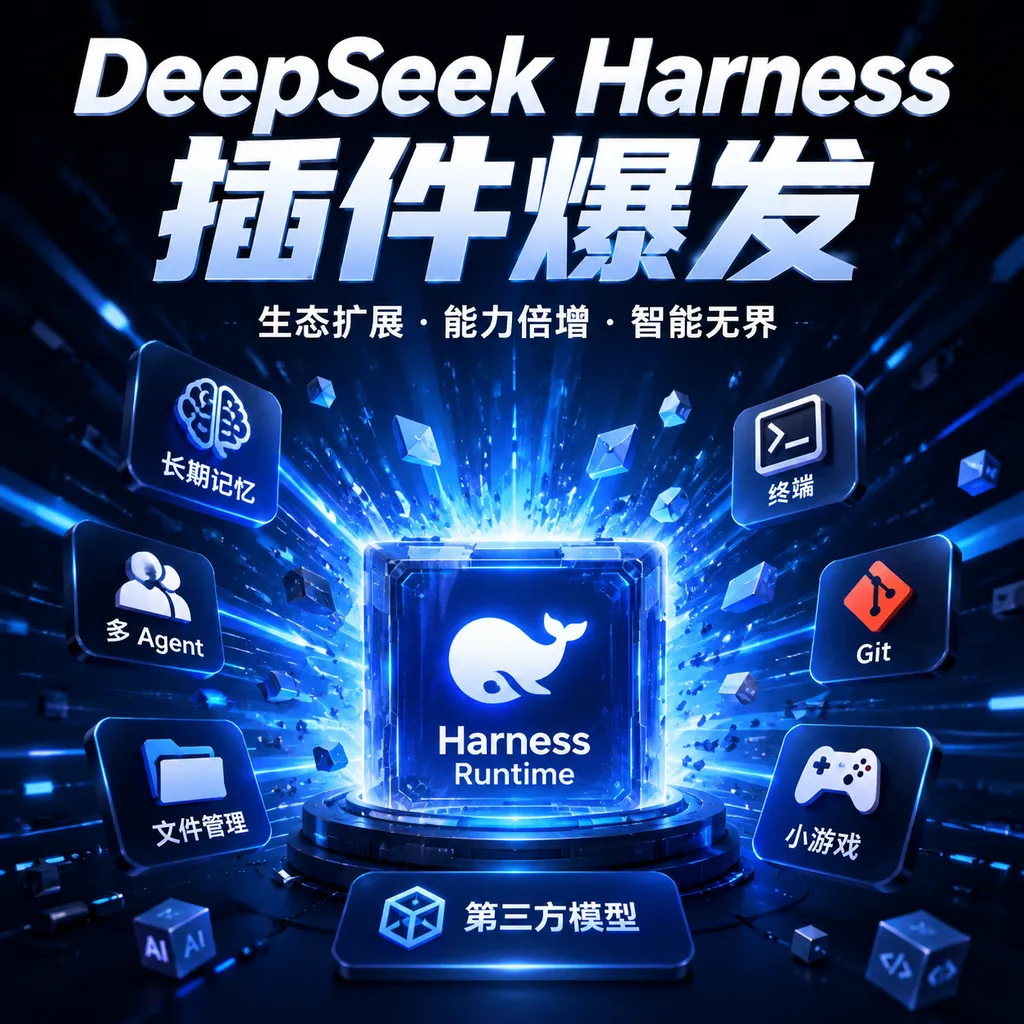
Just two days after launch, DeepSeek Harness has already spawned plugins for long-term memory, multi-agent systems, file references, a mini IDE, and mini-games. Behind the buzz, a battle is beginning over the gateway to the agent runtime.
DeepSeek Harness Plugin Explosion: Agents Are Starting to Grow Their Own Capabilities
Less than two days after DeepSeek Harness was released, developers had already transformed it from an open-source Agent runtime environment into a “plugin container” equipped with long-term memory, multi-Agent teams, file references, a full IDE sidebar, and even virtual pets and browser games.
As of August 15, community-curated directories and the GitHub Topic surrounding DeepSeek Harness had aggregated hundreds of related repositories, with some counts exceeding 700. Of course, that number cannot be equated directly with 700 mature plugins—it includes experimental projects, duplicate implementations, scaffolding, and newly created empty repositories—but the pace of growth is still unusual enough to merit attention.
What deserves the most attention is not the virtual pets, nor the fact that developers can finally play “4399-style” games inside an Agent interface. The real change is that DeepSeek has exposed model selection, context management, tool loops, storage, and UI—capabilities previously encapsulated inside Agent products—to the plugin system.
This makes DeepSeek Harness look more like an Agent Runtime than another Codex or Claude Code.
Within Two Days of Launch, Developers Had Already Filled Four Capability Gaps
DeepSeek Harness opened its developer preview on August 13. It is still at version v0.1 and is open-sourced under the MIT License. Its official slogan is “Everything is a plugin”: models, tools, Skills, sessions, sandboxes, storage, execution loops, schedulers, and UI can all be extended—or even replaced—by plugins.
In traditional software, plugins usually add a button at the edge of a product. Chrome extensions can intercept web pages, and VS Code extensions can add language support, but the browser’s navigation logic and the editor’s core behavior remain under official control.
DeepSeek Harness plugins go much deeper. They can do more than add tools: they can change what the Agent sees, what it remembers, how it invokes models, when it compresses context, and what the final interface looks like.
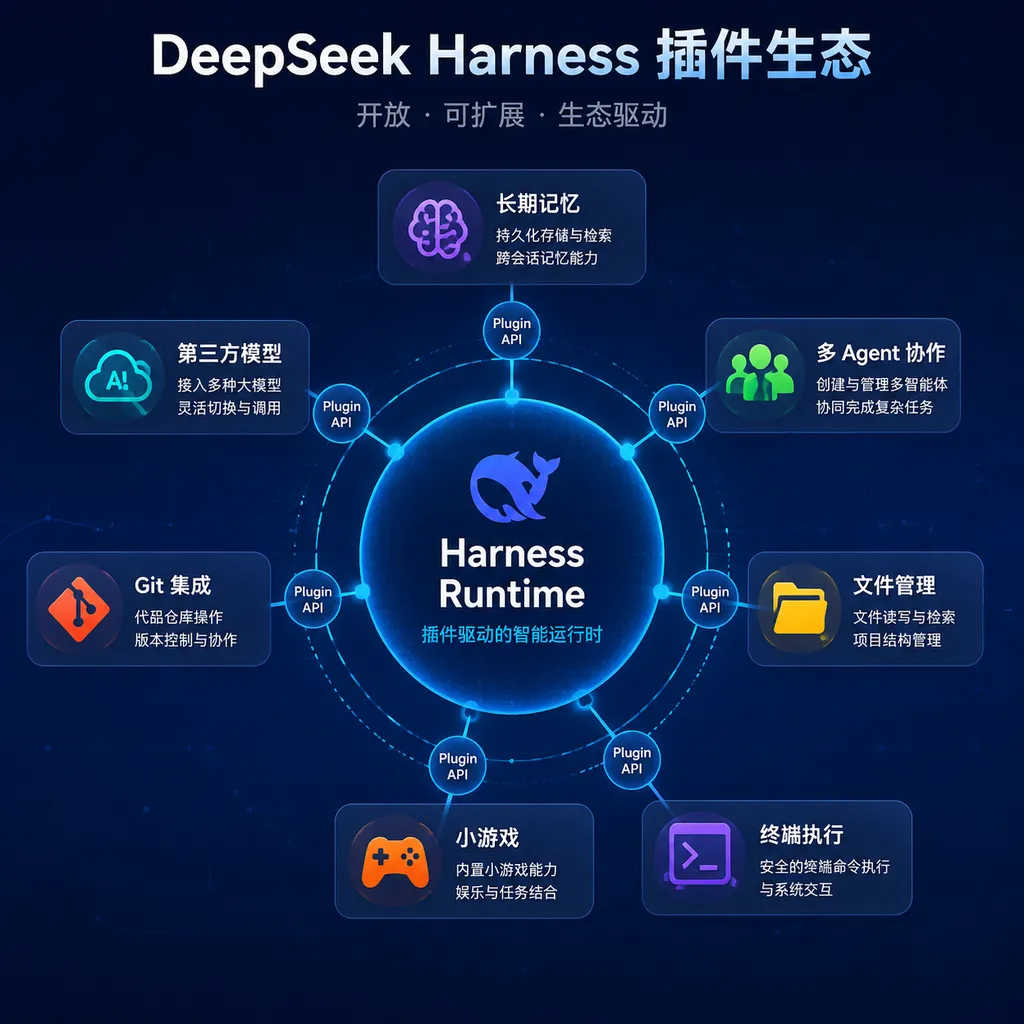
The projects that have emerged over the past two days can be roughly divided into four categories.
1. Long-Term Memory: Preventing the Agent from Forgetting Everything at the Start of Every Session
The category with the most practical value so far is cross-session long-term memory plugins, represented by dsh-memory-evolve.
The problem with a typical Coding Agent is not that it cannot write code, but that it cannot remember the project. You may tell it today that the deployment port is 8080, authentication must go through middleware, and database migrations must never run automatically. A few days later, when you open a new session, you often have to explain all those conventions again.
Long-term memory plugins attempt to persist this information and reinject it into context hierarchically. They store more than chat logs, including:
- Project conventions and architectural decisions;
- Confirmed technical preferences;
- Historical incidents and lessons learned;
- Current task progress;
- Branch-specific Git information;
- Skills distilled from past execution processes.
Their implementation is not simply “a vector database plus RAG.” Existing plugins tend to use local file persistence and layered context injection, while having the model periodically organize and compress its memory. Temporary conversations are not all permanently stuffed into the prompt. Instead, they are first distilled into summaries, rules, or retrievable records, then recalled when needed.
You can think of it as adding a project wiki to the Agent—except that the wiki is maintained by the model as it works.
This may not be as eye-catching as a mini-game, but it could be the most valuable capability to emerge from this entire wave of plugins. For refactoring, migration, and test-completion tasks that continue for weeks, the benefits of long-term memory are often more immediate than a few extra points on a model benchmark.
The risks, however, are equally obvious. Once the model writes an incorrect conclusion into long-term memory, future sessions may consistently repeat the same mistake. A memory system must support provenance tracking, human confirmation, expiration and cleanup, and branch isolation. Otherwise, so-called “self-evolution” can easily turn into the continuous accumulation of technical debt.
2. Multi-Agent Teams: The Primary Agent Becomes a Project Manager on the Spot
dsh-agent-teams represents another popular direction: dynamically launching multiple sub-Agents within the current session.
The user only needs to provide a relatively broad task. The primary Agent can then break down the work, create team members, configure dependencies, and assign sub-Agents to search for information, read code, write tests, or verify results. Different members can also exchange messages, while the web interface displays the status of each Agent.
The workflow looks roughly like this:
User task
   ↓
Primary Agent breaks down the objective
   ↓
Creates research, coding, testing, and other sub-Agents
   ↓
Parallel execution and inter-Agent communication
   ↓
Primary Agent aggregates, verifies, and delivers the result
It looks like a “cyber project team,” but multiple Agents do not automatically mean faster execution.
If a task can be divided clearly—for example, reviewing several independent modules at the same time or checking frontend and backend interfaces in parallel—multiple Agents can indeed improve throughput. But once multiple subtasks share a large amount of implicit state, communication overhead, duplicated context, and conflicting results increase rapidly. Having three Agents modify the same set of files simultaneously may be worse than having a single Agent complete the work sequentially.
The real problems multi-Agent plugins need to solve, therefore, are not whether they can “start a group chat,” but dependency graphs, permission boundaries, shared memory, and conflict resolution. Without a scheduling mechanism, a multi-Agent system merely turns one expensive call into several expensive calls.
3. Files, Terminals, and Git: Harness Is Growing into a Mini IDE
dsh-at-file adds file-reference capabilities similar to Codex. Developers can search workspace files by entering @filename in the input box, then attach the selected content to the current task.
For example, if you want to rewrite a payment page with reference to the existing login module, you previously had to locate the file, copy the code, and paste it into the context. Now you can directly reference the relevant file and specify the required changes.
This feature may appear simple, but it touches on the core user experience of a Coding Agent: how to give the model the right context.
A larger model context window does not mean you should stuff the entire repository into it at once. An explicit @file reference allows developers to quickly specify high-confidence material, reducing retrieval errors while controlling token consumption. It is not the most automated solution, but it is usually more reliable than “letting the Agent guess which files it should inspect.”
Another plugin, DSH Better Sidebar, puts file management, code editing, a Shell terminal, Git diffs, staging and commits, background tasks, and sub-Agent status into the same sidebar. Once installed, Harness is no longer merely a chat window—it becomes a lightweight development workbench.
The practical value of these plugins is straightforward: they reduce the need for developers to switch repeatedly among Harness, VS Code, the terminal, and a Git client.
However, the closer the sidebar gets to an IDE, the more Harness must deal with problems editors have spent years solving, including file watching, character encoding, performance on extremely large repositories, terminal isolation, Git conflicts, and remote environment connectivity. Building a panel that can edit files is not difficult; building a reliable development environment is.
4. Virtual Pets and Mini-Games: Not Productive, but Highly Revealing
The community has also created virtual pets, themes, advertising slots, and mini-game plugins for DeepSeek Harness. From a productivity perspective, these projects are largely unnecessary. From a platform-capability perspective, however, they are among the most intuitive demonstrations.
If a plugin can insert a pet into the interface or add a game panel, that means plugins have gained fairly deep control over the UI. Developers can use the same capabilities to build vertical-industry panels, review workbenches, database browsers, task boards, and visual debuggers.
Mini-games are toys, but they prove that the DeepSeek Harness interface is not a fixed shell.
This is also where DeepSeek differs most from the majority of integrated Agent products: the company has not dictated what the final product must look like. Instead, it treats the interface itself as a composable module.
Its Difference from Codex Goes Beyond Open Source vs. Closed Source
It is inaccurate to think of DeepSeek Harness simply as “an open-source version of Codex.”
Products like Codex place greater emphasis on delivering a complete experience: the model, sandbox, task interface, code operations, and cloud execution are integrated by the vendor, allowing users to get started immediately. The advantage is that the default configuration has been tested as a whole, making compatibility among features more controllable. The trade-off is that developers have little ability to replace the underlying strategies.
DeepSeek Harness has chosen a different path. It provides four runtime modes: a standard mode with a complete toolset; a PTC mode in which the model generates code to orchestrate multi-turn calls; a minimalist mode that retains only Shell and file-editing tools; and a creation mode that allows users to inspect the runtime and experiment with plugin combinations.
Under this design, developers can independently decide:
- Which model to use;
- Which tools the model may invoke;
- How system prompts and Agent Presets are organized;
- When context is compressed and how it is injected;
- Whether tasks are delegated to sub-Agents;
- Where session logs and long-term memory are stored;
- Which interface is ultimately used to present the system.
DeepSeek Harness supports nearly 40 model providers by default, including OpenAI, Anthropic, Google, and Kimi. This also indicates that DeepSeek has not, at least for now, locked Harness into being a dedicated client for its own models. For teams that need unified management of multiple models, Harness is closer to a customizable execution layer.
Its advantage is freedom. Its problem is also freedom.
When an integrated product fails, users usually turn to the vendor. When a plugin-based runtime fails, the problem could lie in any layer: the model, prompts, memory plugin, context compression, tool permissions, or UI state. The larger the space of possible combinations, the harder failures become to reproduce.
DeepSeek mitigates this problem with an append-only session event stream. Model requests, tool calls, context injections, sub-Agent scheduling, and system-prompt changes can all be recorded in logs and used for recovery, branching, and replay. For developers, this kind of Trajectory record is not merely a nice-to-have—it is a prerequisite for the plugin ecosystem to continue expanding.
Without a complete trajectory, an Agent failure leaves behind only a message saying “execution failed.” With a trajectory, developers can at least determine whether the model made the wrong decision or a plugin supplied the wrong context.
700 Repositories Do Not Mean 700 Usable Plugins
This wave of growth has been rapid, but it is still too early to describe it by the standards of a mature ecosystem.
First, DeepSeek Harness remains in Developer Preview, and the company has already warned that future releases may introduce breaking changes. A plugin that works today may no longer load after an upgrade.
Second, GitHub Topics and Awesome Lists solve only the problem of discovery, not quality. Among the hundreds of repositories, the number of projects with complete documentation, testing, versioned releases, and ongoing maintenance is far smaller.
The infrastructure the ecosystem must add next includes at least:
- Plugin manifests and a unified metadata format;
- Harness version compatibility ranges;
- Plugin dependency and conflict detection;
- Permission declarations and runtime isolation;
- Automated testing and signature verification;
- Maintenance status, download counts, and risk warnings;
- A plugin marketplace and review mechanism;
- One-click rollback and safe-mode startup.
Supply-chain security deserves particular vigilance.
A plugin that can modify system prompts, read workspace files, execute Shell commands, access long-term memory, and alter the interface has far more privileges than an ordinary browser extension. A malicious plugin does not need to steal keys directly. It can manipulate the context to induce the Agent to upload code, execute dangerous commands, or write sensitive information to an external service.
“Everything is a plugin” is therefore both the key selling point and the largest attack surface.
Before using plugins in production, teams should at minimum inspect the source code, pin versions, restrict network and file permissions, and bring long-term memory directories under data-governance controls. The most reasonable default attitude toward a virtual-pet plugin from an unknown source is not “install it first and see what happens,” but to treat it as third-party code with Agent runtime privileges.
The Real Competition Is Shifting from Models to Harnesses
Over the past year, the industry has often focused on underlying models when evaluating Agent capabilities: how much coding benchmarks improved, how much context windows expanded, and how much tool-call success rates increased.
The rapid emergence of a plugin ecosystem around DeepSeek Harness shows that another variable is becoming increasingly important: the same model can perform very differently when placed in different Harnesses.
Long-term memory determines whether it understands project history. File retrieval determines whether it can find the right code. Tool loops determine whether it retries after failure. Multi-Agent scheduling determines how complex tasks are divided. The permission system determines whether it can safely take real action.
The model determines the upper limit of capability; the Harness largely determines whether that capability can be delivered reliably.
DeepSeek has already used Harness’s minimalist mode in model evaluations, indirectly indicating that vendors are beginning to treat the execution environment as part of model performance. In the future, when developers compare Agents, they may no longer be able to ask only “Which model does it use?” They may also need to ask, “Which Harness does it run on, which plugins are installed, and what is its context strategy?”
Assessment: The Ecosystem Has Potential, but for Now It Is More Like a Plugin Wild West
DeepSeek Harness’s greatest success so far is not that it has produced a more complete product than Codex, but that it has left enough blank space for developers to fill.
The rapid appearance of long-term memory, @file, multi-Agent teams, and IDE sidebars shows that the Cordis plugin architecture is at least highly extensible. Virtual pets and mini-games demonstrate that the UI layer can also be transformed extensively.
But this only proves that “people are willing to build plugins.” There remains a wide gap before “plugins can be used with confidence”—one that requires an entire foundation of versioning standards, security reviews, dependency management, and commercial incentives.
In the short term, DeepSeek Harness is best suited to developers who are willing to read source code and troubleshoot issues themselves, rather than ordinary teams seeking an out-of-the-box experience. It currently resembles the early VS Code extension marketplace, or an even more chaotic browser userscript community: new projects appear every day, with useful and dangerous ones mixed together.
In the long term, if DeepSeek can keep its underlying interfaces open while adding permission sandboxes, a plugin registry, and compatibility standards, it could indeed become a cross-model Agent runtime gateway. Conversely, if every upgrade breaks large numbers of plugins, hundreds of repositories will quickly become unmaintained examples.
So the mini-games are not the point, and neither are the virtual pets.
The real signal from this explosion is that developers are no longer satisfied with choosing an Agent product—they are beginning to assemble Agents themselves. The next layer of access that model vendors will compete for is moving beyond APIs and chat windows, deeper into Harnesses and plugin ecosystems.
References
- GitHub: dsh-plugin Topic — Used to track DeepSeek Harness-related plugin repositories, update frequency, and the growth of community projects.
- Zhihu: Will DeepSeek Harness Become a New Agent Ecosystem? — Introduces early methods for discovering plugins and discusses ecosystem issues such as compatibility, dependency management, and plugin marketplaces.