Qwen Downloads Surpass 3 Billion, Crowning a New King of Open-Source Models
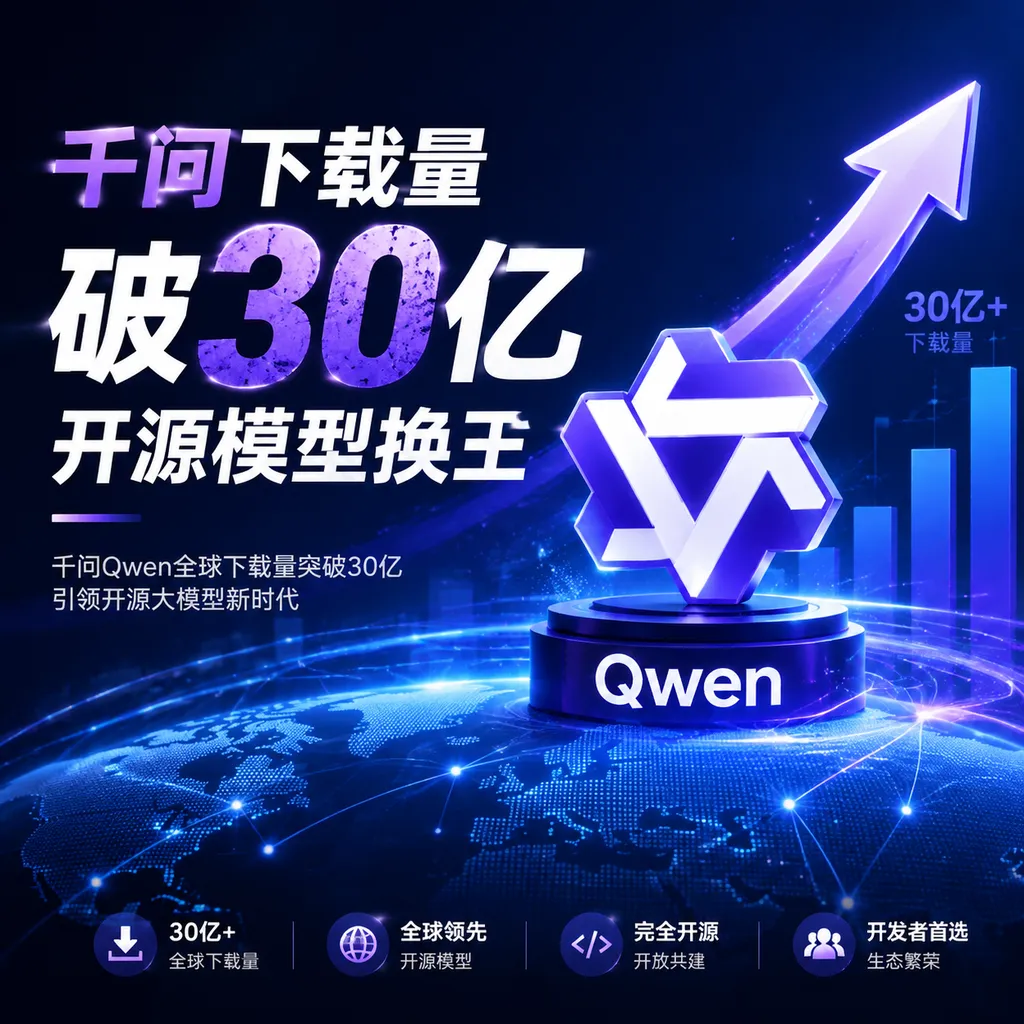
Alibaba’s Qwen has surpassed 3 billion cumulative downloads worldwide over the past six months, including 2.045 billion on Hugging Face alone. More important than the download count, Qwen is becoming one of the default foundation models for fine-tuning, local deployment, and secondary development.
Qwen Becomes the World’s Most-Downloaded Open Model Family
August 15 — Alibaba’s Qwen open model family has surpassed 3 billion cumulative downloads worldwide over the past six months, overtaking Meta and Google to become the world’s most-downloaded AI model family.
This is not a figure inflated solely by domestic platforms.
According to Hugging Face’s State of Open Models report, released on August 14 local time, Qwen has recorded 2.045 billion downloads on the Hugging Face Hub so far in 2026. Over the same period, Google’s open models logged approximately 418 million downloads, while Meta’s recorded roughly 227 million. By this measure, Qwen’s downloads were about 4.9 times Google’s and nine times Meta’s.
Alibaba says Qwen has now open-sourced more than 460 models, spawning over 300,000 derivative models across global communities. Hugging Face alone tracks 151,448 Qwen derivatives—2.6 times Meta’s total and 4.7 times the number of repositories in the Llama family. Google has 82,506 related derivative models.
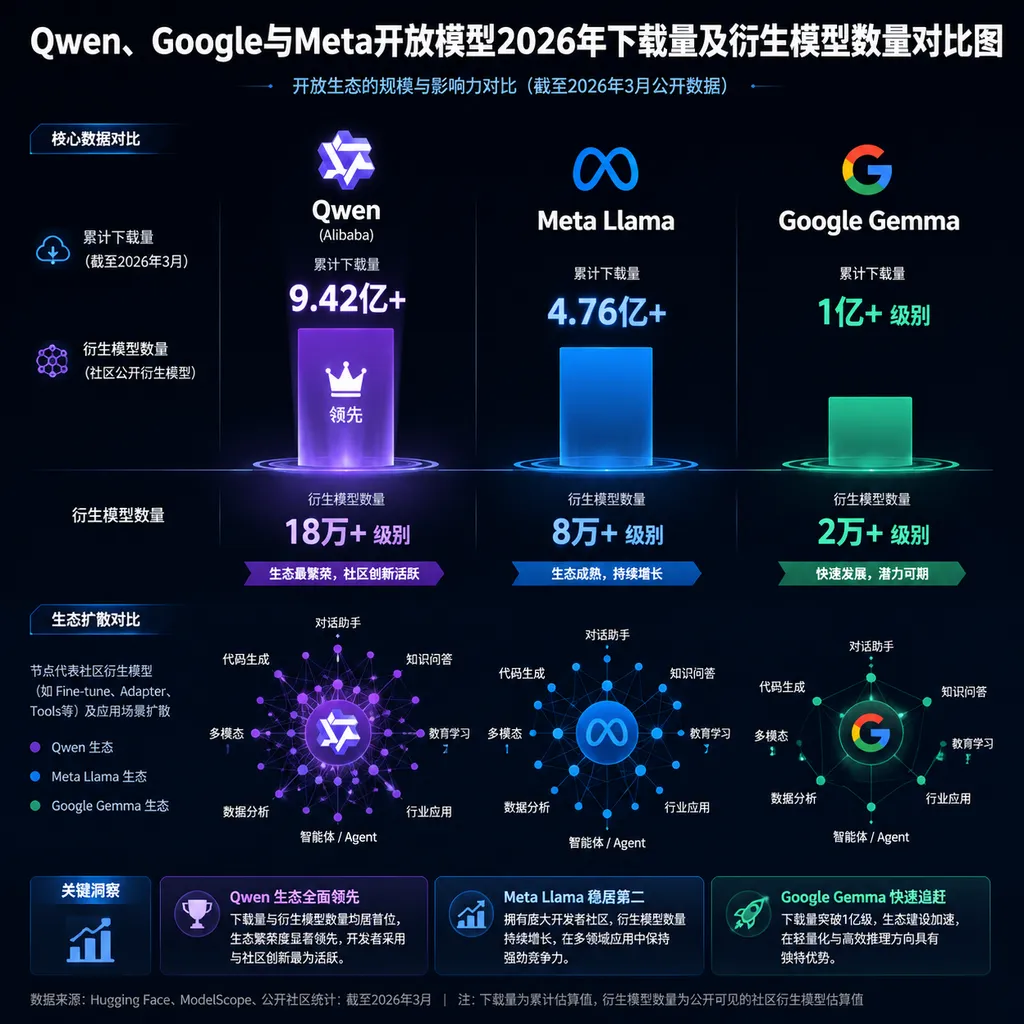
Three billion downloads do not mean 3 billion users, nor do they directly prove that Qwen ranks first in every capability. But when downloads, derivative model counts, quantized versions, and licensing are considered together, the conclusion is already quite clear: Qwen is no longer merely “one of China’s best-performing open-source models.” It has effectively become a major piece of infrastructure in the global open model ecosystem.
The Real Differentiator Is More Than Just One Large Model
A common misconception when discussing Qwen is to treat it as a single chatbot model. In reality, Qwen now resembles an ever-expanding model catalog. It includes flagship models as well as variants designed for coding, vision, speech, reasoning, and on-device deployment. It covers models with hundreds of billions or even trillions of parameters while also offering smaller versions suitable for consumer GPUs, workstations, and edge devices.
This explains how more than 460 official models have gone on to produce over 300,000 derivatives.
After downloading an open model, developers rarely use it unchanged. They typically go on to quantize or distill it, perform instruction fine-tuning or domain adaptation, or convert it into another format. A Qwen base model might be transformed into a legal question-answering model, a code-completion model, or a role-playing model. It might also be compressed into a GGUF version that can run on a phone, Mac, or single GPU.
The number of derivative models therefore says more about ecosystem stickiness than benchmark scores announced at a launch event. Model performance determines whether developers are willing to try a model, while licensing, tool compatibility, and size options determine whether they are willing to build on that foundation over the long term.
Hugging Face concluded in its report that Qwen has become part of the “default workflow” developers use when deciding which models to fine-tune and deploy. That statement carries more weight than “No. 1 worldwide in downloads.” Downloads can result from a short-lived surge in interest, but becoming part of the default workflow means that the model has been embedded into datasets, training scripts, inference frameworks, quantization tools, and deployment templates.
Once that momentum takes hold, later entrants must compete on more than model capabilities—they must also persuade the entire toolchain to adapt all over again.
Small Models Are the Real Driver of Downloads
The report also reveals a fact about the open model market that is often obscured by the parameter race: developers may talk about trillion-parameter models, but what they actually download is mostly small models.
Of all historical downloads, models with fewer than 1 billion parameters account for 83%, while models with more than 100 billion parameters account for only 1%. These figures do not suggest that small models are more capable than large ones. Rather, they show that the core value of the open ecosystem differs from that of closed APIs.
With closed models, users generally care only about performance, price, and latency. The exact number of model parameters or GPUs used for deployment is largely irrelevant. Open models, however, must actually be downloaded and run locally. VRAM capacity, storage requirements, inference speed, quantization loss, and hardware compatibility all directly affect adoption.
For example, a team building offline document retrieval, game NPCs, an in-vehicle assistant, or a factory inspection system may not need the most powerful cloud model. Compared with gaining a few extra benchmark points, the ability to run reliably on a workstation, keep sensitive data from being uploaded, and continue operating without an internet connection is often more valuable.
Qwen’s advantage lies precisely in the breadth and density of its model-size coverage. From small on-device models to flagships, developers can validate a product with a smaller version and then scale up within the same model family according to accuracy and cost requirements.
The report shows that Qwen models in GGUF format receive 39.6 million downloads per month—nearly twice as many as Gemma and more than five times as many as Llama. GGUF is primarily used with llama.cpp and related local inference tools, making it especially suitable for CPUs, consumer GPUs, Macs, and similar devices. This figure indicates that Qwen’s growth is not driven entirely by research institutions downloading model weights in bulk. Local deployment is generating genuine demand.
The newly open-sourced Qwen3.8-27B further reinforces this strategy. It is a native multimodal dense model with 27 billion parameters, designed primarily for programming, office productivity, and local inference. After quantization, it can run on consumer hardware. Compared with Qwen3.8-Max, which has 2.4 trillion total parameters, the 27B version may not appear “flagship” enough, but it is likely much closer to the model most developers will actually deploy.
In other words, Max demonstrates the upper limit of Qwen’s capabilities, while the 27B and smaller versions expand the ecosystem. The latter may attract fewer headlines, but they are more likely to generate sustained downloads and derivative projects.
Apache 2.0 Is a Major Driver of Qwen’s Expansion
The fact that model weights can be downloaded does not necessarily mean a model is sufficiently open. Whether commercial use is permitted, whether modified versions can be redistributed, and whether additional scale-related restrictions apply all influence enterprise decisions.
According to the Hugging Face report, of the 178 models with more than 20 billion parameters released by leading Chinese labs in 2026, 59% use the Apache 2.0 license and 22% use the MIT license. None impose noncommercial restrictions. Qwen3.8-27B likewise uses Apache 2.0.
For developers, this means it is not merely a model that “can be researched,” but one that can enter products relatively easily. Teams can download the weights, deploy the model privately, fine-tune it, and use it in commercial services without first holding several rounds of compliance meetings to interpret ambiguous terms of use.
By contrast, some models with “open” in their names may still impose monthly active-user thresholds, restrictions on specific uses, or additional licensing conditions. Such terms have little effect on personal experimentation, but they make large enterprises more cautious when selecting models.
Permissive licensing does not directly make a model more intelligent, but it can significantly reduce friction in adoption. Performance is only the prerequisite behind Qwen’s rapid development of a vast derivative-model network. Apache 2.0 and compatibility with mainstream inference frameworks are equally critical.
This is also how Chinese open models have found an opening in the global market. While cutting-edge closed-model capabilities remain dominated by a small number of U.S. companies, Chinese vendors are attracting developers to their own foundations through near-frontier performance, lower deployment costs, and more permissive licensing.
Leading in Parameter Count Does Not Automatically Mean Leading in Product Capability
The report also shows that the largest open models released by leading Chinese AI labs in 2026 generally have more parameters than those released by U.S. labs. The upper end of the parameter counts for models released each month by Chinese labs ranged from 754 billion to 2.78 trillion, while U.S. labs remained below 130 billion in most months.
This comparison is striking, but it must be interpreted cautiously.
First, the total parameter count of a mixture-of-experts model is not the same as the number of parameters activated during each inference. An MoE model with more than a trillion total parameters may invoke only a small subset of its experts for a single generation. Comparing total parameters directly is somewhat like measuring the ingredients actually consumed at each table in a restaurant by counting everything in its warehouse.
Second, parameter count is not equivalent to reasoning quality. Training data, architecture, post-training, tool use, and inference-time compute all affect the final result. A well-designed small model can easily outperform a larger model from a previous generation on specific programming or office tasks.
The real progress of Chinese open models therefore lies not simply in making parameter counts larger, but in simultaneously bringing model weights, quantized versions, toolchains, and commercial licensing to the global market. Only when these factors come together can model scale translate into influence among developers.
How Should Three Billion Downloads Be Interpreted?
Hugging Face also cautions that download counts cannot be directly equated with model quality or market share.
Download statistics for model repositories may include automated testing, continuous integration, repeated downloads, mirror synchronization, and file updates. A single developer may also download multiple sizes and quantization levels. Meanwhile, API usage and private enterprise deployments are generally not fully captured by public download data.
Three billion is therefore better understood as an “ecosystem activity metric” than as a measure of “user count” or “commercial revenue.” It answers the question of which models developers around the world are downloading, modifying, and deploying—not which company has made the most money from its models.
Even so, Qwen’s lead is difficult to explain away as statistical noise, for three reasons:
- The margin is large enough. Qwen’s 2.045 billion downloads on Hugging Face alone substantially exceed those of Google and Meta;
- Derivative models are growing in parallel. If downloads were driven mainly by repetitive automated tasks, they would not ordinarily generate more than 150,000 derivative repositories at the same time;
- Local formats are performing strongly. GGUF downloads show that Qwen is entering personal devices and private deployment environments, rather than merely being browsed by researchers.
Any single metric can be questioned. When multiple metrics move in the same direction, however, they are more likely to reflect a genuine trend.
Qwen Is Taking Over the Position Left by Llama
Meta’s Llama was once the almost undisputed center of the open large-model ecosystem. Many fine-tuning tutorials, inference frameworks, and quantization tools were originally built around Llama. But competition among open models has accelerated markedly in recent years, with DeepSeek, Qwen, Gemma, and multiple Chinese labs steadily narrowing the gap in foundational capabilities.
Qwen’s current advantage does not come from having comprehensively defeated every competitor. Rather, it has assembled a relatively complete package spanning release frequency, model-size coverage, multimodal capabilities, Chinese and multilingual performance, and permissive licensing.
Google’s Gemma remains competitive thanks to its research strength and on-device ecosystem. Meta’s Llama has a deeply established toolchain foundation. DeepSeek has built a strong brand around reasoning models and training efficiency. Qwen’s real lead is in “optionality”: developers can almost always find a version within the model family that meets their VRAM, task, and licensing requirements.
This creates a clear snowball effect. More downloads generate more feedback, which drives faster model iteration. More derivative models produce more deployment templates, and lower deployment barriers attract the next wave of developers. In the later stages of open model competition, success is not about a single benchmark result, but about who can make it easiest for developers to move from experimentation to production.
As the Open Ecosystem Expands, Commercialization Questions Will Follow
After becoming the world’s largest open model foundation, Alibaba’s next challenge is to convert its ecosystem influence into sustainable revenue.
Open weights do not mean that every service must be free. Cloud APIs, managed inference, fine-tuning platforms, enterprise support, and computing services can all be monetized. Alibaba can also use Qwen to expand the adoption of its cloud infrastructure and model services, following a model similar to that of open-source software companies monetizing managed services.
But the larger the ecosystem becomes, the more sensitive any change in licensing policy will be. There have recently been market reports suggesting that Alibaba may introduce revenue-sharing requirements for large commercial users of its next-generation open Qwen models. If such rules are implemented, Alibaba will need to strike a balance between commercial returns and developer trust.
One important reason Qwen has been able to surpass Llama and Gemma is precisely that its licensing has been clear and permissive. If large customers are charged in the future, it may not harm the ecosystem as long as the thresholds are clearly defined and the vast majority of developers remain unaffected. But if the terms change frequently or their boundaries are ambiguous, enterprises may reassess the risks of long-term dependence.
This is a challenge every open model vendor must confront. Openness can quickly win developer mindshare, but training and maintaining flagship models requires sustained investment. The eventual winner may not be the most generous team, but the one that first finds the right balance among openness, cloud revenue, and enterprise licensing.
A More Practical Assessment
Three billion downloads do not mark the end of the AI race, nor do they prove that Qwen has defeated GPT, Claude, or Gemini in the closed-model market. Open-weight models and closed cloud APIs address needs that partially overlap but are not identical.
For teams seeking the strongest general-purpose capabilities without the burden of operations and maintenance, closed APIs remain attractive. For projects that prioritize data control, customization, predictable costs, and offline operation, the value of open models such as Qwen is becoming increasingly clear. Using multiple models is also becoming standard practice in real-world development. Aggregation services such as OpenAI Hub, which are compatible with the OpenAI API format, already support Qwen and other mainstream models. Teams can first compare performance and cost through a unified interface before deciding whether to move to private deployment.
What truly deserves attention about Qwen’s achievement is not the highly marketable figure of “3 billion,” but the fact that it has crossed a critical threshold in the open model ecosystem. Developers no longer choose Qwen merely because it comes from a Chinese company, performs well in Chinese, or is inexpensive to access. They choose it because there are already enough ready-made models, quantized files, fine-tuning solutions, and deployment tools available.
Once a model family becomes the default option, competitors must win back more than a position on a leaderboard—they must displace workflows that developers have already built into their projects.
References
- ITHome: Alibaba’s Qwen AI Models Surpass 3 Billion Downloads Worldwide — A summary of Bloomberg’s reporting, data from the Hugging Face report, and Alibaba’s disclosures on the scale of the model ecosystem.
- Hugging Face: Qwen Organization Page — Official Qwen open models, weight files, and the community derivative ecosystem.