Chinese and U.S. Large Models Are Only 2.7% Apart
Stanford’s AI Index 2026 shows that leading U.S. and Chinese models have entered a phase of alternating leadership, with the performance gap narrowing to 2.7%. Meanwhile, industry has contributed more than 90% of frontier models, but benchmark saturation, declining transparency, and uneven capabilities are emerging as new challenges.
Chinese and U.S. Large Models Are Just 2.7% Apart
Stanford University’s AI Index 2026 has recently reignited discussion: the performance gap between the leading Chinese and U.S. large models has virtually disappeared.
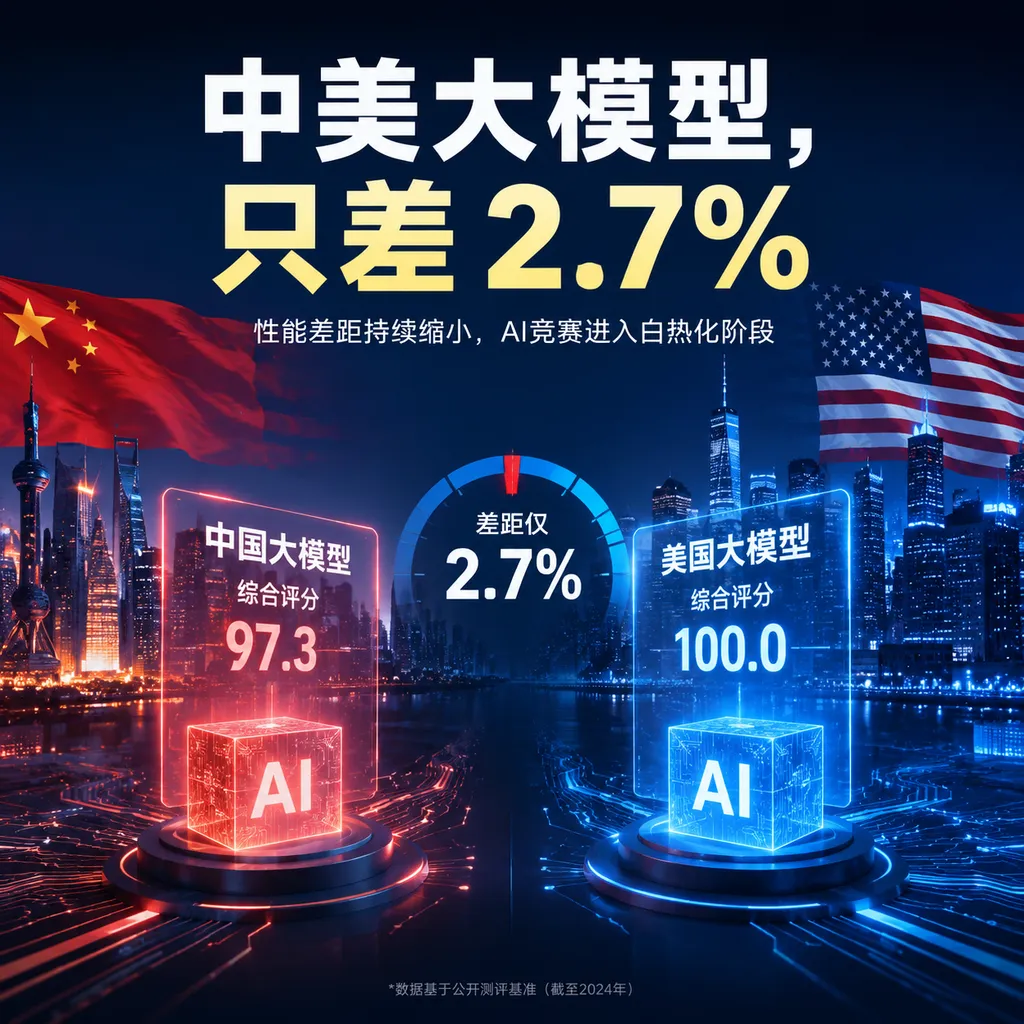
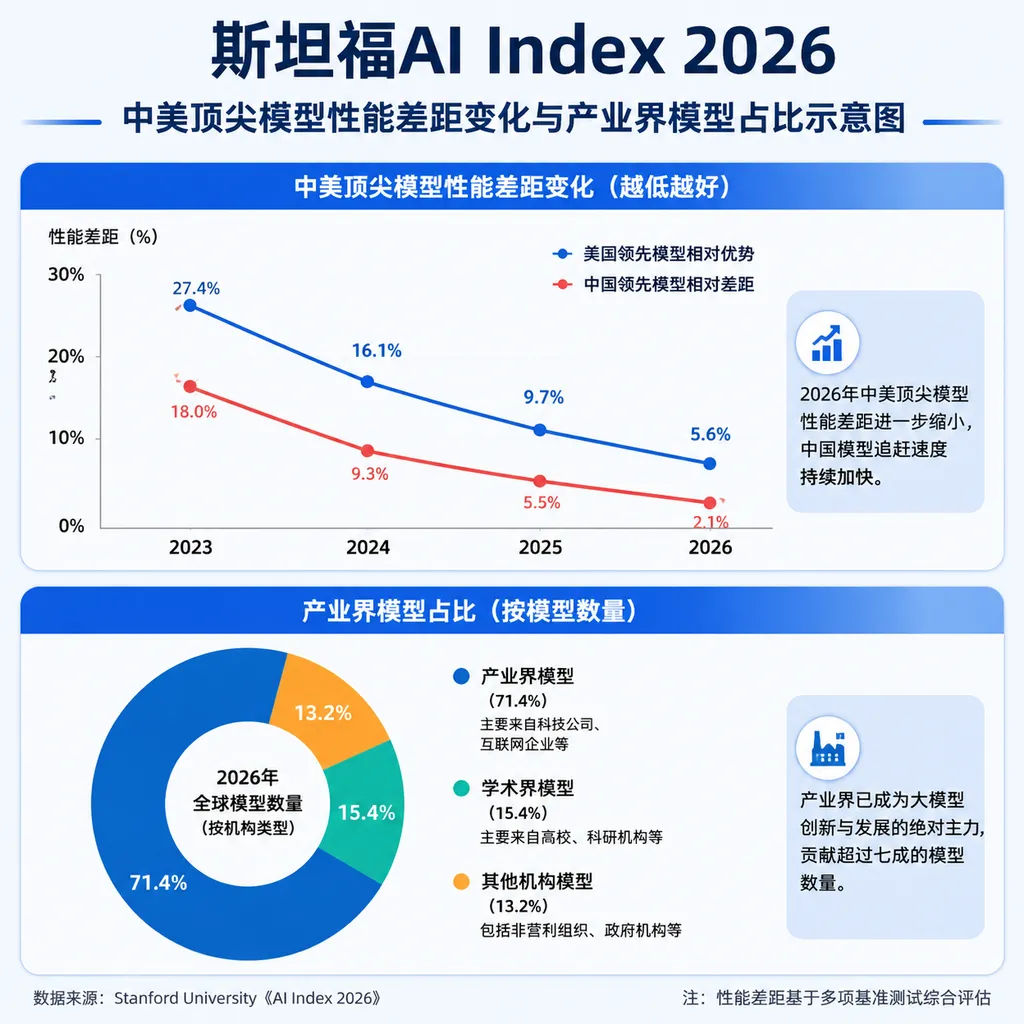
According to the report, Chinese and U.S. models have repeatedly traded places at the top of the rankings since early 2025. As of March 2026, the leading U.S. model’s advantage over its Chinese counterpart had narrowed to just 2.7%. This is no longer the “rapid catch-up” often discussed in the past, but frequent reshuffling within the same performance tier.
Another set of figures deserves even more attention: in 2025, industry produced more than 90% of notable frontier models. Leading models have pushed performance on tasks once thought to require specialized training—including PhD-level scientific question answering, multimodal reasoning, and competition mathematics—close to human baselines, with some tests even surpassing human performance.
In other words, control over frontier AI is undergoing two shifts at once: at the national level, the United States’ long-standing unilateral lead is giving way to neck-and-neck competition with China; at the R&D level, leadership is moving further away from university laboratories and toward large companies with the computing power, data, and capacity to generate commercial returns.
A 2.7% Gap Means the “Generational Gap” Narrative No Longer Works
Arena scores cited in the report show that, as of March 2026, the leading U.S. model scored approximately 1,503, while the best-performing Chinese model scored around 1,464—a difference of 39 points, or 2.7%. Chinese vendors such as Alibaba and DeepSeek have also firmly established themselves in the global top tier.
It is important to emphasize that this is a snapshot as of March, not a real-time model ranking as of August 16. Frontier-model iteration cycles have now shrunk to weeks or even days. A single version update, change in reasoning strategy, or revision to testing rules can reshuffle the rankings.
But that is precisely the point: the true significance of 2.7% is not that one side holds a permanent lead, but that neither side can maintain a lead for long.
Past discussions of competition between Chinese and U.S. large models often applied the “generational gap” framework used for chips or operating systems, as though the leader could establish a multiyear advantage with a single generation of products. That framework is no longer particularly applicable to today’s foundation models. Model capabilities increasingly depend on an entire dynamic system:
- The quality and coverage of pretraining data;
- Post-training and reinforcement learning methods;
- Inference-time compute;
- Tool use, search, and code execution capabilities;
- Context management and agent frameworks;
- Model routing, distillation, and deployment costs.
A foundation-model upgrade is certainly important, but it is no longer the only variable. The same model may perform far better in practice once connected to search, a code interpreter, and long-running task orchestration. Conversely, a model with a high benchmark score may still be unsuitable for production if it has high latency, is expensive, or uses tools unreliably.
The most direct implication of the narrowing performance gap for developers is therefore not that “only domestic Chinese models should be used from now on,” nor that “U.S. models no longer lead.” Rather, model selection is shifting from country-based judgment to task-based judgment.
The best options for coding, search, processing long Chinese documents, analyzing charts, and running agents may each come from different vendors. Multi-model routing, failover, and unified interfaces will continue to grow in importance. For application teams, tying an entire business to a single model is now riskier than it was a year ago.
SWE-bench Nearing a Perfect Score May Not Be Entirely Good News
One of the most striking capability metrics in AI Index 2026 comes from the SWE-bench Verified software engineering benchmark: model performance rose from around 60% to nearly 100% within a single year.
That pace is extraordinary.
SWE-bench Verified requires models to understand real code repositories, locate problems based on issues, modify code, and pass tests. It is closer to developers’ day-to-day work than traditional code completion and was once a key benchmark for evaluating coding agents.
But as leading models approach perfect scores, the benchmark’s ability to distinguish between them is rapidly declining. If an exam is too easy and both the first- and tenth-ranked students score 99%, that does not prove they are equally reliable when handling real-world projects.
Real-world software engineering is far messier than fixing a clearly scoped issue. Requirements may contradict one another, documentation may be outdated, test coverage may be incomplete, and dependent services may fail unexpectedly. Models must not only write code that runs, but also understand organizational constraints, legacy baggage, and deployment risks.
This is also what the report calls the “jagged frontier”: models can score highly on problems at the level of international mathematics competitions, yet may fail to read an analog clock reliably. Agents’ success rate on real-world computer tasks has risen from 12% to 66%, but roughly one-third of tasks still fail.
This capability profile looks less like a smoothly rising line and more like a saw blade. Models have already far surpassed ordinary people on some complex tasks, yet can suddenly stumble over certain common-sense steps.
A nearly 100% score on SWE-bench Verified therefore cannot simply be translated into “programming work has been fully automated.” A more accurate conclusion is: software tasks with clear boundaries, rapid feedback, and test-verifiable outcomes are becoming the first category of work to be taken over by models at scale.
For development teams, what truly needs to change is the workflow:
- Break requirements into small, verifiable tasks instead of asking an agent to complete an entire project at once;
- Add tests, static analysis, and permission isolation for model-generated code;
- Record model versions and prompts to prevent results from becoming irreproducible after model updates;
- Focus human review on architecture, security, and business rules rather than manually writing boilerplate line by line;
- Assume agents will fail, and prepare rollback and human takeover mechanisms.
The bottleneck in AI programming is shifting from “Can the model write it?” to “Can the team verify that it wrote it correctly?”
More Than 90% of Frontier Models Come From Industry, as Compute Reshapes the Division of Labor in Research
In 2025, industry produced more than 90% of notable frontier models. This share indicates that developing the most advanced models has become extremely difficult for traditional university laboratories to accomplish independently.
The reason is straightforward. Training a frontier model requires more than algorithmic research papers. It also demands large-scale computing clusters, data governance, distributed-training engineering, inference infrastructure, safety evaluations, and continuous post-training. Every stage requires sustained investment, while commercial companies are better positioned to turn model capabilities into APIs, subscription services, and enterprise contracts that can fund the next round of training.
The United States still has clear advantages within this system. According to the report, the United States released 50 notable models in 2025, compared with China’s 30. U.S. private AI investment reached $285.9 billion, and the country had 5,427 data centers. The United States has not lost its lead in either capital scale or the supply of high-end compute.
China’s strengths are concentrated elsewhere: it leads in the number of AI papers published, citations, total patents, and industrial robot installations. In 2024, China installed 295,000 industrial robots, accounting for 54% of the global total, compared with 34,200 in the United States.
This contrast reveals two different paths:
- The United States is better at concentrating enormous amounts of capital in a small number of frontier laboratories to compete for the most capable general-purpose models and the gateway to AGI;
- China places greater emphasis on integrating models with manufacturing, education, healthcare, scientific research, and end-user devices, pursuing lower costs and deployment at greater scale.
The two paths are not mutually exclusive, but they may produce different commercial outcomes. The former determines the upper bound of capabilities, while the latter determines how quickly the technology spreads. As the performance gap between models narrows, price, inference efficiency, on-premises deployment, adaptation to Chinese-language use cases, and industry-specific data will become more important.
This is why “Which model has the highest benchmark score?” is becoming an incomplete question. A model with a 2.7% lead may not be more competitive in practice if it costs several times more per call, has higher latency, or cannot be deployed within an enterprise intranet.
The Most Capable Models Are Also Becoming the Least Transparent
One side effect of industry’s dominance in frontier R&D is declining transparency.
Of the 95 notable models tracked by AI Index 2026, 80 did not release their training code, and only four were released as open source. The average Foundation Model Transparency Index score also fell from 58 in the previous year to 40. Leading vendors such as OpenAI, Anthropic, and Google are disclosing less and less information about parameter counts, training datasets, and training duration.
For commercial companies, this choice is easy to understand. Model recipes, data-cleaning methods, and post-training processes have become core trade secrets. Disclosing the details would amount to handing competitors methodologies developed through investments of hundreds of millions of dollars.
But the problems for developers, researchers, and regulators are equally clear:
- Experimental results cannot be independently reproduced;
- It is impossible to determine whether performance gains come from new algorithms, additional compute, or test-set contamination;
- Copyright, bias, and safety risks in training data are difficult to audit;
- Model behavior may change after an upgrade without comprehensive release notes;
- Vendors’ safety claims lack the conditions required for external verification.
This means frontier models are shifting from “researchable software systems” into “black-box services observable only through interfaces.” Their performance is improving, but their interpretability and auditability are declining.
For production systems, developers can no longer treat the aggregate scores published by vendors as the basis for model selection. A more reliable approach is to build internal evaluation sets covering real inputs, edge cases, refusal rates, tool-use success rates, latency, and cost per task—and to rerun regression tests after every model upgrade.
The Technology Gap Is Disappearing, but the Gap in Social Attitudes Remains Wide
Survey data released on August 16 adds another layer of insight to the annual report published in April: 84% of Chinese respondents said they were excited about AI products and services, compared with only 38% of U.S. respondents. In the Edelman Trust survey, 72% of Chinese respondents said they trusted AI, compared with 32% in the United States.
Only 31% of U.S. respondents trusted the government to regulate AI, the lowest figure among the countries surveyed.
This does not mean Chinese users are unaware of the risks of unemployment, privacy violations, and misinformation, nor does it mean U.S. users use AI less. A more likely explanation is that the public in the two countries has different expectations about whether the benefits of AI will reach them personally.
China’s AI narrative focuses more heavily on manufacturing, education, healthcare, scientific research, and productivity. For ordinary users, applications that save time and reduce costs are more likely to create a positive feedback loop. Public discussion in the United States, by contrast, has long focused on risks such as job displacement, content pollution, the power of technology companies, and AI surpassing humanity.
The divide between experts and the public is even more pronounced than the divide between countries: 73% of AI experts expect AI to positively transform how individuals work, while only 23% of the public shares that view—a gap of 50 percentage points. Similar perception gaps exist regarding AI’s economic and healthcare impacts.
This presents AI companies with a challenge even harder than achieving higher benchmark scores: advances in model capabilities do not automatically translate into trust. Users need to see tangible benefits, but they also need to know how their data is used, who is responsible when errors occur, and whether they have the right to opt out and appeal.
After Reaching 53% Population Adoption, Competition Enters the “Real-World Deployment Test”
Generative AI reached a 53% population adoption rate within three years, spreading faster than personal computers and the internet. Organizational adoption reached 88%, and more than 80% of university students have used generative AI. The report estimates that, as of early 2026, U.S. consumers derive $172 billion in annual value from generative AI tools, equivalent to approximately RMB 1.16 trillion. The value per user tripled compared with 2025.
This shows that AI has moved beyond the early-adopter stage. The next round of competition will not be determined solely by model rankings, but by four factors at once:
- Cost: How many tokens and how much inference time are required to complete the same task;
- Reliability: Whether tool use, structured output, and long-running task execution are stable;
- Integration capabilities: Whether the model can connect to enterprise databases, code repositories, and existing workflows;
- Governance capabilities: Whether data boundaries, permissions, auditing, and accountability mechanisms are clearly defined.
For developers, the narrowing of the gap between Chinese and U.S. models to 2.7% is good news because it means more model choices and fiercer competition among vendors on both price and capabilities. Using OpenAI-compatible interfaces to provide unified access to models such as GPT, Claude, Gemini, and DeepSeek will also be more practical than maintaining a separate SDK for each vendor. The value of aggregation platforms such as OpenAI Hub lies in reducing switching costs as model rankings change frequently—not in deciding for developers which model will always be best.
However, switching models still requires more than changing a name and deploying. Models continue to differ in their adherence to system prompts, function calling, context truncation, reasoning parameters, and safety policies. Interface compatibility solves the access problem; business-specific evaluations determine actual usability.
The Real Dividing Line Is No Longer Whether You Have a Model
The most important takeaway from Stanford’s report is not how many points a particular model scored, but three structural signals:
First, the leading Chinese and U.S. models have entered the same competitive tier, and the era of a long-term unilateral lead is disappearing. Second, industry now controls most frontier-model production capacity, while compute and capital continue to exert greater influence over research directions. Third, existing benchmarks are rapidly becoming saturated, even as model reliability in the real world remains far from solved.
Competition among large models has therefore entered a more difficult stage.
The question used to be, “Can you build a model?” The question now is, “Can you reliably integrate the model into real-world workflows at an acceptable price?” Benchmark scores still matter, but cost, latency, transparency, engineering stability, and user trust are increasingly determining who can sustain a lead for longer.
A 2.7% performance gap is already very small. The gap between models and real-world business needs will be the biggest battleground ahead.
References
- ITHome: Stanford Survey Finds 84% of Chinese Respondents Excited About AI, Compared With 38% in the United States — A summary of AI Index 2026 data on Chinese and U.S. model performance, AI adoption rates, public attitudes, and trust in regulation.