Claude Suffers Widespread Outage, API Unaffected for Now
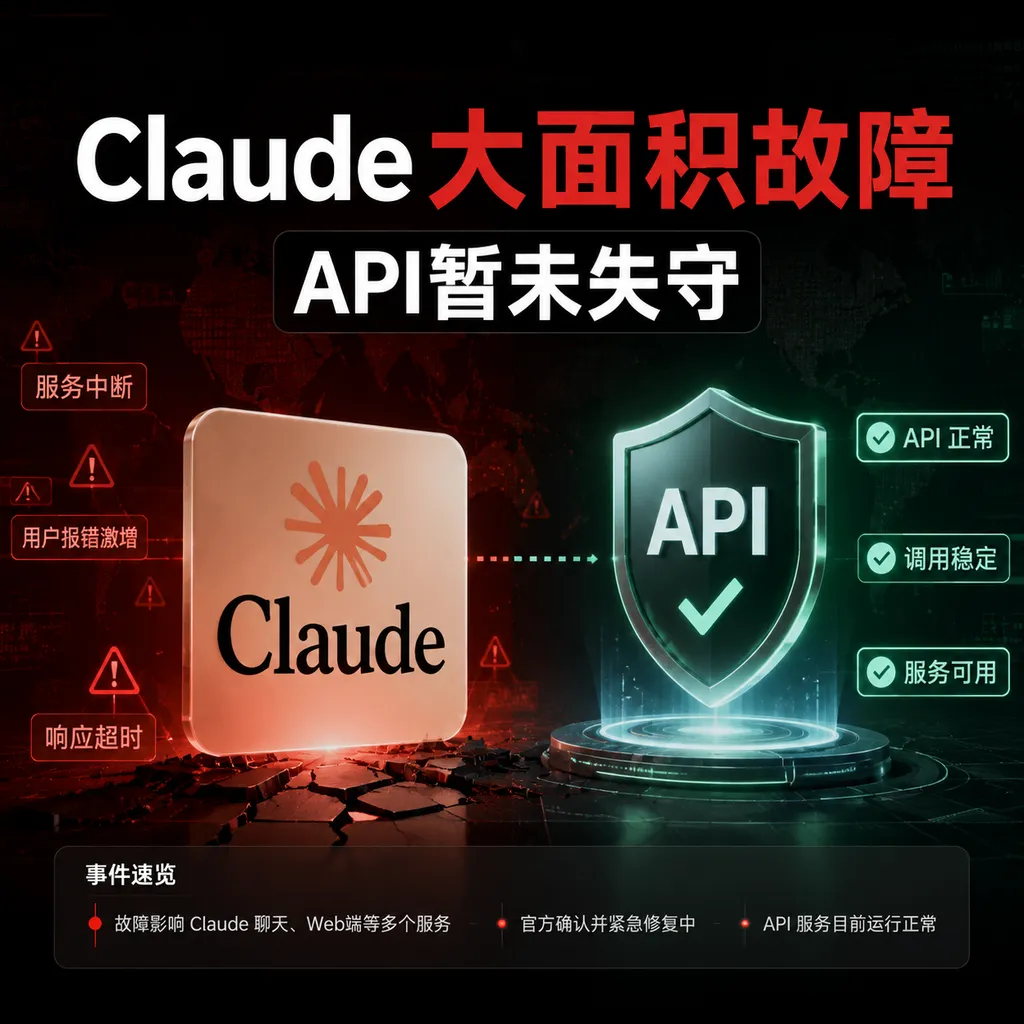
Multiple Anthropic Claude services experienced widespread outages today, affecting Claude.ai, Claude Code, and Claude Cowork. The official API remains operational, suggesting the issue is more likely occurring at the authentication and application service layers.
Widespread Claude Outage, but API Remains Unaffected for Now
Anthropic’s Claude services experienced a widespread outage early this morning.
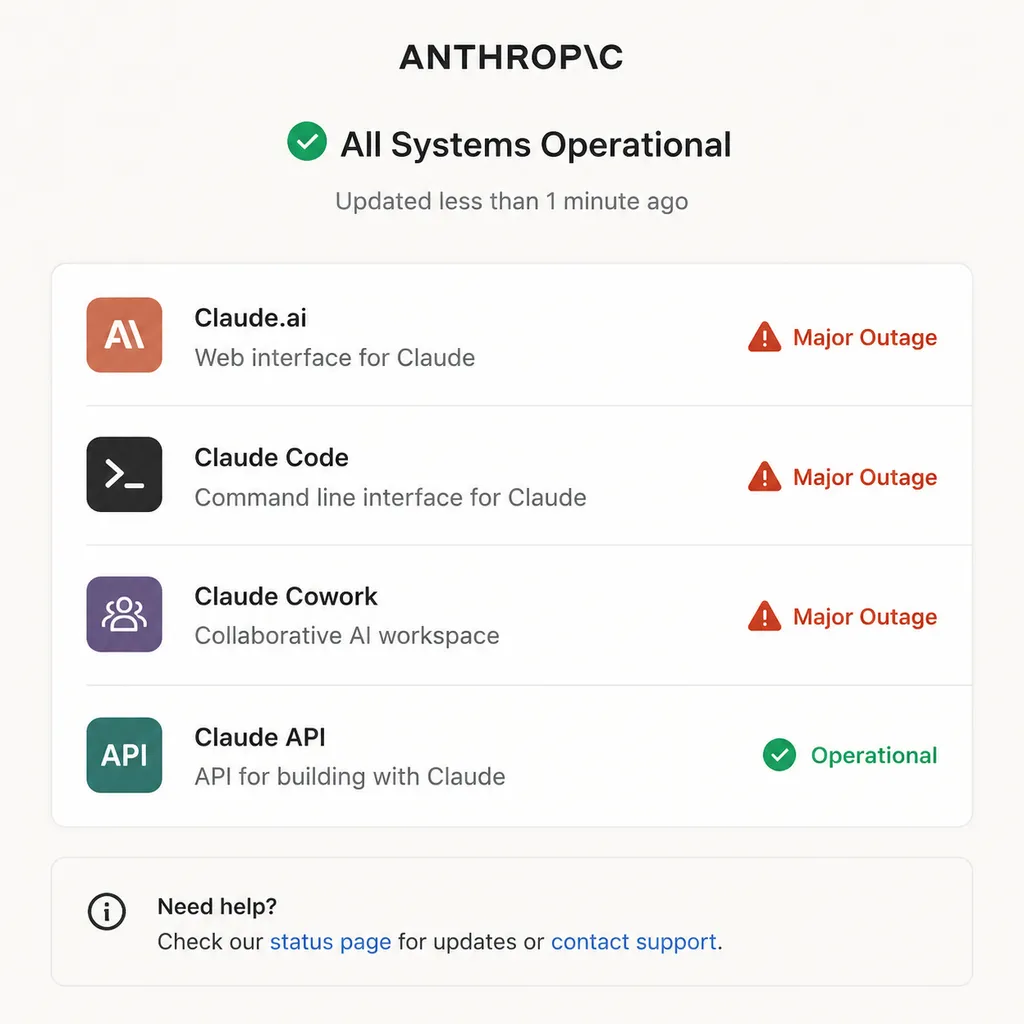
According to Anthropic, the incident began at approximately 5:58 a.m. on August 17, 2026 (Beijing Time). The initial problems centered on authentication, preventing some users from signing in to Claude.ai, Claude Code, and Claude Cowork. The impact subsequently expanded, and the official status page marked all three services as experiencing a “Major Outage.”
Affected users may encounter the following issues:
- Unable to complete authentication or sign in;
- Claude.ai pages failing to load;
- Claude Code unable to connect to the service properly;
- Claude Cowork tasks unable to start or continue;
- Requests remaining unresponsive for extended periods or failing outright.
Notably, as of now, Claude Console and the Claude API are still marked as operational. This means that not all of Claude’s model inference capabilities are offline. The incident is more likely concentrated in authentication, session management, and end-user application services, rather than a complete outage of the underlying model clusters.
Anthropic has not yet disclosed the specific cause, and the incident remains under investigation.
It Is Not That the “Model Has Crashed”—The Entry Points and Application Layer Are More Likely Failing Simultaneously
From a developer’s perspective, the most easily misunderstood aspect of this incident is the assumption that “Claude is unusable” means “Claude models are unavailable.”
These are not exactly the same thing.
Claude.ai is a chat product, Claude Code is a coding agent, and Claude Cowork handles more complex desktop and knowledge-work tasks. Although the three have different interaction models, they may share parts of the same account system, authentication infrastructure, permission checks, session services, and application gateways. A failure in any shared dependency could cause multiple products to lose their entry points simultaneously.
Meanwhile, the Claude API is still shown as operational. At a minimum, this indicates that, according to the public status information, model calls made by developers through the API have not been included in the scope of this widespread outage. One way to understand the situation is that several main entrances to a shopping mall cannot be opened, while some facilities inside may still be operating, and businesses using another set of entrances have not yet been affected to the same extent.
Of course, this is only an assessment based on the current service status and does not mean the root cause has been confirmed. Status pages generally provide only component-level results without revealing internal dependencies, and their updates may lag behind actual conditions. The following questions still need to be answered:
- Whether the authentication service encountered capacity or configuration issues;
- Whether cascading failures occurred across session, subscription, and permission services;
- Whether Claude Code and Cowork rely on the same application gateway;
- Whether the API is merely unaffected so far, or whether localized errors have not yet been reflected on the status page;
- Whether the outage is related to a recent release, configuration change, or upstream infrastructure.
Until Anthropic publishes a post-incident review, it is too early to attribute the problem to any specific component.
The Impact on Claude Code May Feel More Severe Than a Web Outage
When a web-based chat tool is temporarily inaccessible, users can usually switch to another product and continue working. But when a coding agent such as Claude Code goes down, the impact is often more immediate.
Many developers no longer use Claude Code merely to complete a function. Instead, they incorporate it into full software engineering workflows: reading repositories, modifying multiple files, running tests, analyzing errors, and iterating based on the results. In this context, a service interruption does not merely mean missing a single generated response—it abruptly breaks an active chain of tasks.
Long-running agent tasks may already have accumulated a large amount of temporary context, including:
- The current repository structure and dependencies;
- Modification approaches that have already been attempted and failed;
- Test logs and terminal output;
- Temporary file or tool permissions granted by the user;
- Plans and intermediate state not yet written back to disk.
Switching to another coding tool is not difficult. The difficult part is migrating all of this context intact. The model can be replaced, but the execution process may not resume seamlessly.
Claude Cowork faces a similar problem, except that the affected scope extends beyond code repositories to files, office software, and cross-application tasks. When a traditional chatbot fails, users lose one turn of conversation. When an agent fails, users may lose a workflow that was already halfway through execution.
This is why agent products must meet higher availability standards than ordinary chat products. The more an agent resembles a “digital employee,” the less acceptable it becomes for it to disappear in the middle of a task.
A Working API Is Good News for Developers, but the Status Page Is Not Enough
The fact that the Claude API remains operational for now is one of the most important details of this incident.
Applications that integrate directly with the Anthropic API, or call Claude models through a compatibility layer, may currently be affected far less than users of Claude.ai and Claude Code. However, a status page showing a service as operational does not mean application operators can ignore their own monitoring.
A status page answers whether the provider considers a service as a whole to be operating normally. What developers actually care about is whether their own requests are succeeding. There may be a delay between the two, as well as localized differences involving regions, accounts, models, or request types.
A more reliable approach is to monitor the following metrics simultaneously:
- End-to-end success rate: Send real or synthetic requests from the application entry point and verify that complete responses are returned;
- Time to first token: Check whether streaming requests are taking unusually long to begin producing output;
- Total request duration: Monitor for sudden increases in queueing time;
- Error-type distribution: Track authentication, rate limiting, timeouts, and server errors separately;
- Model-level status: Do not monitor only at the provider level, as different models may exhibit different failure patterns;
- Regional and network differences: The same API may behave differently when accessed through different network egress points.
If an application discovers that Claude is unavailable only after users begin complaining, it does not yet have production-grade AI observability.
Multi-Model Support Must Go Beyond “Adding Backup Model Names to the Code”
After several service disruptions affecting Claude this year, multi-model disaster recovery is no longer merely a nice-to-have. It has become a foundational capability for production environments. Yet for many teams, so-called disaster recovery consists of nothing more than adding a few extra model names to a configuration file.
When an actual outage occurs, this approach often fails.
First, prompt compatibility across models is not as strong as many assume. Claude has its own behavioral tendencies regarding long context, XML tags, and tool calls. Even if GPT, Gemini, or other models accept similar message formats, their output structures and instruction-following behavior may differ. Simply replacing the model name may not produce results that downstream systems can consume.
Second, failover requires clearly defined trigger conditions. Without timeout budgets, retry limits, and circuit breakers, an application may repeatedly wait tens of seconds for the primary model and only attempt the backup model after the user has already given up.
A more practical disaster recovery design should include:
- Preparing regression-tested backup models for critical tasks;
- Deciding whether to retry based on the error type, rather than blindly replaying every failed request;
- Assigning task IDs to non-idempotent tool calls to prevent duplicate execution after failover;
- Configuring different routing strategies for timeouts, rate limits, and server-side failures;
- Preserving portable conversation and task state to minimize context loss during failover;
- Performing secondary validation of structured outputs to prevent formatting drift from backup models;
- Gradually shifting traffic back after recovery instead of instantly sending all traffic to the primary service again.
Teams that do not want to maintain separate SDKs and authentication logic for multiple providers can use a unified OpenAI-compatible API to reduce integration costs. Aggregation platforms such as OpenAI Hub can provide access to Claude, GPT, Gemini, DeepSeek, and other models with a single key, while also being better suited to unified routing. However, it is important to emphasize that an aggregation API solves integration problems; it does not automatically provide high availability. Backup-model selection, health checks, circuit breaking, and context migration must still be designed in advance by the application team.
One Outage Exposes a New Single Point of Failure in AI Applications
In the past, enterprises worried about databases, cloud servers, or payment APIs becoming single points of failure. Now, model providers and AI agent platforms are also becoming critical dependencies.
The more difficult issue is that agents generally depend more deeply on providers than ordinary APIs do. A failed chat request can be resent. But when a task that has already read files, executed commands, and modified code fails, recovery may require state replay, renewed permission confirmation, and side-effect checks.
Teams therefore need to bring AI services under a reliability governance framework comparable to those used for databases and message queues, rather than treating them as third-party plugins that occasionally fail. At a minimum, they should answer the following questions in advance:
- Can core business operations continue if Claude becomes completely unavailable?
- If the system must degrade, which capabilities should be preserved first?
- How can active agent tasks be paused, resumed, or rolled back?
- Will users see a clear outage notification instead of waiting indefinitely?
- Will switching providers alter data compliance and privacy boundaries?
- After service is restored, could backlogged tasks create a sudden traffic surge?
There is no universal answer to these questions, but they must be addressed before an incident occurs. Otherwise, being “AI-native” can easily turn into heavy dependence on a single vendor.
Anthropic Needs a Postmortem That Clearly Defines the Scope
As of August 17, Anthropic has only confirmed that it is investigating the widespread outage and has not yet provided a root cause or a complete recovery timeline.
What deserves attention next is not only when service will be restored, but also whether the official postmortem will address the following questions: Why did the incident initially manifest as authentication failures? Why did the impact expand across multiple products? Was the Claude API truly unaffected from beginning to end? And how will Anthropic prevent shared dependencies from taking down multiple agent products again?
The fact that Claude.ai, Claude Code, and Claude Cowork were all simultaneously marked as experiencing a Major Outage indicates that Anthropic’s product portfolio is tightly interconnected at certain foundational layers. Shared infrastructure is not inherently a problem: it can reduce costs, unify permissions, and accelerate iteration. The problem is that when shared components lack sufficient isolation and graceful degradation capabilities, the blast radius expands accordingly.
At present, this incident appears more like a concentrated failure of the application and control planes than a loss of Claude’s underlying model capabilities. For ordinary users, the result is the same: Claude will not open. For developers, however, the distinction is important because it determines whether the appropriate contingency plan is to switch models or bypass the failed entry point and continue using the API.
In the short term, the continued operation of the Claude API is a silver lining. But for teams that have already incorporated Claude Code or Cowork into core workflows, this outage is another reminder that model quality determines whether you want to use a service; service reliability determines whether you dare to depend on it.
References
- ITHome: Anthropic Claude Experiences a Widespread Service Outage — Summarizes the incident’s start time, affected products, and the latest service status disclosed on Anthropic’s status page.