Fengshu 2.0: Turning Soybean Breeding into Data Engineering
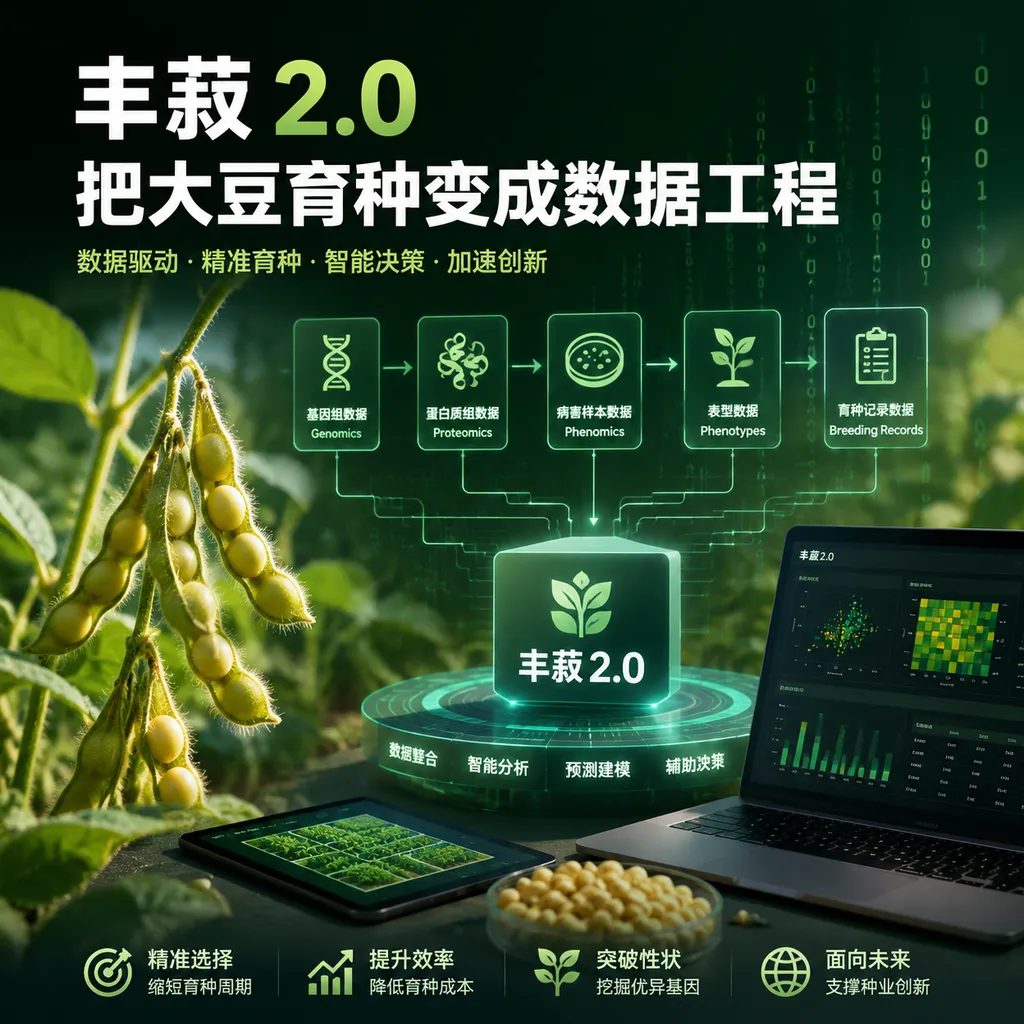
The soybean vertical large model “Fengshu” 2.0 was released on August 16. For the first time, it integrates genomic, protein, phenotypic, disease, and breeding-record data, while using multi-model collaboration to reduce bias from any single model.
Soybean Breeding Now Has a “Multi-Model Consultation Room”
On August 16, Anhui Agricultural University and the Institute of Crop Sciences at the Chinese Academy of Agricultural Sciences released “Fengshu” 2.0, a vertical foundation model for soybeans. Compared with the initial version completed in February this year, the focus of this upgrade is not replacing it with a larger language model, but connecting soybean germplasm resources, genomes, proteins, transcripts, disease samples, and breeding trial records within a single system, then having multiple general-purpose models cross-analyze specialized questions.
This is a more pragmatic direction.
In soybean breeding, what is truly scarce is usually not a model that is better at conversation, but a system capable of linking “what change occurred in a particular gene,” “whether that change affects protein function,” “whether disease resistance or high yield is observed in the field,” and “whether historical trials support this assessment” into a complete chain of evidence.
“Fengshu” 2.0 is designed to address precisely this kind of question spanning multiple layers of data.
Here, “Multimodal” Means More Than Images Plus Text
When consumer-oriented foundation models discuss multimodality, they usually mean text, images, audio, and video. Multimodality in the life sciences is far more complex: the data not only come in different formats and at different scales, but are also connected by explicit yet incomplete biological relationships.
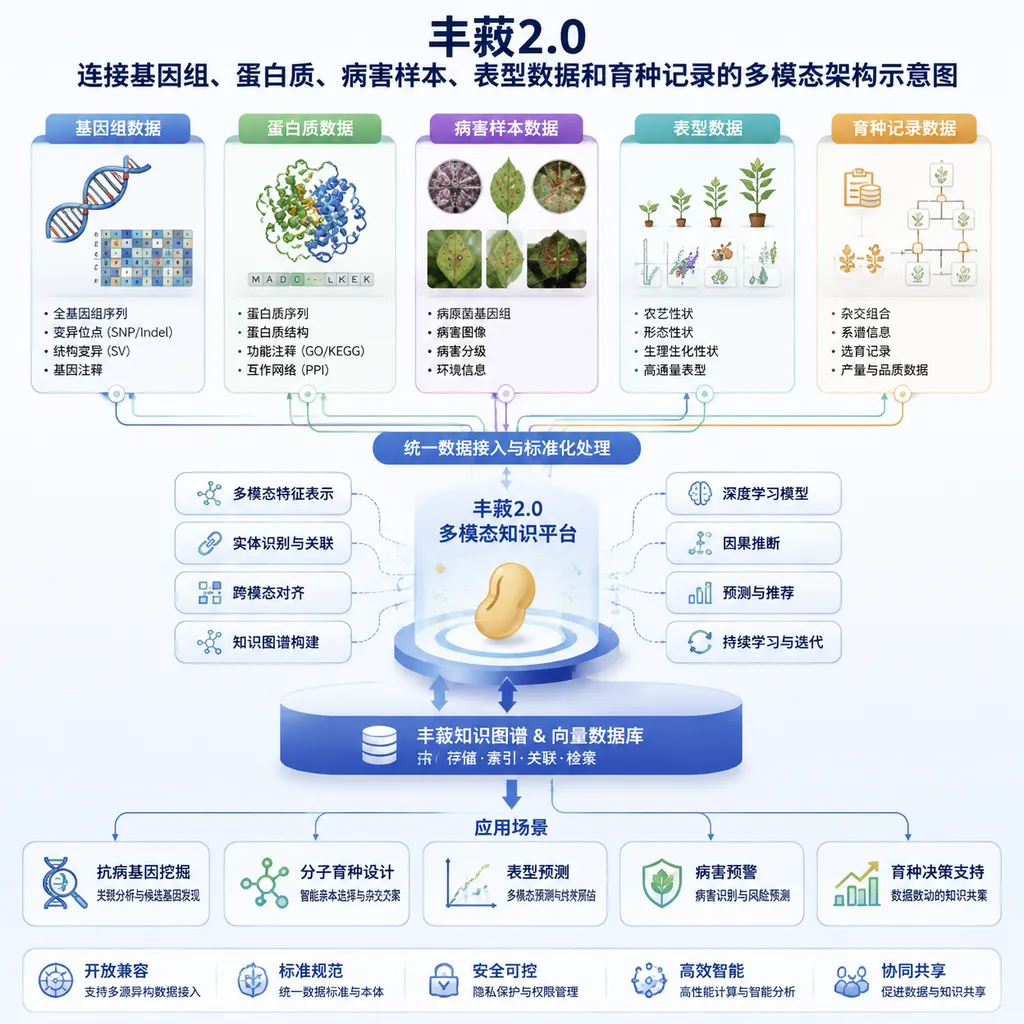
The data integrated into “Fengshu” 2.0 include:
- Soybean germplasm resources and variety information;
- Genomic and coding sequences;
- Protein, transcript, and gene expression data;
- Disease images, samples, and related records;
- Variety phenotypes and agronomic trait data;
- Breeding trials and field practice records;
- Chinese- and foreign-language research literature and patent materials.
These data cannot simply be placed in a vector database and considered complete.
For example, if researchers want to identify a breeding parent that combines disease resistance with high yield, the system must first locate candidate germplasm in phenotypic records, then examine relevant disease-resistance genes or molecular markers, trace evidence from gene expression and protein function, and finally assess usability based on previous crosses and field trials. Missing data at any layer could reduce a conclusion from “supported by experimental evidence” to merely “linguistically plausible.”
The value of “Fengshu” 2.0 therefore lies not only in the variety of data it integrates, but also in how it begins to organize the databases, literature searches, and trial records previously scattered across soybean research into a structured knowledge system that models can query and compare.
Publicly available information indicates that its underlying system has integrated more than 10 million Chinese characters of specialized text and over 10,000 research papers and patents, while building a soybean-domain knowledge graph containing approximately 20,000 entities and 100,000 relationships. It also incorporates resequencing data for 8,000 genomes, approximately 40,000 soybean germplasm accessions, and phenotypic data for more than 3,000 varieties.
These figures are not large by the training standards of general-purpose foundation models. For a vertical research system, however, whether data have been cleaned, entities aligned, and findings experimentally validated matters far more than sheer corpus size. A phenotypic record tied to a specific accession, environment, and trial batch is generally more valuable than thousands of passages of generic agricultural text.
Multi-Model Collaboration Essentially Adds a Layer of “Peer Review” to Answers
Compared with the first generation, “Fengshu” 2.0 adds a multi-model collaborative analysis mechanism. Its workflow can be understood as a small expert consultation process: the system submits the same specialized soybean question to multiple general-purpose foundation models, each of which generates an answer. A synthesis module then combines domain knowledge, proprietary data, and structured comparison rules to analyze the consensus and differences among the answers, as well as the completeness of their evidence, before producing an integrated conclusion.
This is not the same as simple “majority voting.”
If three models all provide the same incorrect answer, a voting mechanism will merely produce the wrong answer consistently. What deserves greater attention in the public description of “Fengshu” 2.0 is its emphasis on “evidence completeness” and “structured comparison rules.” A model’s conclusion should not be evaluated only by whether other models agree with it; the system should also check whether it is supported by genomic data, the knowledge graph, research papers, or breeding records.
In other words, general-purpose models propose candidate explanations, domain data constrain the answers, and the synthesis module resolves conflicts.
This architecture more closely resembles a combination of model routing, retrieval-augmented generation, and multi-agent review. It may not fundamentally eliminate hallucinations, but it can reduce the probability that a single model will reach an incorrect conclusion because of knowledge gaps, prompt sensitivity, or biased reasoning paths.
For agricultural research, this matters far more than simply making answers more fluent. Researchers do not need an answer that reads like a paper; they need an assistive tool that clearly tells them “which evidence is consistent, where conflicts exist, and what should be validated next.”
However, the team has not yet disclosed which general-purpose models have been integrated, nor has it released details of the technical architecture for model routing, conflict resolution, context length, data update frequency, and individual modules. Whether multi-model collaboration truly outperforms the best-performing single model will still need to be demonstrated through standardized evaluations and results from real-world tasks.
Six Modules Cover Everything from Literature Searches to Cross Design
“Fengshu” 2.0 currently integrates six major functional modules—Soybean Encyclopedia, Soybean Molecular Biology, Soybean Literature, Soybean Diseases, Soybean Phenotypes, and Soybean Breeding—covering the knowledge-query and breeding-analysis scenarios most frequently encountered by researchers.
It can already assist with the following tasks involving major agronomic traits in soybeans:
- Disease diagnosis: Narrowing down possible diseases by combining disease samples, symptom information, and historical records, while recommending directions for further testing;
- Breeding parent selection: Identifying candidate parents from germplasm resources and phenotypic records based on target traits;
- Virtual cross design: Evaluating different options based on parental characteristics and historical cross data before actual crosses are made;
- Phenotypic data analysis: Conducting association analyses of agronomic traits such as plant height, maturity, yield, and stress resistance;
- Molecular marker-assisted breeding: Linking target traits with available markers, genomic regions, and germplasm accessions;
- Candidate gene function analysis: Ranking candidate genes by integrating evidence from sequences, expression data, proteins, and the literature.
Among these, virtual cross design and candidate gene analysis best demonstrate the potential of vertical models. In traditional workflows, researchers often need to switch manually among multiple databases, then use spreadsheets or scripts to screen materials. If a model can translate natural-language questions into structured queries and return results together with their sources of evidence, it can significantly reduce the time required for preliminary information gathering and experimental design.
But “assist” remains the key word.
Breeding outcomes are affected by genotype, environment, and their interaction. The same accession may exhibit different traits under different latitudes, temperatures, soils, and cultivation methods. An association identified by a model in historical data does not mean that it will remain valid in a new environment. Virtual crosses also cannot replace actual crossing, progeny selection, and multi-year, multi-location field trials.
It Is Research Infrastructure First and a Chatbot Second
Simply categorizing “Fengshu” 2.0 as an agricultural version of ChatGPT would underestimate the significance of this upgrade.
Based on the information disclosed so far, it is more like a data and model middleware layer for soybean research: the upper layer consists of question-answering, analysis, and design tools used by researchers, while the lower layer connects knowledge graphs, omics databases, phenotypic data, breeding records, and multiple general-purpose models.
This product form also shows that vertical foundation models are shifting away from “fine-tuning a model on industry-specific corpora” toward “orchestrating models, data, and rules around operational tasks.” The former can be deployed quickly but tends to remain limited to industry knowledge Q&A. The latter requires more engineering work but has a better chance of entering real research workflows.
The current advantage of “Fengshu” 2.0 is its clearly defined domain boundary. Soybean germplasm, genes, diseases, and breeding objectives are relatively well defined, allowing the system to build knowledge graphs and evaluation sets around a limited number of high-value tasks. Compared with a general agricultural assistant intended to cover every agricultural question, this crop-specific vertical approach may actually be easier to develop in depth.
Its weaknesses are equally clear: publicly available materials primarily describe data scale and functional modules, but do not yet provide reproducible benchmarks. It is therefore still impossible for outsiders to assess its actual performance in metrics such as disease identification accuracy, recall in parent selection, candidate gene ranking, citation accuracy, and generalization across years.
To demonstrate that the system has moved from a “research demo” to a “production tool,” it will need to answer at least several questions:
- Can every conclusion be traced back to specific data, papers, and trial records?
- How does the system assign confidence when faced with conflicting papers or phenotypic records?
- When different general-purpose models provide inconsistent answers, are the adjudication rules stable?
- How are access controls, de-identification, and auditing handled for proprietary breeding data?
- Can the knowledge base be continuously updated as new germplasm, genomic, and field data are added?
- How often do the parents and crosses recommended by the model prove successful in real trials?
These metrics would be far more convincing than an agricultural knowledge Q&A leaderboard.
The Real Test Is in the Field, Not the Chat Window
The R&D team’s next steps will be to advance field pilots, accumulate specialized data, iterate on algorithms, and strengthen validation between model analysis results and actual breeding trials. The system also plans to further incorporate the climate, soil, and cropping patterns of China’s different major soybean-producing regions to support germplasm resource exploration, trait analysis, variety development, large-scale cultivation, and agricultural extension.
This step will determine how far “Fengshu” 2.0 can ultimately go.
A common problem with agricultural models is that they have abundant laboratory data but insufficient environmental data; comprehensive knowledge from the literature, but incomplete local field records. Significant differences exist among spring soybeans in Northeast China, summer soybeans in the Huang-Huai-Hai region, and multiple-cropping areas in southern China in terms of accumulated temperature, photoperiod, water availability, and disease pressure. A “high-yielding cross” divorced from its regional environment may be meaningless on a specific plot of land.
If future versions can incorporate climate, soil, management practices, and multi-year, multi-location trials into a unified analysis, the model may be able to evolve from a knowledge retrieval tool into a breeding decision system. Researchers’ questions would then shift from “What does this gene do?” to “Under the conditions of a particular agroecological zone, target maturity period, and level of disease pressure, which parental combinations are most worth advancing to the next round of trials?”
This is also the most noteworthy aspect of “Fengshu” 2.0: it does not treat a foundation model as an omnipotent brain intended to replace breeding experts. Instead, it attempts to organize scattered data, papers, and models into a research infrastructure that can be queried, compared, and validated.
At this stage, the most reasonable assessment is that it is moving in the right direction and has established a data foundation of a certain scale, but its effectiveness must still be demonstrated through field results. Multi-model collaboration can reduce bias in answers, but it cannot replace experimental validation. Multimodal data can raise the ceiling of analytical capabilities, provided that data quality, sample coverage, and environmental annotations are sufficiently reliable.
If evaluation sets, task metrics, and field validation results are made public in the future, the significance of “Fengshu” 2.0 will extend beyond the addition of another vertical agricultural foundation model. It could provide an example—one more closely aligned with real production workflows—of how generative AI can be applied in the life sciences and breeding.
References
- ITHome: Chinese Scientists Release “Fengshu” 2.0, a Vertical Foundation Model for Soybeans, to Advance AI-Assisted Breeding—Summarizes publicly available information on the model’s release date, developers, range of multimodal data, multi-model collaboration mechanism, and six major functional modules.