Alibaba’s Happy Xiami: Write a Complete Song with a Single Sentence
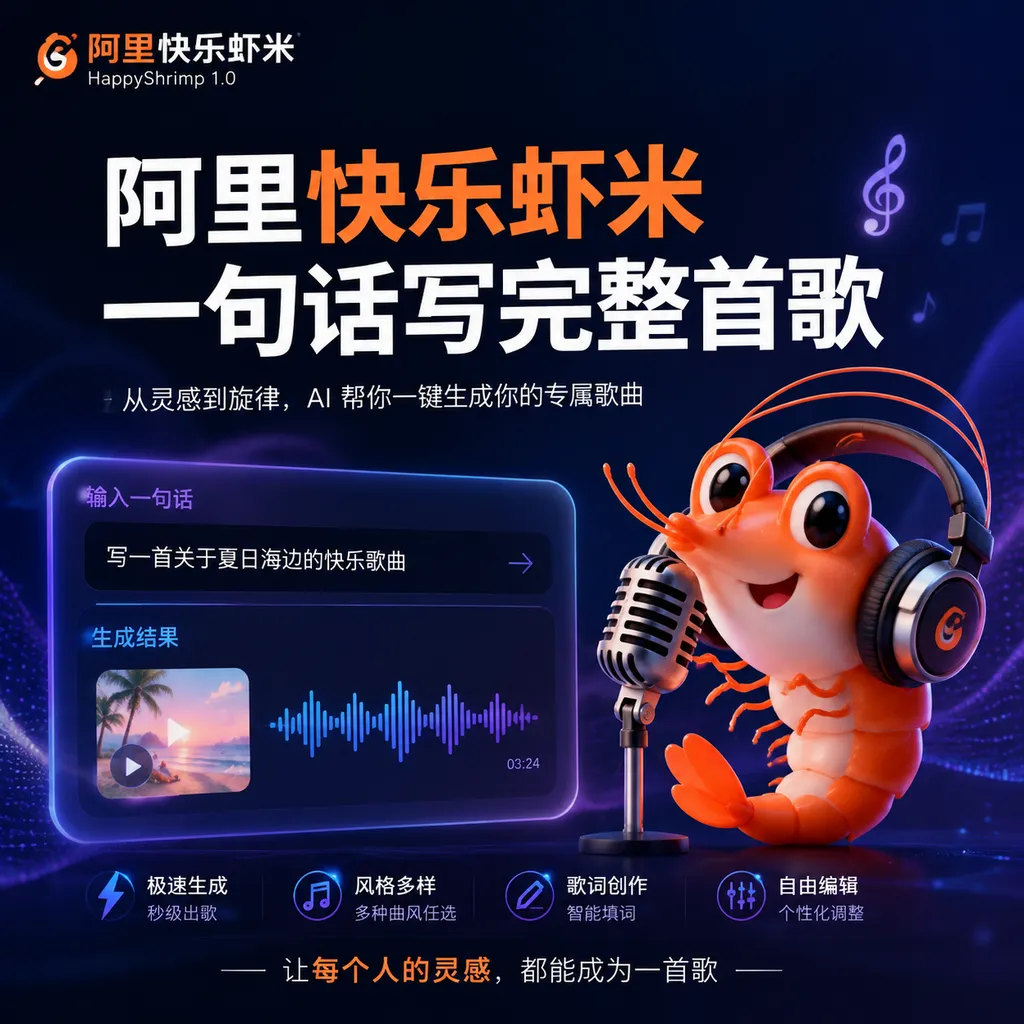
Alibaba launched its AI music model HappyShrimp 1.0 today, which can turn descriptions of emotions, stories, and scenes directly into complete songs featuring lyrics, melodies, arrangements, and vocals. What it truly aims to address is not whether AI music can simply “make sound,” but whether it can understand natural language and maintain a coherent song structure throughout an entire track.
Alibaba’s HappyShrimp: Write a Complete Song with a Single Sentence
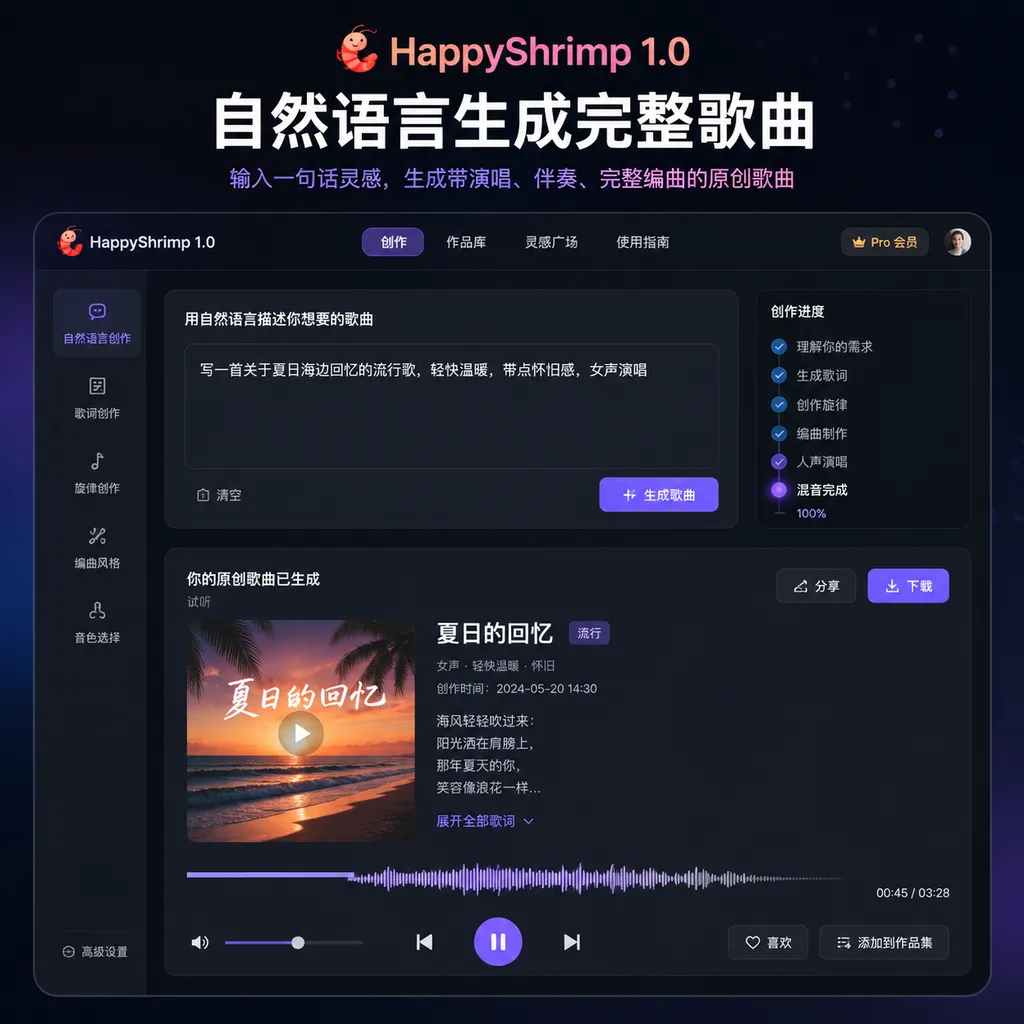
Alibaba officially launched its AI music model HappyShrimp 1.0 today (August 17), known in Chinese as “快乐虾米” (“Happy Shrimp”). Users do not need to learn about BPM, chord progressions, instrumentation, or mixing first. They only need to describe an emotion, a story, or a memory, and the model can generate a complete song with lyrics, melody, arrangement, and vocals.
The product is now available simultaneously in China and overseas through a desktop web interface, with free credits offered to new users. Alibaba defines it as an end-to-end full-song generation model for the general public, rather than merely a melody clip generator or AI arrangement plug-in.
If judged solely by its ability to “generate a song from a single sentence,” HappyShrimp is not particularly early to the market. The AI music market has already demonstrated that models can produce audio resembling a pop song in a matter of seconds. What truly makes HappyShrimp noteworthy is its attempt to shift the focus of competition from “Can it generate music?” to “Can it understand? Can it be controlled? And does the song work as a complete piece?”
These three questions are also among the toughest challenges facing AI music today.
No Need to Translate Your Ideas into Tags First
Many previous AI music tools have operated more like automated arrangement machines that accept tags. Users need to enter keywords such as “Lo-fi R&B,” “90 BPM,” “female vocals,” “electric piano,” or “key change in the chorus,” after which the model assembles a result based on those tags.
This approach is convenient for the model, but not necessarily for the user.
What ordinary people want to express is usually not, “I want a 4/4 Neo-Soul track with syncopated rhythms,” but rather, “Write a song for a friend from high school. Don’t make it too sentimental; make it feel like the restrained happiness of meeting again after many years.” The former consists of music production parameters, while the latter reflects the actual creative intent. If users must first translate the latter into the former, the goal of lowering the barrier to creation has only been half accomplished.
HappyShrimp instead processes natural language directly. According to Alibaba, the model can identify standard genres such as Lo-fi R&B and K-pop, while also understanding emotions, settings, relationships between characters, period aesthetics, and narrative arcs—and translating those descriptions into specific musical decisions.
For example, when a user enters “Write a song for a friend from high school,” the model needs to determine on its own:
- Whether the lyrics should use a first-person perspective or the perspective of shared memories;
- Whether the emotion should be passionate, nostalgic, or somewhat restrained;
- How the verses should develop the story and where the chorus should introduce a memorable hook;
- Whether the vocalist’s gender, singing style, and timbre suit the theme;
- How the instrumentation should transition from a school-days atmosphere to an adult looking back;
- How to maintain consistency in tempo, key, and emotional progression throughout the song.
This is not simple keyword expansion, but a form of “compilation” that converts vague intent into musical structure. Users speak in ordinary language, while the model translates it into decisions about lyrics, composition, performance, and production.
This is the right direction. Truly democratizing music creation tools does not mean merely replacing professional interfaces with chat boxes. It means having the model take responsibility for the professional judgments that users previously had to make themselves.
With End-to-End Full-Song Generation, the Challenge Is the “Full Song,” Not the “Generation”
Another core capability of HappyShrimp 1.0 is end-to-end full-song generation.
When given requirements involving lyrics, genre, mood, era, vocals, key, BPM, and instrumentation, the model does not first generate lyrics, call a composition module, add vocals, and then mechanically stitch the outputs together. According to the official description, it plans all these conditions as a whole, generating lyrics, music, arrangement, and performance simultaneously while accounting for the song’s long-range structure.
The two approaches can be compared to shooting a short video versus making a feature-length film.
Clip-based generation only needs to ensure that the next dozen seconds sound good. A catchy melody and convincing timbre are enough to make a strong first impression. Full-song generation, however, must handle a much longer context: What imagery is introduced in the first verse, and does the second verse develop it further? How many times should the chorus repeat, and should the instrumentation change with each repetition? How should the bridge create contrast? How should the final chorus heighten the emotion, and how should the song ultimately resolve?
Music also has its own “grammar” and “context.” A melodic phrase may sound excellent in isolation but may not make sense within the full song. The most common problems with AI music tend to emerge precisely when the timeline grows longer:
- Loose structure: The verses, choruses, and bridge feel randomly assembled, with no clear emotional progression;
- Melodic drift: The central motif established earlier disappears in the second half, leaving the song without a unifying hook;
- Mismatch between lyrics and music: Stress falls on words or syllables that should not be emphasized; Chinese polyphonic characters, phrase breaks, and sustained syllables are particularly prone to errors;
- Mechanical vocals: Breathing, articulation, vocal runs, and emotional intensity feel unnatural, as though text has simply been pasted onto a melody;
- Overcrowded arrangements: Different parts compete for the same frequency ranges; there may be many instruments, but the result sounds muddy;
- Conflicting instruction adherence: The model satisfies requirements such as “female vocals” and “retro,” but ignores the user’s request for a restrained mood or a particular narrative perspective.
HappyShrimp claims to have made targeted improvements to sonic detail, musicality, vocal naturalness, and the alignment between lyrics and melody. More importantly, it does not treat “female vocals, French, slow tempo, pipe organ, and a shift from sadness to anger” as five independent tags. Instead, it uses the overall intent to determine when these elements should appear and how they should evolve.
From a technical product perspective, this matters more than simply improving audio quality. Poor audio quality can be addressed in post-production, but a collapsed structure is difficult to repair through mixing.
HappyShrimp’s Strength Will Depend on Whether It Can Preserve the Main Thread in Complex Prompts
Current official demonstrations focus on natural-language understanding, complete-song generation, and multidimensional control. However, it is too early to conclude from demonstrations alone whether HappyShrimp 1.0 has truly reached an industry-leading level.
AI music product demos can always cherry-pick “the best song.” A genuinely discriminating test should examine whether the model remains consistent across repeated generations from the same prompt, and which requirements it prioritizes when the prompt contains conditions that constrain one another.
Consider an instruction like this:
Write a Chinese song for a ten-year graduation reunion, with female vocals. The first half should be restrained Lo-fi R&B, while the second half should transition into live-sounding pop rock. Do not make it excessively nostalgic, and avoid common words such as “youth” and “dreams” in the lyrics. The chorus should be easy for a group to sing along to, but the overall song should not sound like an advertisement.
This type of prompt simultaneously includes subject matter, language, vocals, genre transitions, prohibited lyric terms, performance context, and negative constraints. If the model merely recognizes tags, it may produce a song in which “all the elements are present, but the whole feels wrong”: it does indeed contain female vocals and guitars, and it does mention classmates, but it fails to complete the emotional transition from restraint to release.
The value of HappyShrimp’s claimed “holistic planning” should become apparent in scenarios like this.
Our preliminary assessment is therefore: The direction is more meaningful than simply releasing “another AI music generator,” but the true limits of version 1.0 still need to be tested through highly constrained prompts, the stability of Chinese-language singing, and consistency across multiple generations. If it can maintain unity among lyrics, composition, vocals, and arrangement under complex requirements, it will have established genuine differentiation. If it performs well only with simple prompts, it will ultimately fall into commoditized competition.
“Everyone Can Write Songs” Is True, but That Does Not Make Everyone a Musician
Alibaba’s slogan for HappyShrimp is that everyone should be able to write a good-sounding song. From a tooling perspective, this claim is not an exaggeration.
In the past, producing a complete song required navigating multiple stages, including lyric writing, composition, arrangement, performance, recording, and mixing. Now, users can obtain a playable finished product from a single sentence. For short-video soundtracks, podcast intros, game prototypes, event theme songs, internal brand content, and personal commemorative songs, the efficiency gains are immediate.
Developers and content teams may be among the first to use it in scenarios such as:
- Rapidly creating draft theme songs for game characters or story chapters;
- Generating temporary music that matches the mood of short-form dramas, videos, and podcasts;
- Producing multiple stylistic versions during the advertising proposal stage to reduce experimentation costs;
- Turning user stories, travel journals, or commemorative writing into personalized songs;
- Building voices and musical styles in bulk for virtual characters;
- Testing directions for melodies, lyrics, and arrangements before formal production.
However, “generating a song” and “completing a musical work” are still not the same thing.
A model can reduce execution costs, but it cannot automatically create meaningful expression on the user’s behalf. The broader the prompt, the more likely the output is to drift toward what is statistically “correct”: the melody is pleasant, the structure is familiar, and the emotion is clear, but it lacks details that only the creator can provide. What ultimately gives a work its identity may not be the model’s parameters, but whether the user can articulate the specific place, action, tone, and conflict embedded in that memory.
AI music is more likely to change the division of creative labor than simply replace musicians. Ordinary users gain production capabilities, while professional creators can treat the model as a high-speed drafting tool—rapidly experimenting with genres, adjusting sections, and comparing vocal options before manually rewriting and producing the versions worth keeping.
Without an API, It Is Currently More of a Consumer Product Than Developer Infrastructure
Based on the information currently available, HappyShrimp 1.0 has initially launched as a desktop web application in China and overseas. In this release, Alibaba has not disclosed a public API, model parameters, context or song-length limits, inference costs, copyright terms for generated content, or commercial plans for enterprise users.
This means that it currently resembles a consumer application for creators more than music-generation infrastructure that can be directly embedded into games, video tools, or content platforms.
For developers, the most important question is not how many additional genre templates will be added to the web interface, but whether the following capabilities will eventually become available:
- Submitting instructions through an API that combines structured input with natural language;
- Exporting lyrics, melodies, vocals, and accompaniment as separate stems;
- Extending, rearranging, or selectively regenerating existing audio;
- Locking in a singer’s timbre, a character’s voice, or a brand’s musical style;
- Providing predictable generation latency, concurrency limits, and pricing;
- Clearly defining training data, ownership of outputs, and the boundaries of commercial use;
- Providing watermarking, provenance tracking, and similarity detection for generated content.
Without these interfaces, HappyShrimp will struggle to enter developer workflows and will be limited largely to one-off creation through the web interface. Conversely, if Alibaba later integrates it into its cloud model services and provides stem export and editing capabilities, it could become more than a tool for “entering one sentence and downloading an MP3.” It could become a foundational capability for audio applications.
Xiami Is Back, but This Time It Is Not a Music Player
The Chinese name “快乐虾米” also inevitably evokes Xiami Music, Alibaba’s former music streaming service. Xiami Music ceased operations in 2021, having built a following among users for its discerning catalog, independent musician ecosystem, and music-fan community. Five years later, “Xiami” has returned to Alibaba’s music portfolio in the form of a generative AI product. This time, its purpose is not to discover and play music, but to produce music directly.
It also continues Alibaba’s tradition of animal-based naming. In addition to Tmall, Ant, Cainiao, Fliggy, Freshippo, and Xianyu, Alibaba has introduced a series of “Happy” AI products in recent years, including HappyHorse and HappyOyster. HappyShrimp is the latest member of this series in the field of music generation.
The nostalgia evoked by the name may help the product attract its first wave of attention, but it cannot create a lasting competitive moat. Competition in AI music will ultimately return to several hard metrics: the accuracy of natural-language understanding, the stability of complete-song generation, the naturalness of vocals, the degree of control available, and the safety of commercial use.
HappyShrimp 1.0’s answer is to treat music as a special language with grammar, semantics, and long-range context, then use an end-to-end model to create the entire song in a single pass. This narrative makes sense from a technical perspective and addresses real pain points in existing products.
But for a version 1.0 product launched only today, it is more appropriate to ask whether it can withstand the unprofessional, vague, and even contradictory ways ordinary users express themselves than to rush to declare that “music creation has been disrupted.” After all, understanding “Lo-fi R&B” is not difficult. Understanding a regret that someone cannot clearly articulate—and turning it into a complete, original song with a coherent structure—is where the true difficulty of AI music lies.
References
- ITHome: Alibaba Launches the HappyShrimp 1.0 AI Music Model—Covers the launch date of HappyShrimp 1.0, its natural-language understanding and end-to-end full-song generation capabilities, and the availability of its web interface.