Baidu Aims to Bring ERNIE Back into the Top Tier

Baidu’s AI business revenue has accounted for more than half of its general business revenue for two consecutive quarters, while GPU cloud revenue surged 283% year over year. However, with both total revenue and net profit declining, whether ERNIE can return to the top tier will still depend on proving itself through its models, applications, and commercialization.
Baidu’s AI Transformation Has Crossed the Revenue Inflection Point
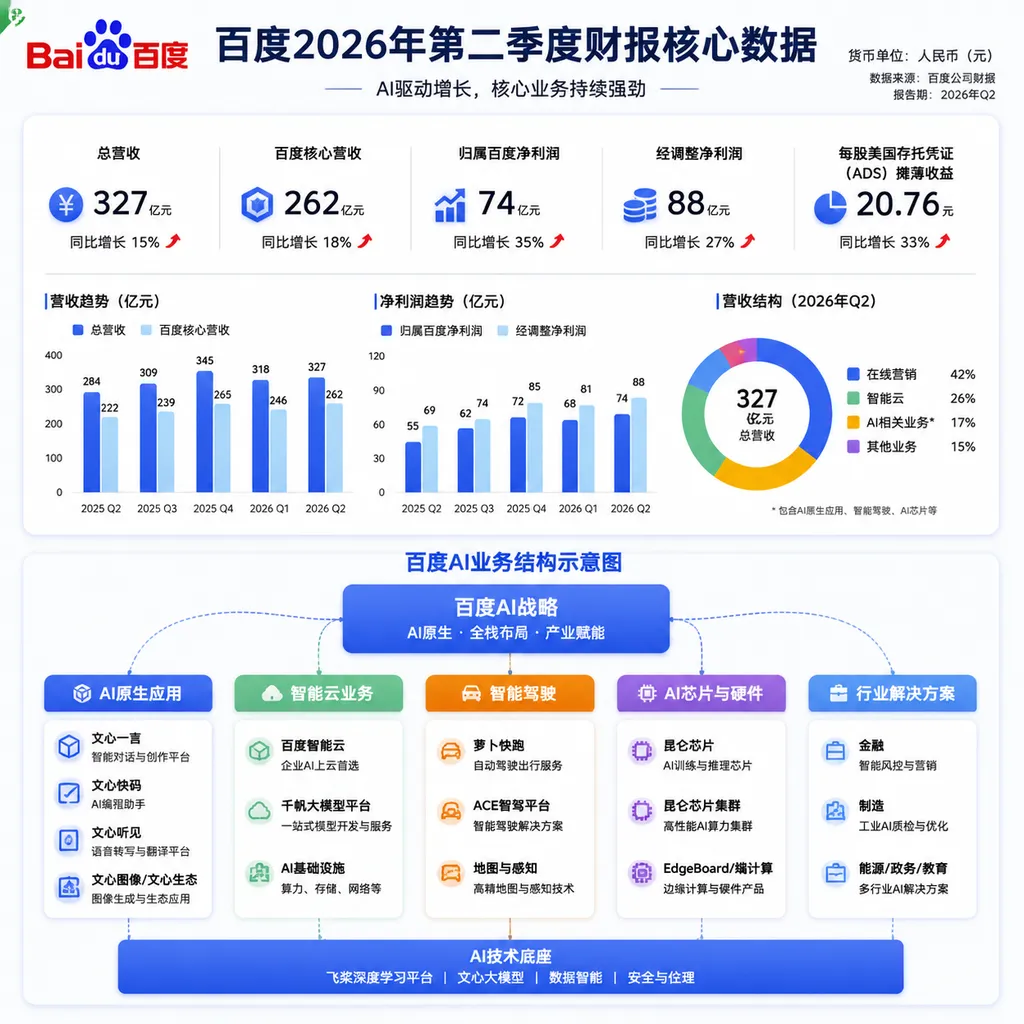
Baidu released its second-quarter 2026 financial results today (August 18). Total quarterly revenue was RMB 31.3 billion, down 4.4% year over year; net income attributable to Baidu was RMB 2.319 billion, down 68.33%. In a set of results that was far from easy, AI remained the clearest growth driver: Baidu’s core business revenue was RMB 25.2 billion, with AI business revenue accounting for approximately 50%, reaching half or more for the second consecutive quarter.
During the earnings call, Baidu Chairman and CEO Robin Li also set a more direct goal for ERNIE: through organizational adjustments, talent recruitment, and sustained investment, return ERNIE to the top tier of foundational large models.
That statement is worth unpacking. Baidu did not say that ERNIE had already returned to the top tier. Instead, it acknowledged that ERNIE needs to “return” there. As competition among domestic foundational models enters a phase of high-frequency iteration, rapidly falling prices, and steadily narrowing capability gaps, this is closer to reality than simply announcing first place on a particular ranking.
AI Revenue Exceeds Half, but the Overall Business Is Still Contracting
Let’s start with the key figures:
| Metric | Q2 2026 Performance | Year-over-Year Change | | --- | ---: | ---: | | Total revenue | RMB 31.275 billion | Down approximately 4% | | Baidu core business revenue | RMB 25.2 billion | As disclosed in the financial report | | AI business as a share of core business revenue | 50% | Above or at half for two consecutive quarters | | AI cloud infrastructure revenue | RMB 7.3 billion | Up 50% | | GPU cloud revenue | Absolute figure not disclosed separately | Up 283% | | AI application revenue | RMB 2.5 billion | Up 3% | | AI-native marketing services revenue | RMB 2.6 billion | Essentially flat | | Net income attributable to Baidu | RMB 2.319 billion | Down 68.33% | | Cash flow from operating activities | RMB 3.4 billion | Remained positive |
Using Baidu’s core business revenue of RMB 25.2 billion and an AI share of 50% as a rough calculation, Baidu’s AI business revenue this quarter was approximately RMB 12.6 billion. The three AI-related items listed in the financial report, namely AI cloud infrastructure, AI applications, and AI-native marketing services, totaled approximately RMB 12.4 billion. The difference may be attributable to rounding in the percentage and differences in statistical definitions, so it should not be mechanically treated as a data conflict.
In the previous quarter, Baidu’s AI business revenue was RMB 13.6 billion, accounting for 52% of core business revenue. In other words, it is true that AI revenue has exceeded half for two consecutive quarters, but its absolute scale did not continue to rise this quarter. Instead, it declined from the first quarter. AI cloud infrastructure revenue also fell from RMB 8.8 billion in the first quarter to RMB 7.3 billion.
Therefore, “more than half” has two implications. On the one hand, AI has indeed evolved from an experimental investment area into a major source of revenue for Baidu. On the other hand, the contraction of traditional businesses is also passively pushing up AI’s share. Determining whether the transformation is truly complete requires more than looking at changes in the denominator. It also requires examining whether AI revenue can continue to grow, whether gross margins can improve, and whether related investments can be converted into stable cash flow.
For now, Baidu has at least demonstrated that AI can generate quarterly revenue on the scale of tens of billions of yuan. It has not yet demonstrated that this business can offset the pressure on search advertising and the profit strain caused by heavy investment. The decline in total revenue and nearly 70% drop in net profit are the unavoidable backdrop to these results.
GPU Cloud Revenue Grew 283%, Making It More Significant Than “AI Revenue Exceeding Half”
The most impressive metric this quarter was not 50%, but the 283% year-over-year growth in GPU cloud revenue. This business has achieved triple-digit growth for four consecutive quarters, with its growth rate accelerating further from 184% in the first quarter.
GPU cloud can be understood as Baidu packaging and selling computing clusters, scheduling systems, and model training and inference environments. Customers do not need to purchase chips, build data centers, or maintain clusters themselves. They can obtain the computing resources needed to train and deploy large models on demand. For enterprises moving AI from demonstration projects into production environments, the real cost is not just the price of calling a model once. It also includes cluster utilization, inference throughput, fault recovery, data security, and model adaptation.
Baidu’s advantages here are straightforward: it has full-stack capabilities spanning Kunlunxin, Baidu Intelligent Cloud, PaddlePaddle, and ERNIE, and it can also support third-party models such as DeepSeek, GLM, and MiniMax. Customers may not necessarily be buying ERNIE, but as long as training, fine-tuning, or inference runs on Baidu Cloud, Baidu can still generate infrastructure revenue.
This is also why GPU cloud has stronger defensibility than a single model API. The leading position among foundational models may change every few months, while computing power and cloud platforms are more like selling water, electricity, and development environments. The more models there are, the longer agent call chains become, and the greater the volume of inference, the more certain the demand for underlying infrastructure becomes.
However, 283% growth also needs to be viewed in the context of the underlying base. Baidu did not separately disclose GPU cloud’s absolute revenue or profit margin, so it is currently impossible to determine what share of the RMB 7.3 billion in AI cloud infrastructure revenue it represents. Rapid cloud revenue growth does not necessarily mean that cloud profits are growing at the same pace. In a market where domestic computing adaptation, cluster expansion, and price competition are happening simultaneously, revenue quality is equally important.
Why Does ERNIE Need to “Return” to the Top Tier?
During the earnings call, Robin Li acknowledged that foundational models are still evolving rapidly, that the leader may change every few months, and that no single model can remain permanently ahead across every dimension. Baidu has recently optimized its organizational structure and recruited senior foundational-model talent in an effort to accelerate ERNIE’s iteration.
This positioning actually adjusts Baidu’s competitive objective. Baidu is no longer emphasizing the creation of an all-purpose model that leads on every metric. Instead, it is shifting toward an application-driven approach, prioritizing capabilities most needed by Baidu’s own businesses, including search, digital humans, agents, no-code development, and industry decision-making.
That is more pragmatic than chasing the lead on every public benchmark.
Take AI search as an example. A model must do more than answer questions. It must understand query intent, assess webpage quality, handle time-sensitive information, provide sources, and maintain user trust between advertisements and organic results. A model that scores highly on a mathematics benchmark may not be able to deliver a good search experience directly. The click, dwell-time, query-reformulation, and content-quality signals accumulated by search systems can also feed back into a closed loop for model training and evaluation.
Baidu has search, Wenku, Wangpan, Maps, and enterprise cloud customers. These applications can provide real-world tasks rather than just leaderboard scores. If ERNIE can obtain feedback from these scenarios and then consolidate those capabilities into its foundational model, it does have opportunities to differentiate itself.
But “top tier” cannot be declared by a vendor itself. From a developer’s perspective, at least five things need to be evaluated:
- Whether general capabilities are stable. Code, mathematics, tool use, long context, and multimodality cannot have obvious weaknesses.
- Whether performance on real-world tasks is competitive. Search Q&A, complex workflows, and enterprise knowledge bases cannot work only in internal case studies.
- Whether inference costs are competitive. At the same level of accuracy, latency, throughput, and token pricing directly determine whether applications can scale.
- Whether the API and toolchain are mature. Structured output, function calling, caching, batch processing, monitoring, and version compatibility affect the developer experience more than a single evaluation score.
- Whether the iteration pace is sustainable. Being in the top tier is not a ranking achieved at one product launch, but the ability to remain competitive across multiple consecutive versions.
ERNIE 5.1 previously achieved strong results in some search-related evaluations and was trained using Kunlunxin clusters. This shows that Baidu’s model and proprietary computing capabilities are already able to form an internal loop. However, based on the actual choices of domestic developers, ERNIE still faces competition from models such as DeepSeek, Qwen, GLM, and MiniMax. Globally, it must also be compared with the model ecosystems of OpenAI, Anthropic, and Google. Returning to the top tier will require more than leading in search alone.
AI Application Revenue Grew Only 3%, Exposing Another Challenge
Compared with the rapid growth of GPU cloud, Baidu’s AI application revenue was RMB 2.5 billion this quarter, up only 3% year over year. AI-native marketing services revenue was RMB 2.6 billion, essentially unchanged year over year.
These figures show that enterprises are willing to pay for computing power and infrastructure, but upper-layer AI applications have not yet experienced a similarly powerful breakout. Baidu is advancing products including AI search, digital-human platforms, Miaoda, Famao, and intelligent agents for Wenku and Wangpan. These products cover consumers, marketing, and industrial decision-making, but whether they can generate sustained subscription or usage-based revenue still requires time to validate.
Commercializing AI applications is much more difficult than demonstrating a model. An agent completing a task in testing does not mean it can reliably enter an enterprise production workflow. Enterprises care about permission boundaries, error tracking, human intervention, system integration, data isolation, and service-level agreements. Once an agent can modify orders, schedule equipment, or generate marketing content, hallucinations are no longer merely incorrect answers. They can become actual losses.
Therefore, Baidu’s emphasis on an “application-driven” strategy is directionally correct. The next challenge is not to release several more agents, but to turn them into reliable software systems. Revenue of RMB 2.5 billion shows that Baidu is not starting from zero, while 3% growth indicates that these applications have not yet become a new high-growth engine.
Baidu’s Real Advantage Lies in Whether Chips, Cloud, Models, and Applications Can Reinforce One Another
Baidu has emphasized full-stack AI for several years. The concept once seemed broad. It is now beginning to have more concrete commercial significance:
- Kunlunxin provides domestic AI computing power and reduces reliance on a single external chip supplier;
- Baidu Intelligent Cloud supports training, inference, and enterprise deployment needs;
- ERNIE provides foundational model capabilities while validating Baidu’s proprietary chips and training platform;
- Search, digital humans, Miaoda, and industrial agents provide real traffic and task feedback;
- Data and revenue generated by applications can then feed back into the models and infrastructure.
If this flywheel begins to operate, Baidu does not need to remain number one on every general-purpose benchmark. It can also build a moat through search and enterprise scenarios. The problem is that full-stack capabilities are both an advantage and a cost: chips, models, cloud platforms, and applications all require sustained investment, and inefficiency at any layer can drag down overall profitability.
Net income attributable to Baidu was RMB 2.319 billion this quarter, down 68.33% year over year. This already shows that the cost of the transformation remains heavy. Baidu’s AI story is moving from “does it have the technology?” to “can the technology generate high-quality growth?”
What This Means for Developers
For developers, these financial results send three practical signals.
First, the domestic model market will not quickly consolidate around one or two companies. Baidu has clearly decided to increase investment in ERNIE again, which means competition among models, cloud platforms, and API prices will continue. Developers should continue to maintain multi-model routing and replaceable architectures to avoid locking business logic into a single vendor.
Second, computing infrastructure may establish a stable commercial model earlier than chatbots. GPU cloud has achieved triple-digit growth for four consecutive quarters, indicating that enterprise AI investment is shifting from experimental budgets to deployment budgets. Development opportunities around inference optimization, model gateways, observability, agent runtimes, and permission governance may be more solid than building yet another general-purpose chat interface.
Third, model capabilities ultimately have to deliver value in specific workflows. Baidu’s focus on search, digital humans, and industrial agents effectively acknowledges that simply selling tokens is difficult to turn into a long-term differentiator. When selecting a model, developers should not compare rankings alone. They should use their own datasets to evaluate accuracy, latency, cost, and failure-recovery capabilities.
Conclusion: AI Has Taken Over, but ERNIE Has Not Won Yet
Baidu has completed an important shift in its revenue structure: its AI business has accounted for half or more of core business revenue for two consecutive quarters, GPU cloud has become its fastest-growing segment, and AI is no longer merely a cost center. There is little dispute about this.
But “AI revenue exceeding half” does not mean the transformation has already succeeded. Total revenue continued to decline in the second quarter, net profit fell sharply, AI applications and marketing services saw limited growth, and AI cloud revenue also declined from the first quarter. Baidu now has a rapidly growing GPU cloud engine, but it has not yet fully filled the gap left by the slowdown in its legacy businesses.
As for whether ERNIE can return to the top tier, organizational adjustments and talent recruitment are only the starting point. The real answer will depend on whether the next generation of models can deliver convincing results simultaneously in coding, reasoning, search, agents, and cost, and whether those capabilities can translate into developer usage and enterprise renewals.
Baidu also stated that it has advanced the conversion to a dual primary listing in Hong Kong and expects to complete it by the end of 2026. For the capital markets, what needs to be watched next is not just a model ranking, but also the absolute growth of AI revenue, profit margins, and cash flow.
Baidu has turned the steering wheel decisively toward AI. The question is no longer whether it wants to transform, but whether it can control costs while accelerating and genuinely catch up with the top tier.
Sources
- ITHome: Transcript of Baidu’s 2026 Q2 Earnings Call: ERNIE Will Return to the Top Tier of AI — Summarizes Baidu management’s comments during the earnings call on ERNIE’s positioning, the structure of the AI business, and plans for a primary listing in Hong Kong.
- ITHome: Baidu Fiscal 2026 Second Fiscal Quarter Financial Data — Includes key figures such as total revenue, net profit, cash flow, AI cloud, AI applications, and marketing services.