Robot Training Moves into the “Second World”
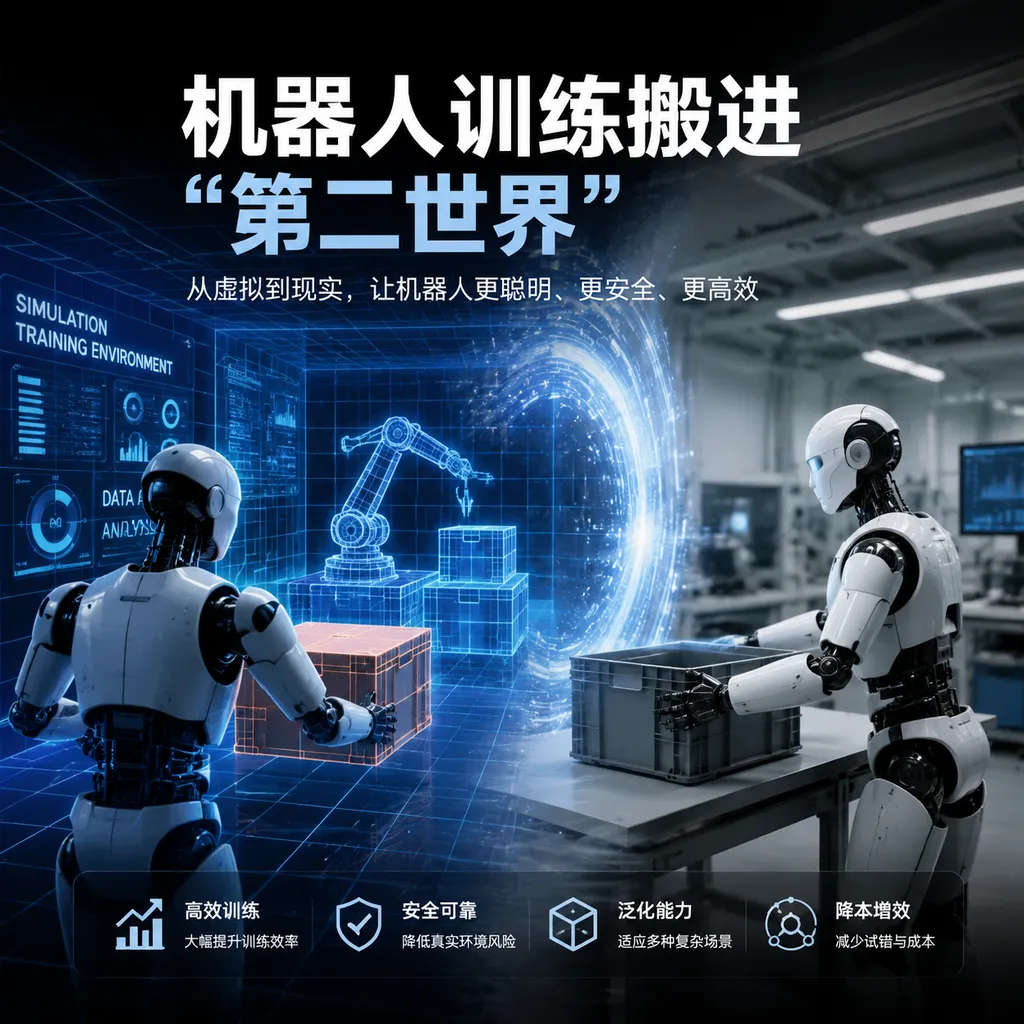
A Chinese team previously cited by π0 has recently released a new work on world simulation. Robot simulators are evolving from low-cost practice environments into neural world models that can be trained and evaluated, helping narrow the Sim-to-Real gap.
Robot Training Moves into a “Second World”
A Chinese research team previously cited by the π0 robotics foundation model recently released a new world simulator for robot training. It is not trying to solve the problem of “how to generate a video that looks realistic,” but a harder and more practical one: Can we build robots a second world that is close enough to reality while allowing repeated trial and error?
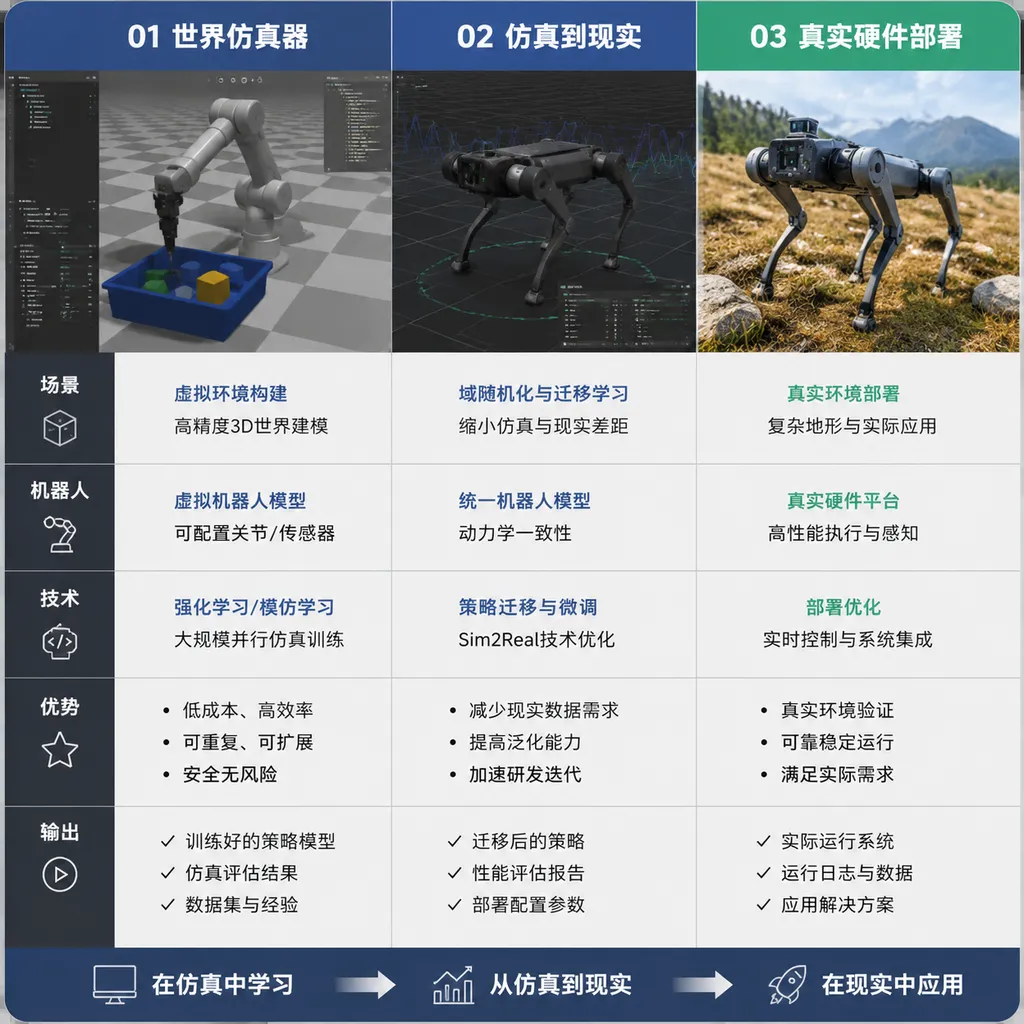
As of August 18, publicly available demonstrations indicate that the work focuses on robotic manipulation and locomotion scenarios. Based on a robot’s actions, the system must continuously predict what will happen next to the environment, objects, and the robot itself, while enabling policies trained within it to potentially transfer directly to real hardware.
This represents a shift in what the robotics field expects from world models. In the past, world models were often treated as an ambitious wrapper around video generation models. Now, the evaluation criteria are becoming concrete: Will the cup slip? Did the robotic arm hit the table? Will a quadruped lose its balance after planting its foot? And will a policy learned in a virtual environment still work when deployed on a real robot?
It Is Not About Making the Image Look Real, but About Getting the Consequences of Actions Right
Traditional robotics simulators rely on manually authored geometry, rigid-body dynamics, collision rules, and material parameters. Their advantage is controllability: developers know the value of gravity, can configure coefficients of friction, and can access the precise state of every object.
The problems are equally apparent. The real world does not simply provide robots with coefficients of friction, object masses, or contact-point coordinates. The deformation of flexible packaging, resistance in drawer slides, lighting reflections, camera noise, and the small but critical shifts that occur when a gripper contacts an object are all difficult to describe fully with a set of handcrafted parameters.
Neural world simulators take a different approach: learning how the environment changes from real interaction data.
Given the current observation, robot action, and task conditions, the model predicts future states or video frames. Instead of immediately executing every candidate action, the robot can first “imagine” several trajectories within the model, then select the one with the highest probability of success and the lowest risk.
Consider a straightforward example: a robotic arm is preparing to pick up a cup from a cluttered tabletop. A reactive policy typically outputs an action directly from the current image. A policy equipped with a world model can first compare several options:
- Will approaching from the side of the handle cause a collision with the bowl next to it?
- If grasped from above, will the gripper slip because the rim is too wide?
- Would pushing the obstacle aside first create a more stable grasping area?
- If the action fails midway through execution, is there still a recovery path?
This is more like search in a Go-playing program than camera-based recognition. The model’s value lies not only in “understanding the present,” but also in rehearsing “what happens afterward.”
World Models and Simulators Are Converging
In robot training, “world models” and “simulators” were not originally identical concepts.
| Approach | Primary Representation | Advantages | Limitations | |---|---|---|---| | Traditional physics simulation | Geometry, joints, rigid bodies, and contact parameters | Interpretable, controllable, and state-accurate | High modeling costs and limited coverage of real-world details | | State-based world models | Low-dimensional states and their transitions | Fast rollouts and well suited to reinforcement learning | Depend on reliable state information and offer limited visual realism | | Video world models | Pixels, multi-view video, and actions | Can directly absorb real-world data and provide broad visual coverage | Long-horizon drift and insufficient physical consistency | | Hybrid simulation | Physics engines plus neural generative modules | Balances controllability and realism | Complex systems with high training and validation costs |
A new generation of world simulators is combining these approaches. Physics engines enforce fundamental rules such as collisions and joint constraints. Generative models fill in textures, lighting, materials, and interaction details that are difficult to model explicitly. Action-conditioned models then predict the outcomes of executing a policy.
This is also what makes this new release genuinely noteworthy: it does not simply pursue more attractive synthetic imagery, but treats the simulated environment as both a training ground and an evaluation environment for robot policies.
If the visuals are realistic but do not respond to action controls, the system is merely generating video. If collisions are accurate but the visual gap from reality is enormous, it will still struggle to support the direct transfer of vision-based policies. Robots need the more difficult intersection of the two: the world must both look like reality and respond correctly to the robot’s actions.
Why Robots Need a “Second World”
Large language models can be trained on internet text, but robots do not have access to action data at an equivalent scale and on demand.
Scraping another webpage has almost no marginal cost, while a single real-world robot interaction involves hardware occupancy, manual resets, camera calibration, damage to consumables, and safety monitoring. For contact-rich tasks such as opening doors, pouring water, or inserting and removing connectors, failures may directly damage the robotic arm or nearby equipment.
Simulation is therefore not a nice-to-have, but a prerequisite for training at scale. It can address at least three categories of problems.
1. Scaling Up Interaction Data
In a real laboratory, one robot can perform only a limited number of tasks each day. A virtual environment, by contrast, can run many instances in parallel, allowing policies to train repeatedly with different objects, viewpoints, lighting conditions, and initial positions.
Traditional data augmentation merely changes image colors or crop boundaries. A world simulator can alter the entire course of a task: a cup may be knocked over, a drawer may fail to open fully, or the robot may lose its grasp midway through the operation, and the environment must continue to evolve afterward.
2. Creating Failures That Are Rare in Reality
Routine successful trajectories are easy to collect, while dangerous situations and edge cases are scarce. Examples include a quadruped stepping onto a low-friction surface, a robotic arm grasping deformable packaging, or a mobile robot encountering a suddenly appearing obstacle in a narrow passage.
These scenarios are unsuitable for repeated testing on real hardware, but their frequency can be increased in a virtual environment. The autonomous driving industry has already validated this approach: the most valuable part of simulation is not reproducing ordinary straight-road driving encountered every day, but generating extreme long-tail scenarios at scale.
3. Performing Inference-Time Search Before Execution
A more important change is taking place at inference time. World models are not limited to offline training; they can also act as an “internal simulator” while a robot prepares to act.
The robot first proposes multiple actions. The world model predicts the result of each, scores them according to task progress, visual plausibility, and failure risk, and then refines the action. This “propose–simulate–evaluate–refine” loop resembles how large models improve answer quality by increasing inference-time computation, except that the robot searches over physical actions rather than text.
Sim-to-Real Remains the Real Barrier
World simulator demonstrations are often compelling, but developers should focus on one metric: How much of the improvement achieved in simulation transfers to a real robot?
This is the Sim-to-Real problem. No matter how rich a virtual training ground may be, if its key rules differ from reality, a policy may learn to exploit flaws in the simulator.
For example, if object contact is excessively stable in the simulator, the policy may develop grasping techniques that would never work in reality. A video model may predict a visually smooth robotic arm trajectory whose joint velocities or torques are physically infeasible. Errors may accumulate during long autoregressive generations, causing the latter half of a trajectory to be built on a world that has already diverged from reality.
Evaluating a world simulator therefore requires more than inspecting generated videos. It must also examine:
- Action controllability: Given the same initial state, do different actions produce distinct and plausible consequences?
- Long-horizon consistency: Do object identity, spatial position, and contact relationships remain stable across long trajectories?
- Multi-view consistency: Do different cameras observe the same three-dimensional world?
- Physical executability: Do predicted trajectories satisfy the robot’s joint, velocity, torque, and collision constraints?
- Policy transfer performance: Can policies trained in the model be deployed on real robots zero-shot or with minimal fine-tuning?
- Failure calibration: Does the model recognize its own uncertainty, rather than assigning high confidence to incorrect futures?
Public demonstrations can show that a system “runs,” but proving that it can become reliable robotics infrastructure requires results on real hardware across robot embodiments, tasks, and scenarios. Existing world models remain far from solving tasks involving fabrics, liquids, transparent objects, and high-speed contact in particular.
From RWM to Action-Conditioned Video Models, Two Approaches Begin to Intersect
Earlier research on robotic world models demonstrated another path: training a neural network simulator in a low-dimensional state space, then using model-based reinforcement learning within the model to optimize policies.
The advantage of these methods is fast rollouts. Robotic arms or quadrupeds can perform large numbers of rollouts within the model, after which the resulting policies can be deployed zero-shot on real hardware. As long as state-transition predictions are sufficiently accurate, this can substantially reduce the number of real-world interactions required.
Action-conditioned video models are closer to how humans observe the world. A model receives images, task instructions, and candidate actions, predicts multi-view future imagery, and estimates task progress at the same time. It does not necessarily require access to precise physical states that are difficult to obtain in reality, making it easier to leverage large-scale real-world video and robot manipulation data.
Both approaches come with costs. State models are fast but depend on high-quality state representations. Video models can draw from broader data sources but are more computationally expensive to roll out and more prone to drift in long-horizon predictions. The more practical solution may not be to choose one or the other, but to combine them hierarchically:
- A low-dimensional dynamics model handles rapid search;
- A video model evaluates visual consequences and task progress;
- A traditional physics engine checks hard constraints;
- A small amount of real-world robot data continuously calibrates model bias.
The industry signal represented by this new world simulator is that this convergence is accelerating. World models are no longer merely prediction modules in research papers; they are beginning to enter the pipelines for data generation, reinforcement learning, closed-loop evaluation, and real-world deployment.
Our Assessment: The Direction Is Sound, but “Looking Real” Is Far from Enough
World simulators are likely to become key components of robotics foundation models, for a straightforward reason: real-world robot data is too expensive, while purely simulated data is not realistic enough. Whoever can narrow the gap between the two may be able to reduce the marginal cost of training embodied intelligence.
At this stage, however, they should not be understood as a complete replacement for real-world data. Simulators themselves still need real-world data for training and calibration. Without sufficient real-world data, a model is likely to scale up existing biases. World models can help robots use real-world experience more efficiently, but they cannot create reliable physical laws from nothing.
For developers, the most practical near-term approach is not to have a single model take over the entire training process end to end, but to integrate world simulators into three specific stages: long-tail scenario generation, policy regression testing, and candidate-action screening before execution on real hardware.
These stages can tolerate a certain degree of model error while immediately reducing hardware usage. Training entirely within generated worlds and then deploying zero-shot to any real robot remains a goal, not a capability that has already been broadly achieved.
Over the past few years, the robotics industry has been searching for its own “data flywheel.” It is becoming increasingly clear that this flywheel will not consist solely of real robots. Real-world data provides the anchor, world simulators expand the range of scenarios, and real-hardware deployment results feed back into correcting the models.
Robot training is shifting from “repeatedly completing tasks in a fixed simulator” to “learning a second world that responds to actions.” The significance of this new release lies in moving that approach another step closer to practical engineering use.
References
Because the links at the end of this article are restricted to specified domains accessible from China, the following are search entry points for relevant open-source resources. For specific versions, weight licenses, and reproduction requirements, refer to the respective project pages.
- GitHub: Search for robotics world model projects—Can be used to find code for world models, neural simulators, and Sim-to-Real training.
- GitHub: Search for τ0-WM repositories—For checking open-source implementations and community reproductions of action-conditioned video world models.
- Hugging Face: Search for robot world models—A collection of robot video prediction, action-conditioned generation, and related model weights.