Xiaomi MiMo Is Moving from Models to Desktop Applications
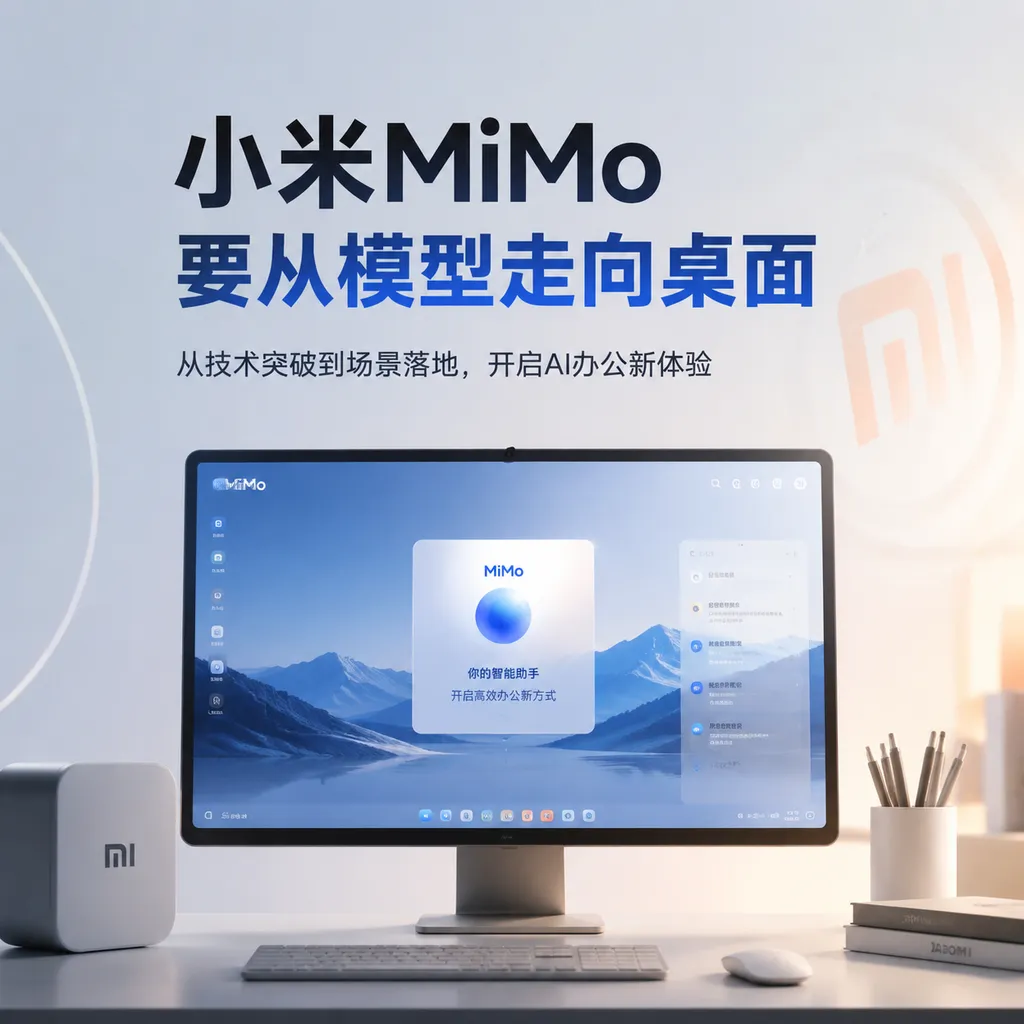
Xiaomi confirmed that MiMo’s first personal desktop application will launch soon, and that its next-generation model has also entered the training phase. More noteworthy than the parameter upgrade is that MiMo has begun simultaneously validating its product entry point, developer ecosystem, and commercialization.
Xiaomi Advances Desktop Product and New Model in Parallel
Xiaomi MiMo is shifting from competing purely on model capabilities to competing for the primary user touchpoint.
On the evening of August 18, Xiaomi Group CFO Alain Lam revealed during an earnings call that MiMo will soon launch its first personal desktop application, positioned as a one-stop solution for users to complete work and everyday-life tasks. Meanwhile, the next-generation MiMo model is currently in training and is expected to be released soon.
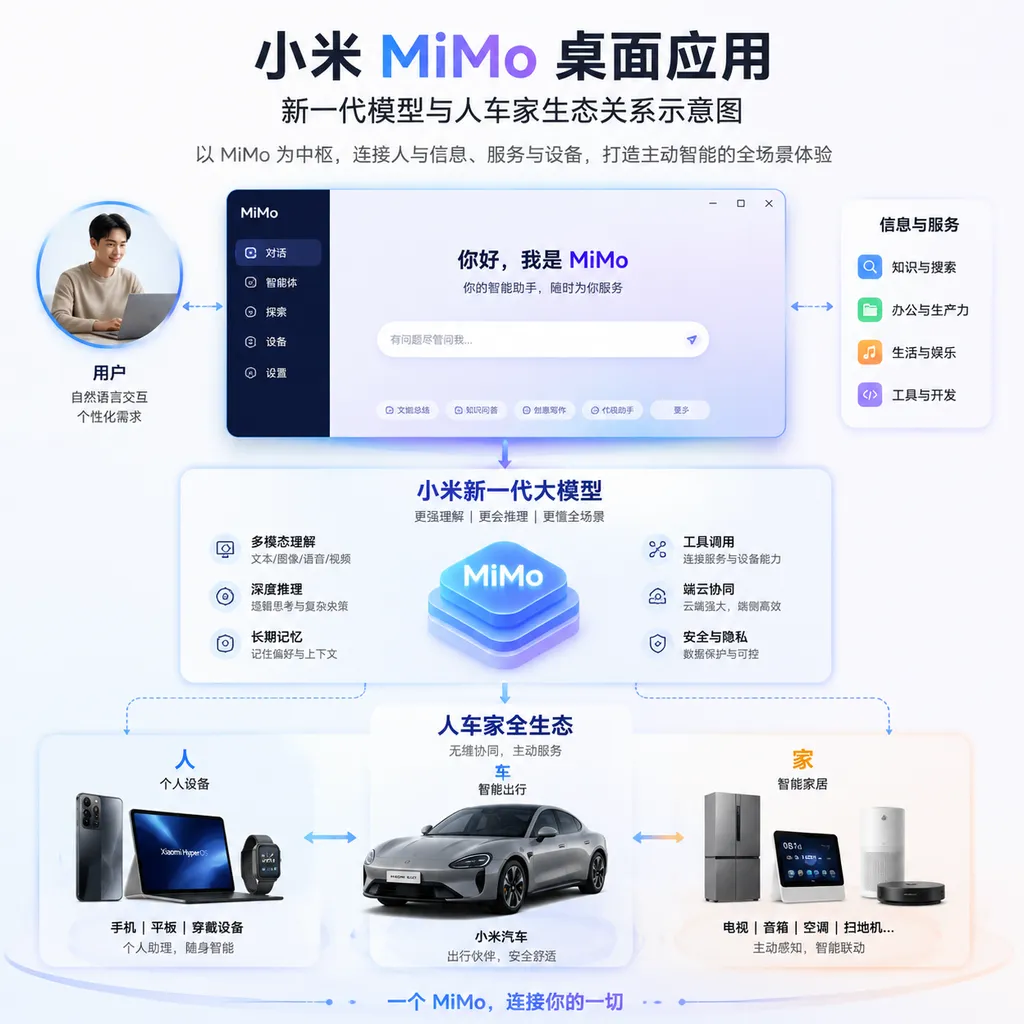
Early signs of commercialization have also emerged. Lam said MiMo’s Token Plan has begun generating revenue and is growing rapidly. However, Xiaomi still views AI as an investment-intensive business and is not prioritizing monetization in the short term. It will continue using AI to reshape its “Human × Car × Home” ecosystem.
The announcement did not disclose the desktop application’s name, supported platforms, or specific launch date. Nor did it provide details on the new model’s parameter count, architecture, or context length. Strictly speaking, this was not a full product launch. But taken together—the desktop touchpoint, next-generation model, and Token revenue—these three moves make MiMo’s strategy much clearer than before: the model establishes the ceiling for capabilities, the desktop application targets high-frequency use cases, and the Token Plan provides an early test of whether developers and professional users are willing to pay.
A Desktop Application Is More Than Just Another Chat Box
The phrase “personal desktop application” can easily bring to mind yet another chat client wrapped around a large model. If the final product offers only Q&A, translation, summarization, and file uploads, its competitiveness will be quite limited. By 2026, desktop AI clients are no longer scarce. What users truly lack are tools that can take over workflows rather than merely provide answers.
Xiaomi describes the product as a way to “complete work and everyday-life tasks in one place.” The key part of that statement is not “in one place,” but “tasks.”
Chatbots handle single-turn or multi-turn information exchanges. Task-oriented products, by contrast, must turn model outputs into executable actions. For example:
- Reading multiple local documents, extracting conclusions, and generating presentation materials;
- Compiling to-do items from emails, calendars, and instant messages;
- Calling system tools with the user’s authorization to archive files, convert formats, or organize data;
- Connecting phones, tablets, cars, and smart home devices to extend intentions expressed on a computer to other endpoints;
- Retaining ongoing work context instead of starting from scratch every time the application is opened.
The difficulty of building such products has never been limited to whether the model is intelligent enough. Permission management, local file indexing, application invocation, task-state recovery, long-running stability, and rollback mechanisms after failures all directly determine whether the product can become part of real-world workflows.
In other words, the difference between a desktop agent and a chat box is similar to the difference between “providing navigation directions” and “actually driving the car to the destination.” If the former gives a wrong answer, the user can simply ask again. If the latter executes incorrectly, it may overwrite files, send messages to the wrong recipient, or even operate the wrong device.
Therefore, the most important thing to watch about Xiaomi’s desktop application is not what its home screen looks like, but how many system-level capabilities it can access and how many engineering resources Xiaomi is willing to invest in execution reliability.
Xiaomi’s Advantage Goes Beyond the Model
If the comparison is limited to general-purpose large models, Xiaomi faces an extremely crowded market. Leading model vendors continue to improve reasoning, coding, multimodal, and agent capabilities, while developers in China and abroad have already established relatively stable model preferences. It will not be easy for MiMo to reshape the market based on benchmark rankings alone.
The desktop application, however, broadens the dimensions of competition.
Xiaomi has smartphones, tablets, PCs, wearables, cars, and a vast range of smart home products. For a device manufacturer, a desktop application does not have to be isolated software; it is more likely to become a control center for cross-device tasks. A user might ask it to organize meeting materials on a computer and then sync reminders to a phone; after planning a trip, send the route and schedule to a car; and when leaving the office, coordinate with home devices. Such scenarios are difficult to achieve with a model API alone, but they align naturally with Xiaomi’s existing device ecosystem.
This is where the “Human × Car × Home” ecosystem offers more room for imagination than a generic AI assistant. Model capabilities will gradually converge, but device permissions, user state, and cross-device coordination are far more difficult to replicate.
Of course, having a large hardware portfolio does not automatically create a strong ecosystem. For a cross-device agent to truly work, at least three issues must be addressed:
- Unified identity and context. Phones, computers, cars, and home devices must understand that they are serving the same user and the same task.
- Unified tool protocols. The model must be able to discover device capabilities, invoke tools, and receive execution results in a consistent manner.
- Clear permission boundaries. Accessing information, generating recommendations, and taking direct action must be assigned different permission levels. Sensitive operations should also require secondary confirmation and retain audit logs.
Without this infrastructure, “Human × Car × Home” could easily remain a collection of devices that each integrate AI separately, rather than a single AI that works continuously across multiple devices.
The Next-Generation MiMo May Prioritize Efficiency Over Scale
Lam only confirmed that the next-generation MiMo is currently in training and did not disclose further technical details. At this stage, it is impossible to determine whether it will be an upgrade to the general-purpose model, an upgrade to the coding model, or a series of updates aimed at agents and on-device deployment.
However, judging from the areas Xiaomi has recently emphasized publicly, the new model may not make “more parameters” its only selling point.
In July, MiMo V2.5 ranked first in both monthly and weekly usage on OpenRouter, a third-party model access platform. Xiaomi attributed this performance to systematic advantages in model capabilities, inference efficiency, and cost control. It should be noted that usage rankings on a single platform cannot be equated with global large-model market share. Such rankings are affected by the composition of the platform’s users, pricing, routing strategies, and temporary promotions. Nevertheless, developers’ willingness to continue using the model at least indicates that MiMo has achieved an attractive balance between performance and price.
For a desktop agent, this balance matters more than any individual benchmark score.
A complex office task may require the model to carry out planning, retrieval, tool calls, result verification, and retries after failures in succession, resulting in far more backend calls than an ordinary chat interaction. If every step uses the most expensive model with the highest latency, the product will be difficult to make widely available. A more practical architecture generally involves model tiering: simple tasks are assigned to faster, smaller models; complex reasoning is escalated to more capable models; and multimodal understanding and code execution are handled by specialized modules.
Key metrics to watch for the next-generation MiMo therefore include:
- Tool-call success rates and parameter-generation accuracy;
- Planning stability and error-recovery capabilities during long-running tasks;
- Inference cost per Token and time to first token;
- Information retrieval performance with long contexts;
- Multimodal input capabilities for images, documents, and on-screen content;
- The feasibility of deployment on devices or in local environments;
- The ability to operate in real software environments, beyond code generation.
If the new model merely delivers routine improvements in knowledge Q&A and benchmark scores, it will have limited synergy with the desktop application. If the upgrade focuses on tool use, long-running tasks, and multimodal interaction, then this training effort will genuinely support Xiaomi’s next phase of product development.
MiMo Code Has Already Begun Exploring the Path
The desktop application is not MiMo’s first step from model to tool.
On June 11, Xiaomi released and open-sourced MiMo Code V0.1.0. It is an experimental AI coding assistant that runs in the terminal, with built-in access to the MiMo-V2.5 multimodal model for free for a limited time. It also supports models such as DeepSeek, Kimi, and GLM, as well as third-party Token Plans.
MiMo Code’s product approach reveals two signals.
First, Xiaomi has not completely locked the tool to its own model. For developers, multi-model access makes it possible to choose among capabilities, cost, and latency based on the task, while also lowering migration barriers. This strategy is closer to competing at the tool layer: first embed the product in users’ workflows, then work to increase model usage.
Second, a terminal-based coding assistant is itself a testing ground for agents. It needs to read code repositories, understand relationships among files, generate modification plans, invoke commands, and process execution results. This loop is fundamentally no different from that of a desktop productivity agent; the toolset simply expands from compilers, shells, and version control to documents, calendars, communication software, and system capabilities.
MiMo Code can tolerate a certain degree of “developers handling the rest themselves”: if a command fails, developers can inspect the logs; if a code change is incorrect, they can undo it with version control. A desktop application aimed at ordinary users cannot make the same assumption. It must provide clearer execution previews, more conservative default permissions, and error messages that nontechnical users can understand.
From this perspective, MiMo Code is the advance scout for the technical roadmap, while the personal desktop application will be the true stress test for product engineering.
The Token Plan Is Generating Revenue, but It Is Too Early to Claim a Closed Commercial Loop
The fact that the Token Plan has begun contributing revenue is another significant piece of information from the earnings call.
This means MiMo is no longer merely an internal R&D project or a brand showcase; it is now seeing genuine paid usage. For a model business, revenue growth can validate three things: whether developers are willing to entrust tasks to the model, whether its pricing is competitive, and whether the service is stable enough to support production workloads.
However, “beginning to generate revenue” and “achieving sustainable profitability” are two different things. Model training, inference clusters, talent, and product development all require substantial funding. Rapid growth in usage may also amplify inference costs. If pricing is too low, higher revenue does not necessarily mean better gross margins.
Xiaomi has made it clear that its AI business remains in a period of large-scale investment and that monetization is not currently its primary objective. This position reflects present realities. For Xiaomi, the value of AI may not be limited to Token revenue; it may also be reflected in device experiences, user retention, ecosystem coordination, and hardware sales.
This is also what distinguishes Xiaomi from pure-play model companies. Pure model vendors need to demonstrate as quickly as possible that API and subscription revenue can cover their high costs. Xiaomi, by contrast, can treat its models as an operating-system-level capability and use them to enhance the overall competitiveness of its smartphones, cars, and smart home products. The former focuses more on gross margin per million Tokens, while the latter also considers whether AI makes users more willing to remain within its device ecosystem.
What Developers Should Watch Next
The information currently available to the public remains limited. Rather than prematurely speculating about the model’s name or the desktop application’s interface, it would be more useful to focus on several concrete metrics when they are released:
- Openness: Whether the desktop application supports third-party models, plugins, or tool protocols;
- Platform coverage: Which desktop operating systems will be supported at launch, and whether the application will be deeply tied to Xiaomi devices;
- Local capabilities: Whether file indexing, private data processing, and some inference can be performed locally;
- Observability: Whether the agent’s execution process can be viewed, paused, rolled back, and audited;
- Model routing: Whether different MiMo model variants will be selected automatically based on the task;
- Developer interfaces: Whether third-party applications can register their capabilities as callable tools;
- Pricing model: How desktop subscriptions, Token Plans, and device benefits will be combined.
The most important of these is support for third-party tools. If the personal desktop application can invoke only Xiaomi’s own services, it will be more like a remote control for the ecosystem. If developers are allowed to register tools and participate in task execution under a clear permission framework, it will have a chance to become a true platform.
MiMo Is Adding the Missing Product Touchpoint
Xiaomi has historically been more visible for its devices and ecosystem, while MiMo has given it a model foundation of its own. The upcoming launch of a personal desktop application means Xiaomi is preparing to add the missing user-facing AI touchpoint.
This step is more important than publishing another set of benchmark rankings. Model capabilities determine what the product can do, the desktop touchpoint determines whether users will use it every day, and the Token Plan determines whether developers are willing to build services around it. Only when all three are in place can MiMo evolve from a popular model into a continuously operating business.
At this stage, however, expectations should remain measured: the desktop application has not yet been officially unveiled, and the next-generation model is still in training. Xiaomi has outlined the direction, but it has not yet delivered the answer.
The real test will come after the product launches: will it be just another AI chat window, or a task hub capable of safely and reliably coordinating a computer with devices across the “Human × Car × Home” ecosystem? The former would merely fill a gap in Xiaomi’s product portfolio; only the latter could become a critical gateway for Xiaomi’s AI strategy.
References
- ITHome: Xiaomi CFO Alain Lam Says MiMo’s First Personal Desktop Application Is Coming Soon and a Next-Generation Model Is in Training—Summarizes information disclosed during Xiaomi’s earnings call regarding the desktop application, model training, Token Plan revenue, MiMo Code, and other developments.