Tencent Cloud Unveils WorkBuddy in Malaysia
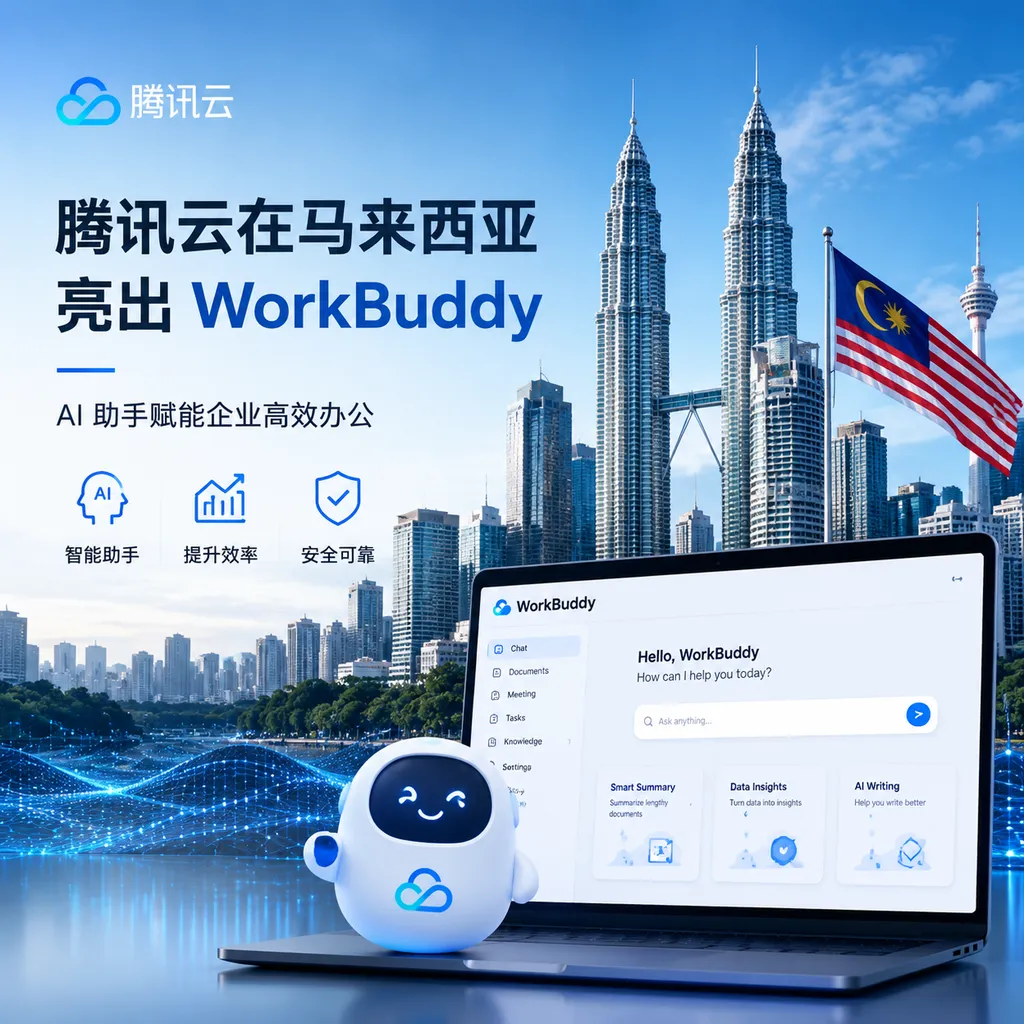
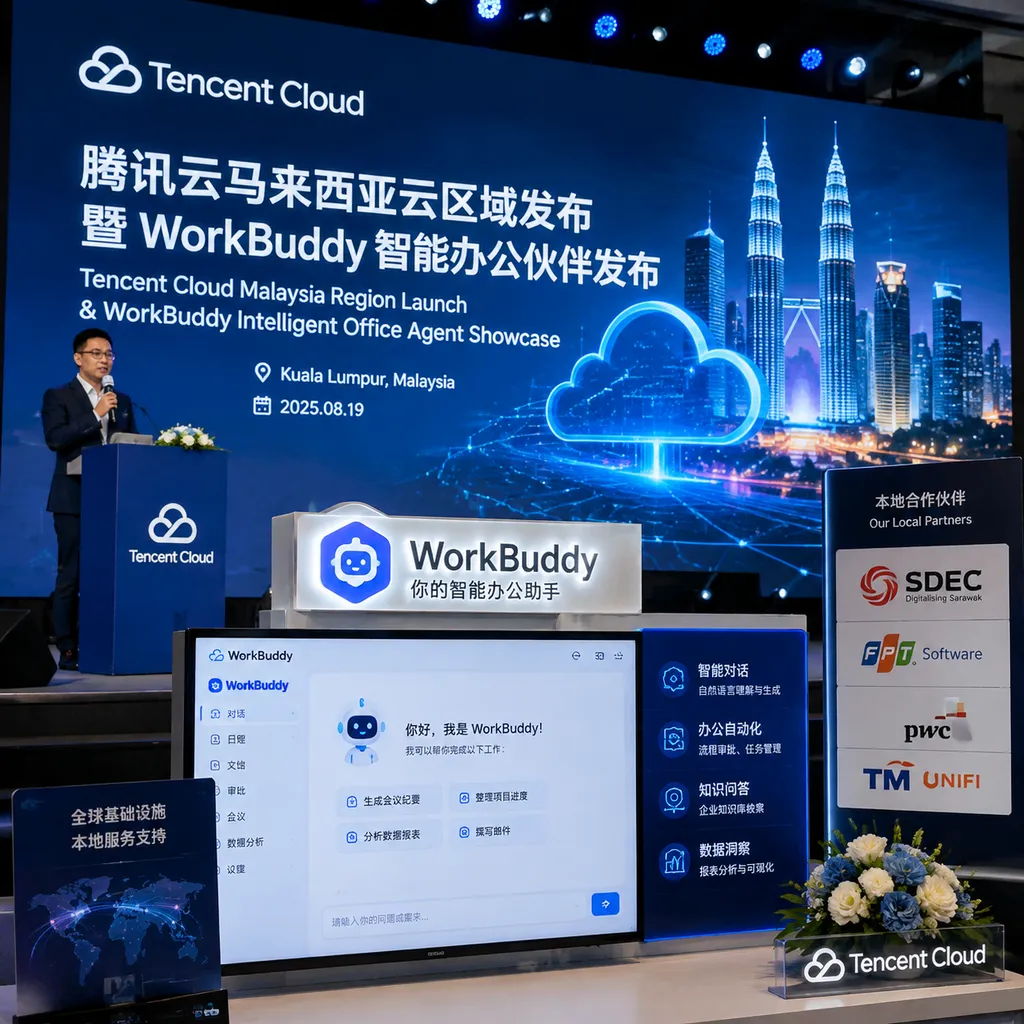
On August 18, Tencent Cloud announced that it will build its first cloud region in Johor, Malaysia, and unveiled WorkBuddy, a desktop AI-native office agent, in the country for the first time. The product offers more than 100 Skills and aims to move AI beyond the chat window into an office workspace capable of handling files, invoking tools, and delivering results.
Tencent Cloud Unveils WorkBuddy in Malaysia: AI Productivity Moves Beyond the Chat Window
On August 18, Tencent Cloud announced that it would establish its first cloud region in Johor, Malaysia, with three availability zones planned for the initial phase. On the same day, Tencent Cloud showcased WorkBuddy, its desktop AI-native productivity agent workspace, and announced collaboration plans with institutions and companies including Universiti Teknologi Malaysia, Boost, and Genting Plantations Group.
On the surface, this launch was about deploying cloud infrastructure overseas. What deserves more attention, however, is that Tencent Cloud has brought WorkBuddy into the real-world environment of enterprise digitalization and AI commercialization in Southeast Asia. For developers, this is not just another AI assistant that can chat and write summaries. Rather, Tencent is attempting to turn agents into a product that can enter the desktop environment, read local files, invoke external tools, and ultimately deliver completed work.
Tencent Cloud disclosed that servers in the new Malaysia cloud region will connect to its global network, which spans 23 regions and 66 availability zones. Meanwhile, Tencent plans to work with Universiti Teknologi Malaysia on AI talent development, with the goal of training more than 1,000 AI professionals.
WorkBuddy’s Core Value Is Not Answering Questions, but Taking Action
Over the past two years, the main entry point for enterprise AI productivity tools has remained the chat box: users upload files, ask questions, and the model generates answers. This model is already mature enough for Q&A, rewriting, summarization, and basic analysis, but it has a clear limitation: models generally stop at providing recommendations, while people must still handle the actual file organization, spreadsheet processing, system data entry, and cross-application collaboration.
WorkBuddy attempts to push beyond that boundary.
According to the product introduction published by the Tencent Cloud Developer Community, users can describe their goals in natural language, and WorkBuddy will break down the task, plan the steps, and—once authorized—operate on local files and relevant productivity tools. For example, instead of manually creating multiple filtering rules, users can directly make requests such as:
- Categorize contracts, quotations, and meeting materials on the desktop by project, and apply standardized file names;
- Analyze user feedback from the previous week, identify frequently mentioned issues, and generate a structured insights report;
- Create presentation materials based on sales data and flag abnormal fluctuations;
- Regularly collect information about competitors, compile it into a weekly report, and send it to a designated collaboration group.
The key to these tasks is not whether the model can write a fluent paragraph, but whether it can execute continuously. A genuinely useful productivity agent needs to understand file structures, select the appropriate tools, manage dependencies between steps, pause and request confirmation when it encounters permission issues, formatting problems, or data anomalies, and ultimately produce results that can be reviewed.
In terms of product positioning, WorkBuddy is closer to a desktop workflow orchestration layer. It brings together large-model reasoning, file system operations, productivity software interactions, and connections to external platforms in a single workspace. The user provides a task description, while the system must complete a sequence of actions like the following behind the scenes:
Understand the objective
  -> Read and identify local files
  -> Break down the task and select Skills
  -> Invoke models and external tools
  -> Generate or modify results
  -> Validate results and request confirmation when necessary
  -> Output files, reports, or collaboration messages
This is also the most substantive difference between desktop agents and ordinary AI chat products: the former are evaluated not by “how human-like their answers are,” but by “whether they can get things done in a real-world environment.”
What Do More Than 100 Skills Mean?
Tencent Cloud emphasized that WorkBuddy has more than 100 Skills covering scenarios such as market research, data analysis, and project planning. A Skill can be understood as a capability module designed for a specific task—similar to equipping a general-purpose model with a set of callable professional tools and operating procedures.
But the number of Skills is not in itself what gives the product value. Developers should pay closer attention to three questions: Can these Skills be combined? Can they connect to systems that enterprises already use? Can their execution be audited?
If a Skill can only independently “generate a summary,” it is not significantly different from existing Copilot products. A truly valuable combination should work like this: first retrieve data from a customer service system, then use a model to classify and cluster it, write anomalous samples into a spreadsheet, and finally generate a report and push it to an enterprise collaboration platform. The longer the task and the more steps it involves, the more important the agent’s planning, state management, and failure recovery capabilities become.
The Tencent Cloud Developer Community previously stated that WorkBuddy supports parallel collaboration among multiple agents and provides capabilities tailored to roles in operations, design, data, development, finance, legal affairs, and other functions. Ideally, users would only need to provide a business objective, and multiple agents could separately handle requirements analysis, data processing, content generation, quality checks, and other work.
The advantage of this design is that it can improve throughput for complex tasks, making it particularly suitable for scenarios such as market research, content production, and internal project management. The risks are equally apparent: if multiple agents lack clearly defined context boundaries, they may duplicate work, overwrite one another’s results, or amplify incorrect judgments from one layer to the next. Enterprises evaluating the product should therefore pay more attention to whether it provides task logs, step replay, permission isolation, human approval, and result validation than to “how many expert roles” it offers.
Local File Access Is Both a Selling Point and a Risk
WorkBuddy’s desktop form factor offers a direct advantage: it can access local files within the scope authorized by the user, rather than requiring users to upload all materials to a web interface first. For financial spreadsheets, internal proposals, contracts, code directories, and historical project materials, this way of working more closely reflects real office environments.
However, the ability to operate on local files also means that the product must address more complex security issues. A model that only returns text can, at worst, provide an incorrect answer. For an agent capable of moving, renaming, modifying, or even deleting files in batches, an error can directly turn into a business incident.
Desktop agents therefore need at least the following controls:
- Clearly defined authorization boundaries: Read-only, editing, execution, and external-sharing permissions should be distinguished, and file access should not default to the entire drive.
- Confirmation for high-risk operations: Actions such as deleting files, overwriting original documents, sending external emails, and executing scripts should require step-by-step confirmation or approval.
- Complete operation logs: The system should record which files were used, which tools were invoked, which models were used, and what changes were ultimately made.
- Rollback capabilities: Version histories should be retained for bulk modifications, format conversions, and file archiving to prevent a single erroneous operation from causing irreversible damage.
- Sensitive data governance: Enterprises need to know what content will be sent to model service providers, whether the data is desensitized, and whether localized deployment or regional data storage is supported.
Tencent Cloud emphasizes that WorkBuddy offers enterprise-grade security auditing capabilities, but currently available public information is still insufficient to determine its specific data storage, cross-border transmission, and tenant isolation arrangements in the Malaysian market. For enterprises in finance, healthcare, government, and large-scale manufacturing, this information will directly determine whether the product can enter production environments.
Why Tencent Cloud Is Betting on Malaysia Now
The deployment of a cloud region provides an infrastructure foothold for WorkBuddy’s overseas expansion. Tencent Cloud’s plan to build three availability zones in Johor means that it is not merely providing a local node with faster access, but also attempting to establish cloud infrastructure with redundancy and regional service capabilities.
Malaysia’s value to Chinese cloud providers goes beyond the size of its market. The country is an important data center and digital economy hub in Southeast Asia, close to Singapore and connected to multiple ASEAN markets. For Chinese internet, gaming, e-commerce, and manufacturing companies expanding overseas, a local cloud region can improve network latency, data compliance, and disaster recovery deployment. For local enterprises, it offers another option that can compete with AWS, Microsoft Azure, Google Cloud, and regional cloud providers.
Tencent Cloud’s decision to present infrastructure, AI solutions, and a talent development initiative at the same launch also indicates that its overseas strategy is shifting from “selling cloud resources” to “selling complete AI implementation capabilities.” Offering only compute, storage, and databases can easily lead to competition over price and resource scale. If cloud providers can additionally offer model services, enterprise applications, agent workspaces, industry solutions, and training systems, they may be able to move customers from purchasing individual resources to adopting deeper application-layer services.
But this path will not be easy. Southeast Asian enterprises typically operate in multilingual, multicultural, and multi-vendor IT environments. WeCom is not the default collaboration tool in the region, and workflows may not be designed around the organizational practices of Chinese companies. Whether WorkBuddy can integrate with the email, CRM, ERP, collaboration software, and identity systems commonly used locally—and whether it can support English, Malay, and other workplace languages—will determine whether it is a genuine regional product or merely a Chinese productivity tool being showcased overseas.
How Does WorkBuddy Compare With Products Like OpenClaw?
Publicly available materials describe WorkBuddy as a desktop AI agent deeply compatible with the open-source project OpenClaw. Both emphasize an agent’s ability to operate computers and tools, but they follow different product strategies.
The advantages of open-source agents lie in their customizability and support for self-hosting. Developers can integrate tools, modify execution logic, and control the operating environment according to their own requirements. They are more like underlying systems that users can assemble themselves, making them suitable for those with engineering teams who are willing to bear deployment and maintenance costs.
WorkBuddy’s advantages, by contrast, lie in its out-of-the-box usability, preconfigured Skills, enterprise billing, and security management. It packages installation, model switching, tool integration, and productivity tasks into a single product, lowering the barrier for ordinary enterprises to adopt agents. This kind of packaging is more attractive to teams that want to quickly validate the value of AI productivity tools but lack the ability to maintain complete agent infrastructure.
The trade-off is that it may offer less control and transparency than open-source solutions. Enterprises need to confirm whether the execution logic of Skills can be reviewed, whether models can be selected independently, whether third-party tool invocations have clearly defined permissions, whether product updates will alter task behavior, and whether responsibility can be traced when errors occur.
In other words, WorkBuddy’s competitiveness does not depend on whether it can “click around” on a computer, but on whether it can operate reliably within real enterprise workflows. Completing a data analysis task once in a demo is easy. Running automatically every day for three consecutive months—with traceable results and human takeover when anomalies occur—is the threshold for a production-grade agent.
The Next Battleground for AI Productivity Is the Workflow, Not the Chat Box
From ChatGPT, Claude, and Gemini to various enterprise Copilots, model vendors have already turned natural-language interaction into infrastructure. Going forward, the differences between products will increasingly depend on who can connect to more systems, who can execute longer task chains, and who can embed results into teams’ existing workflows.
The emergence of WorkBuddy represents Tencent’s attempt to shift its competitive position from being a “gateway for model invocation” to an “entry point for office automation.” It may not replace existing productivity software, nor does it mean employees can hand all their work over to AI. But it may change the relationship between people and software: in the past, people learned a software application’s buttons and menus; now, people describe their objectives, and agents invoke the software to complete the process.
For developers, this creates two types of opportunities.
The first is the ecosystem of Skills and tools. Enterprises will not be satisfied with generic market research, data analysis, and project planning. They need integrations with internal databases, ticketing systems, knowledge bases, financial systems, and business APIs. Whoever can package these systems into reliable, auditable tools may become the new integration layer in the agent era.
The second is agent engineering infrastructure, including permission control, context management, task orchestration, observability, evaluation, rollback, and cost management. Model capabilities determine the upper limits of agents, but engineering systems determine whether enterprises can trust them.
Tencent Cloud’s launch of WorkBuddy in Malaysia is therefore significant not only because it introduces another AI productivity product, but also because cloud providers are beginning to bundle agents, cloud regions, talent development, and local enterprise services together. For developers, what is truly worth monitoring over the long term is not the number of Skills WorkBuddy offers, but whether it can reliably complete, across regions, languages, and systems, the work that previously had to be manually stitched together by people.
Conclusion
As of August 18, Tencent Cloud had announced plans to build a cloud region in Malaysia and showcased WorkBuddy locally. The three availability zones and the initiative to train more than 1,000 AI professionals strengthen both the infrastructure and ecosystem sides of the strategy, while WorkBuddy is tasked with bringing AI capabilities directly into enterprise workplaces.
This approach has practical value, but it must still be tested in production environments. The core metric for a desktop agent is never how many actions it can complete in a demonstration, but whether it can minimize errors, remain traceable, and recover when faced with permission restrictions, dirty data, network failures, and ambiguous requirements. Whether Tencent can transform WorkBuddy from “AI that can operate a computer” into “a digital employee that enterprises trust with tasks” will determine whether this overseas debut is merely a product showcase or the beginning of genuine commercialization.
References
- ITHome: Tencent Cloud to Establish Its First Cloud Region in Malaysia and Launch a Local AI Talent Development Initiative: Reports on Tencent Cloud’s Malaysia cloud region, partners, WorkBuddy showcase, and talent development initiative.
- Tencent Cloud Developer Community: What Is WorkBuddy?: Introduces WorkBuddy’s product positioning, Skills, desktop file operations, and multi-agent capabilities. This link is used to provide additional product background; the main text retains only publicly available information relevant to this event.
- Tencent Cloud Developer Community: Tencent WorkBuddy AI Desktop Agent: Introduces WorkBuddy’s product features, including task automation, file processing, and multi-model support.