Alibaba Cloud Brings the Full AI Agent Stack to South Korea
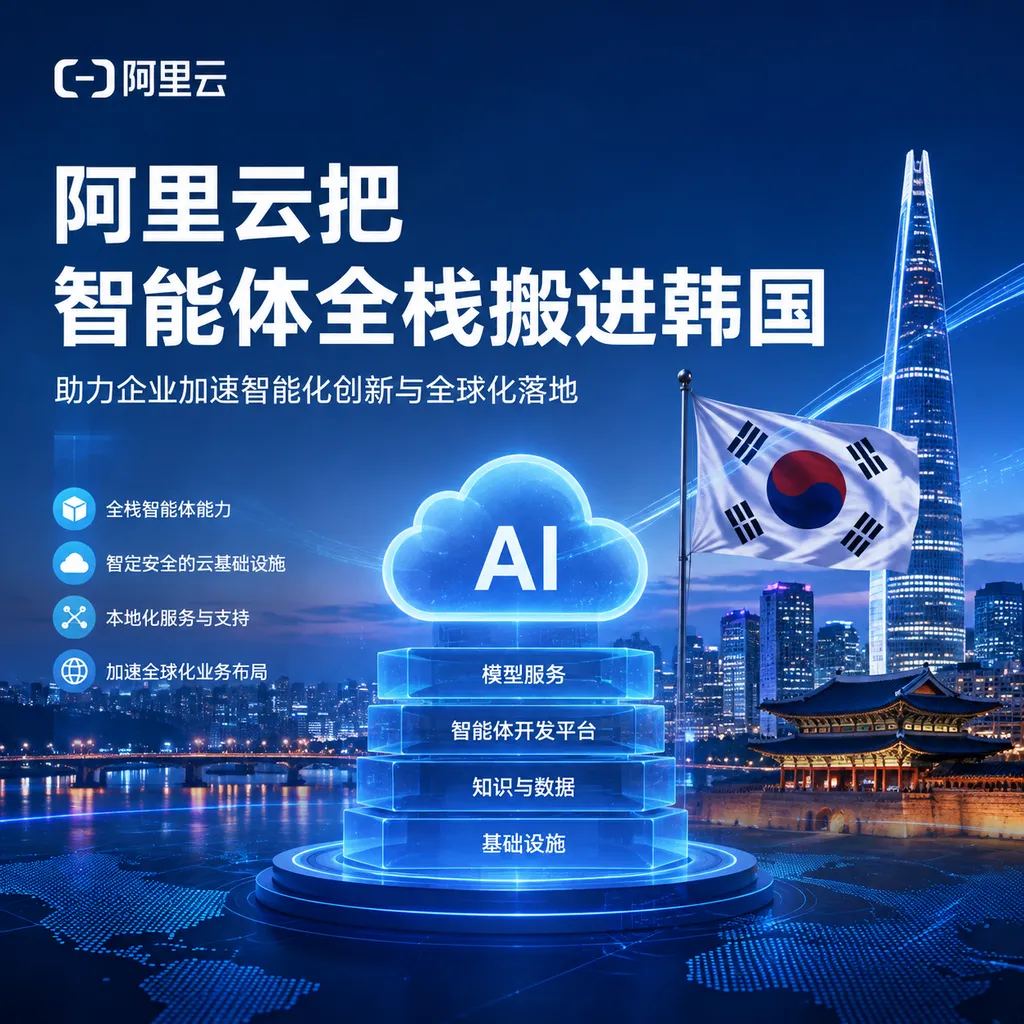
Alibaba Cloud’s third data center in South Korea went live today, bringing six Agentic AI services, including AgentRun and STAROps, to the market. More noteworthy than simply expanding capacity is that Alibaba Cloud is beginning to offer overseas markets a complete technology stack for agent development and operations.
Alibaba Cloud in South Korea: More Than Just Another Data Center
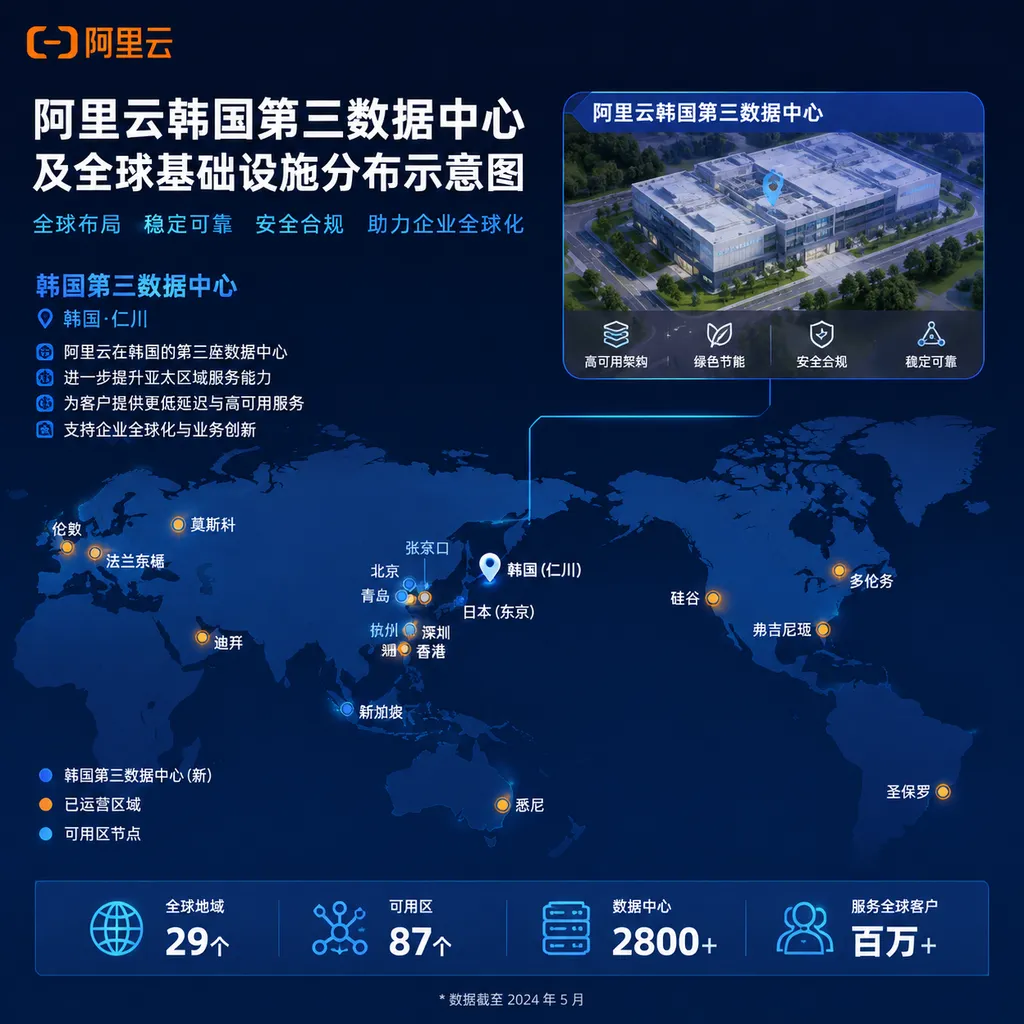
On August 18, Alibaba Cloud announced the official launch of its third data center in South Korea. It also introduced six Agentic AI services in the local market, including AgentRun and STAROps, covering agent development, deployment, operations, and security management.
The new data center will also provide enterprise-grade services including computing, storage, networking, security, databases, containers, and cloud-native capabilities. Following this recent round of infrastructure expansion across Northeast Asia, Southeast Asia, Western Europe, and Latin America, Alibaba Cloud's global infrastructure will reach 30 regions and 104 availability zones.
On the surface, this appears to be a routine overseas expansion of cloud infrastructure. But what really deserves attention is not the addition of another data center. It is that Alibaba Cloud has begun moving its agent development and operations system, together with the underlying cloud resources, into overseas markets.
In the past, cloud providers expanding overseas primarily sold computing, storage, databases, and CDNs. This time, they are selling an entire AI application production line. Enterprises are not merely calling a model in the cloud. They need to connect the model to internal data, business systems, and permission structures, then keep the agent running over the long term. The latter is clearly more complex and more likely to create platform stickiness.
The Six Agentic AI Services: The Focus Is Not the Number
Alibaba Cloud has confirmed the launch of six Agentic AI services, but the information currently available publicly only identifies two names, AgentRun and STAROps. The remaining services have not yet been fully disclosed, nor have the functional boundaries, pricing models, service-level agreements, or supported model ranges for each product been provided.
Therefore, it is not yet possible to infer their specific architectures from the product names alone. What can be confirmed is that this group of services is intended to cover four areas:
- Development: Assembling models, knowledge bases, tools, and business processes into agents;
- Deployment: Running agents in a stable, scalable cloud environment;
- Operations: Monitoring invocation paths, performance, latency, costs, and failure rates;
- Security management: Controlling data access, tool permissions, and the behavioral boundaries of agents.
These four areas are precisely where enterprise agents are most likely to run into problems when moving from demonstration projects into production environments.
Building a chatbot that can answer questions is not difficult. The real challenge is making it execute tasks reliably. For example, an e-commerce operations agent may need to read inventory data, query orders, generate promotional plans, and then call internal systems to modify campaign configurations. The model is not the only core component here. The system also needs authentication, tool calling, workflow orchestration, exception retries, human approval, and audit logs.
In other words, the model is like the brain, while an Agentic AI platform is more like the nervous system, hands, feet, and governing rules. A brain alone cannot become enterprise software.
The name AgentRun may lead developers to associate it with an agent runtime and deployment environment, while STAROps clearly carries an operations-management connotation. However, until Alibaba Cloud releases further technical documentation, these can only be regarded as judgments about product positioning and cannot substitute for official definitions.
Why Local Deployment in South Korea Is Necessary
Agents depend more heavily on local cloud infrastructure than traditional chat applications do.
The first factor is latency. If a normal question-and-answer interaction takes one or two seconds longer, users may simply find the experience unpleasant. But if an agent needs to make successive calls to retrieval systems, databases, code execution environments, and third-party tools, the additional network round trips at each step accumulate. In a workflow with more than a dozen steps, cross-border network fluctuations can easily turn a usable product into an unusable demo.
The second factor is data. Enterprise agents typically need to access more sensitive information than public chatbots, including customer records, contracts, orders, production data, and internal knowledge bases. Model invocation is only one part of the chain. Vector databases, object storage, logs, caches, and identity systems also require clearly defined data locations and access boundaries.
The third factor is availability. Once an agent enters customer service, e-commerce, content production, or manufacturing processes, it is no longer an optional auxiliary tool. A failure in the underlying compute, database, or tool gateway could bring the entire automation workflow to a halt. The value of a third data center lies more in its potential to provide additional capacity, redundancy, and fault isolation.
However, it is important to emphasize: A new data center does not automatically satisfy all compliance requirements, nor does it mean that all Agentic AI services inherently support disaster recovery across data centers. Enterprises still need to confirm the scope of data residency, log storage locations, backup strategies, ownership of encryption keys, and the high-availability architecture of specific products. The information Alibaba Cloud has disclosed so far is insufficient to answer these implementation-level questions.
This is also the biggest point to watch in this announcement: The infrastructure scale has been disclosed, but the product documentation, regional availability, quotas, pricing, and SLAs that developers actually care about still need to be provided.
Alibaba Cloud Is Competing for the Agent Control Plane, Not the Model Leaderboard
The competition among global cloud providers around generative AI has shifted from providing GPUs and model APIs to competing for control of the agent control plane.
The control plane can be understood as the platform enterprises use to centrally manage models, data, tools, permissions, and runtime status. Whoever controls this layer is closer to the customer's core business and is harder to replace. An enterprise can relatively easily switch to a different underlying model, but migrating hundreds or thousands of workflows, knowledge bases, permission rules, and monitoring metrics is far more costly.
Therefore, binding services such as AgentRun and STAROps to local infrastructure in South Korea is not simply an attempt to follow the agent trend. The logic is clear:
- Use local data centers to address latency, capacity, and data-location requirements;
- Use models and agent tools to lower the barrier to application development;
- Use deployment, operations, and security capabilities to keep projects on the cloud platform;
- Ultimately build a complete consumption chain from infrastructure through the AI application layer.
The advantage of this approach is integration. Compute, containers, databases, security products, and the agent platform belong to the same cloud ecosystem, so enterprises should theoretically need to assemble fewer components during procurement and implementation. The risk also comes from this integration: If the interfaces are not open enough, or if models, observability data, and workflows are difficult to migrate, development convenience may turn into platform lock-in.
For development teams, the key questions should not be limited to whether the platform offers a visual orchestration interface. They should also ask whether agent definitions can be exported, whether tool protocols are open, whether logs can be integrated with existing observability systems, whether models can be switched freely, and how data can be migrated after the platform is discontinued.
What the Two South Korean Customer Cases Show
Alibaba Cloud also disclosed two cases from the South Korean market.
Zepeto, operated by Naver Z under Naver, uses Alibaba Cloud infrastructure to support real-time 3D avatar generation and immersive interaction across Asia. Gendive, an AI company headquartered in Gwangju, has integrated multiple Alibaba Cloud models into its products to help enterprises build automated workflows.
These two cases point respectively to content interaction and enterprise automation, two areas where agents are relatively likely to deliver tangible value.
Real-time 3D products such as Zepeto are highly sensitive to computing resources, network latency, and traffic spikes. Gendive's automated workflows are closer to a typical agent scenario: The model is not merely generating a piece of text but participating in a multistep business process.
However, these cases cannot directly prove that the six newly launched Agentic AI services have already been adopted comprehensively by customers. The current public statements mainly indicate that Alibaba Cloud's infrastructure and model capabilities have been incorporated into South Korean enterprise products. There is currently no quantitative data on the actual customer scale, production workloads, or migration results of AgentRun and STAROps.
This is a common source of confusion in industry announcements: A customer using the cloud and its models does not mean that the customer is already using the complete agent platform. Determining whether the new services have truly been adopted will require clear production cases, invocation volumes, and efficiency metrics in the future.
Questions Developers Should Pay More Attention To
If a team is preparing to deploy an agent for users or internal enterprise operations in South Korea, it would be better to verify the following points directly rather than starting with the product marketing page:
1. Regional and Resource Availability
Are all six services officially available for commercial use in the South Korean region, or are some still in preview? Do the underlying inference resources require quota applications? Could traffic be throttled during peak periods? These questions have a greater impact on launch schedules than a feature list does.
2. Which Models Are Supported
Does the agent platform support only Alibaba Cloud's own models, or can it also connect to third-party models, privately deployed models, and enterprise fine-tuned models? If the same workflow can switch models based on cost, latency, and performance, the platform will be far more practical.
3. Tool Calling and Protocol Openness
Enterprises typically already have API gateways, message queues, databases, and internal microservices. Whether the platform can connect directly to these systems, and whether it supports standardized tool description and invocation protocols, will determine the migration cost.
4. Is Observability Sufficiently Granular?
Agent failures are often not as simple as returning an error code. A retrieval step may go astray, the model may select the wrong tool, or a permission check may block an invocation. At a minimum, the platform should provide step-level tracing, input and output records, token and cost statistics, latency analysis, and failure replay capabilities.
5. Can Security Boundaries Be Applied to Specific Actions?
Content filtering alone is far from sufficient. Enterprise-grade agents also require least-privilege access, approval for sensitive operations, key isolation, data masking, audit logs, and an emergency shutdown mechanism. In particular, for agents capable of writing to databases, sending messages, or modifying orders, the model's authority to make recommendations must be separated from the system's authority to execute actions.
6. Is It Easy to Exit?
This is one of the most easily overlooked issues. Teams should confirm in advance whether workflows, prompts, knowledge-base indexes, runtime logs, and evaluation sets can be migrated. Whether a platform is worth using over the long term depends not only on how easy it is to enter, but also on how difficult it is to leave.
Assessment: The Direction Is Right, but the Product Still Needs Documentation
Alibaba Cloud's launch of its third data center in South Korea, alongside six Agentic AI services, shows that overseas cloud competition is entering a new phase. Cloud providers are no longer satisfied with renting out servers or providing model interfaces. They are beginning to take responsibility for the entire agent lifecycle, from development through operations.
The direction is sound. What enterprises truly lack is not another chat interface, but the engineering capabilities needed to connect agents reliably to production systems. Combining local infrastructure, cloud-native services, and an agent platform also offers greater commercial value than selling model APIs separately.
From a developer's perspective, however, the information released so far remains largely conceptual. The complete list of the six services, technical specifications, model compatibility, pricing, SLAs, data boundaries, and customer metrics have not been sufficiently detailed. Whether AgentRun and STAROps can become genuinely useful production platforms rather than merely new product labels born from the agent boom will have to be demonstrated through subsequent documentation and real-world workloads.
This announcement can therefore be summarized as follows: Alibaba Cloud has brought the full agent stack to South Korea, but proving that the stack is usable, open, and portable will require a sufficiently specific answer for developers.
References
- IT Home: Alibaba Cloud's Third Data Center in South Korea Goes Live, Global Infrastructure to Reach 104 Availability Zones — Covers the new data center, six Agentic AI services, the scale of Alibaba Cloud's global infrastructure, and customer cases from South Korean enterprises.