
QQ natively integrates the Hermes Agent — the era of IM + intelligent agents has arrived.
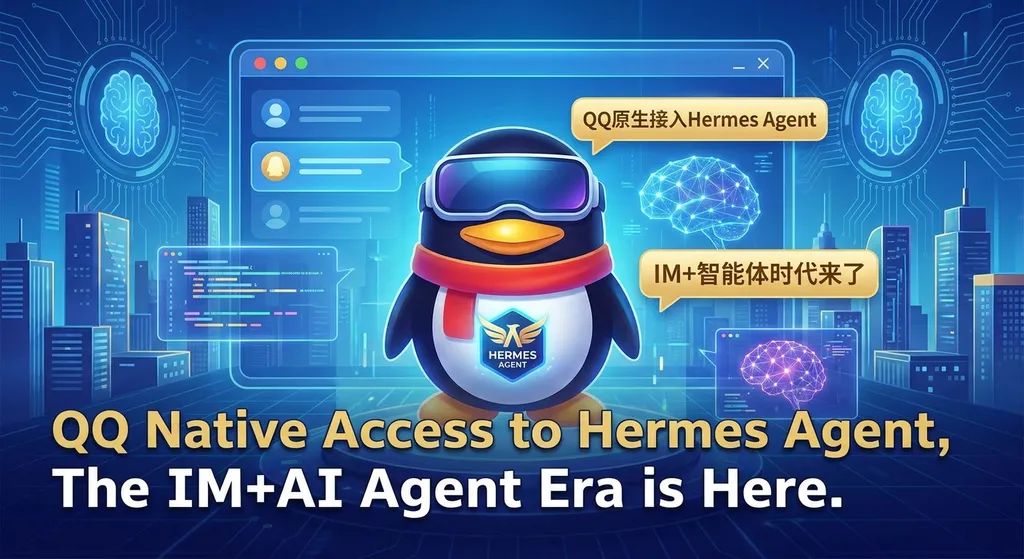
Tencent QQ announced the native integration of the Hermes Agent open-source intelligent agent framework, allowing users to directly interact with autonomous AI Agents within QQ. It supports text, voice, and image message types, marking a major domestic instant messaging platform’s official adoption of the autonomous agent ecosystem.
From Raising Lobsters to Raising Horses, QQ Is Serious This Time
On April 16, Tencent QQ officially announced native integration with Hermes Agent — the QQ Bot plugin has been merged into the official Hermes Agent codebase. Users can now directly select the QQ Bot channel in the Messaging Platforms configuration, embedding a self-evolving autonomous AI agent with cross-session memory into a national-level instant messaging app.
The significance here isn’t “just another chatbot,” but that a platform with over 500 million monthly active users is, for the first time, integrating a true Autonomous Agent as a first-class citizen.
What Is Hermes Agent? Don’t Confuse It with an Ordinary Chatbot
Let’s clarify the concept first.
Hermes Agent is developed by the AI research institute Nous Research and was open-sourced in February 2026. In less than two months, it gained over 60,000 stars on GitHub. The community nicknamed it "Hermès," but it has nothing to do with luxury brands — it’s actually a descendant of OpenClaw (nicknamed “Lobster”).
It differs fundamentally from ordinary IDE coding assistants or chatbots wrapped around an API. The core differences are:
- Persistent operation: It runs on your own server — not as a single disposable chat session, but as a 24/7 resident process.
- Self-evolution: It contains a complete skill-learning loop — autonomously creating, improving, and recalling skills and memories across sessions. The more you use it, the better it learns your habits and needs.
- Cross-platform communication: Supports 15+ major messaging platforms, including Telegram, Discord, Slack, WhatsApp, WeCom, DingTalk, Feishu, and now QQ.
In short, a normal chatbot just “answers your questions,” while Hermes Agent “lives in your digital world, increasingly knows you, and can proactively get things done.” It even has a built-in Cron scheduler — tell it in natural language, “summarize my GitHub notifications every morning at 9,” and it really will do so regularly.
That’s why QQ’s integration is fundamentally different from simply connecting a standard bot.
Integration Details: Three Steps, but the Devil Is in the Details
Operationally, integrating QQ with Hermes Agent is straightforward:
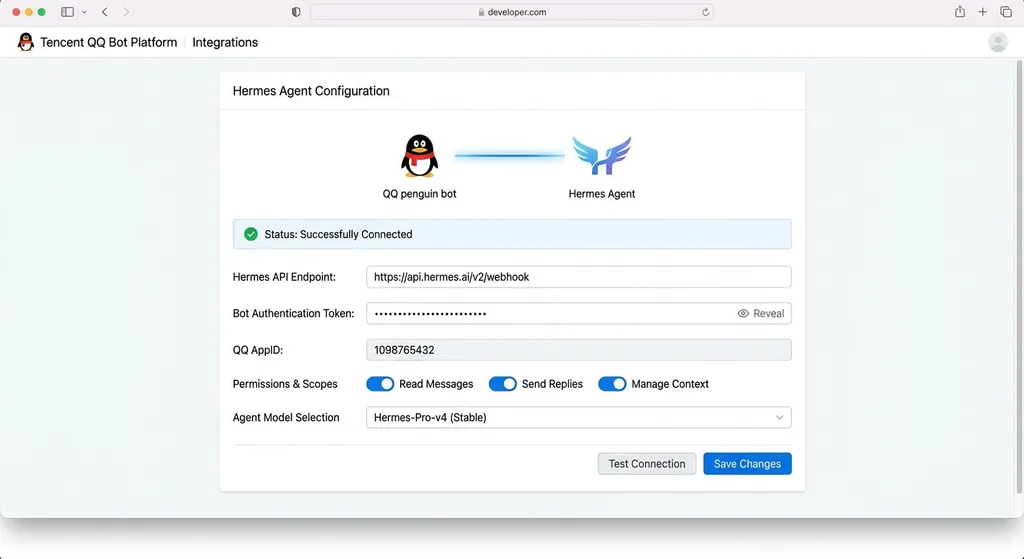
- Log in to the QQ Open Platform (https://q.qq.com), create a QQ Bot, and obtain the AppID and AppSecret
- Run the configuration wizard in Hermes Agent and select the QQ Bot channel
- Fill in your credentials and start the gateway service
Command-line steps look like this:
# If Hermes Agent is already installed, enter gateway configuration
hermes setup gateway

# Select QQ Bot in the interactive wizard
# Enter the AppID and AppSecret obtained from QQ Open Platform
# Install and start the gateway afterward
hermes gateway install
After integration, QQ currently supports sending and receiving text, voice, and image messages. The official roadmap notes “more message types and channel capabilities in development,” meaning file transfer, rich-text cards, and group chat functions will likely follow.
A notable point: Hermes Agent’s channel system is designed so that one backend process connects all configured platforms simultaneously. In other words, one Agent can exist in QQ, WeCom, Feishu, and Telegram at the same time — sharing the same memory and skills. What you teach it on QQ, it remembers on Feishu.
This is highly practical. For example, if you’re a tech lead, your team communicates via Feishu while clients prefer QQ — the same Agent can serve both, sharing consistent context.
Why QQ? And Why Now?
The logic becomes clear in a broader context.
Tencent has long focused on building AI Agent infrastructure, rather than directly building Agent products. Just two days earlier, on April 14, Tencent Cloud launched a Hermes Agent application template for its Lighthouse lightweight cloud server, supporting one-click deployment. Earlier, when OpenClaw (Lobster) gained attention, Lighthouse was also the first to offer a cloud deployment solution.
Now that QQ has natively integrated Hermes Agent, Tencent essentially opened its consumer-side traffic gateway. This forms a complete chain:
Tencent Cloud Lighthouse → Hermes Agent Framework → QQ User Access Channel
For Tencent, this is a clever move. It doesn’t need to compete with other Agent products. By keeping its infrastructure and traffic gateways friendly to the open-source ecosystem, developers will naturally come. With QQ’s massive monthly active user base, this channel is highly attractive for developers wanting to reach ordinary users.
From Hermes Agent’s perspective, QQ integration fills a key gap in China’s communication ecosystem. It already supported WeCom, DingTalk, and Feishu — all office-oriented. QQ, however, covers broader social and community use cases — gaming, study groups, hobby circles — where demand for intelligent agents is strong but previously inaccessible.
How Does Hermes Agent Compare to Competitors?
To be honest, the AI Agent space in 2026 is crowded. Yet Hermes Agent’s ability to gain 60,000 stars in two months shows its strengths.
Compared to platform-based products like Coze (ByteDance) or Baidu’s Wenxin Agents, Hermes Agent’s key advantages are open source and self-hosted deployment. Your data, memory, and skills stay on your own server — independent of any third-party service. For enterprises with data sensitivity needs, this is critical.
Compared to open-source frameworks like AutoGPT or CrewAI, Hermes Agent’s unique strength lies in its persistence. Most frameworks are task-oriented — you assign a job, it executes, then ends. Hermes Agent is long-term-oriented — with persistent memory, self-learning, and scheduling — more like a digital employee than a mere tool.
Of course, it has downsides. It doesn’t support native Windows (needs WSL2). Users must configure API Keys manually instead of plug-and-play setup. For non-technical users, deployment is still a bit high-bar — though Tencent Cloud Lighthouse’s one-click template alleviates this.
Model Selection: Flexibility as a Double-Edged Sword
Hermes Agent’s philosophy regarding models is “vendor-agnostic.” It supports OpenAI, Anthropic, DeepSeek, MiniMax, and Xiaomi MiMo, among others, allowing flexible model switching.
Recently, Nous Research partnered with Xiaomi to bring MiMo V2 Pro to the Hermes Agent ecosystem, available for free via Nous Portal from April 8–22. This model performs well in multi-step reasoning and code tasks — ideal for Agent scenarios.
For developers, flexible switching means you can select the best model per use case: a cheaper one for casual chat, a high-performance one for complex reasoning.
If you already have API Keys for multiple models or use OpenAI Hub–style aggregators, Hermes Agent’s configuration is easy — it’s OpenAI-compatible, so you can call various models via one endpoint:
# Connect multiple models through OpenAI Hub (OpenAI-compatible)
hermes config set OPENAI_API_KEY your-openai-hub-key
hermes config set OPENAI_BASE_URL https://api.openai-hub.net/v1
hermes config set MODEL_NAME gpt-4o  # or claude-sonnet-4, deepseek-chat, etc.
If you want to implement similar multi-model scheduling in your own app, code would look like:
from openai import OpenAI

client = OpenAI(
    api_key="your-openai-hub-key",
    base_url="https://api.openai-hub.net/v1"
)

# Use the same client to switch models
response = client.chat.completions.create(
    model="deepseek-chat",  # or gpt-4o, claude-sonnet-4, etc.
    messages=[
        {"role": "system", "content": "You are an intelligent assistant in a QQ group"},
        {"role": "user", "content": "Summarize the key points of today’s group discussion"}
    ]
)
print(response.choices[0].message.content)
Flexibility, however, brings complexity. For newcomers, deciding which model to use can be daunting. Hermes Agent’s documentation and community guides could better address this learning curve.
From Lobster to Hermès: How OpenClaw Users Can Migrate
If you previously used OpenClaw (“Lobster”), migrating to Hermes Agent is simple. The official one-click command is:
hermes claw migrate
This automatically migrates settings, memories, skills, and API keys from OpenClaw. Community feedback says the process is smooth — most are done in minutes.
The main difference: Hermes Agent’s architecture has been comprehensively upgraded — more persistent memory, smarter skill systems, broader channel coverage. If OpenClaw was “usable,” Hermes Agent is now “awesome.”
Some users note it consumes more resources — at least 2-core CPU and 4GB RAM recommended. If you used a 1-core/1GB machine before, you may need to upgrade.
Real-World Applications: What Can QQ + Hermes Agent Do?
After all that tech talk, what can the QQ + Hermes Agent combo actually do?
Some concrete examples:
- Gaming community management: Deployed in QQ gaming groups, the Agent can auto-answer FAQs, organize guides, and post event reminders. With memory, it improves accuracy over time.
- Study group assistant: In exam prep or coding study groups, it can help answer questions, compile notes, and track progress. Tell it “remind everyone to submit their weekly report every Friday at 8pm” — it will do so punctually.
- Customer support: For small online shops, the Agent handles ~80% of typical inquiries (sizes, shipping, returns), escalating only complex ones to humans.
- Personal digital assistant: Treat it as your personal helper — managing schedules, logging ideas, summarizing daily info sources.
Of course, the QQ channel is still early — limited to text, voice, and image. Group @mentions, rich cards, and mini app integrations are missing but likely coming in future updates.
Staying Sober: Where Are the Pitfalls?
No new system is perfect. Some caveats for QQ + Hermes Agent integration include:
- QQ Bot review process — Creating a QQ Bot requires Open Platform registration and approval, which could be a hurdle for individual developers due to usage and compliance requirements.
- Message-type limitations — Only basic message types (text, voice, image) are currently supported; complex formats (files, Markdown cards, buttons) are not.
- Rate limiting — QQ imposes message frequency limits. For highly active groups, bots may hit throttling.
- Privacy and compliance — Since Hermes Agent stores conversation memories persistently, using it in group chats involves handling member privacy and data compliance properly.
Looking Forward: The Potential of IM + Agent
Zoom out, and QQ’s integration of Hermes Agent reflects a broader trend: IM platforms evolving from “human-to-human communication tools” to “interfaces for human–AI interaction.”
Telegram pioneered this with its mature bot ecosystem. Discord, with gaming and developer communities, became another AI bot hub. In China, WeCom, DingTalk, and Feishu already offer Agent integrations in business contexts.
QQ’s inclusion is uniquely significant — it’s one of the few platforms covering both social and community contexts, with a younger, tech-savvy user base. If Hermes Agent works well on QQ, it validates not just a technical integration, but the idea that autonomous agents can be accepted by everyday social users.
That answer might matter more than any technical detail.
References:
- From Raising Lobsters to Raising Horses — Tencent QQ Announces Native Hermes Agent Integration - IT Home (Original report including setup instructions)
- From Raising Lobsters to Raising Horses — QQ Integrates Hermes Agent - Linux.do (Community discussion)
- Just Now: Tencent’s Hermes Agent Is Live! Quick Deployment Guide - Juejin (Lighthouse deployment tutorial)


