Tencent TuSi Bridges the Last Mile of AI App Development

Tencent Toast has launched a paid, one-stop app publishing service that integrates AI-generated Android apps, software copyrights, regulatory filings, compliance materials, and distribution through Tencent MyApp into a single workflow. It addresses delivery bottlenecks, but “one-click publishing” does not mean bypassing review.
Tencent Tusi Bridges the Last Mile for AI-Generated Apps
Tencent is taking AI-generated apps from “producing an APK” to “actually getting into an app store.”
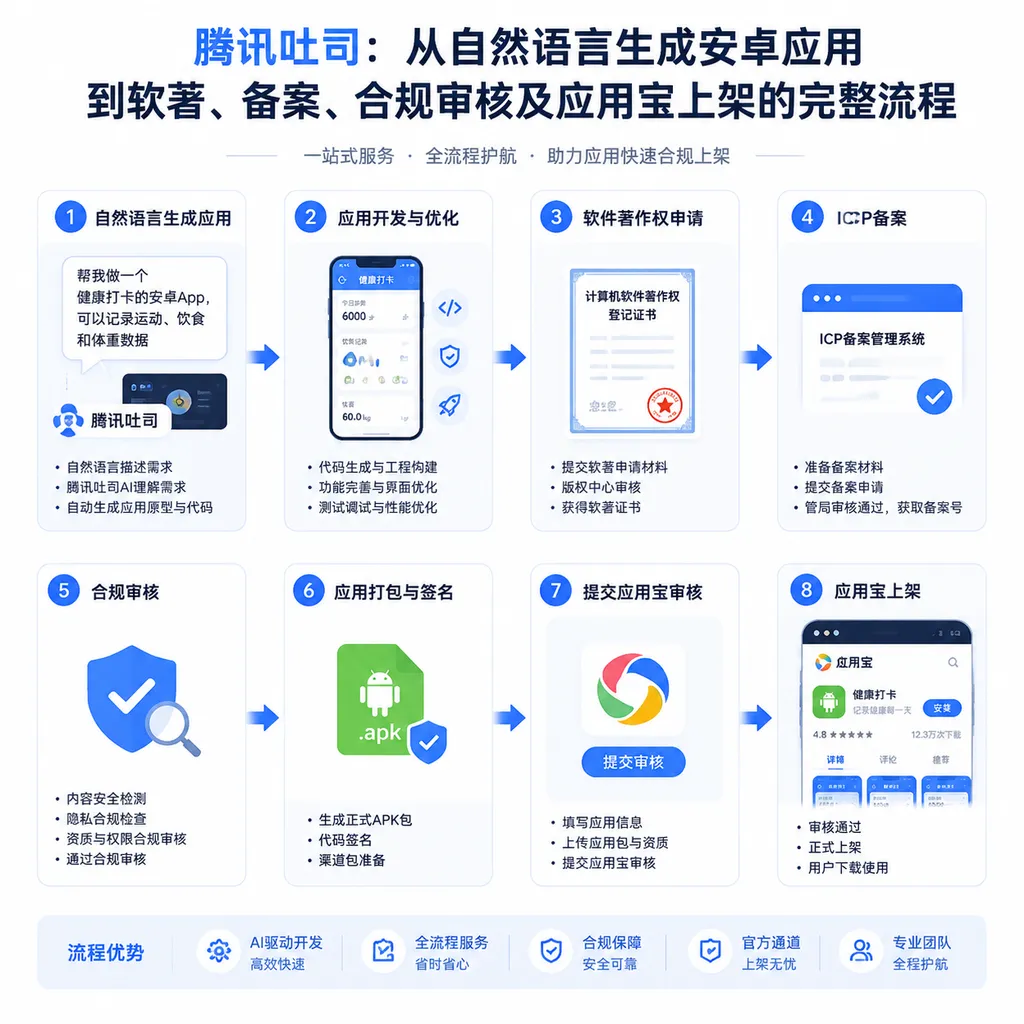
On August 19, Tencent announced that its AI app-generation platform, Tusi, had launched a paid “one-stop app publishing” feature. After generating an Android app with natural-language prompts, users can continue within Tusi to apply for software copyright registration, obtain guidance on app filing, generate compliance documents, and submit a listing application to Tencent App Store. Once approved, the app can be distributed through Tencent App Store.
This update does not fundamentally transform the model’s ability to write code. Instead, it fills in one of the most easily overlooked parts of today’s AI app-generation products: the compliance and distribution process between a runnable demo and public delivery.
In the past, vibe-coding products typically treated a preview page, code repository, or installation package as the finish line. Tusi is now trying to move that finish line one step further—not merely “the file has been generated,” but “people who do not know the developer can search for, download, and install the app from a store.” For nonprofessional developers, the gap between the two is often wider than the process of generating the app itself.
“One Click” Solves the Paperwork, Not the Development
Tusi is an internally incubated Tencent platform for app generation and collaborative ideation. Compared with AI coding tools such as Cursor and Claude Code, it is positioned closer to ordinary users. Users do not need to create a project, choose a framework, or configure a build environment first. They simply describe what they need, and the AI breaks down the features, generates a preview, and supports further adjustments through multiple rounds of conversation.
On Android, Tusi can package an APK directly. On iOS, it is currently used primarily by adding the app to the phone’s home screen. Generated apps can also be shared through links, QR codes, or installation packages.
These capabilities have already solved the question of “how to build it,” but they do not fully solve “how to deliver it.” An APK that can be installed on your own phone is not necessarily ready for public release and operation. To officially enter app stores in China, Android apps generally still need to go through several types of work:
- Prepare the app name, icon, screenshots, version information, and feature description;
- Create a privacy policy, user agreement, and other documents based on the app’s actual capabilities;
- Review the app’s use of networking, accounts, storage, location, contacts, and other permissions;
- Handle app filing, developer verification, and related documentation;
- Rectify privacy pop-ups, permission requests, and content-compliance issues according to app-store requirements;
- Repeatedly enter highly similar—but not identically formatted—information in different back-end systems.
The most troublesome part is not any single form, but the repeated transfer of information between multiple systems. If there is even one inconsistency in the app name, package name, version, responsible entity, feature description, or privacy policy, the application may be rejected and returned for revision.
In essence, Tusi’s new service adds a “delivery agent” layer to this process. The platform can extract information and screenshots from the generated app, assist with completing the required materials, and integrate software copyright registration, app filing, compliance documents, and Tencent App Store submission into a single workflow. Tencent says processing time for apps that do not connect to the internet can be reduced to as little as one week.
This offers more practical value than adding another page template or supporting one more animation effect. AI has already reduced development time from weeks to hours, but software copyright registration, filing, and review do not automatically disappear simply because the code was generated by AI. If users must still search for tutorials, find templates, and fill out forms across multiple back-end systems during the second half of the process, then the promise of “generating an app with a single sentence” has only been half fulfilled.
Starting at RMB 899, What You Are Buying Is a More Predictable Path
Tusi has also launched “Developer Benefits Packages,” currently available in two tiers:
| Plan | Early-Bird Price | Validity Period | Main Services | | --- | ---: | ---: | --- | | Plus | RMB 899 | 180 days | One expedited software copyright registration, app-filing guidance, compliance-agreement generation, an expedited Tencent App Store listing channel, 120 Tusi credits, and more | | Pro | RMB 7,999 | 365 days | More Tusi credits and expedited software copyright registrations, plus guidance on publishing to multiple platforms, ad-component integration, and more |
The target users for the Plus plan are relatively clear: independent developers, solo entrepreneurs, and OPCs (One Person Companies) with a fairly complete product idea who want to complete their first release at a relatively low cost.
The RMB 899 fee is not simply a software subscription. Expedited software copyright registration, developer-entity verification, document preparation, and communication already carry explicit or implicit costs. By bundling these services, Tusi is selling predictability and time—not merely more AI-generation credits.
At RMB 7,999, however, the Pro tier enters a different competitive landscape. At that price, users will compare it with human filing agents, mature low-code platforms, outsourced development teams, and even in-house development. Whether multi-platform guidance and ad integration are worthwhile depends on whether the app can generate sustained traffic, not whether it can successfully produce its first installation package.
In other words, Plus is more like “helping you get your first product into an app store,” while Pro begins to bet that “this product is worth continuing to operate.” The two tiers do not address exactly the same needs.
One-Click Submission Is Not One-Click Approval
“One-click app publishing” can easily be interpreted as automatic publication after clicking a button, but the actual process still includes platform review. The service is also currently limited to apps developed through Tusi’s Android offering.
These boundaries need to be made clear.
First, Tusi can help generate materials and reduce repetitive data entry, but it cannot assume all compliance responsibilities on behalf of developers. Whether a privacy policy is accurate depends on the data the app actually collects, the system permissions it invokes, the third-party SDKs it integrates, and the behavior of its server side. A comprehensive template does not guarantee that the app’s actual operation is compliant.
Second, Tencent App Store remains responsible for review and distribution. Problems involving content safety, copyright, manipulative practices, unlawful data collection, or unusable features will not be exempt from scrutiny simply because the app came from Tencent’s own generation platform. The so-called expedited channel should be understood as shortening the process and reducing documentation errors—not bypassing review.
Finally, this workflow currently has clear platform boundaries: it primarily connects Tusi with Tencent App Store. Although the Pro plan provides guidance on publishing to multiple platforms, that does not mean a single submission can be automatically synchronized to every Android app store. Qualification requirements, review standards, and document formats may still vary between distribution channels.
The feature is therefore most useful for small utilities, personal productivity apps, event apps, content-display products, and lightweight prototypes. For apps involving payments, finance, healthcare, news, educational qualifications, UGC moderation, or extensive sensitive permissions, the real challenges remain business compliance and ongoing operations. Those challenges do not disappear simply because the development method has changed.
Tencent Wants More Than Lower Development Barriers
From Tencent App Store’s perspective, this update is also a supply-side transformation.
One of the problems facing traditional app stores is that, as the mobile internet has matured, the supply of new native apps has slowed. Developing an app is expensive, and user acquisition costs even more. As a result, many long-tail needs have ultimately been absorbed by mini programs, web pages, spreadsheets, or group-chat bots. AI-generation tools, however, could produce a new wave of apps with narrower scopes, shorter lifecycles, and highly specific use cases.
For example, a club could create a check-in and points tool for a one-off event; a small store could make an app for scheduling, inventory, or membership inquiries; a creator could build a content index for readers; or a family could create a household-chore points app. These may never become large-scale commercial products, but they could form a new source of long-tail app supply.
Tusi turns ideas into apps, while Tencent App Store handles review, distribution, and subsequent operations. By connecting the two, Tencent has effectively established an internal closed loop:
- Users describe their needs in natural language;
- Tusi generates and iterates on an Android app;
- The platform assists in preparing software copyright, filing, and compliance materials;
- The app is submitted to Tencent App Store for review;
- Once approved, it enters store distribution;
- Developers continue with version updates, ad integration, and user operations.
The value of this closed loop to Tencent goes beyond selling benefits packages for RMB 899 or RMB 7,999. More importantly, it can turn AI-generated content from a one-off experience into new supply for Tencent App Store, while moving the store from being merely a download channel toward becoming delivery infrastructure for AI-generated apps.
Of course, increased supply could also create new problems. The lower the generation barrier, the easier it becomes for derivative apps, reskinned products, low-quality content, and abandoned projects to flood the market. The next challenge for app stores is not merely “how to list more apps,” but also how to identify duplicate products, assess real-world usability, and control review costs when apps can be rapidly generated by AI at scale.
If a platform only lowers listing barriers without simultaneously improving quality governance, it may ultimately end up with an inspiration gallery full of demos rather than an app ecosystem that users will continue to search and download from.
AI Coding Enters the Era of “Delivery Competition”
Over the past two years, AI coding products have primarily competed on code completion, agents, autonomous debugging, context windows, and multi-file editing. These capabilities remain important to developers, but the competitive dimensions of app-generation platforms aimed at ordinary users have begun to change.
Ordinary users do not care whether the underlying app was generated with React Native, Flutter, or native code. They care more about several direct outcomes:
- Can it run on their own phones?
- Can they send it to other people to install?
- Can it save data?
- Can they continue modifying it if something goes wrong?
- Can it be distributed publicly, legally, and reliably?
- After an update, can existing users upgrade smoothly?
The next stage of AI-generated apps will therefore not be determined merely by who can produce the prettiest first screen. The competition will be about who can connect databases, authentication, payments, monitoring, compliance, review, distribution, and version maintenance into one workflow. Code generation is only the production stage; listing and operations determine whether the product truly exists.
Tencent Tusi’s judgment in this update is correct: the biggest bottleneck in AI app generation is shifting from “not knowing how to write code” to “not knowing how to deliver a product.”
But this is not the end state. One-stop processing can make a single app launch smoother, but its long-term value will still depend on three things: the stability of generated apps, their ability to receive continuous updates after approval, and whether Tencent App Store can bring these long-tail products real users. If listing numbers increase without downloads, retention, or monetization, the closed loop will still be only half complete.
For independent developers looking to validate demand quickly, the RMB 899 Plus plan has some appeal, especially for first-time publishers who do not want to shuttle back and forth between multiple back-end systems. Its value is relatively limited, however, for teams that already possess mature engineering capabilities. Such teams typically need controllable code repositories, automated builds, testing systems, and multi-channel publishing rather than a packaged administrative service.
Tusi has not replaced professional development tools. It is doing something else: compressing a lightweight process that previously required separate participation from product, development, legal, and operations teams into a single entry point for individuals.
This may be the real sign that “building an app with a single sentence” is finally becoming practical. It is not that AI can draw an interface, but that it is finally beginning to handle the unglamorous, tedious work that determines whether an app can make it beyond the developer’s own phone.
References
- ITHome: Tencent’s AI App-Generation Platform Tusi Launches Paid “One-Click App Publishing” Feature — Introduces the one-stop publishing process, scope of application, plan pricing, and Tencent App Store distribution mechanism.