Sutton Warns: Synthetic Data Is Not the Next Scaling Solution

Turing Award laureate Richard Sutton recently warned that the AI industry's embrace of synthetic data as the new fuel for scaling large models could repeat a fundamental strategic mistake. What is truly scarce is not the volume of text, but experiential data from real-world environments that includes feedback on actions.
Sutton’s Warning: Synthetic Data Is Not the Next Answer to Scaling
Turing Award winner and reinforcement learning pioneer Richard Sutton has once again taken aim at the mainstream trajectory of the large-model industry.
On a Sequoia Capital podcast aired on August 18 local time, Sutton was asked whether synthetic data could help large language models continue to scale. His direct response was that this was “absolutely a huge mistake,” adding that it could become the AI industry’s next major lesson.
The statement carries particular weight because it comes from the author of The Bitter Lesson. In recent years, the industry has frequently cited that essay to argue that general-purpose algorithms, combined with greater compute and more data, will ultimately outperform carefully designed human rules. Sutton is not now rejecting scaling itself. Rather, he is warning the industry that if the data fed into models becomes increasingly detached from the real world, simply expanding the scale of training may only amplify errors more quickly.
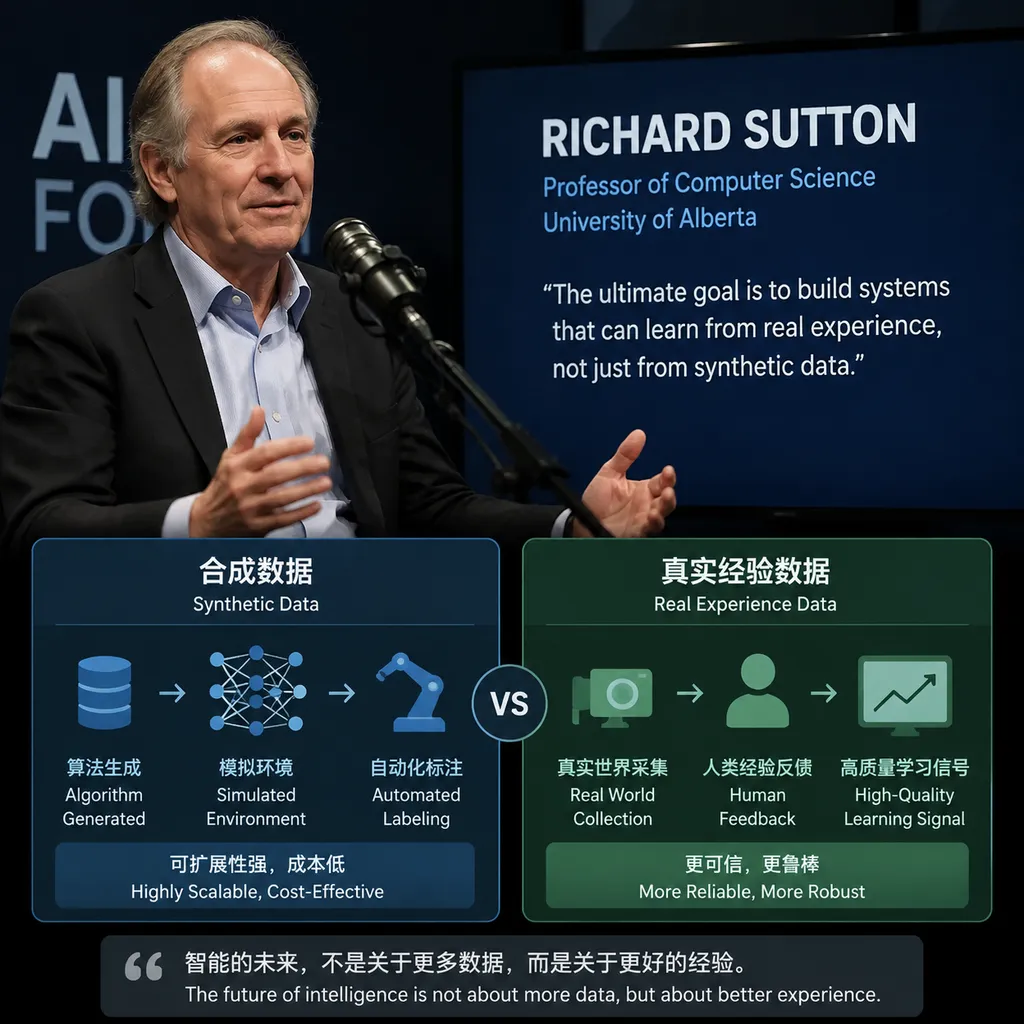
Synthetic Data Solves the Quantity Problem, but Not the Truth Problem
Synthetic data is not mysterious. It is data generated by programs, simulators, or other AI models rather than collected directly from the real world.
Autonomous-driving companies can use computers to generate images featuring different combinations of weather, roads, and vehicles. Risk-control systems can create fictional banking transaction records. Language models can have stronger models generate question-and-answer pairs, reasoning traces, and preference samples, then use that data to train the next generation of models.
Its appeal is practical: it is inexpensive, controllable, and virtually unlimited in scale. Real-world data must be collected, cleaned, licensed, and anonymized, often incurring additional privacy, copyright, and compliance costs. Synthetic data, by contrast, can be produced in bulk on demand and specifically used to fill gaps in long-tail scenarios. For a model company that needs to keep expanding its training set, it can seem like an oil well that will never run dry.
The problem is that model-generated data is usually only a rearrangement of existing knowledge. It can create more samples that “look like answers,” but it does not necessarily provide more new information about the world.
Consider a simple example: asking a model to generate one million math problems. As long as there is a reliable programmatic verifier, the answers can be checked, and synthetic data is genuinely useful. But if the model is asked to generate one million judgments about the real world, the problem changes. Who can guarantee that those judgments do not simply repeat existing errors? If the generator, filter, and model being trained share similar biases, then the larger the dataset becomes, the more easily those biases can be packaged as consensus.
This is the core of Sutton’s criticism: artificially generated data cannot fully replace real experience. Using human behavior as an example, he said that humans cannot create synthetic data for other people’s thoughts. For systems such as drones and robots that must act in physical environments, simulators likewise cannot exhaustively account for variables such as friction, wear, latency, occlusion, temperature changes, and occasional failures. Simulation can provide a starting point for training, but it cannot automatically become reality itself.
What Large Models Lack Most Is Not “More Text”
From a technical perspective, Sutton is questioning the gap between the training objectives of large language models and feedback from the real world.
During pretraining, models primarily learn to predict the next word based on context. This objective is extremely efficient and is precisely why they can extract linguistic patterns, code structures, and knowledge relationships from vast quantities of internet text. But what they learn first and foremost is “how humans describe the world,” not “what happens to the world after a particular action is taken.”
The two may appear similar, but they are actually very different.
A model may accurately complete the sentence “After you let go, the cup will...” with “fall to the floor,” but that does not mean it possesses a state-transition model capable of calculating the cup’s trajectory in a new environment, determining the height of the table, and estimating the result of the collision. What it has learned are statistical patterns in language, not causal experience formed from the outcomes of actions.
This is also why language models can excel at code completion, document Q&A, and information reorganization, yet fail at seemingly simple real-world tasks: they do not know whether what they predict has already changed the environment, nor do they have a continuously operating objective for testing whether their actions are effective.
Under these conditions, synthetic data can easily become “descriptions of descriptions.” A model reads material written by humans, generates a batch of seemingly more standardized material, and the next generation of models learns from that material. The training set becomes cleaner and more consistent, but not necessarily closer to the truth.
The Real Danger Is Information Loss in Recursive Training
When discussing synthetic data, the industry often frames the issue as a binary question: Is synthetic data good or bad? That question is too simplistic.
Synthetic data is extremely valuable in fields where external ground truth is available. In board games, mathematics, program verification, chip layout, and certain scientific computing tasks, reliable feedback can be obtained through self-play, execution tests, or physical rules. AlphaZero has already demonstrated that in environments with clearly defined rules, systems can learn strategies that surpass human game records by interacting with the environment, without relying on human demonstrations.
But knowledge in the open world is not so simple. Judgments about news facts, user intent, social relationships, real-world operations, and complex causality often lack a perfect verifier that can be invoked at low cost.
Without independent real-world data or reliable environmental feedback, recursive generation creates three risks.
- Errors are repeatedly amplified. A single accidental hallucination that enters the generated dataset may, after filtering, distillation, and retraining, become a stable tendency in the model.
- The distribution gradually narrows. Models favor content that is familiar, easy to generate, and easy to score, while rare but important real-world samples become marginalized.
- Fluency masquerades as factuality. Synthetic data is usually formatted and quality-filtered, making the text appear more complete and making it easier for models to learn a style that merely “looks like the correct answer.”
These risks do not necessarily manifest immediately as an overall decline in model capabilities. More troublingly, benchmark scores may remain impressive for a time even as edge-case errors begin to increase in real-world deployments. For developers, rising offline evaluation scores do not necessarily mean that a system is becoming more reliable in unfamiliar environments.
Why Tech Giants Are Still Competing for Real-World Data
Sutton’s assessment is not detached from industry reality. On the contrary, recent moves by several technology companies show that the industry itself knows real-world data is becoming increasingly valuable.
OpenAI previously issued a public call for large-scale proprietary datasets, seeking training material that is difficult to find on the internet. Earlier this week, Google agreed to pay $10 million to acquire the internal data and software of the bankrupt Spirit Airlines. Regardless of how this data is ultimately used, such deals demonstrate that data reflecting real business processes, real user behavior, and real operating conditions has become a scarce asset in model competition.
Publicly available internet text was once the most important fuel for scaling large models, but high-quality content is not unlimited. As public data is repeatedly scraped, the next phase of competition is shifting from “who can collect more web pages” to “who can obtain more distinctive real-world feedback.” Proprietary data from fields such as airline operations, healthcare workflows, industrial equipment, software development, and customer service is valuable not only because of its volume, but also because it records how real systems operate, how errors occur, and how actions produce outcomes.
In other words, competition over data is shifting from content ownership to ownership of experience.
Sutton Is Betting on Agents That Can “Learn on the Job”
In July of this year, Sutton co-founded Oak Lab with his former student Khurram Javed. The company has not disclosed any funding rounds or investor information, but its direction is already clear enough: it aims to develop AI agents capable of continuously learning from their own experiences, rather than relying primarily on massive datasets curated in advance.
The key to this approach is not simply connecting a chatbot to a memory store, but giving an agent a continuous cycle of perception, action, feedback, and updating.
In the architecture Sutton describes, a system that more closely approximates general intelligence would need at least several types of capabilities:
- Perception: Determine its current state and identify the objects and constraints in its environment.
- Policy: Decide what action to take next.
- Value function: Estimate the value of different outcomes relative to long-term goals, rather than considering only immediate rewards.
- State-transition model: Predict how the world may change after an action is taken.
This overlaps with today’s common approach of “large language models plus tool use,” but the emphasis is different. Tool use typically involves a model selecting an API during a single reasoning process, executing a task, and generating a response. The system Sutton envisions, by contrast, must turn the results of its actions into long-term experience that changes how it makes future decisions. It must not only remember “which tool it used last time,” but also learn “which actions, taken in which states, usually lead to which outcomes.”
This introduces new engineering challenges, including the stability of online learning, catastrophic forgetting, reward design, exploration costs, privacy protection, and safe rollback. Allowing a model to update its parameters in real time means that errors may also enter the system in real time. For an agent that continuously learns, it is not enough to ask, “Can it do this now?” We must also ask, “Will it forget old skills after learning new ones?”, “Which failure caused it to change its behavior?”, and “Can it return to a trusted state when something goes wrong?”
Sutton’s approach is therefore not a low-cost substitute for large-model engineering. It is a heavier and more difficult-to-validate form of systems engineering, but one that may be closer to real-world intelligence.
This Does Not Mean “LLMs Are Dead”; It Means Scaling Logic Must Be Layered
Interpreting Sutton’s warning as saying that “language models have no value” would be equally mistaken.
LLMs remain the most mature general-purpose interface available today. They can process natural language, code, and multimodal information; use tools; and serve as the planner, interpreter, and interaction layer of an agent. The problem is that language models themselves cannot automatically provide the final arbiter of truth in the real world.
A more sensible direction may be a layered combination: use pretrained models for knowledge compression and generalization; use verifiable programs, simulators, and proprietary data to construct feedback; and then allow agents to update continuously based on the results of their actions in real tasks. Synthetic data can expand coverage, while real experience calibrates direction. The former is like running a simulation; the latter is like playing the actual game. If a system does only the former, it may become increasingly skilled at demonstrating tasks without necessarily becoming better at actually performing them.
For developers, three questions can help determine whether a batch of synthetic data is worth using:
- Does the data have a validation signal independent of the model that generated it?
- Is it covering real-world long-tail cases, or merely repeating forms of expression the model already knows?
- After the data is incorporated into training, can real production-task outcomes demonstrate that the model has actually improved?
If none of these questions has a clear answer, synthetic data is better treated as supplementary material rather than the primary source of facts for the next training cycle.
This is where the practical significance of the debate lies. Large models will not stop scaling because of one researcher’s criticism, nor will synthetic data disappear because it carries risks. What truly needs to change is the industry’s understanding of “scale.” Scale is not only about the number of parameters, tokens, and GPUs; it also encompasses the breadth of a model’s exposure to real environments, the quality of feedback from its actions, and the efficiency with which the system turns experience into capability.
Sutton’s warning is not “do not generate data.” It is a warning not to mistake generated content for experience itself. As models begin entering software development, robot control, enterprise operations, and complex decision-making scenarios, what determines whether they can continue to improve may no longer be how much text they have read, but whether they have actually done enough things—and whether they know which things they did wrong.
Conclusion: The Next Source of Fuel May Come from the Environment, Not the Corpus
Over the past decade, the large-model industry has achieved astonishing progress through larger datasets, longer training cycles, and more powerful hardware. But the marginal returns from public text are declining, while the proportion of content generated by models for other models is increasing. Under these conditions, continuing to increase the volume of data can easily lead to conflating “more samples” with “more new information.”
The experience-based learning approach proposed by Sutton cannot replace pretraining in the short term, nor can it bypass the costs of data and compute. Its value lies in reminding developers to distinguish between two kinds of scaling: one is the more efficient compression and combination of existing knowledge, while the other is obtaining previously unavailable feedback from the world.
The former remains a strength of large models. The latter may determine the upper limit of AI intelligence.
If future model competition shifts from “who has more web pages” to “who has more verifiable experience from taking action,” then the true moat may lie not in the total number of tokens in a training set, but in whether a model can safely enter the real world, complete tasks, bear the consequences, and turn those outcomes into better decisions the next time around.
OpenAI Hub currently supports mainstream models including GPT, Claude, Gemini, and DeepSeek, and is compatible with the OpenAI API format. For developers, this type of unified gateway is suitable for comparing how different models perform in tool use, code generation, and complex tasks. But whether a model truly possesses the ability to keep learning from real-world experience still depends on the training and agent architecture behind it, rather than on the API invocation method itself.
References
- ITHome: Turing Award Winner Sutton Warns That the AI Industry’s Overreliance on Synthetic Data Is a Huge Mistake: Reports Sutton’s latest views on the Sequoia Capital podcast, as well as related moves by OpenAI and Google involving real-world data.
- Tsinghua University: Turing Award Winner Richard Sutton Discusses the Future of AI at the “Peak Dialogue” Event: Introduces Sutton’s public remarks on the transition from the era of human data to the era of experiential learning.