MoQi MoRA Makes Its Debut: Robots Begin Tackling Long-Horizon Tasks
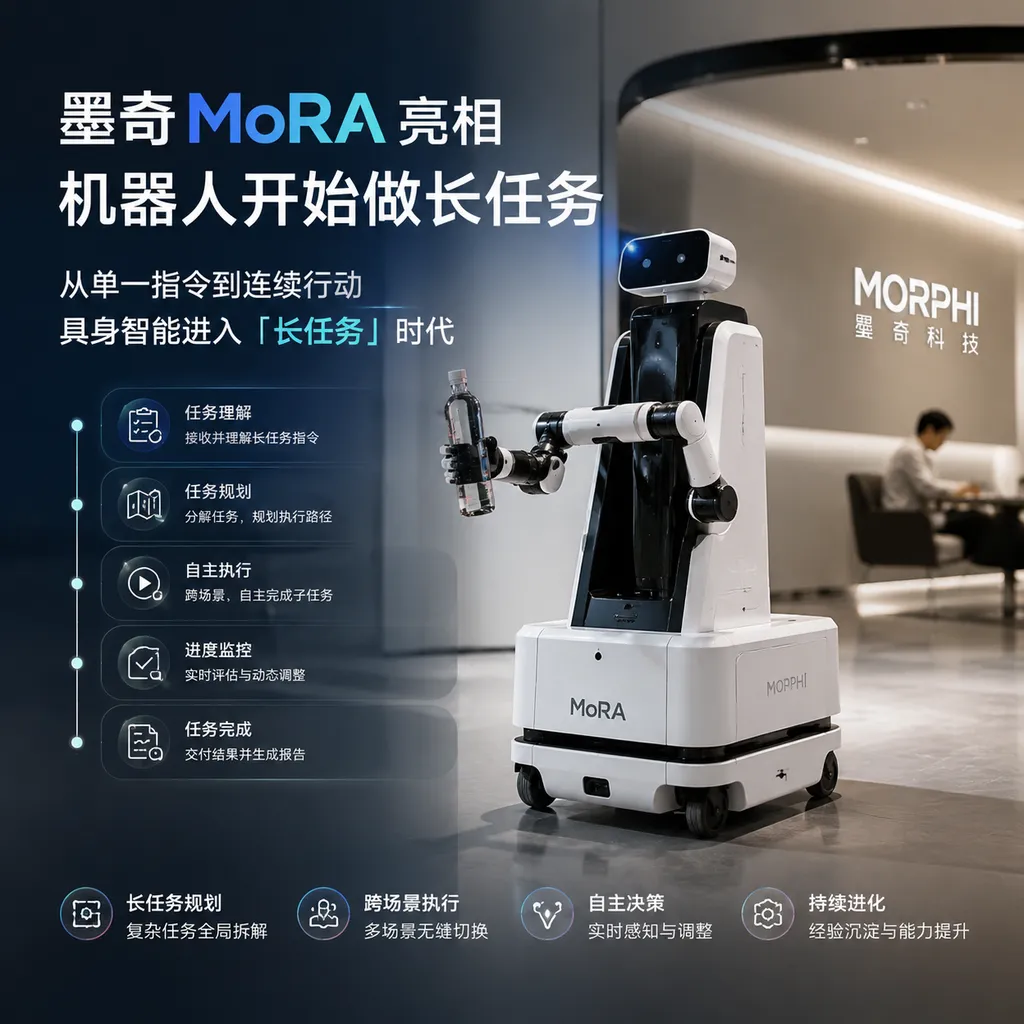
On August 19, Moqi Intelligence presented its embodied intelligence model architecture, MoRA, in a systematic showcase in China for the first time at WRC 2026, and launched MORPHI KINO, a wheeled robot designed for long-horizon household tasks. It seeks to embed memory, goal maintenance, and task-progress assessment into the policy model, enabling robots to move from “completing a single action” to “persistently getting things done.”
MORPHI MoRA Debuts as Robots Begin Tackling Long-Horizon Tasks
On August 19, the World Robot Conference (WRC 2026) opened in Beijing. MORPHI Intelligence, a recently established embodied AI company, made its first systematic appearance in China, publicly showcasing its embodied intelligence model architecture, MoRA, and launching MORPHI KINO, a wheeled robot designed for long-horizon household tasks.
The focus of this launch was not whether a robot can pick up a cup, but whether it can continuously handle a complex task for more than ten minutes: tidying a table, restocking a refrigerator, then handling laundry, all while dealing with changes in object locations, occlusions, and failed actions along the way.
This is precisely the lesson embodied intelligence must learn as it moves from demonstrations to products. Having a robot complete a single action increasingly resembles an engineering problem. Enabling it to continuously understand goals, adjust its plans in real-world environments, and recover from failures is much closer to what a true service robot requires.
MoRA Aims to Change More Than Model Size
MoRA stands for MORPHI Reasoning and Autonomy. Around this architecture, MORPHI has proposed an “Agentic-Native” approach. Its core premise is that a robot’s agent capabilities should not exist only in a large model at the upper layer responsible for planning; they should also be built natively into the policy model that directly controls the robot’s actions.
To understand this change, it helps to first look at the division of labor commonly used in embodied agents today.
- System 2 is responsible for thinking: understanding the user’s goal, breaking down the task, determining the steps, calling tools, or replanning.
- System 1 is responsible for doing: using visual, tactile, and environmental state information to output continuous actions for the robotic arm, mobile base, or dexterous hand.
For a relatively short instruction, this division of labor is usually sufficient. For example, with “put the water glass on the table into the cabinet,” System 2 plans once, System 1 completes the grasping and placement, and the task is over.
But once a task becomes longer, the problems quickly emerge. The system must remember not only the final goal, but also what has already been completed, what comes next, whether the previous action succeeded, and whether the environment has changed. Having System 2 maintain all of this state at a high level is like assigning a project manager to issue new instructions to an execution team every few seconds: it can work in theory, but in practice it is prone to information loss, context breaks, and repeated planning.
MORPHI’s approach is to ensure that System 1 is no longer merely an “action player.” In addition to predicting the next action, it must retain execution memory, maintain local goals, and determine how far the task has progressed. In other words, the policy model needs a certain degree of autonomy, allowing it to continue completing the current subtask when high-level planning is temporarily uninvolved.
This does not mean MoRA eliminates System 2. More accurately, it redefines the boundary between the two systems: System 2 handles long-term goals and global strategy, while System 1 handles continuous decision-making close to the physical world, along with some execution-related memory and judgment.
Why Long-Horizon Execution Is So Difficult
A “long-horizon task” may sound like nothing more than chaining together multiple actions, but in practice it adds far more than just the number of actions.
First, the task state is constantly changing. While the robot is tidying a table, objects may be moved, dropped, or taken away by someone else. While it is restocking a refrigerator, shelf space, product orientation, and graspable positions may all differ from the initial observation. The robot must continuously update its environment model rather than follow a fixed script generated at the start.
Second, action outcomes are not always unambiguous. A cup may not have been grasped securely, a drawer may have opened only halfway, or laundry may be blocking the dryer door. For a digital agent, a failed tool call typically returns an error code. For a robot, failure often appears as an ambiguous physical state that must be inferred from visual and sensor signals.
Third, long tasks require memory across steps. The robot must know not only that it is supposed to “pick up a piece of clothing,” but also which area the item came from, whether it has already been processed, and where it should ultimately be placed. If every action starts from scratch, the robot is likely to repeat operations, skip steps, or drift away from the goal.
As a result, the bottleneck in long-horizon execution is often not single-action precision, but “task-state management.” This is where MoRA is particularly worth watching: it treats an embodied agent as a continuously operating control system, rather than as a serial system in which a large model handles planning and the robot simply follows instructions.
KINO Trains in Hotels First, Then Moves Toward Homes
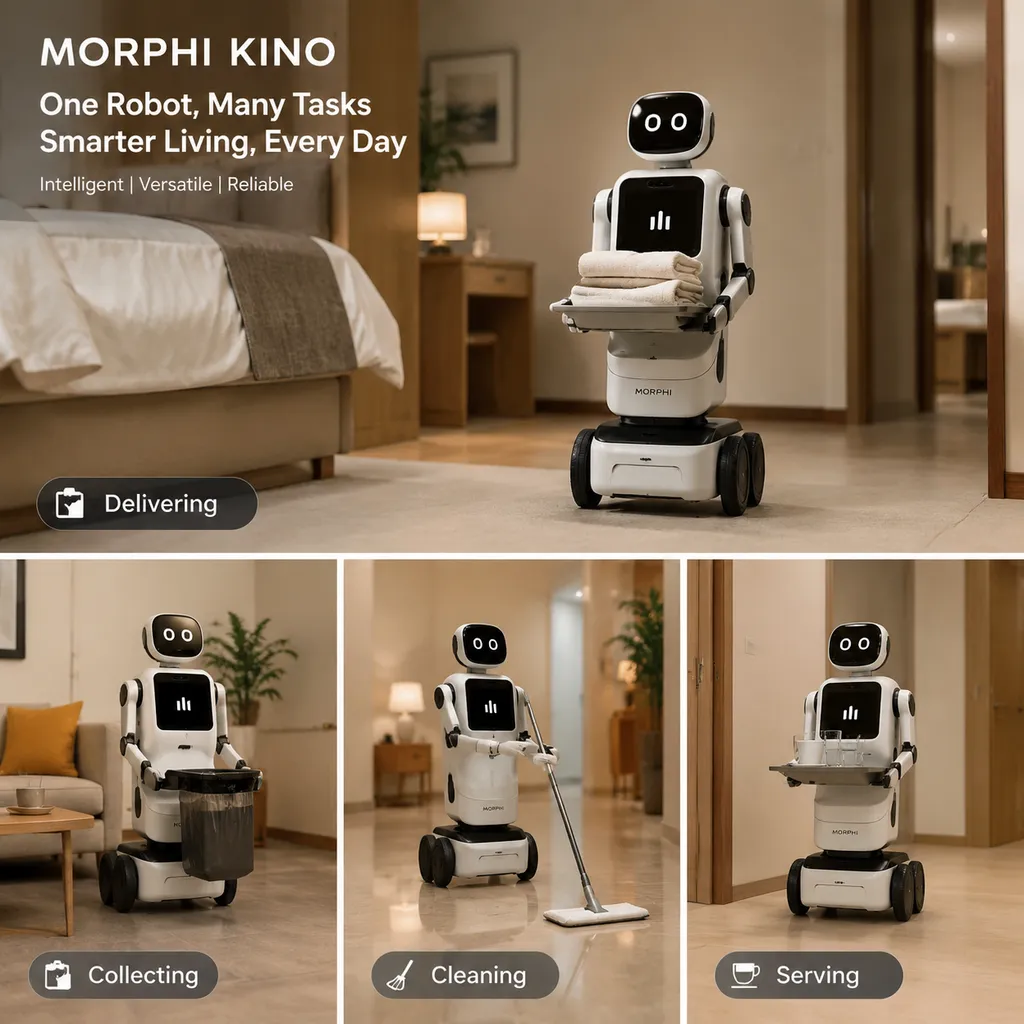
MORPHI KINO, which debuted alongside MoRA, is a wheeled robot designed for household service scenarios. MORPHI has chosen hotels as its initial real-world training environment, with plans to expand to apartments and eventually household settings.
This is a relatively pragmatic path. Homes are among the most complex application environments for embodied intelligence: layouts are highly nonstandardized, the types and placement habits of objects vary widely, and users may intervene in tasks at any time. Hotels also contain variability, but room layouts, cleaning procedures, and service objectives are easier to standardize, making them more suitable for accumulating reusable real-world data.
According to information from the event, KINO demonstrated a continuous household-style task lasting approximately 15 minutes, covering table organization, refrigerator restocking, and laundry handling. Fifteen minutes is not particularly long in itself, but it reveals more about system capabilities than a point demonstration in which the robot “picks up an object and places it in a specified location.” The robot must move between multiple areas, continuously manipulate different types of objects, and decide what to do next after completing each step.
MORPHI also stated that it has accumulated approximately 30,000 hours of real-world scenario data and plans to build a data reserve of 150,000 to 200,000 hours in 2026. For embodied models, the value of data is not determined by volume alone. What truly matters is whether the data covers non-ideal conditions such as failures, recovery, occlusions, missing objects, and human-robot interaction.
If the data consists mainly of successfully completed trajectories, the model may learn only the “standard answer.” Real household and hotel environments, however, are defined precisely by the many situations that deviate from the standard answer. Whether MoRA can establish an advantage will depend to a large extent on MORPHI’s ability to turn the abnormal states and recovery processes encountered in long tasks into high-quality training material.
An Architectural Upgrade, and a Competition in Data and Deployment
For some time, the embodied intelligence industry has focused on demonstrating individual capabilities: pouring water, folding clothes, grasping objects, and opening doors. These demonstrations can prove that a robot possesses a particular capability, but they cannot directly prove that it is suitable for work.
Product deployment requires a different set of metrics:
- How long can a single task continue?
- Can the robot recover independently after a failure?
- How well does it generalize to new objects and new arrangements?
- Does latency remain stable during continuous operation?
- How often does it require human intervention?
- Is the cost of each task lower than that of human service?
By making “bringing agentic capabilities down into the policy model” its technical approach, MoRA theoretically has the potential to reduce the latency and context loss caused by frequent intervention from the high-level model. This is important for robots that require real-time response. If a robot must wait for the upper-level model to reassess every small movement during a grasping operation, the system will be both slow and more likely to lose continuity between actions.
However, this approach also presents clear challenges. Once the policy model takes on more responsibility for goal maintenance and local planning, training becomes more difficult and errors may become harder to detect. High-level planning errors are usually relatively easy to identify, such as choosing the wrong route. An error in the policy model’s internal state judgment, by contrast, may appear as the robot continuously carrying out an action that seems reasonable but has actually diverged from the goal. How to monitor, correct, and safely take over the system will be critical to MoRA’s ability to become a product.
Moreover, bringing agent capabilities down into the policy model does not mean that every problem can be solved by the model. Mobile-base localization, robotic-arm control, collision detection, object recognition, and safety policies still require mature systems engineering. No matter how capable an embodied model becomes, it cannot replace hardware reliability or on-site deployment capabilities. Whether partnerships and potential orders with hotel and logistics groups can turn into large-scale, long-running projects will say more than a continuous demonstration at a launch event.
What MORPHI’s View Means for the Industry
From a technical perspective, MORPHI is not starting from scratch. Instead, it has identified a shared challenge for the next stage of embodied intelligence: how to unify memory, multistep planning, and continuous execution within an operational system. Similar issues are also prompting the industry to reconsider the classic architecture in which “a large model handles planning and a policy model handles control.”
MORPHI’s answer is to make the policy model more like an executor with short-term memory and local autonomy. This design could provide stronger task continuity and may be better suited to scenarios such as hotels, logistics, and household services that require sustained operation.
It is still too early to draw conclusions. The 30,000 hours of real-world data are an encouraging signal, and the annual target of 150,000 to 200,000 hours demonstrates the company’s ambition to build a data loop. However, data volume does not automatically translate into generalization. What needs to be observed is whether the same model can remain stable after leaving the training hotels and operating in rooms with different layouts and apartments of different types; whether the robot can understand priorities when users change instructions on the fly; and, when a failure occurs, whether it can recover autonomously or quickly request human intervention.
For developers, MoRA’s value lies not in the emergence of yet another model name, but in pushing the focus of competition in embodied intelligence further away from “can it perform an action?” and toward “can it manage a task?” Future robotic systems may no longer consist simply of a vision model followed by a controller. Instead, they may be continuously operating agents composed of global reasoning, local memory, policy execution, and safety monitoring.
This is the most significant signal from MORPHI’s appearance: for robots to truly enter the service industry, what matters will not be a video that looks intelligent, but whether they can remember what they are supposed to do and finish the job over the course of ten or twenty minutes, or even longer.
Sources
- Zhihu: Safe Embodied Intelligence for Long-Horizon Tasks: A Cross-Layer Analysis of Robot Manipulation (Part II) — Discusses safety issues in long-duration robot manipulation from the perspectives of planning, policy, and execution, and can be used to understand the technical background of long-horizon embodied tasks.
Note: The factual information in this article concerning MORPHI Intelligence’s MoRA, MORPHI KINO, the on-site WRC 2026 demonstration, the scale of its real-world scenario data, and the progress of its commercial partnerships was compiled from publicly available reports. Due to restrictions on the domains of the reference sources, only domestic links that meet the accessibility requirements have been retained at the end of the article.