
GPT-5.3-Codex Fully Launched: Cost Drops Below 1 Cent per Dollar

OpenAI has officially launched GPT-5.3-Codex, priced below $0.1 per million tokens, and Free users can use it directly. This marks another head-to-head clash in programming capabilities following Claude Opus 4.6.
GPT-5.3-Codex Fully Launched: Cost Drops Below 1 Cent Per Dollar
In mid-April, OpenAI quietly completed the full deployment of GPT-5.3-Codex. This model, optimized specifically for code generation, is priced at under $0.1 per million tokens — an order of magnitude cheaper than the flagship models. More importantly, Free users can now call it directly, without needing a Plus subscription.
This marks OpenAI’s clear stance in the programming vertical. Last month when Claude Opus 4.6 was released, Anthropic highlighted its code comprehension and multi-file refactoring capabilities. Now OpenAI responds with pricing and openness: “Whatever you can do, I can do — cheaper and with a lower barrier.”
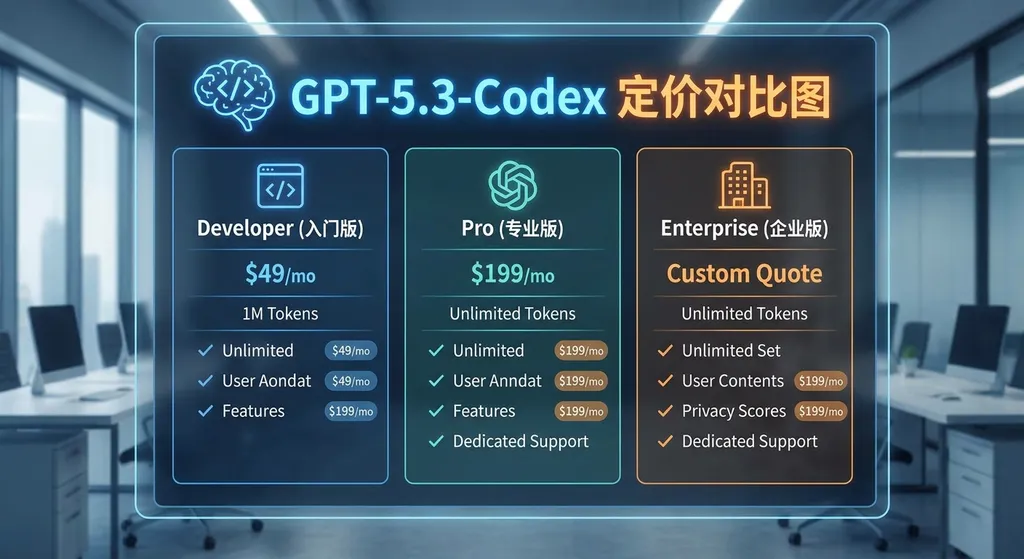
Pricing Logic: Trading Cost for Scale
The pricing strategy of GPT-5.3-Codex is straightforward — attract developers to embed it into daily workflows through extremely low per-call costs.
According to community testing, the input cost of Codex is around $0.08 per million tokens, and output cost $0.24 per million. Compared to GPT-4 Turbo’s $10/$30, this price is nearly “use as you wish.” A medium-size code completion (≈ 2000 tokens input + 500 tokens output) costs less than 0.03 cents.
Such pricing is rare in AI models. Usually, new models start expensive and adjust once costs drop. Codex flips this approach, launching near cost price. The logic behind this could be:
- Seizing the IDE integration market: Tools like GitHub Copilot, Cursor, and Windsurf are all competing for the developer entry point. Codex’s low price encourages third-party integration instead of forcing them to pick Claude or other solutions.
- Countering Claude’s enterprise penetration: Anthropic has been aggressive in enterprise markets recently, and Opus 4.6’s long context and code review capabilities are attractive. OpenAI’s price advantage with Codex lets small teams and individuals adopt it early and build habits.
- Preparing for GPT-5: Codex may be a vertical slice of the GPT-5 architecture. Large-scale deployment will yield real-world feedback to inform iteration for the main model.
A Pleasant Surprise for Free Users
More noteworthy is Free account access.
According to feedback from the Linux.do community, some Free users briefly lost access to Codex in early April but regained it after updating CPA (likely “Content Policy Agreement” or some account status). This indicates that OpenAI is gradually loosening restrictions rather than cutting off Free users entirely.
This is a clever move. Free users are usually students, indie developers, or potential customers still evaluating. Letting them use Codex for free lowers trial friction and fosters habits. When they later require higher rate limits or enterprise support, they’ll naturally move to paid plans.
In comparison, Claude’s Free tier does allow access to Sonnet 3.5, but Opus 4.6 remains Pro-exclusive. OpenAI wins on openness this time.
Real-World Performance: More Than “Cheap”
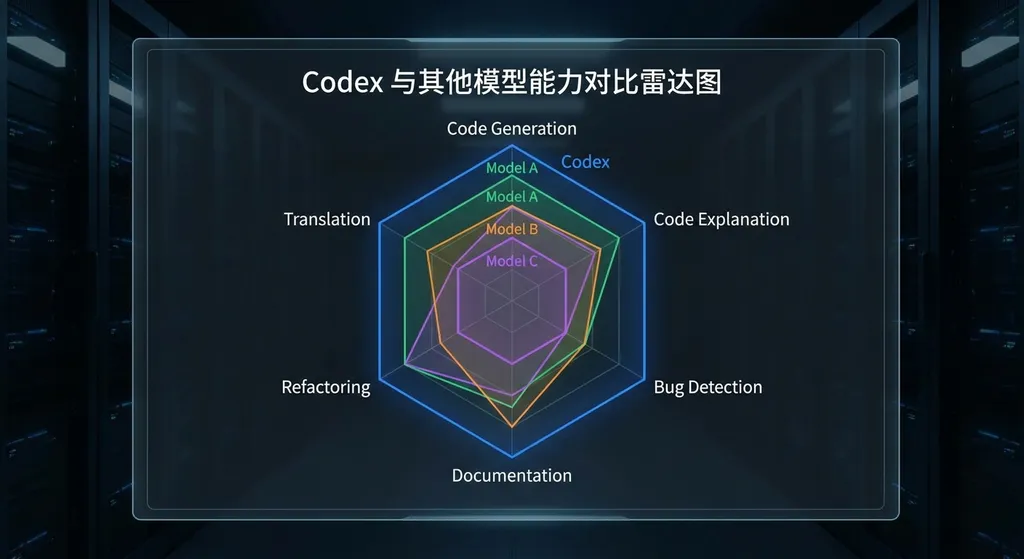
Codex’s capability focus is clear: code generation, completion, explanation, and simple refactoring. It’s not a GPT-4 replacement for complex reasoning — it’s tuned specifically for programming responsiveness and accuracy.
Community feedback shows Codex performs well in these scenarios:
- Function-level code generation: Generates implementation from function signature and comments; accuracy close to Copilot but faster responses.
- Code explanation and annotation: Converts complex logic to natural language or adds comments.
- Unit test generation: Automatically generates test cases with common edge coverage.
- Simple refactoring: Variable renaming, function extraction, formatting, etc.
But it also has clear limitations:
- Weak multi-file understanding: Struggles with cross-file dependency analysis or architectural refactoring — a strong suit of Claude Opus 4.6.
- Limited context window: Although official figures weren’t disclosed, testing suggests around 16K tokens — large codebases require manual segmenting.
- Limited reasoning depth: For multi-step algorithmic problems (dynamic programming, graph algorithms), Codex underperforms compared to GPT-4 or o1.
In other words, Codex is a “gunslinger” — best for high-frequency, low-complexity tasks. If you need an “architect” for system-level analysis, GPT-4 or Claude Opus are still the way to go.
Integration: API and Third-Party Tools
Codex currently supports two main integration paths:
1. Official API
OpenAI’s API supports the gpt-5.3-codex model identifier. The usage is identical to other models:
import openai

openai.api_key = "your-api-key"

response = openai.ChatCompletion.create(
    model="gpt-5.3-codex",
    messages=[
        {"role": "system", "content": "You are a helpful coding assistant."},
        {"role": "user", "content": "Write a Python function to calculate Fibonacci numbers using memoization."}
    ],
    temperature=0.2,
    max_tokens=500
)

print(response.choices[0].message.content)
If you use OpenAI Hub, the same code works — just replace api_key and api_base with Hub’s configuration:
import openai

openai.api_key = "your-openai-hub-key"
openai.api_base = "https://api.openai-hub.net/v1"

response = openai.ChatCompletion.create(
    model="gpt-5.3-codex",
    messages=[
        {"role": "user", "content": "Explain this code: def fib(n): return n if n < 2 else fib(n-1) + fib(n-2)"}
    ]
)

print(response.choices[0].message.content)
OpenAI Hub offers direct domestic connectivity, network reliability, and one key for all mainstream models (Claude, Gemini, DeepSeek, etc.), making comparison and fallback easier.
2. Third-Party Integrations
Several tools already support Codex:
- Cursor — choose Codex in settings as the completion model; much faster than GPT-4.
- Continue.dev — open-source IDE plugin supporting custom model configurations; Codex can be set as default.
- Poe — Quora’s AI chat platform, now hosting the
gpt-5.3-codex-sparkvariant. Some users report empty responses when forwarding via sub2api — likely configuration-related.
If Poe’s Codex gives blank replies, check:
- Model name correctness — Poe’s identifier is
gpt-5.3-codex-spark, notgpt-5.3-codex. - Token limits — Poe’s free tier enforces rate caps that may trigger silent failures.
- sub2api configuration — verify endpoint and headers are properly set.
Competitive Landscape: Codex vs Claude Opus 4.6
Codex’s timing is strategic — launching exactly one month after Claude Opus 4.6.
Opus 4.6 is marketed for “understanding complex codebases” and “multi-file refactoring,” ideal for enterprise scenarios. Codex focuses on “fast completion” and “low cost,” appealing to individuals and high-frequency tasks.
Their positioning diverges:
| Dimension | GPT-5.3-Codex | Claude Opus 4.6 | |------------|---------------|------------------| | Pricing | ~$0.08/1M tokens (input) | ~$15/1M tokens (input) | | Context Window | ~16K tokens | 200K tokens | | Response Speed | Fast (optimized latency) | Moderate | | Multi-file Understanding | Weak | Strong | | Code Completion | Strong | Moderate | | Best Use Cases | IDE integration, fast completion | Code review, architectural refactoring |
For personal developers frequently using code completion and interpretation, Codex is better. For enterprise projects analyzing dozens of interdependent files or large-scale refactoring, Opus 4.6 fits best.
Ideally, both complement each other: use Codex for everyday tasks, and switch to Opus or GPT-4 for complex ones. This is why aggregation platforms like OpenAI Hub are gaining traction — one key accesses all models, dynamically matched to task type.
Technical Speculation
OpenAI hasn’t detailed Codex’s internals, but pricing and performance suggest:
- Likely a distilled model — probably distilled from GPT-4 or GPT-5 and fine-tuned for code tasks; preserves accuracy while dramatically cutting inference cost.
- Inference optimization — noticeably faster than GPT-4, possibly using speculative decoding or similar acceleration techniques.
- Code-heavy training data — strong generation precision but weaker general reasoning implies increased proportion of code data in training.
- Possibly GPT-5 architecture shared — if Codex is indeed a vertical slice, this rollout acts as stress testing for GPT-5’s core, gathering large-scale real-world performance data.
Impact on Developers
Codex’s release directly affects the developer ecosystem in several ways:
1. Cheaper IDE Plugins
Previously, AI coding tools (Cursor, Tabnine, etc.) either trained their own models or paid for GPT-4 calls — costly approaches. Codex’s low price enables lower subscription fees or more generous free tiers.
2. Lower Barrier for Individuals
Free access means students and indie devs can experience AI-assisted coding without expense — key for cultivating AI coding habits among new developers.
3. Enterprise Cost Reassessment
Teams using GitHub Copilot or per-seat tools may find direct API calls to Codex more economical. For heavy usage, cumulative call cost may undercut seat subscription prices.
4. More Flexible Model Selection
With a “cheap and fast” option like Codex, developers can now dynamically choose per-task:
- Simple completions → Codex
- Complex refactoring → Claude Opus 4.6
- Algorithmic reasoning → GPT-4 or o1
- Ultra-long context → Gemini 1.5 Pro
This “model mix-and-match” strategy will become standard practice.
Future Trends: Are Specialized Models the Way Forward?
Codex’s release signals a trend — general-purpose LLM + specialized task models becoming mainstream.
General-purpose models (GPT-4, Claude Opus) handle complex reasoning and multitasking — powerful but costly and slow. Specialized models (Codex, Gemini Code Assist) are finely tuned for specific domains — cheap and fast but narrow in scope.
This tiered strategy benefits both sides:
- Users — can pick the most cost-effective model per need, avoiding paying “general model tax” for simple tasks.
- Vendors — can expand coverage with specialized models while retaining premium positioning for general ones.
OpenAI already had task-optimized models like gpt-3.5-turbo-instruct; Codex extends that direction. Expect more vertical models ahead — for data analysis, copywriting, translation, etc.
Anthropic and Google are likely to follow. Claude already has Haiku (fast/cheap) and Opus (strong/expensive); next could be a code-specialized version. Google’s Gemini Code Assist is moving in that direction too.
Summary
GPT-5.3-Codex represents OpenAI’s decisive bet on the programming vertical. Through ultra-low pricing and Free user access, it may quickly dominate IDE integrations and personal developer markets.
But it’s not all-powerful. For tasks requiring deep code understanding or multi-file refactoring, Claude Opus 4.6 still excels. The ideal use case combines both — Codex for daily coding, Opus for complex jobs.
For developers, this is a great moment. Models are proliferating, getting cheaper and faster; toolchains are maturing. The key is understanding each model’s strengths and weaknesses, choosing based on actual needs — not just chasing the latest.
Within this context, aggregation platforms like OpenAI Hub will become increasingly valuable — one key to access all models, switching automatically or manually per task to balance cost and performance.
References
- Linux.do Community Discussion: GPT-5.3-Codex Pricing and Experience – User testing on Codex pricing and Free account access
- Linux.do: Free Account Codex Access Issues – Discussion on restored access after CPA update
- GitHub Notes: AI Application Product Management – Analysis of AI model market and pricing strategies


