Meta burns through tens of trillions of tokens every week.

<think>**Planning accurate translation preserving markdown**</think> According to Bloomberg, Meta purchases hundreds of millions of dollars’ worth of AI services from Microsoft Azure each year and consumes tens of trillions of tokens every week, making it one of Microsoft’s largest AI customers. Behind this spending is a new business model emerging as large models shift from a race to train them to high-frequency, enterprise-level inference.
Meta Burns Trillions of Tokens Every Week, Becoming One of Microsoft’s Top AI Customers
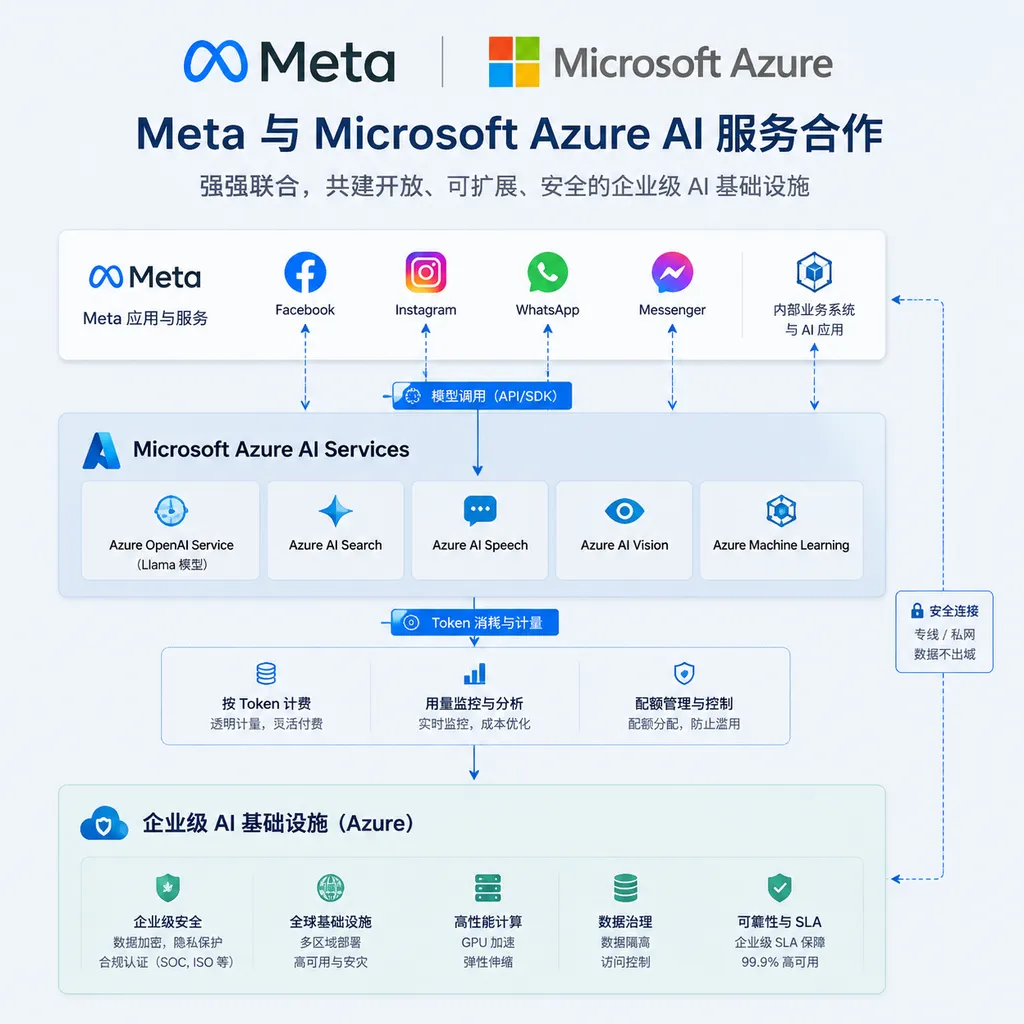
Meta is becoming one of Microsoft Azure’s most important AI customers.
According to a Bloomberg report on August 20, Meta spends hundreds of millions of dollars each year purchasing AI services through Microsoft Azure. People familiar with the matter said that Meta’s weekly AI compute consumption through Azure has reached several trillion tokens.
This is neither a one-off model trial nor an internal experiment by a few teams. For a company that is simultaneously developing its own large models, training recommendation systems, building AI assistants, and developing an API business, this scale means that model calls have entered everyday software production workflows: code generation, code review, product prototyping, model evaluation, data processing, and a large number of internal automation tasks are all continuously consuming inference resources.
Why Does Meta Still Need to Purchase Large Amounts of External Models?
Meta is not short of its own models.
Over the past several years, Meta has continued investing in the Llama family of models and has tried to embed model capabilities into its social products, advertising systems, recommendation systems, and AI assistants. The company is also building a model API business for external customers, which may eventually allow developers to call Meta’s models directly.
But developing in-house models and using external models solve two different kinds of problems.
Training a model is like building an engine: the cycle is long, the cost is high, and the result must go through extensive testing. Calling an external model is more like renting an already tuned power system, allowing development teams to connect it to their workflows immediately. For a company like Meta, the most rational strategy is not to rely solely on its own models for every task, but to switch between different models according to the requirements of each task.
People familiar with the matter cited by Bloomberg said that Meta purchases models from different platforms based on their availability and cost. Meta developers have also used OpenAI technology through Azure AI Foundry to evaluate the performance of its own models.
This point is critical. The value of external models to Meta is not merely that they provide additional computing power. They also serve as a persistent benchmark. Whether an in-house model has actually improved cannot be determined solely by internal metrics; it must also be repeatedly compared with leading models in the industry on coding ability, complex reasoning, instruction following, and stability.
Model evaluation itself is a highly compute-intensive task. A single evaluation may require multiple models to process the same batch of code, product requirements, or structured data, followed by scoring by humans or another model. As long as the evaluation set is large enough and the iteration frequency is high enough, token consumption can quickly rise from the millions and billions to the trillions.
What Do Several Trillion Tokens Really Mean?
Tokens are not the same as the number of characters, nor are they simply equivalent to the number of requests.
For Chinese, one character is typically close to one token, but the actual number depends on the tokenizer. English words, meanwhile, may be split into multiple tokens. The consumption of a request includes both input and output tokens. In code tasks, document analysis, and agent tasks involving long contexts, the input component can expand particularly quickly.
Consider an example closer to a development workflow: a normal code-completion request may consume only a few hundred tokens. A codebase-level refactoring task, however, may require reading multiple files, retaining context, generating a modification plan, and running tests, increasing the consumption of a single task by several orders of magnitude. If an agent also repeatedly calls tools, reads error logs, modifies code, and reruns tests, then one task effectively becomes a series of model calls.
Therefore, several trillion tokens do not indicate how many chat requests Meta has sent. They indicate that AI has been embedded into a complex software production chain. The consumption may come from the continuous tasks generated every day by tens of thousands of engineers, or from development and evaluation workflows that automated agents run continuously in the background.
More importantly, this level of usage is likely still growing. As models become more capable, companies may not reduce their usage. Instead, they may hand AI more responsibilities:
- Expanding from code completion to codebase understanding and automated refactoring;
- Expanding from single-turn question answering to agents capable of autonomously calling tools;
- Expanding from manual sample-based evaluation to large-scale regression testing for every model update;
- Expanding from R&D teams to advertising, customer service, operations, data analysis, and internal knowledge management;
- Expanding from calls to a single model to parallel generation, cross-validation, and automatic routing across multiple models.
This is also why tokens are becoming an increasingly important unit of measurement in the AI business. The number of GPUs tells you how much production capacity a company has prepared; the number of tokens is closer to measuring how much that capacity is actually being used.
Azure Foundry Sells More Than a Single Model
Microsoft Azure currently provides models from multiple vendors through its Foundry platform, including OpenAI, Anthropic, DeepSeek, Mistral AI, xAI, and Meta. As of July this year, the platform offered 11,604 models and had 100,000 customers.
The number of models alone does not represent a platform’s capabilities, but it reflects a practical shift in the way enterprises purchase AI services: many customers are no longer satisfied with choosing one model and assigning every task to it.
In real production environments, customers often need to consider several factors at once:
- Whether the most powerful model is needed for complex reasoning tasks;
- Whether simpler models can handle classification, summarization, and rewriting at a lower cost;
- Whether a model supports a specific context length and tool calling;
- Whether latency meets the requirements of interactive products;
- Whether data can remain in a designated region and comply with regulatory requirements;
- Whether the system can quickly switch to a backup model when a particular model is rate-limited or fails;
- Whether the costs of calls from different business lines can be accurately tracked and allocated.
When a customer uses only one model, the model provider can directly capture most of the value. But when customers begin choosing among multiple models, the platform layer becomes more important. Azure’s practical capabilities include identity management, access control, network isolation, logging, billing, data governance, and enterprise support. These often determine whether an AI service can go live more than the model’s name itself.
For Meta, Azure also offers a practical advantage: it can access multiple models through the same enterprise infrastructure and place model evaluation, software development, and internal application deployment in a relatively unified environment. This may not always be the cheapest approach, but it can reduce the complexity of system integration, access management, and procurement processes.
Microsoft’s Business Is Growing, but It Is Also Becoming More Dependent on Large Customers
Meta’s status as one of Microsoft’s top AI customers is clearly positive for Azure, but it also highlights an easily overlooked issue: Microsoft’s AI business is becoming increasingly dependent on a small number of large technology companies.
According to the referenced reports, Microsoft’s largest AI customers primarily come from the technology sector. In addition to Meta and ByteDance, Adobe, Perplexity, and Sierra, a customer-service AI company co-founded by OpenAI Chairman Bret Taylor, are also among Microsoft’s major customers.
The advantages of these customers are clear: they have large usage volumes, mature technical teams, and fast AI deployment. Once a model is integrated into a development workflow, usage is typically continuous, making revenue more stable than that from one-off experimental projects.
But their disadvantages are equally clear: customer concentration is high, and purchasing budgets can be affected by model prices, capital expenditure cycles, and internal development strategies. Meta may use external models through Azure today, but tomorrow it may move more tasks back to its own infrastructure. Large customers also have sufficient bargaining power to demand lower unit prices, higher quotas, and more flexible service terms.
The report also noted that OpenAI contributed approximately 70% of Microsoft’s total AI revenue in Microsoft’s most recent fiscal year. This indicates that although Microsoft’s AI revenue is growing rapidly, it is not yet fully diversified. By placing multiple model vendors on the same platform, Azure can expand customer choice and reduce the platform’s dependence on any single model. However, judging from its revenue structure, Microsoft still needs to demonstrate that more enterprises and business scenarios can continue paying for these services.
The AI Industry Is Entering an Era of Token Cost Management
Over the past two years, the keywords in the AI infrastructure race have been GPUs, data centers, and training scale. Now, another question is becoming more urgent: how much sustainable revenue can this computing power actually generate?
Token cost management will become part of the daily work of enterprise AI deployment. Companies will not use the most expensive and capable model for every request forever. Instead, they will manage model calls much as they manage cloud computing resources: simple tasks go to smaller models, while complex tasks go to larger models; short contexts use low-cost channels, while long contexts are tightly controlled; high-value results receive larger reasoning budgets, while low-value requests are subject to limits.
What developers truly need to focus on is no longer just the highest score on a model leaderboard, but the total cost of a task:
- How many input and output tokens a single request consumes;
- How much automatic retry and tool calling amplify costs;
- Whether model output is stable enough to avoid rework;
- Whether increased latency causes business conversion rates to decline;
- Whether caching, batch processing, and model routing can reduce overall expenses;
- Whether existing prompts and evaluation results remain valid after a model upgrade.
Meta’s consumption of several trillion tokens per week indicates that the most advanced AI buyers have already entered a stage of refined operations. They are not simply asking which model is the strongest. They are also asking which model is the most cost-effective for a specific task, and whether different models can be combined into a stable production pipeline.
This also explains why the value of multi-model platforms is rising. A platform does more than forward model APIs to customers. It may also handle model routing, cost monitoring, access management, failover, and call auditing. For enterprises, this amounts to adding a control plane between models and business applications.
Could Meta Become a Seller Instead of a Buyer?
Meta is developing model API services for external customers. This means it may eventually shift from being a model purchaser on Azure to becoming a supplier of AI infrastructure and model services.
On the surface, this is a typical upstream-downstream competitive relationship: Meta purchases external models through Microsoft’s platform while building its own API platform, which may eventually compete with multi-model platforms such as Azure Foundry.
In the short term, however, Meta is more likely to pursue a parallel strategy. Its own models can serve the products and infrastructure it considers most important, while external models can be used for R&D, evaluation, and capability supplementation. When its own models gain cost or performance advantages on certain tasks, Meta can gradually expand the proportion of internal substitution.
Meta Chief Technology Officer Andrew Bosworth said on a podcast in July this year that the company is developing its own AI models while also renting other leading models for development work. This approach is not contradictory. In fact, it is becoming standard practice among major technology companies: models are strategic assets, but model calls are also means of production.
Meta’s real challenge is to solve the return-on-investment problem for its computing investments. The company needs substantial computing power to train models, improve its advertising and recommendation systems, develop personal and business AI assistants, and prepare for future external demand for its API business. As long as revenue growth from these businesses can cover the costs of model training, inference, and infrastructure, external procurement is not wasteful. It is an efficiency tool during a period of expansion.
What This Means for Developers
Meta’s Azure procurement, worth hundreds of millions of dollars, sends three signals to developers.
First, multi-model calling will become a mainstream architecture. Development teams will not remain permanently tied to a single model. Instead, they will build model portfolios around task type, price, speed, and stability. For application developers, integration layers that support the OpenAI format, unified authentication, and easy model switching will become increasingly important.
Second, token budgets will become part of project management, much like cloud server budgets. If an agent project calculates only the unit price of a model while ignoring context growth, tool calls, failed retries, and concurrency, costs can easily spiral out of control after launch. Model performance evaluations should also include the cost per task rather than focusing solely on accuracy and human preference scores.
Third, platform capabilities will become a core competitive factor in production environments. Developers need more than an interface that returns text. They also need reliable routing, observability, rate-limiting strategies, call logs, cost analysis, and failover. These foundational capabilities determine whether a model can move from a demo into a business system.
Meta’s consumption of several trillion tokens per week is obviously not a scale that ordinary development teams can directly replicate. But it represents how the most advanced customers in the AI industry are using these systems: models are no longer tools that people open occasionally. They are becoming infrastructure that software organizations rely on continuously.
Whether Microsoft can turn this usage into high-quality, sustainable profits, and whether Meta can convert its proprietary models and massive computing investments into new revenue, will depend on the results of the next several fiscal years. What is clear is that competition in the AI industry has moved beyond who can train the largest model. It is now also about who can turn trillions of tokens into genuinely valuable products and business outcomes at lower cost and with greater stability.
Sources
- ITHome: Meta Becomes One of Microsoft’s Largest AI Customers, with Annual Purchases Reaching Hundreds of Millions of Dollars and Weekly Consumption of Several Trillion Tokens: Reports on Meta’s purchase of AI services through Azure, the scale of its token consumption, and the customers and models available on Azure Foundry.
This article was compiled from publicly available reports. Information in the article concerning customer procurement volume, token consumption, and platform customer numbers is based on statements from sources cited in those reports. Subsequent disclosures by Microsoft and Meta may lead to revisions.