Galaxy General’s “Xingzai” Makes Its Debut: Robots Begin Learning Movements on Their Own
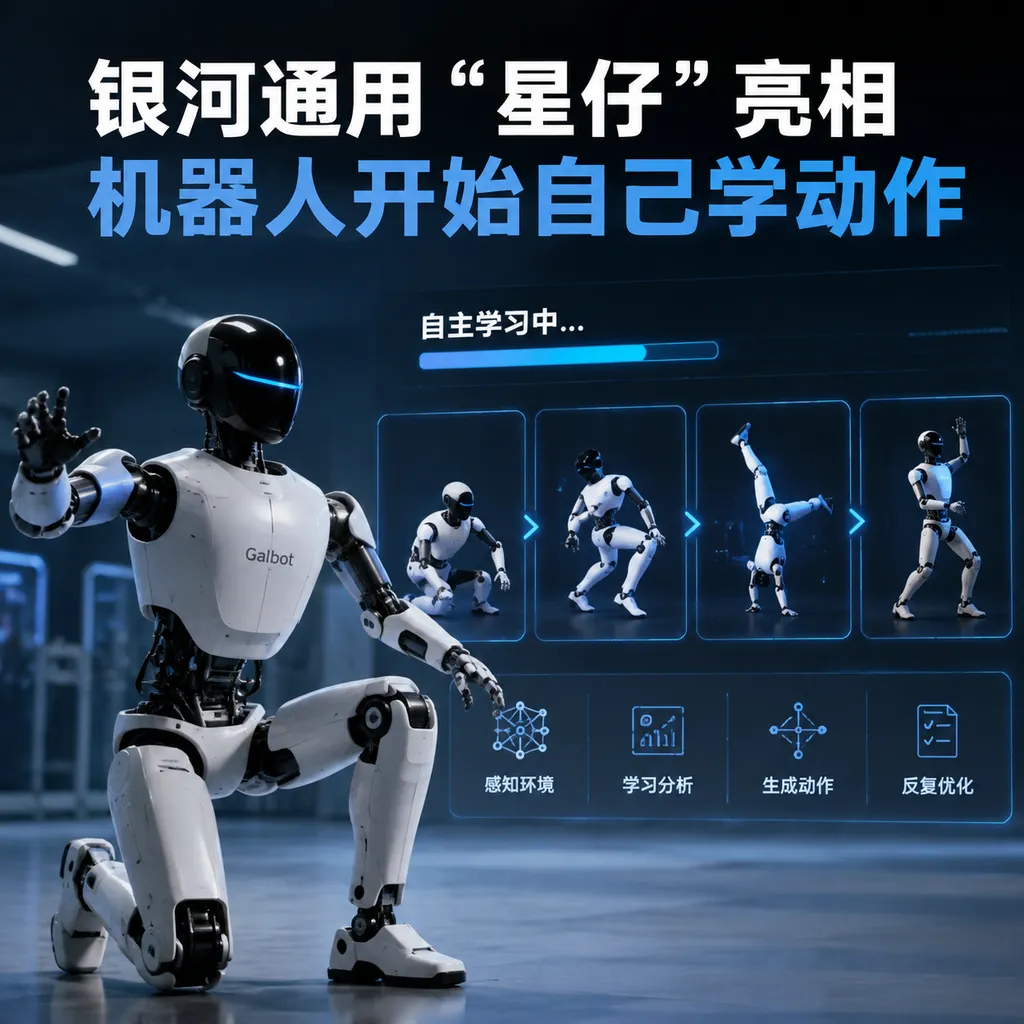
On August 20, Galbot’s first bipedal humanoid robot, the Galbot ET1 “Xingzai,” made its public debut at the 2026 World Robot Conference. According to the company, it is powered by the Galbot Brain, enabling it to understand speech and generate actions in real time, as well as autonomously learn new skills through interaction with people.
Galaxy General’s “Xingzai” Makes Its Debut: Robots Begin Learning Skills on Their Own
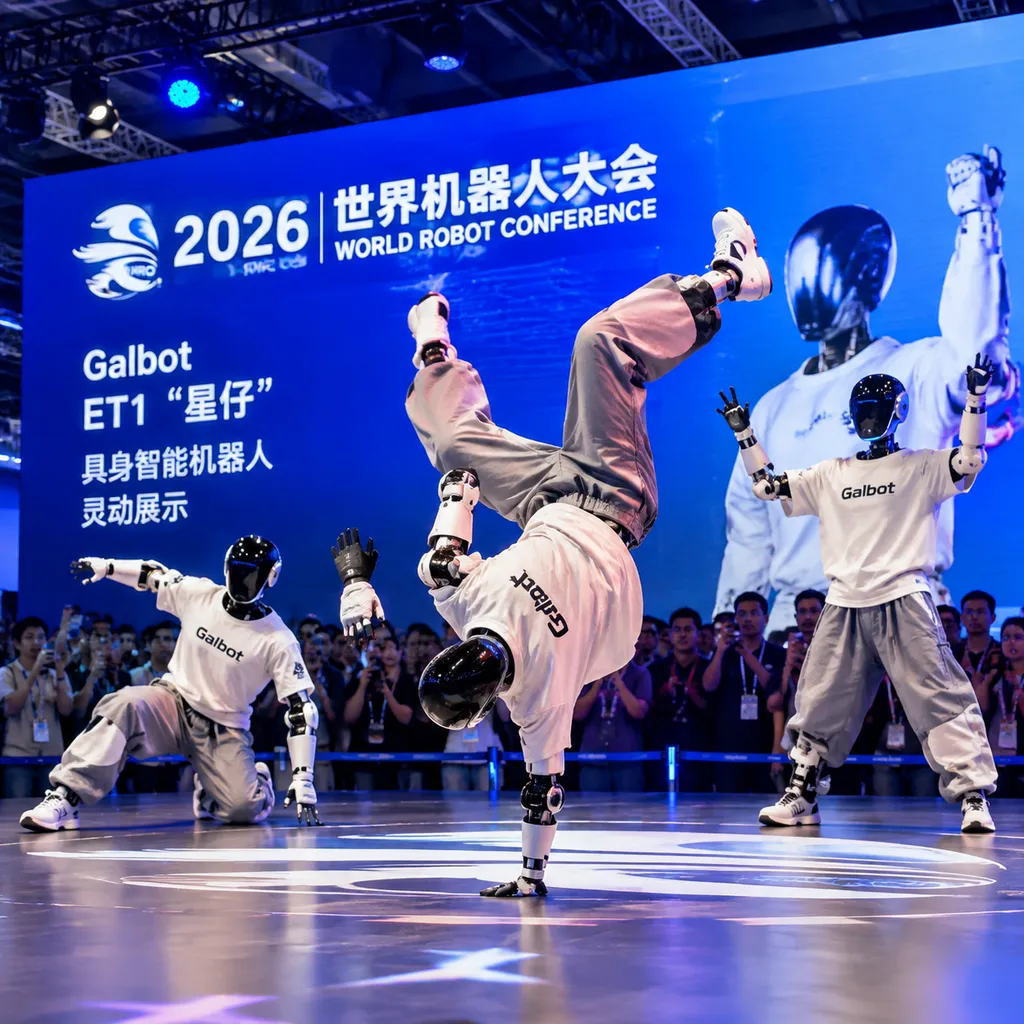
On August 20, Galaxy General’s first bipedal humanoid robot, Galbot ET1 “Xingzai,” made its public debut at the 2026 World Robot Conference (WRC).
Rather than following a fixed stage script to perform a routine wave, turn, or walk, it immediately demonstrated movements more likely to stick in the audience’s memory: supporting itself on the ground with its hands, doing a handstand, breakdancing, and synchronizing in real time with a human dancer. Wang He, founder and CTO of Galaxy General, said that Xingzai is equipped with the company’s self-developed “Galaxy Brain,” which can understand speech and environmental information in real time and dynamically generate movements, enabling interaction without relying on preset scripts.
The company also gave Xingzai a more ambitious positioning: it is “the world’s first physical agent with autonomous learning capabilities.”
The emphasis in this statement is not on the word “humanoid,” but on “autonomous learning” and “physical agent.” In recent years, demonstrations in the robotics industry have increasingly resembled large-model launches: the model understands instructions, while the robot executes actions, but between the two there is often a prewritten action library. When a user says, “Do a dance,” the system calls Action A; when the user says, “Pick up the cup on the table,” the system matches Grasping Procedure B. The robot appears to understand, but in reality it may simply be mapping the input to a pre-prepared program.
What Xingzai is attempting to demonstrate is a different way of working: the robot first observes the real-world environment, understands human language and movements, and then plans its own behavior in real time. For developers, this means that robot control systems are moving from “skill callers” toward architectures more closely resembling agents.
From Fixed Scripts to Real-Time Motion Generation
The hardest part of traditional humanoid robotics has never been getting a robot to perform an isolated movement. It is getting the robot to continuously complete a sequence of movements in the real world while handling all kinds of unpredictable changes.
For example, “Bring me the water cup on the table” appears to be just one sentence, but in practice it involves at least several layers of problems: the robot must identify which object is the “water cup,” determine the positions of the table and the person, plan a walking route, control its arms and fingers to grasp the cup, and finally adjust its delivery posture based on the person’s position. If someone walks by, the cup is moved, or an obstacle appears under the robot’s feet, the system must make immediate corrections rather than stopping because one step no longer matches the script.
More complex movements, such as breakdancing, handstands, and hand-supported movements, place even greater demands on the system. The robot must simultaneously handle whole-body motion control, shifts in its center of gravity, changes in contact state, and movement rhythm. When a bipedal robot performs a handstand, its support relationship shifts from its feet to its hands, changing its center of gravity, joint loads, and ground contact points. Any local control error could destabilize the entire movement.
Galaxy General did not disclose Xingzai’s detailed hardware specifications, control frequency, model size, training data volume, or safety redundancy design. Therefore, it is currently impossible to determine the full extent of its technical capabilities based solely on the event footage. However, judging from the direction of the demonstration, the company wants to emphasize not that “the robot can dance,” but that its movements are no longer completely choreographed frame by frame by engineers. Instead, they are jointly generated by visual perception, task planning, and whole-body motion control.
Galaxy General said that Xingzai uses world-class motion-control models and data infrastructure, giving it the ability to recognize, extract, and reproduce human movements in real time. In other words, it is not merely playing a dance video, nor simply mechanically reproducing motion-capture data. Rather, it is attempting to extract transferable movement skills from human actions and map them onto its own body.
This distinction is crucial. Motion capture solves the problem of “how to reproduce this particular movement,” while autonomous learning must solve “how to understand the movement and perform it again with different bodies and in different environments.” The former is more like recording and playback; the latter is closer to learning and generalization.
The “Galaxy Brain” Is Intended to Solve More Than a Single Robot’s Problems
Based on the information Galaxy General has publicly released, Xingzai is not an isolated humanoid robot, but an implementation of Galaxy Brain on a bipedal platform.
The company has previously emphasized that Galaxy Brain aims to allow robots with different forms to share a general-purpose intelligence: the same “brain” understands tasks and plans actions, then generates corresponding movements based on the capabilities of different bodies, such as bipedal, wheeled, or heavy-load platforms. This approach is consistent with the current direction of the embodied-intelligence industry. Its central goal is to reduce the cost of having “one model for each type of robot and one set of skills for each scenario.”
For large models, cross-task transfer is already a basic capability; for robots, transfer is far more difficult. A language model only needs to output the next token, while a robot must output a sequence of movements in a continuously changing physical world, bearing the risks of collisions, falls, equipment damage, and even injury to people. Even if a model understands “put the box on the shelf,” it must also know the box’s weight, friction, grasping position, and the shelf’s height, while continuously adjusting based on the execution results.
As a result, the real competition in embodied intelligence will not take place solely at the level of “whose model gives smarter answers.” It includes at least three components:
- Perception and understanding: Identifying people, objects, spatial relationships, and changes in the environment, then converting language instructions into executable tasks.
- Task planning: Breaking long-term goals down into a sequence of actions and replanning when execution fails or the environment changes.
- Motion control: Converting planning results into joint-level control signals to ensure that movements are stable, coordinated, and safe.
The real-time speech-to-motion generation emphasized in Xingzai’s demonstration is effectively intended to establish a shorter feedback loop between these three layers. After the user speaks, the robot does not need to first pass the instruction to a fixed skill interface and wait for an action library to return a result. It can directly generate behavior by combining context with environmental information. Only this makes more natural interactions possible, such as improvising a response to a joke or responding to human movements in real time.
However, “real-time generation” cannot simply be equated with “complete autonomy.” Robot systems generally still need to pass through safety constraints, motion boundaries, and low-level controllers. Large models are well suited to deciding “what to do” and “how to arrange it,” but they are not suited to directly controlling every motor without safeguards. A usable system typically needs to combine a high-level agent with specialized motion-control models, state estimation, and safety policies.
This is also the most significant technical signal from the Xingzai demonstration: if it can indeed connect natural-language understanding, motion imitation, and whole-body motion control, then the company’s focus has shifted from showcasing isolated skills to closed-loop decision-making in the physical world.
The Value of Autonomous Learning Depends on Whether Learned Skills Can Be Reused
“Autonomous learning capabilities” is the statement most likely to be amplified in this release, and also the aspect that requires the most continued observation.
There are several broad approaches to having a robot learn a new movement. The first is manual programming, in which engineers design trajectories and constraints for each movement. The second is motion capture, which maps human movements onto the robot. The third is teleoperation, in which a person remotely controls the robot to collect training data. The fourth is the approach more closely associated with autonomous learning: the robot builds its own mapping from environmental states to action policies through observation, interaction, and trial and error.
The first three approaches have not lost their value. Most advanced robotic systems today still rely on high-quality demonstration data and teleoperation data. However, they share the problems of high cost and limited coverage. The fact that a movement can be completed in a laboratory does not mean that the robot can reliably reproduce it across different floors, lighting conditions, target objects, and body postures.
Therefore, determining whether Xingzai truly has autonomous learning capabilities requires more than observing whether it can complete a dance at a product launch. Several stricter conditions must be considered:
- Can it learn new skills that engineers have not explicitly written into its action library?
- Can it acquire a skill through interaction with a person without motion-capture footage?
- Can it transfer the result of one learning experience to different environments, targets, or tasks?
- Can it identify the cause of a failure during execution and improve through feedback, rather than simply calling an artificial script again?
- Can it keep the learning process within acceptable limits of time, computing resources, and safety costs?
In supplementary information, Galaxy General said that Xingzai can learn new movements through interaction with humans without relying on motion capture or motion videos. The company also said that the robot is gradually acquiring complex athletic skills such as tennis. If these claims are supported by more details in subsequent product demonstrations, technical papers, or public tests, their value will be far greater than that of a highly polished dance performance.
The reason is practical: consumer and industrial robots cannot be retrained from scratch for every user, factory, or piece of equipment. The real product moat is not how many movements a robot can perform, but whether it can continue absorbing new data after deployment and transfer its skills to new tasks.
This Launch Still Looks More Like a Statement of Capability
Based on the information disclosed so far, Xingzai cannot yet be directly considered a mature, commercially deployable general-purpose humanoid robot.
First, the public materials do not provide key metrics such as price, mass-production plans, battery life, payload, movement speed, fall protection, or maintenance costs. For developers and enterprise customers, these parameters often determine whether a product is worth deploying more decisively than a high-difficulty dance performance.
Second, stage environments are usually carefully prepared. The floor is level, the space is open, and task boundaries are clear. Engineers and safety measures are also present to provide support. A robot’s ability to perform difficult movements in such an environment demonstrates the system’s upper limit. Commercial deployment, however, is more concerned with average performance and stability under network jitter, changing lighting, occlusion, crowded conditions, and repeated task failures.
Third, a bipedal form does not inherently translate into greater practical value. Bipedal robots are well suited to stairs, narrow corridors, and environments designed for humans, but their balance control and mechanical structures are also more complex. Their costs and maintenance burdens are generally higher than those of wheeled platforms. Whether enterprises ultimately choose humanoid robots depends on whether they can deliver sufficient efficiency gains in real workflows, not on whether their appearance is more humanlike.
In other words, Xingzai’s clearest value at this stage is demonstrating Galaxy General’s technical path toward “real-time robot intelligence,” rather than announcing a product solution that has already completed large-scale delivery.
Industry Competition Is Moving from “Can It Move?” to “Can It Generalize?”
The humanoid-robot industry has already gone through a phase of competing over whether robots can walk, run, and perform backflips. As hardware-based motion capabilities gradually improve, the dividing lines in the next stage will become increasingly clear: Can robots understand open environments? Can they execute long-horizon tasks? Can they correct themselves during a task? Can they transfer capabilities learned in one scenario to another?
This resembles the large-model industry’s shift from “can it chat?” to “can it call tools and complete complex workflows?” Robots likewise need to move beyond demonstrating isolated skills and develop persistent state, memory, planning, and feedback as physical agents.
Xingzai’s release arrives precisely at this juncture. It lowers the public’s barrier to understanding through dancing, handstands, and real-time interaction. But the aspects most relevant to developers are whether Galaxy General can consolidate these capabilities into unified model interfaces and a closed-loop data system: how the robot receives tasks, how it communicates its current state, how it handles failures, how it uploads and uses interaction data, and how new skills are transferred between different robot bodies.
If Galaxy Brain can allow bipedal, wheeled, and heavy-load robots to share general capabilities, then the unit of competition for the company will no longer be a single robot, but an intelligent infrastructure system that can support multiple robot embodiments. Hardware is the entry point; models, data, and deployment feedback are the long-term moat.
Galaxy General has not yet publicly released a complete developer platform, model interface, or evaluation protocol. For external developers, the most important things to watch next are not how many more flashy movements Xingzai can perform, but three questions: whether the model can be accessed through an open interface, whether the robot supports third-party skill integration, and whether the company will use reproducible metrics to explain how much “autonomous learning” actually improves efficiency.
As of August 20, Galbot ET1 “Xingzai” remains a new product focused primarily on technology demonstration. It shifts the industry’s attention from “can humanoid robots perform complex movements?” toward the more challenging question of “can robots learn movements on their own and reliably reuse them in the real world?” This question is much harder than performing a breakdance routine, and it will have a greater influence on whether embodied intelligence can ultimately move from exhibition stages into homes, factories, and service environments.
If subsequent public demonstrations cover unfamiliar environments, continuous tasks, and failure recovery, the Xingzai launch will represent more than a product debut. It could become a clear positioning move for Galaxy General in the physical-agent field. Conversely, if autonomous learning still relies primarily on pre-prepared data and motion procedures, then the central value of this release will remain its demonstration of solid motion-control capabilities.
More real-world scenarios and verifiable data are needed to complete the picture. What can be confirmed at this stage is that Galaxy General has moved the narrative of bipedal-robot competition from “how humanlike are the movements?” to “can intelligence form a closed loop within the body?”