UBTECH’s “Walker” Secures Registration

<think>**Clarifying translation nuances**</think> UBTECH’s self-developed “Walker Embodied Intelligence Model” has completed the filing process for generative AI services, with a focus on strengthening emotional interaction and content security. The filing is not a certification of capabilities, but it is an essential piece of the compliance puzzle that humanoid robots must put in place before entering household and public service settings.
UBTECH’s humanoid robots are securing a key “pass” for entry into homes and public-service settings.
On August 20, UBTECH disclosed that its self-developed “Walker Embodied Intelligence Model” passed the Cyberspace Administration of China’s assessment and review on August 18, formally completing the filing process for generative AI services. According to UBTECH, the company is among the first group of enterprises in the embodied-intelligence robotics industry to complete the relevant model filing.
This filing does not cover a specific robot, robotic arm, joint module, or motion-control system. Instead, it concerns the model behind the robot—the system responsible for perception, understanding, planning, and interaction. More precisely, it means that this “embodied brain” has established a content-safety framework that meets current regulatory requirements when providing generative services to users.
It does not amount to national-level certification of the model’s capabilities, nor does it prove that the robot has solved reliability issues in home environments. But for manufacturers preparing to deploy robots in shopping malls, exhibition halls, and even living rooms, filing is not merely decorative—it is becoming an increasingly unavoidable prerequisite for launching products at scale.
The Filing Covers a Robot Model That Can “Talk and Act”
The input and output boundaries of traditional chat models are relatively clear: a user submits text, an image, or speech, and the model returns content. Embodied-intelligence models are far more complex.
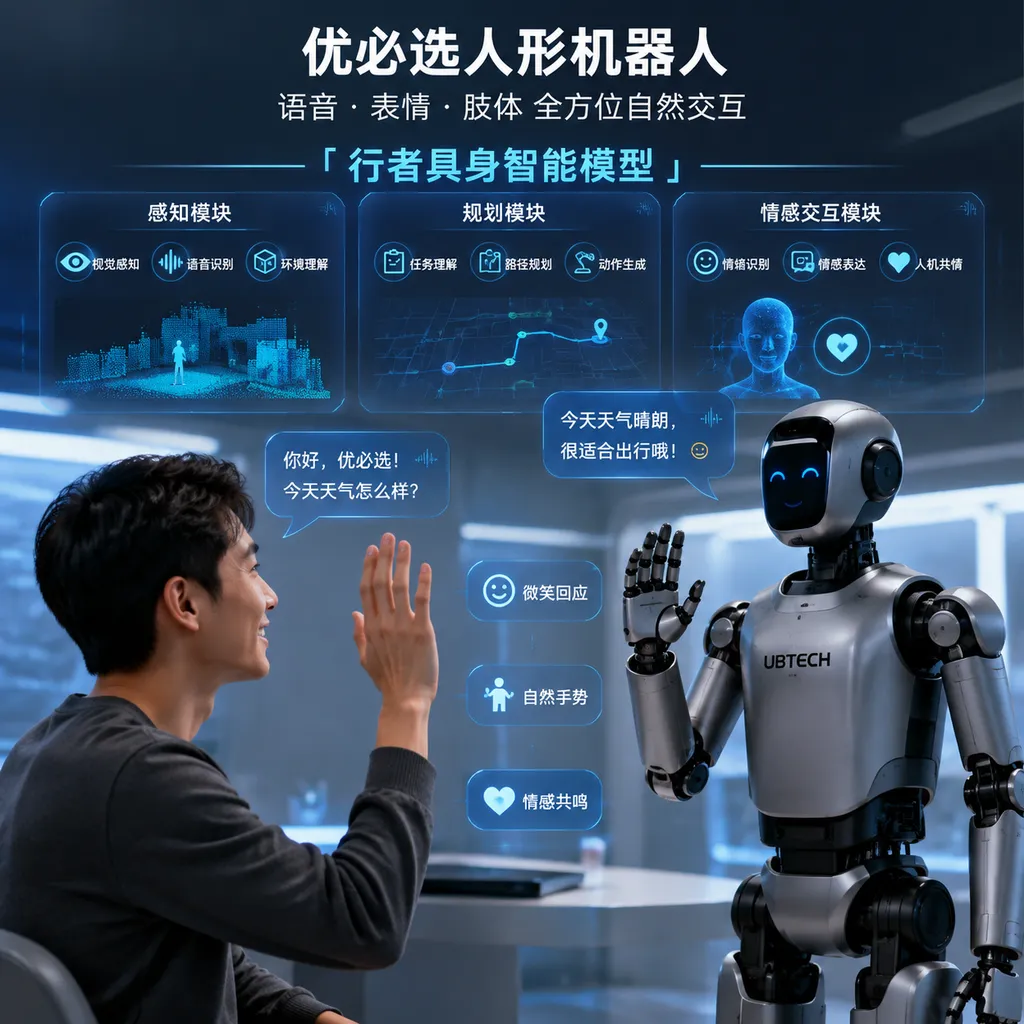
Such a model must not only understand the instruction “Bring me the water on the table,” but also identify where the table is, which object is the water, whether the route is obstructed, and whether the cup is likely to spill. It must then break a natural-language objective down into a sequence of actions. In companionship and service scenarios, the model must also assess the user’s emotional state and coordinate speech, gaze, facial expressions, posture, and even haptic feedback.
In other words, when a conventional large model says something incorrect, the primary risk remains on the screen. When an embodied model misunderstands something, however, the error may travel through the task-planning and motion-execution pipeline into the physical world.
The real significance of the Walker model completing its generative AI service filing is therefore not simply that another filing number has been issued. Rather, embodied-intelligence products are beginning to be incorporated into a governance framework aligned with how they actually provide services. A robot is both an entry point for content generation and a physical execution terminal. Content safety, interaction safety, and motion safety must ultimately form a single, connected chain.
According to UBTECH, the version covered by this filing underwent specialized fine-tuning for emotional interaction. While retaining environmental perception and long-horizon task-planning capabilities, it improves the naturalness of language and the human-like quality of its interactions. Its target scenarios include:
- In-home companionship and emotional interaction;
- Reception services in shopping malls, exhibition halls, and business parks;
- Customer-service consultation and business introductions;
- Advertising, promotion, and brand guidance;
- Smart navigation in hospitals, government service halls, and other public spaces.
These scenarios may appear less “hardcore” than material handling in factories, but they place greater demands on open-ended interaction. Industrial robots usually perform clearly defined processes within designated areas, with relatively stable inputs. Home and public-service robots, by contrast, must interact with users whose ages, communication habits, and emotional states vary widely, while handling questions that do not follow a fixed menu. Once a model can freely generate content, hallucinations, inappropriate answers, privacy leaks, and manipulative language become possible as well.
Providing “Emotional Value” Means More Than Offering a Few Extra Words of Comfort
It is no surprise that UBTECH has made emotional interaction a key focus of Walker.
For humanoid robots entering the home, mobility determines whether they can perform tasks, while emotional interaction determines whether users are willing to live with them over the long term. A robot that only follows instructions resembles a mobile home appliance. A robot that can recognize tone, adjust how it responds, and coordinate its gaze and movements with its words comes closer to a true companion product.
Embodied emotional interaction also differs significantly from the voice assistants found on smartphones. The latter primarily communicate through text, audio, and on-screen animation. Robots, however, have a “physical presence”: they can turn their heads toward the speaker, lower their volume and reduce the amplitude of their movements when a user is feeling down, and respond through posture, distance, and gestures.
This effectively expands a single language-model output into multiple synchronized channels:
- Language content: What the robot actually says;
- Vocal prosody: Speaking rate, volume, pauses, and emotional tone;
- Facial expression and gaze: Changes in expression and the direction of attention;
- Body posture: Moving closer, stepping back, nodding, or gesturing;
- Action decisions: Whether to carry out a request and how to do so safely.
This is also where the challenges arise. If these channels are not synchronized, the result can easily fall into the “uncanny valley”: the robot may offer comforting words while suddenly turning away, or its language system may conclude that the user needs quiet while its body continues moving closer. More important than whether a response is fluent is whether the model’s output can be mapped reliably to the robot’s motion system while remaining constrained by a rules layer and safety controller.
The information UBTECH has disclosed so far focuses primarily on emotional fine-tuning, environmental perception, and long-horizon planning. It has not disclosed Walker’s model parameter count, training-data composition, context length, proportion of edge-versus-cloud deployment, action-policy latency, or red-team testing results. For developers and enterprise customers, these metrics would be more informative than claims that interactions are “more natural” or “warmer.”
This is particularly true in home settings. What users really need to know is: Which tasks can the robot still complete without an internet connection? Do camera and microphone data ever leave the local device? How are interaction policies isolated for children, older adults, and vulnerable groups? Must model-generated task plans pass through a deterministic safety controller? Filing alone cannot answer these questions.
Sharing a Foundation with Thinker, Walker Is More Like a Product-Oriented Branch
In terms of embodied capabilities, UBTECH says Walker shares the same embodied-model foundation as Thinker.
Thinker is UBTECH’s visual-language foundation multimodal model for embodied-intelligence R&D. Open-sourced in February 2026, it emphasizes “small parameter count, high performance, and full open-source availability.” It is designed primarily to provide industrial humanoid robots with environmental perception, spatial understanding, task planning, and embodied decision-making capabilities. According to UBTECH, Thinker was benchmarked alongside models from teams including NVIDIA, ByteDance, the Beijing Academy of Artificial Intelligence, and the Beijing Humanoid Robot Innovation Center, achieving nine global No. 1 rankings in relevant embodied-intelligence benchmarks.
Two concepts need to be distinguished here: Thinker is closer to a foundational capability platform for research and secondary development, while Walker builds on those shared embodied capabilities and adapts them into a product for user-facing emotional interaction and generative services.
The former can be understood as the robot’s “general education and spatial reasoning course,” while the latter adds “service standards, communication styles, and safety boundaries.” The two are not necessarily successive versions of the same model. They are more likely branches of the same foundation, tailored to different deployment environments.
This approach is more sensible than training a companion model from scratch. Visual recognition, spatial understanding, and task-planning capabilities accumulated in industrial settings can be reused in home robots, while consumer-facing natural-language interaction, safety alignment, and emotional expression can be added through specialized data and post-training.
The problem is that experience gained in industrial settings cannot be transferred directly into the home. Factory environments are structurally optimized, with relatively stable lighting, pathways, materials, and processes. In homes, casually placed clutter, pets, children, and constantly changing layouts sharply increase the difficulty of perception and planning. Leading benchmark results demonstrate only a model’s capabilities on prescribed tasks. There is still a long engineering road ahead before such systems can operate continuously and reliably in real homes.
Filing Is Not “Capability Certification,” but It Will Affect the Speed of Product Deployment
Generative AI service filing is often mistaken for a certification of model performance. That interpretation is inaccurate.
The filing process primarily examines whether a service provider has established mechanisms for content safety, data governance, personal-information protection, complaint handling, and emergency response. It does not determine whether a model is intelligent enough, nor does it verify for users whether a robot can grasp a cup reliably.
That does not mean filing is merely an administrative formality.
When embodied models enter reception, navigation, and in-home companionship scenarios, they interact directly with ordinary users and continuously generate open-ended content. Without robust filtering, refusal, log-auditing, and minor-protection mechanisms, more capable models may amplify risks rather than reduce them.
More importantly, embodied robots have a longer risk chain than chat products:
User intent → Multimodal perception → Language understanding → Task planning → Action generation → Controller execution → Real-world feedback
An error at any point in this chain can turn a content problem into a physical one. For example, if a user vaguely asks a robot to “clean this place up,” the model may misjudge which items are trash. Or during an emotional interaction, the robot may incorrectly assess the user’s state, offer inappropriate advice, and make that advice more persuasive through human-like expression.
A mature embodied system therefore cannot allow a large model to control motors directly. A sound architecture will typically place the generative model at the high-level planning layer, with permission checks, action allowlists, collision detection, speed limits, emergency-stop mechanisms, and human takeover capabilities downstream. Filing addresses part of the content and service-compliance challenge, but mechanical, electrical, functional-safety, and scenario-specific liability issues must still be covered by other systems.
UBTECH Has Completed Five Algorithm Filings as Compliance Becomes Platformized
To date, five of UBTECH’s algorithms have officially completed China’s internet information service algorithm filing process. Work on large-model registration and human-like interactive services is also progressing in parallel.
This is more noteworthy than the filing of any single model. It indicates that UBTECH is gradually transforming compliance capabilities from one-off product projects into internal processes spanning algorithm R&D, training, evaluation, deployment, and operations.
For robotics companies, model iteration will become increasingly frequent. If every new character, interaction feature, or application scenario requires an improvised safety assessment, product development will inevitably slow down. By contrast, establishing data-classification, content-evaluation, version-traceability, and risk-response mechanisms in advance can make subsequent model updates more like a standardized release process.
This may also become an invisible dividing line between embodied-intelligence companies.
Historically, competition in the industry has focused mainly on robot-body costs, joint performance, walking stability, and demonstration results. Going forward, companies will also compete in model post-training, data flywheels, content safety, and large-scale operational capabilities. Walking and moving boxes are only the first stage. The truly difficult part is operating in public spaces over the long term while assuming responsibility for the services provided.
A Necessary Step Forward, but Filing Should Not Be Mistaken for Product Maturity
For UBTECH, Walker’s completion of the filing process is clearly positive. It reduces compliance uncertainty when deploying the model in scenarios such as in-home companionship, reception and customer service, and smart navigation. It also gives the company a relatively early position as embodied intelligence expands from industrial applications into consumer and service settings.
However, it is still far too early to interpret this as meaning that “home robots are about to mature.”
The filing demonstrates that the company’s governance of generated-content safety has reached an auditable state. It does not prove that the robot can operate at low cost, with a low failure rate, or around the clock. Home users will not accept frequent charging, sluggish movement, or repeated task failures simply because a robot’s model has completed the filing process. Nor will enterprise customers overlook deployment costs, maintenance cycles, and accident liability based solely on a demonstration of emotional interaction.
What will truly be worth watching in the next stage is whether UBTECH can provide more specific product data:
- Which robots and terminals actually deploy Walker;
- Whether the model uses on-device inference, cloud inference, or edge-cloud collaborative inference;
- Its success rate on continuous tasks and average response latency;
- Whether it supports private enterprise knowledge bases and permission systems;
- How user data is collected, stored, and deleted;
- How large-model planning is isolated from low-level motion control;
- What boundaries are imposed on emotional-companionship features for children, older adults, and other groups.
From an industry perspective, this filing sends a clear signal: embodied intelligence is no longer merely a visual-language-action model in a laboratory, nor is it just a backflip at a trade show. As robots begin to converse with ordinary users, form relationships, and influence the physical environment, model companies and robot manufacturers must answer two questions at the same time—what the robot can do, and how it is allowed to do it.
With this filing, UBTECH has partially answered the second question. Whether Walker can truly enter the home will depend on what the upcoming mass-production, deployment, and long-term operational data reveal.
References
- Information disclosed by UBTECH on August 20, 2026, regarding the filing of the “Walker Embodied Intelligence Model,” along with public reporting on the model’s capabilities, application scenarios, and filing progress. Because the domain of the original report is not within the designated range of citable sources, no corresponding link is included here.
- Hugging Face: Search for UBTECH Thinker Models and Related Materials—Used to locate public model pages, model cards, and community releases. Specific capabilities should still be evaluated based on official disclosures from the project team and reproducible testing.