Doubao Equips Its Office Agent with 200 Tools

On August 21, Doubao Work Tasks introduced skills, connectors, and work partners, offering more than 200 capabilities and allowing users to build their own workflows. This fills a key gap in the tool layer for office agents, but permissions, security, and the stability of long-running tasks will still determine whether it can truly enter production environments.
Doubao Starts Turning Office Agents from “Lone Operators” into “Teams”
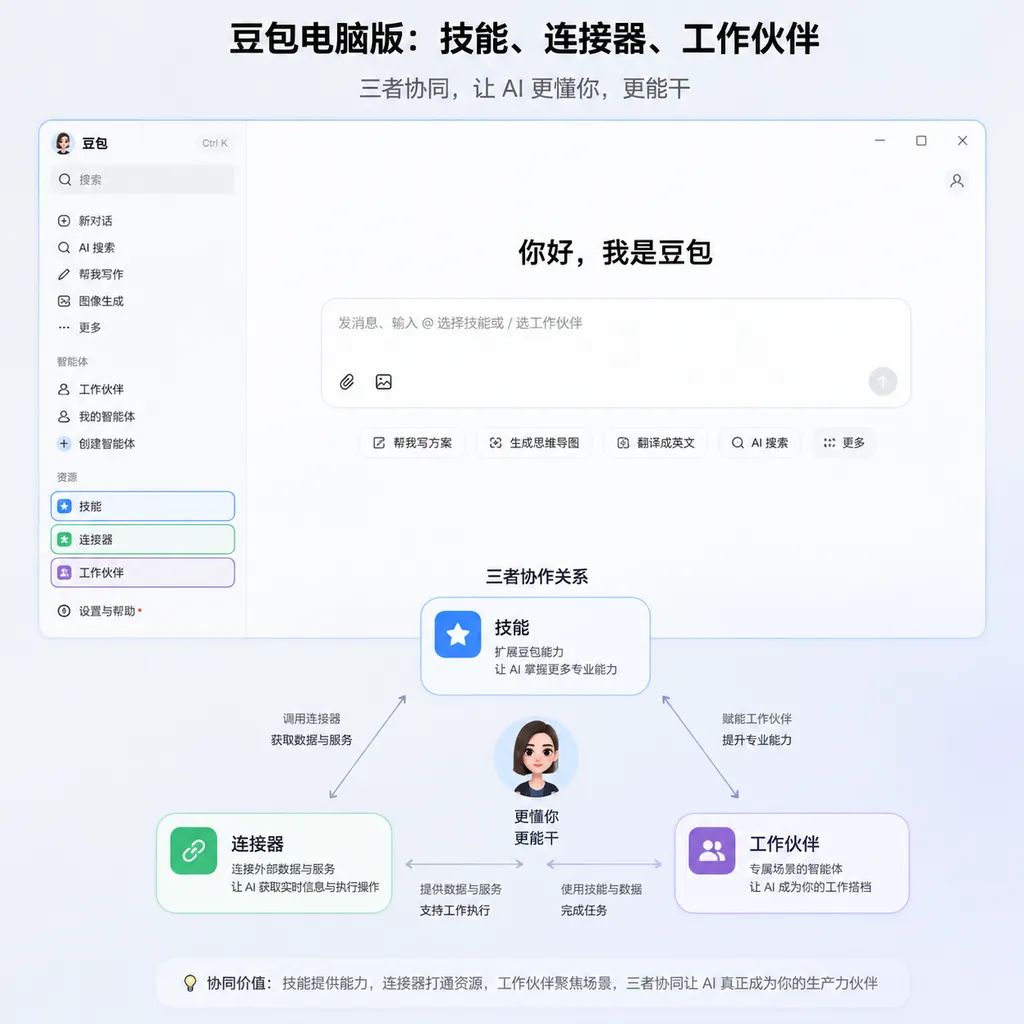
On August 21, Doubao continued updating its “Work Tasks” mode, officially launching “Skills · Connectors · Work Partners / Squads.” After entering the corresponding section in the sidebar of the desktop version of Doubao, users can access more than 200 skills and connectors, create their own skills through conversation, and then select Agents with different areas of expertise to complete tasks together.
The focus of this update is not simply to add a few more buttons for generating PowerPoint presentations or organizing spreadsheets. Rather, Doubao is attempting to fill in the three most critical layers of capabilities for office Agents: encapsulating work methods as skills, connecting external systems through connectors, and enabling multiple Agents to divide work and collaborate.
If ordinary chatbots are responsible only for “thinking,” while office Agents have previously begun trying to “take action,” then what Doubao wants to do this time is enable Agents to find the right tools, access the context of a task, and deliver results according to a repeatable process.
The direction is sound, and it is closer to real-world productivity than simply improving model benchmark scores. But more than 200 entry points only indicate the size of the product shelf. What will truly determine the user experience is still the success rate of tool calls, permission controls, and whether the Agent can remain clear-headed by the time a task reaches its tenth step.
Three New Modules, Each Addressing a Different Long-Standing Problem
The capabilities launched by Doubao this time have been divided into skills, connectors, and work partners. They can be used independently or combined within the same task.
Skills: Helping Agents Remember “This Is How We Always Do It at the Company”
Skills can be understood as reusable standard operating procedures. Users can organize frequently used steps, delivery standards, reference templates, and other information so they do not have to rewrite the same prompt every time.
For example, a marketing professional may need to produce a weekly competitor report. The complete process could include:
- Collecting product and operational updates from designated companies;
- Categorizing them by product, market, financing, recruitment, and other dimensions;
- Removing duplicate information and marking the source and publication date;
- Comparing the content with the previous week’s report;
- Producing summaries, assessments, and action items according to the department’s fixed template.
In the past, these requirements were typically crammed into a very long prompt or scattered across chat histories, document templates, and employee experience. Doubao’s skills feature essentially encapsulates this tacit knowledge into a process that can be repeatedly invoked.
More noteworthy is that users can create skills directly through conversations with Doubao. This lowers the barrier to building workflows: users describe “what to do first, what to do next, and what conditions the result must meet,” while the system organizes the natural-language description into an executable configuration.
However, a skill is not the same as a deterministic program. Given the same input, a traditional script generally produces predictable output; in an Agent skill, many steps still depend on the model’s judgment. Saving a process only means that the “framework for doing things” is relatively fixed—it does not mean the results will be identical every time. Therefore, high-risk tasks such as financial reconciliation, contract review, and external publishing still require clearly defined checkpoints.
Connectors: No Longer Relying on Users to Copy and Paste Context
Connectors address the problem of information silos. After connecting commonly used office software and information-retrieval platforms, Doubao can directly search for information, organize content, or advance tasks within the corresponding tools. Users no longer need to repeatedly download files, copy webpages, and then stuff the materials into a chat box.
This is the clearest dividing line between office Agents and ordinary chat products.
A model that has no access to internal company materials can provide only generic advice, no matter how strong its reasoning abilities are. An Agent connected to a knowledge base, project system, and document platform, however, may be able to answer questions such as “Why didn’t this customer renew last time?” or “Which blocking issues remain in the current version?”
The value of connectors can be summarized in three points:
- Reducing manual transfer: Eliminating the mechanical work of searching, copying, and consolidating content across multiple applications;
- Adding context: Giving the Agent real-time materials relevant to the current task, rather than relying solely on the model’s training data;
- Creating a closed action loop: When permissions allow, the Agent may not only read information but also write to documents, update tasks, or generate deliverables.
But connectors are also where risks are most concentrated. Reading a public webpage and reading an internal company contract clearly should not use the same authorization logic. Searching documents and modifying documents should not share the same permissions either. A mature office Agent should at least distinguish between read-only, write, delete, and external-send operations, and require human confirmation before high-risk actions.
Doubao has announced the number of connectors and how they are used, but enterprise users should be asking several more specific questions: Do authorizations follow the principle of least privilege? How are credentials stored? Can invocation records be audited? Are authorizations automatically revoked when an employee leaves? How long are intermediate files generated by the Agent retained?
These questions are not particularly eye-catching, but they will determine whether enterprises dare to use the product far more than “how many connectors are supported.”
Work Partners: Multi-Agent Systems Are More Than Just Opening Several Chat Windows
“Work Partners / Squads” allows users to select Agents with different areas of expertise according to the task. These Agents can jointly analyze problems, break down steps, and collaborate on deliverables.
Ideally, a complex task can be divided among multiple roles: a research Agent collects materials, a data Agent cleans and calculates data, a writing Agent organizes the report, and a review Agent checks facts, formatting, and omissions. The primary Agent acts like a project manager, assigning tasks, consolidating results, and deciding whether rework is necessary.
This design is more consistent with how real organizations work than having a single model handle everything from beginning to end. It may also reduce interference caused by excessively long contexts. For example, the Agent responsible for data processing does not need to carry the requirements for writing the entire report, while the reviewing Agent does not need to repeat all the preceding steps.
The problem is that multiple Agents do not automatically improve quality.
Every additional division of labor introduces another context transfer; every additional tool call increases latency, reasoning costs, and potential failure points. If role boundaries are unclear, several Agents may repeat the same searches or produce conflicting conclusions. The final aggregation Agent may then package those errors into a polished-looking finished product.
Therefore, whether “Work Partners” are useful should not be judged by how many roles can be selected in the interface. Instead, it should be judged by three factors:
- Whether subtasks can be accurately divided and assigned clear completion criteria;
- Whether the information passed between Agents consists of structured results or a large block of unorganized dialogue;
- Whether the system can retry, degrade gracefully, or hand the task back to the user when an Agent fails.
More Than 200 Capabilities Are Not the End; the Product Lies in Combining Them
Doubao officially says that it currently offers more than 200 skills and connectors. This number is enough to form an initial tool shelf, but it does not directly equal 200 stable and usable productivity capabilities.
Having many connectors does not mean that the enterprise systems users actually need have been connected. Having many skills does not mean that they are suitable for a company’s specific processes. Office scenarios are highly fragmented. Even when the task is nominally the same—“produce a weekly report”—sales, R&D, investment research, and e-commerce teams may require completely different fields, data sources, and acceptance criteria.
Doubao’s support for user-created skills is essentially an acknowledgment of reality: a general-purpose product cannot predefine every company’s way of working. The platform provides the model, tools, and orchestration capabilities, while users inject their own business experience.
This also means that Doubao is shifting from an AI assistant that provides standard functions toward a lightweight workflow platform. Its competitors are no longer just other chatbots. They also include desktop office Agents such as Tencent WorkBuddy, as well as automation systems built internally by enterprises.
Compared with Agent frameworks familiar to developers, Doubao’s advantage is its low installation and configuration barrier. Ordinary users do not need to deal with model keys, tool protocols, runtime environments, or dependency conflicts; they can create skills through natural language. Its weakness is equally apparent: the more deeply the platform abstracts away the underlying details, the less visibility users generally have into model selection, execution paths, error handling, and cost control.
For individual users, “open it and use it” may be more important than observability. For enterprise developers, however, invocation logs, permission boundaries, and failure recovery are often more important than whether the interface is friendly. This is a hurdle that consumer-grade Agents must clear as they move into enterprise production.
Doubao Is Filling in Its Previously Weakest Layer
In June this year, the professional version of Doubao added Agent execution capabilities such as local computer control, browser calls, Skills, and scheduled tasks, while establishing a paid system around office tasks. This update further places skills, connectors, and multi-Agent collaboration within a unified entry point—effectively supplementing the previous execution capabilities with a tool directory and collaborative orchestration.
Judging from its product cadence, Doubao clearly does not want to be merely a chat entry point with a large user base. It hopes to bring tasks that users previously scattered across browsers, documents, spreadsheets, and local files into its “Work Tasks” mode.
This approach aligns with the core of the current competition among office Agents: model capabilities are rapidly converging, and what truly creates differentiation is the Harness beyond the model—that is, the tool calling, permission management, context organization, execution environment, and result-verification mechanisms built around the model.
Developers can think of it this way: the large model is the CPU, skills and connectors are more like drivers and peripherals, and multi-Agent orchestration is the task scheduler. A machine with only a CPU and no drivers cannot actually process work; peripherals may be connected in abundance, but if their drivers are unstable, errors will still occur frequently.
At present, external evaluations of Doubao’s office tasks are not entirely consistent. Some user experiences suggest that it has handled skill creation, screenshot-based questions, office suites, and low-barrier usage carefully. Other tests have found that local software identification, computer operation, and complex task execution can still fail. There is no contradiction between these observations: the product design is moving in the right direction, but the stability of the underlying execution has not yet fully caught up.
The Real Test Is Long-Task Stability
When demonstrating an office Agent, the easiest thing to show is a smooth path: enter a request, have the Agent search for information and call tools, then output a document. Real work is rarely this clean.
A webpage may require a login, spreadsheet fields may change, internal documents may be inaccessible, local software may open pop-up windows, and search results may conflict with one another. The longer the task, the more the probability of an error accumulating at some step.
If a task has 10 critical steps and each step has a 95% success rate, the theoretical probability of completing all of them successfully on the first attempt is only about 60%. This is why office Agents often seem intelligent on short tasks but, once they begin operating across applications and files, resemble capable yet unreliable interns.
Doubao’s skills can standardize processes, connectors can reduce manual transfers, and work partners can divide tasks. All three help alleviate the long-task problem, but none can eliminate it. What deserves closer observation next is not whether the total number of skills will increase from 200 to 500, but whether Doubao can provide more robust execution safeguards:
- Does each step display its inputs, outputs, and basis for the call?
- After a tool call fails, can the system resume from a checkpoint instead of rerunning the entire task?
- Do high-risk operations such as external sending and file deletion require mandatory confirmation?
- When multiple Agents reach conflicting conclusions, does the system explicitly alert the user?
- Can users set budgets, runtimes, and maximum numbers of calls?
- Can enterprise administrators centrally configure permissions, auditing, and data-retention policies?
These capabilities may seem less intuitive than “200+ skills,” but they determine whether an Agent can evolve from a tool for individual experimentation into team infrastructure.
A More Practical Approach: First Have the Agent Handle Checkable Intermediate Steps
At this stage, it is not realistic to hand over an entire core business process to an office Agent. A more reliable approach is to start with tasks that have clear boundaries, checkable results, and recoverable failures.
Scenarios that are suitable for prioritizing with Doubao’s Work Tasks include:
- Collecting materials from multiple public information sources and generating a first draft in a fixed format;
- Organizing meeting minutes into conclusions, responsible people, and deadlines;
- Batch-processing documents, spreadsheets, or images according to a template;
- Checking existing reports for structure, formatting, and missing items;
- Generating weekly reports, project summaries, and competitor briefs according to team guidelines.
Scenarios requiring cautious authorization include financial payments, bulk deletion, contract confirmation, official external publication, and directly modifying data in critical production systems. For such tasks, the Agent can prepare materials and offer recommendations, but human approval should preferably remain in place for the final step.
Assessment: The Direction Is Correct; Success Will Not Depend on the Number of Skills
The significance of Doubao’s latest update lies in combining skills, connectors, and specialized Agents—previously scattered functions—into a more complete framework for office tasks. For ordinary users unfamiliar with Agent development, creating skills through conversation and directly connecting office tools is indeed easier to put into practice than configuring models and workflows themselves.
This is also Doubao’s most practical advantage over developer tools: it does not require users to become Agent engineers before they are qualified to use an Agent.
From the perspective of developers and enterprise users, however, more than 200 skills and connectors are merely an entry ticket. What will truly determine competitiveness next is whether tool calls are reliable, permissions are controllable, processes are auditable, long tasks can recover, and multi-Agent collaboration can improve quality rather than inflate costs.
Doubao has moved beyond “being able to chat” to “being able to call tools and work in teams.” In the next stage, it needs to prove not how many different actions an Agent can perform, but whether those actions can be completed reliably on real computers, with real data, and under the constraints of real organizations.
If this layer can be reinforced, Doubao’s client entry point and low barrier to use could help bring office Agents to a broader audience. If stability and permission mechanisms continue to lag behind, however, its more than 200 skills may ultimately amount to nothing more than a tool kit that looks rich but in practice requires users to keep taking over.
Sources
- ITHome: Doubao Adds “Skills · Connectors · Work Partners” to Work Tasks — Product update information from Doubao on August 21, including more than 200 skills and connectors, user-created skills, and work partner functionality.
- Zhihu Column: Experience with Doubao Professional’s Office Task Mode — An introduction to the task decomposition, tool calling, and deliverable-generation logic of Doubao’s office Agent.