Ox Alpha is free for a limited time and already outperforms Claude on benchmarks.
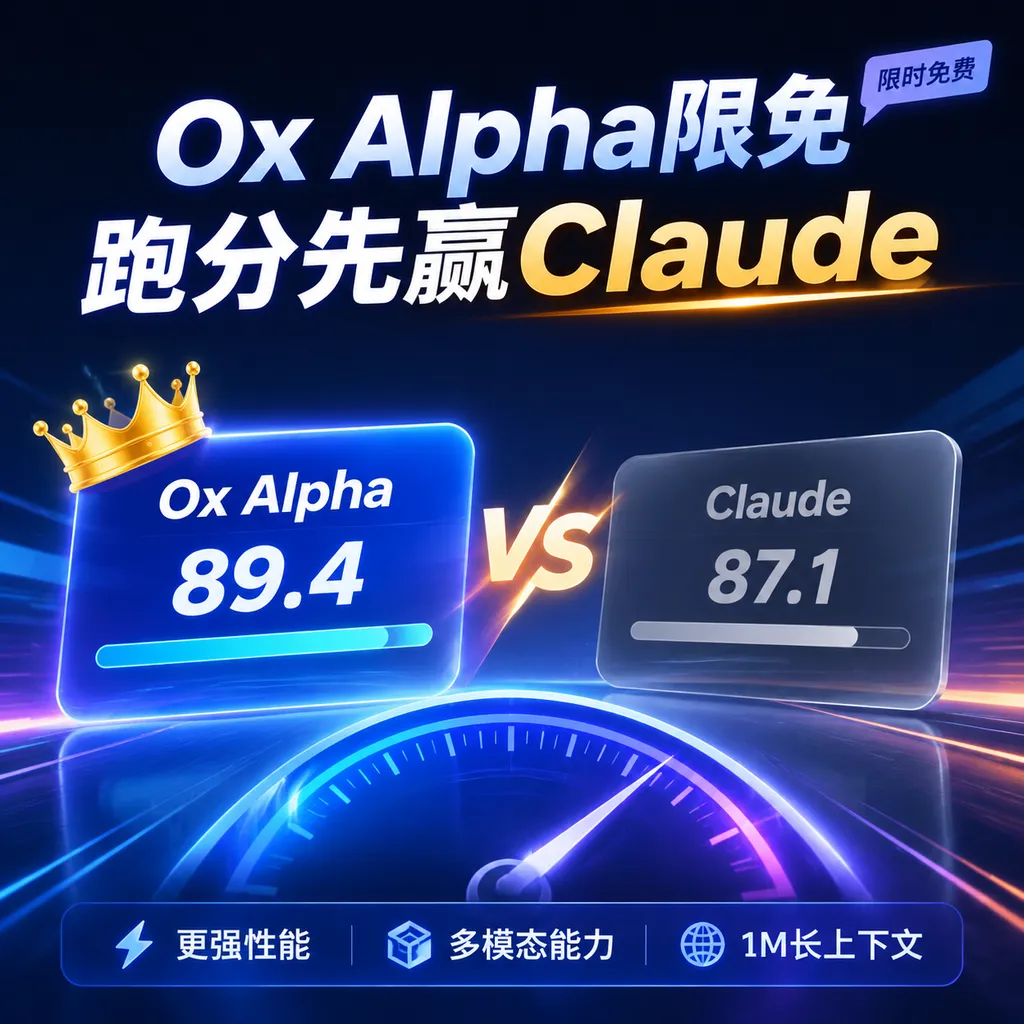
The anonymous model Ox Alpha is now available on OpenRouter for a one-week free preview and is said to have scored 80% across 10 DeepSWE tests. However, given the small sample size and its undisclosed identity, it is currently better suited for stress testing than for direct deployment in production.
Anonymous Model Suddenly Goes Live, Free for One Week
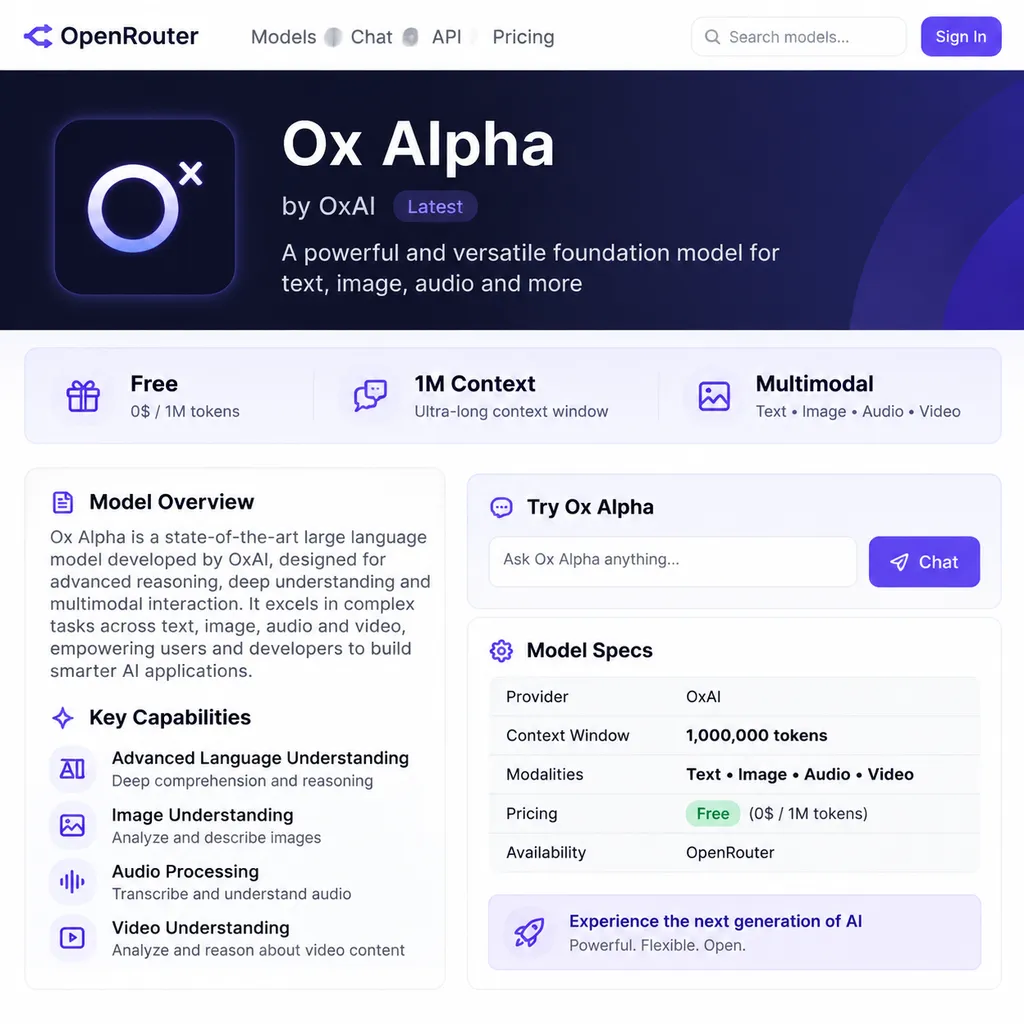
OpenRouter recently launched a new model whose developer identity has not been disclosed: Ox Alpha, fully identified as stealth/ox-alpha. The model entered preview on August 20 and is scheduled to be available free of charge for approximately one week, with the window expected to last until around August 27.
What has drawn attention is not just the fact that it is free.
Developer Ben Davis tested it using 10 real-world software engineering tasks from DeepSWE. Ox Alpha allegedly achieved an average pass rate of 80%, higher than Claude Fable 5 at 65%, GLM-5.3 and Grok 4.6 at 62%, and GPT-5.6 Sol at 52%.
More interestingly, this model—which currently has no disclosed brand, technical report, or formal launch event—is being “reverse-identified” by the community through its tokenizer, video encoder, and API response characteristics. Existing clues broadly point to Zhipu, but as of August 22, Zhipu had not publicly claimed the model, and OpenRouter had not disclosed the model provider behind it.
So, for now, only two things can be confirmed: it is indeed available for free use, and its early programming test results are indeed impressive. As for who it is and whether it has truly reached the level of leading closed-source models, there is still no definitive answer.
80% vs. 65%: How Should We Interpret This Result?
The most widely circulated results so far come from DeepSWE. This test does not ask a model to complete a function or solve an algorithm problem. Instead, it places the model inside a real codebase and asks it to inspect the project, locate issues, modify the code, and pass the existing regression tests.
It can be understood as a scaled-down online bug-fixing exercise: the model must not only know how to write code, but also understand the repository structure, dependencies, and testing constraints, ultimately delivering a patch that does not merely break one part of the system while fixing another. Compared with single-file code-generation tests such as HumanEval, this is closer to the actual working environment of coding agents such as Claude Code and OpenCode.
The publicly released results are as follows:
| Model | Average score on 10 DeepSWE tasks | | --- | ---: | | Ox Alpha | 80% | | Claude Fable 5 | 65% | | GLM-5.3 | 62% | | Grok 4.6 | 62% | | GPT-5.6 Sol | 52% |
Judging from the table alone, Ox Alpha did not merely edge ahead; it exceeded Claude Fable 5 by 15 percentage points. Subsequent retesting by community testers produced results of four passes, four near-passes, and two clear failures, broadly consistent with an 8-out-of-10 result.
However, this is still insufficient to conclude that “Ox Alpha comprehensively surpasses Claude.” The reason is straightforward: the sample contains only 10 tasks.
Ten tasks are suitable for discovering that a model “may be very strong,” but not for precisely determining the stable gap between models. Passing or failing just one additional task would change the score by 10 percentage points. The final results may also be affected by each model’s invocation parameters, reasoning budget, agent scaffolding, number of retries, and tool errors.
More importantly, OpenRouter has not yet provided formal results from larger-scale benchmarks such as SWE-bench Verified or Terminal-Bench. The DeepSWE test can demonstrate that Ox Alpha performs exceptionally well on several real-world coding tasks, but it is not enough to prove that the model has consistently entered the top tier occupied by flagship GPT, Claude, and Gemini models.
Our assessment is: 80% deserves serious attention, but it is not yet something to base a procurement decision on. It is more like a powerful trailer than a complete evaluation.
The Specifications Are Indeed Impressive: 1M Context, 130,000 Output Tokens, and Multimodality
Ox Alpha’s currently disclosed specifications are quite aggressive:
- A context window of 1,048,576 tokens;
- A maximum output of 131,072 tokens per request;
- Support for text, image, and video inputs;
- Designed for reasoning, programming, and agent workflows;
- Both input and output are free during the preview period;
- OpenCode claims to have prepared processing capacity for 100 trillion tokens per day.
A 1M context window is not simply a matter of extending the chat history. For coding agents, it theoretically means the model can receive a larger codebase, more logs, test outputs, and terminal history in a single request, without aggressively compressing the context after every execution cycle.
The maximum output of 130,000 tokens is equally noteworthy, but that does not mean developers should actually ask the model to produce tens of thousands of tokens at once. Extremely long outputs increase the risks of going off track, repetition, and inaccurate tool-state tracking. Their real value lies in giving long-running agents a higher ceiling—for example, when generating cross-file patches, continuously explaining execution traces, or handling complex tasks that combine documents, screenshots, and video clips.
Recent data on the OpenRouter page also shows that Ox Alpha has a median time to first token of approximately 1.95 seconds, an output speed of around 49 tokens per second, and an availability rate close to 100% in recent days. These figures look good, but the model has been online for too short a time, and neither the sample size nor traffic distribution is transparent. Once the free period draws in a surge of traffic, latency, rate limits, and interruptions are likely to continue fluctuating. Some users have already reported execution interruptions in OpenCode.
Therefore, the “1M” and “free” labels in the specification sheet can serve as reasons to test the model, but not as an SLA.
Why Everyone Is Pointing to Zhipu
The most interesting aspect of an anonymous model is that the community does not need the model provider to speak up in order to trace its model family from interface behavior.
Researchers conducted tokenizer fingerprint analysis using 25 groups of prompts. A tokenizer fingerprint can be understood as a model’s “word-segmentation habit” on the input side: given the same sentence, different model families may split it into different numbers and granularities of tokens. By preparing a set of prompts containing Chinese and English, special symbols, code, and rare characters, researchers can observe whether the token statistics of an anonymous API are close to those of known models.
The tests found that Ox Alpha’s token counts for these prompts almost completely matched those of GLM-5.3, with the main difference being a roughly constant offset of about 75 tokens. This fixed difference looks more like a system prompt or message template automatically added by the outer API layer than a difference in the underlying tokenizer.
In addition to the tokenizer, other clues include:
- Similar video encoder behavior. When processing video inputs, Ox Alpha’s token changes and limitations resemble those seen in Zhipu’s model architecture.
- Similar API response characteristics. Its returned fields, reasoning behavior, and certain error patterns bear traces of the GLM family.
- Similar output style. Some analyses suggest that Ox Alpha’s frequency of emoji use in text is closer to GLM and Qwen, differing from the output habits of Claude, GPT, and Grok.
- Concentrated results from elimination. Candidates such as Xiaomi MiMo, DeepSeek, Gemini, Qwen, Grok, GPT, and Claude all show varying degrees of mismatch in tokenizer behavior, video capabilities, or interface performance.
This evidence makes the probability of Ox Alpha being a model from the “Zhipu family” quite high, but it still does not constitute official confirmation. The outer API layer can rewrite prompts and wrap returned results, and service providers can deliberately imitate certain behaviors. Output style is even easier to adjust through system prompts.
In other words, the community currently has a fairly consistent set of technical corroborating clues, not a model identity card. It is still too early to directly describe Ox Alpha as Zhipu’s new model.
Free Access Is Not a Benefit; It Looks More Like a Public Stress Test
OpenCode has publicly claimed that it has prepared capacity for 100 trillion tokens per day for Ox Alpha. This figure clearly does not look like an ordinary trial offer. It looks more like an invitation for developers around the world to place the model into real agent workflows and push it to its limits.
A model performing well on internal benchmarks does not mean it will continue to work reliably after being introduced into real projects. Developers will give it messy repositories, outdated dependencies, incomplete documentation, conflicting tests, and terminal tasks that run for hours. It must handle tool timeouts, context growth, failed commands, and permission restrictions—problems that are difficult to cover with a laboratory-designed test set.
Anonymity combined with free access creates an efficient mechanism:
- Anonymous release reduces brand exposure; model failures will not directly damage the reputation of an established product;
- Free quotas quickly attract coding agents and long-context workloads;
- Real development tasks expose problems in tool use, context management, and patch quality;
- The provider can use the results to optimize routing, system prompts, reasoning budgets, and service capacity;
- After testing ends, the provider can officially claim, price, or launch the model.
Developers receive free compute, while the model team obtains a more complex task distribution than it could through a closed beta. The so-called “free trial” is essentially an exchange: users do not pay for API calls, but they contribute pressure-test data and failure cases through real workloads.
This is also why Ox Alpha is currently best suited for evaluation rather than quietly replacing a production model. An anonymous provider means developers do not know whether the model will be switched to another version, how it will be priced after the free period, or whether the service provider will suddenly tighten rate limits.
Worth Testing, but Do Not Hand It Production Control
If a team has a model evaluation plan this week, Ox Alpha is worth adding to the candidate set, particularly for the following scenarios:
- Issue localization and patch generation in large codebases;
- Refactoring tasks spanning multiple modules;
- Multimodal debugging involving screenshots, UI recordings, or architecture diagrams;
- Long-running terminal-based coding agents;
- Side-by-side comparisons with Claude, GPT, Grok, and GLM on the same tasks.
During testing, do not look only at whether a task “eventually passed.” At a minimum, also record:
- First-patch pass rate and pass rate after retries;
- The number of regressions caused by newly added code;
- Tool-call failure and interruption rates;
- Actual input and output token consumption;
- Instruction-following performance in the latter half of long-context tasks;
- Result variance across multiple runs of the same task;
- Estimated costs and migration costs after the free period ends.
In production, teams should continue to maintain a model abstraction layer and fallback mechanisms. Do not hard-code Ox Alpha’s specific output formats, prompt habits, or oversized context window into business logic. The most realistic risk of an anonymous model is not that it is “not capable enough,” but that you cannot be sure the model you call tomorrow will still be the same version.
For developers in China, OpenRouter’s free window is suitable for quickly getting a sense of the model. If the model is formally released later and becomes available on more aggregation platforms, there will still be time to compare its price, latency, and stability. The value of OpenAI-compatible aggregation services such as OpenAI Hub lies precisely in reducing the cost of switching models, not in requiring teams to place an early bet on a particular anonymous provider.
A Valuable Preview, but the Verdict Is Still Premature
Ox Alpha is one of the few recent models to maximize “specifications, benchmark scores, and mystery” all at once: a 1M context window, text, image, and video inputs, a maximum output of 130,000 tokens, and one week of free access. These features naturally make it suitable for entering the testing queues of various coding agents.
The 80% score on DeepSWE suggests that it is likely not merely an ordinary mid-sized model in disguise. At least on some codebase-level tasks, it has already demonstrated frontier-level capabilities. The evidence from the tokenizer and video encoder also genuinely concentrates the identity clues around Zhipu.
However, until larger-scale, reproducible evaluations emerge, saying that it “crushes Claude” remains an overstatement. Ten tasks can produce a striking leaderboard, but they cannot cover a model’s reasoning stability, tool use, frontend development, multilingual coding, safety boundaries, and long-running agent performance.
The most reasonable attitude at this stage is simple: test it freely during the free period, but do not bet production on it yet.
What is truly worth watching next is not how many more identity clues the community can uncover, but three more practical questions: who will ultimately claim the model, how it will be priced after the free period, and whether large-sample coding benchmarks can reproduce the 80% result. If it passes all three tests, Ox Alpha will be more than an anonymous-model marketing exercise; it could become the next model to genuinely enter mainstream developer toolchains.
References
- ITHome: Mysterious Ox Alpha AI Model Goes Live with Free Access—Summarizes the model’s specifications, early DeepSWE results, and technical clues pointing to Zhipu.
- Zhihu: Mysterious AI Model’s Programming Test Surpasses GPT-5.6 and Claude—Provides additional analysis of the tokenizer, video encoder, output style, and free testing period.