
Tencent Hunyuan World Model 2.0: From Generating Videos to Directly Creating Games
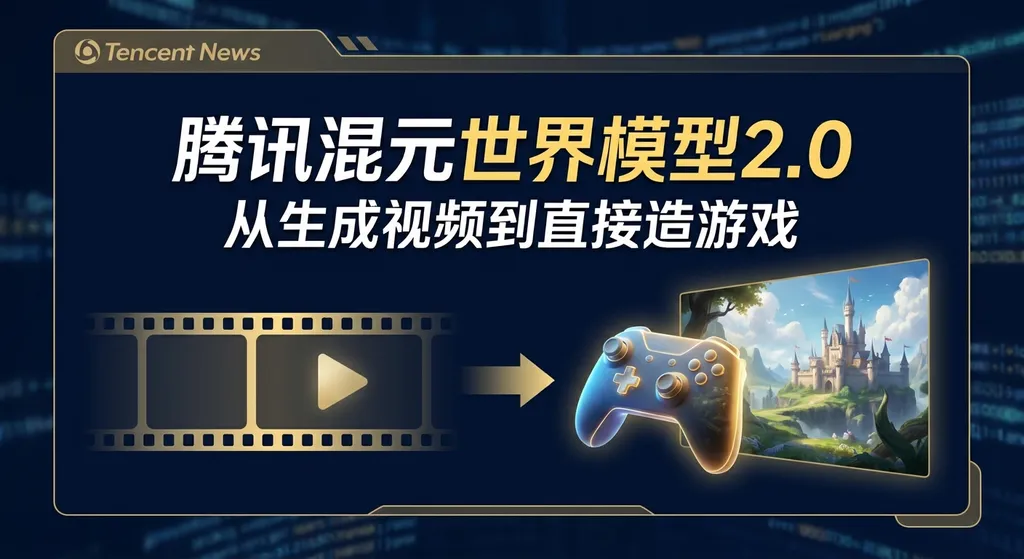
Tencent Hunyuan HY-World 2.0 Open Source Release: Supports text/image/video multimodal input to directly generate editable 3D world assets, capable of exporting in Mesh/3DGS/point cloud formats for seamless integration with Unity/UE engines, enabling AI to evolve from “drawing pictures” to “creating worlds.”
Tencent Hunyuan World Model 2.0: From Generating Videos to Creating Games
Today (April 16), Tencent open-sourced the Hunyuan 3D World Model 2.0 (HY-World 2.0). The core advancement of this upgrade is that AI no longer just generates video files—it now directly outputs editable 3D assets.
What does that mean? When you input a sentence or an image, the model doesn’t output a demo video—it produces a 3D scene file that can be directly imported into Unity or Unreal Engine, including full assets such as meshes, 3D Gaussian Splatting (3DGS) point clouds, depth maps, and normal maps. Game developers can immediately modify these and use them to quickly prototype maps or level frameworks.
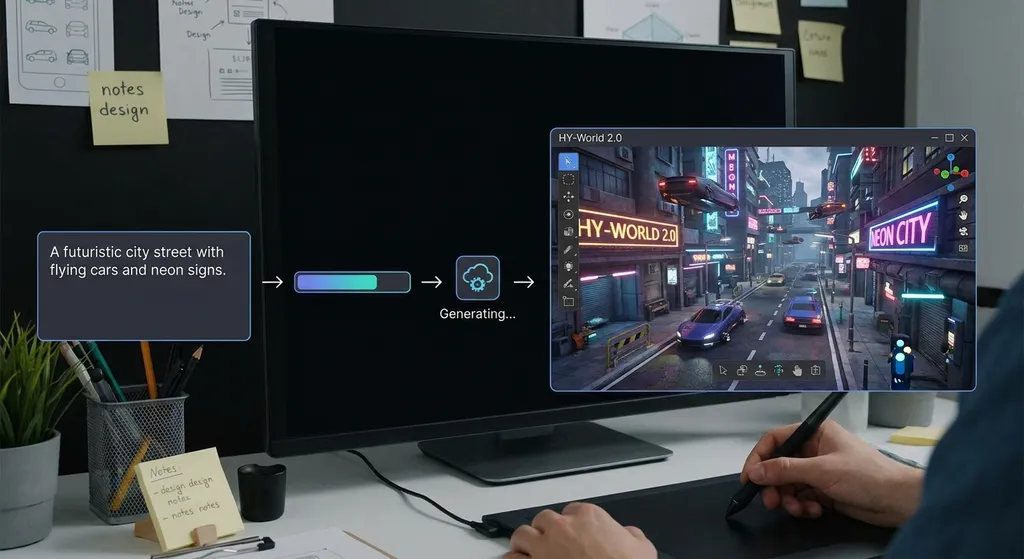
The Essential Difference from Genie 3
Google’s Genie 3 and Tencent’s own Hunyuan World Model 1.5 both generate video files—you get a rendered sequence of frames. Want to change scene layouts or object materials? Not possible; you’d have to regenerate everything.
HY-World 2.0, in contrast, outputs structured 3D data. For example:
- Genie 3: Generates a “cyberpunk street” video with fixed resolution, camera angle, and lighting.
- HY-World 2.0: Generates a 3D scene file containing building models, ground meshes, and lighting configurations; you can adjust building heights, change materials, and relight the scene within an engine.
This isn’t “better video generation”—it represents a generational shift in workflow. The former is a demo tool; the latter is a production tool.
Multimodal Input, Unified 3D Output
HY-World 2.0 supports three input methods:
1. Text-to-World Generation
Input a written description, and the model interprets the semantics to generate a corresponding 3D scene. The official demo shows you can specify styles—realistic, comic, or game-like—which means there’s an underlying style control module, not just a simple text-to-image-to-3D pipeline.
2. Single or Multiple Image Generation
Upload a reference image (such as a concept art sketch), and the model will infer a complete 3D space. Providing multiple viewpoints improves reconstruction accuracy. This uses the upgraded WorldMirror 2.0 architecture, which predicts:
- Dense point clouds (for geometry reconstruction)
- Multi-view depth maps (for spatial relationships)
- Surface normals (for lighting calculation)
- Camera parameters (for viewpoint calibration)
3. Video-to-World Reconstruction
Record a short indoor clip or a street video, and the model can reconstruct a digital twin. This capability has direct applications in interior design, urban planning, and cultural heritage digitization—no professional LiDAR scanners are required; a simple mobile video can yield a high-fidelity 3D model.
Technical Architecture: A 3D-Centric Unified Framework
Traditional “world models” are actually “video generation models” in disguise—they perform temporal prediction in pixel space. HY-World 2.0’s architecture follows a different logic:
- Input Processing: A multimodal encoder maps text/images/video into a unified semantic space
- 3D Understanding: A spatial reasoning module infers geometric structures, physical relationships, and occlusions
- Hybrid Representation Generation: Simultaneously outputs 3DGS (for high-fidelity rendering) and Mesh (for editable geometry)
- Multi-format Export: Supports point clouds, meshes, and voxels to match different engine requirements
The key here is “3D as the main axis”—it models directly in 3D space instead of generating 2D images first and then converting them. This approach offers:
- Geometric consistency: No distortions or missing surfaces when rotating views
- Physical interactivity: The scene includes real collision volumes, allowing physical interaction with characters
- Editability: Mesh format naturally supports vertex editing, UV unwrapping, and material replacement
Character Mode: Not Just Watching—You Can Play
HY-World 2.0 supports a “character mode”—you can control a character to move freely in the generated world, with physical collisions and no time limits.
This may sound like a game, but the technology works differently. Traditional game engines use prebuilt maps, while here, an AI maintains a “world state” in real time. As the character moves, surrounding regions dynamically load or generate—similar to Minecraft’s chunk loading, but driven by neural network logic.
This is very useful for level prototyping. Designers can test gameplay logic immediately by generating a scene from a description and running through it in character mode to verify pacing and flow—even before artists build assets.
Comparing World Models: Practical Usability Is the Divide
Current mainstream world models fall into two categories:
Video-Generation Models
- Google Genie 3: Input text or images to generate interactive videos
- Hunyuan World Model 1.5: Similar capability but with higher video quality
- Limitation: Output is a video file—non-editable and not engine-importable
3D-Asset Generation Models
- HY-World 2.0: Outputs editable 3D assets
- Advantages: Integrates directly into production workflows; supports physical interactivity
- Tradeoff: Much higher technical complexity—requires simultaneous handling of geometry, texture, and lighting
According to Tencent’s comparison benchmarks, HY-World 2.0 performs better in “scene completeness” and “input fidelity.” Scene completeness means objects’ sides and backs are correctly generated—video-based models often break when the camera rotates. Input fidelity measures how closely the generated scene matches the reference input, relying on multimodal alignment precision.
Open-Source Strategy: Model Weights + Inference Code
Tencent has fully open-sourced both model weights and inference code. Developers can deploy locally or call via API.
Quick test example via OpenAI Hub (if integrated):
import openai

# Configure OpenAI Hub
openai.api_base = "https://openai-hub.com/v1"
openai.api_key = "your-api-key"

# Use HY-World 2.0 to generate a 3D scene
response = openai.ChatCompletion.create(
    model="hunyuan-world-2.0",
    messages=[
        {
            "role": "user",
            "content": "Generate a cyberpunk street scene with neon signs and wet pavement"
        }
    ],
    # Specify output formats
    response_format={"type": "3d_asset", "formats": ["mesh", "3dgs"]}
)

# Download generated 3D assets
asset_url = response.choices[0].message.content
print(f"3D asset download link: {asset_url}")
To generate from an image:
response = openai.ChatCompletion.create(
    model="hunyuan-world-2.0",
    messages=[
        {
            "role": "user",
            "content": [
                {"type": "text", "text": "Generate a complete 3D scene based on this image"},
                {"type": "image_url", "image_url": {"url": "https://example.com/reference.jpg"}}
            ]
        }
    ],
    response_format={"type": "3d_asset", "formats": ["mesh", "point_cloud"]}
)
Application Scenarios: Beyond Gaming
Although Tencent emphasizes gaming, HY-World 2.0’s potential extends far beyond it:
Game Development
- Quickly generate map prototypes and test level designs
- Auto-generate background scenes to reduce art costs
- Dynamically generate content based on player behavior (an upgrade to procedural generation)
Film and Production
- Virtual scene previews replacing traditional storyboards
- Rapid setup of virtual shooting environments
- Automated expansion of digital asset libraries
Architecture and Design
- 3D visualization of interior design schemes
- Rapid iteration of building exteriors
- Digital twins for urban planning
Education and Training
- 3D reconstruction of historical scenes
- Virtual lab environments
- Immersive scenes for safety training
Metaverse and Social
- User-customized virtual spaces
- Dynamic generation of social environments
- Quick setup for virtual events
Technical Challenges: From “Usable” to “Useful”
Although HY-World 2.0 achieves technical breakthroughs, several issues remain before large-scale commercialization:
1. Generation Stability
3D asset quality can vary considerably across runs. For professional contexts (e.g., architecture), inconsistent outputs are problematic.
2. Fine-Grained Control
Current text/image inputs offer limited control over details. Precisely defining an object’s size, placement, or material using natural language is difficult. This might require structured parameter inputs or interactive editing UIs.
3. Asset Optimization
AI-generated 3D models often have excessive polygons or messy topology, making them unsuitable for real-time rendering. Additional optimization (decimation, retopology, texture baking) is still needed—currently human-assisted.
4. Physical Accuracy
While the generated scenes include collision volumes, physical properties (mass, friction, elasticity) are estimates and may not match true physics. That limits use in high-precision simulations (e.g., engineering).
Industry Impact: A Paradigm Shift in Production Tools
The significance of HY-World 2.0 isn’t just that “AI can do something new,” but that it transforms the content production workflow.
Traditional 3D creation is linear: concept → modeling → texturing → lighting → rendering. Each phase requires specialists—long cycles and high costs.
AI world models compress this into: describe the requirement → generate a draft → make manual adjustments. The higher the initial quality, the less work remains for artists. Once AI output passes the “usable” threshold, industry productivity can rise by an order of magnitude.
This especially empowers small teams and indie developers. Previously, 3D game art was a major barrier; now one programmer and one designer can produce a playable prototype using AI tools. Though not AAA-level quality, it’s sufficient for indie games, educational uses, and enterprise training.
Synergy with Other AI Capabilities
HY-World 2.0 isn’t an isolated tool—it can integrate with other AI systems:
- + Large Language Models: Use an LLM to generate storylines and level descriptions, then world models to create corresponding scenes
- + Character Generation Models: World model builds the environment, character models populate NPCs—forming complete worlds
- + Motion Generation Models: AI characters plan movements dynamically within generated scenes
- + Physics Engines: Import 3D assets for realistic mechanical simulation
Such modular AI composition enables a new development paradigm: rather than hand-coding and modeling from scratch, developers can “build with AI building blocks,” rapidly testing ideas.
Strategic Intent Behind Open Sourcing
Tencent’s full open-sourcing of HY-World 2.0 reflects several intentions:
1. Establishing Technical Standards
World model technology remains early-stage without unified benchmarks. Open sourcing invites collaboration and drives standard formation. Whoever’s standard gains traction holds influence.
2. Ecosystem Building
3D content production spans modeling tools, game engines, and renderers. Open sourcing allows plugin and integration development, fostering a complete toolchain.
3. Data Flywheel
Open models generate widespread use; usage data (outputs, feedback, edits) continuously improve the model. A virtuous cycle emerges: better model → more users → more data → better model.
4. Commercial Pathways
The open model itself isn’t monetized directly but enables revenue via cloud services, enterprise editions, or technical support—a proven open-source business pattern seen in Linux and Kubernetes.
Future Direction: From Static Worlds to Dynamic Worlds
Current world models produce “static snapshots”—scenes remain unchanged over time.
Next-generation models must support “dynamic evolution”:
- Time dimension: Worlds evolve (day-night cycles, seasonal shifts, weathering)
- Interaction dimension: User actions permanently alter world states (chopping trees, building houses, mining)
- Social dimension: Multiple AI entities interact autonomously, forming social systems
This requires moving from “generator” to “simulator”—beyond initial state generation to simulating physical laws, ecosystems, and societies. It’s a far larger challenge but vastly more imaginative.
If AI can generate and simulate an internally coherent, interactive virtual world, it becomes not just a production tool—but a creative tool—one that helps humanity build new realities.
References
- Tencent HY-World-2.0 Model Partially Released - Linux.do – Community discussion including technical details and user feedback
- Tencent Releases Hunyuan 3D World Model 2.0 - Daily Economic News – Official announcement and product positioning
- Tencent Releases and Open-Sources Hunyuan World Model 2.0 - Sina Tech – Technical architecture and application overview


