Faraday: 27B can also lead a team in conducting scientific research.

Inherent has launched Faraday, a 27-billion-parameter AI research agent, claiming that its ability to reproduce research papers surpasses GPT-5.5 and Claude Opus 4.8. However, this appears to be more a victory for the agentic system than a small model outperforming flagship models on its own.
The Small Model Didn’t Go Head-to-Head—It Learned to Lead a Team
On August 23, London-based AI lab Inherent unveiled Faraday, a scientific research agent. According to the company, Faraday can autonomously reproduce experimental results from published papers without knowing the target answers, outperforming OpenAI’s GPT-5.5 and Anthropic’s Claude Opus 4.8 on this specific task.
Even more eye-catching is the model’s size: Faraday’s core model is based on Qwen 3.6 and has just 27 billion parameters, far fewer than the flagship models from the two frontier labs.
However, the claim that “a 27B small model beat flagship models” tells only half the story.
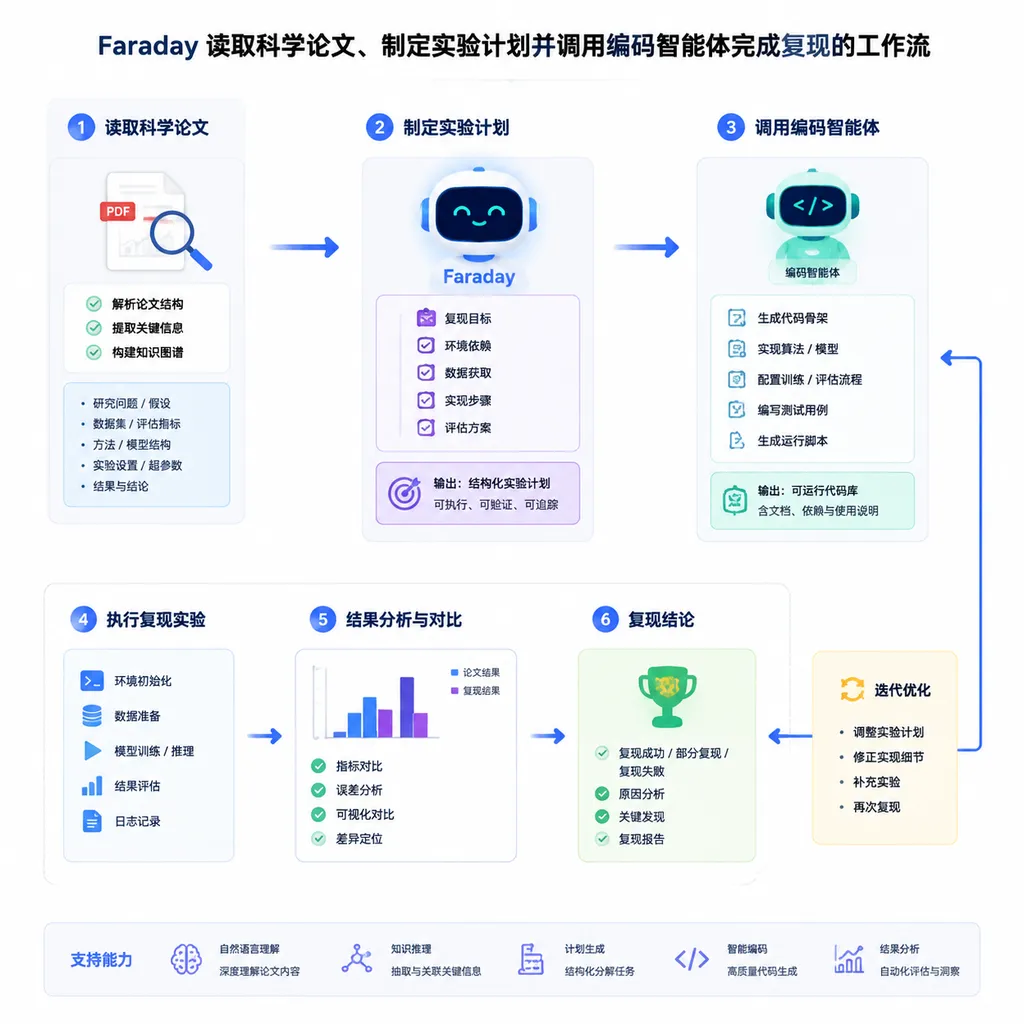
Faraday does not rely on a single 27B model to handle everything from paper comprehension and experimental design to code implementation and result analysis. It operates more like a project lead: it proposes hypotheses, schedules experiments, and decides which direction to pursue, while delegating the actual programming work to more capable coding agents. Public information indicates that Faraday can call frontier coding tools such as GPT-5.5 Codex to execute tasks. During training, it used GPT-5.4-mini and was able to generalize to more powerful execution tools.
So the real takeaway from this comparison is not that a small model has suddenly overcome the parameter gap in general capabilities. Rather, it highlights another technical path that is becoming increasingly clear: decouple scientific judgment from code execution, and use a specially trained small model to orchestrate more powerful general-purpose tools.
That has more practical significance than “yet another larger foundation model.”
Reproducing a Paper Is Not a Reading-Comprehension Exercise
Faraday is designed for paper reproduction. Its input is a published paper, but the system does not have access to the target charts and tables ultimately produced by the paper. Within a limited compute budget, it must autonomously write code, run experiments, and reproduce the paper’s key results as closely as possible.
The process it faces looks roughly like this:
Paper input
  ↓
Identify core claims and experimental variables
  ↓
Propose testable hypotheses
  ↓
Plan experiments and allocate the compute budget
  ↓
Call coding agents to implement the code
  ↓
Run experiments and analyze intermediate results
  ↓
Revise hypotheses or troubleshoot implementation issues
  ↓
Reproduce target trends, tables, or figures
The challenge is not simply “translating the equations in a paper into Python.”
Papers generally present only the successful path, without fully documenting the failed approaches their authors tried. Data preprocessing, random seeds, training epochs, and hyperparameters may be scattered across the main text, appendices, and code repositories—or omitted entirely. The agent must determine for itself: if the results do not match, is there a bug in the code, a discrepancy in the experimental setup, or was the initial hypothesis wrong?
This is also why Inherent regards paper reproduction as a training ground for scientific research. Co-founder and Chief Scientist Edward Hughes compares it to PhD training: when many researchers enter a field, the first thing they do is reproduce prior work. Reproduction may appear not to create new knowledge, but in practice it encompasses the entire research pipeline, including literature comprehension, experimental design, tool use, and failure diagnosis.
From the perspective of task design, this direction is also better suited to training long-horizon agents than traditional question-answering benchmarks. If a model gets a multiple-choice question wrong, the feedback is only 0 or 1. A failed paper reproduction, by contrast, can be broken down into multiple stages to determine whether the problem lay in the plan, the code, the experiment, or the judgment. As long as the evaluation mechanism is reliable, these tasks can generate much denser training signals.
There are also enough papers to continuously expand the task space, without repeatedly optimizing against a handful of static question banks that are easily contaminated by training data.
The Real Selling Point Is Turning “Research Taste” Into a Training Objective
Inherent does not merely require Faraday to produce the correct result. It is also attempting to train a capability that is much harder to quantify: research taste.
Research taste is not about whether a model can suggest ten more experiments. It is about whether, under limited time and compute, the model can determine:
- which hypothesis is most worth testing first;
- which experiment can best distinguish between competing explanations;
- whether an anomalous result calls for further hyperparameter tuning or a change in direction;
- which intermediate observations are merely noise and which might overturn the current hypothesis;
- when to stop exploring and begin consolidating conclusions.
Many scientific research agents today appear highly industrious: they generate dozens of ideas at once, launch a large number of experiments, and then produce a properly formatted report. But that is still far removed from genuine research ability. The key constraint in research has never been “whether more options can be listed,” but “whether resources can be committed to the options that yield the most information.”
Faraday’s training method targets precisely this problem. According to currently disclosed information, Inherent automatically generates fine-grained scoring criteria for different reproduction tasks, then reduces evaluation noise through multi-sample aggregation and round-by-round credit assignment.
One way to understand this is that the system does not merely check at the end of a project whether the final charts look similar. It also attempts to assess whether the agent made reasonable choices at each critical juncture. If an experiment fails but effectively rules out an important hypothesis, it may still receive positive feedback. Conversely, blindly stumbling upon the correct result does not necessarily mean the agent has learned how to conduct research.
This approach has significant potential, but it is also the aspect of Faraday that most needs validation. Scientific value is inherently difficult to assess in real time, and automated scorers may favor formally complete, readily verifiable experiments while overlooking higher-risk but more original directions. If the judge itself lacks research taste, the agent may ultimately learn only “how to please the judge.”
“Outperforming GPT-5.5” Requires Three Qualifiers
Inherent’s results deserve attention, but at this stage they should not be interpreted as evidence that a 27B model has surpassed GPT-5.5 or Claude Opus 4.8 in overall capability.
At least three qualifiers must be added: specific task, agentic system, and company-run evaluation.
First, this is a paper-reproduction task, not a comparison of general capabilities spanning reasoning, programming, writing, vision, and tool use. It is not unusual for a specially trained model to outperform general-purpose flagship models on a narrow task. A compiler optimizer, for example, may outperform a general-purpose chatbot at code optimization, but that does not justify calling it “more intelligent.”
Second, Faraday is a system. Its core decision-making model has only 27 billion parameters, but it calls external coding agents. Parameter count describes only one component and cannot directly represent the computational cost of the system as a whole.
If a single task requires the 27B model to perform extensive long-context reasoning, make multiple calls to GPT-5.5 Codex, run training jobs, and repeatedly sample outputs, then its total cost may not be lower than using a flagship model directly. Determining whether this approach is genuinely more efficient requires data on:
- the total tokens, GPU time, and external-tool costs consumed by each task;
- whether each system was given the same number of experimental rounds and the same compute budget;
- whether GPT-5.5 and Claude Opus 4.8 were equipped with agent scaffolding at the same level in the comparison;
- how much Faraday’s performance declines when external tools such as Codex are removed;
- whether the scorer was validated by an independent team, and how closely human assessments align with automated scores.
Finally, the publicly available results have primarily been disclosed by Inherent itself. Paper reproduction is inherently more difficult to evaluate than standard question banks: two different experimental paths may both be reasonable, and reproducing the correct trend but obtaining different exact values does not necessarily constitute failure. Claims of “outperforming flagship models” will carry sufficient weight only when the test set, execution logs, budget constraints, and scoring rules can be externally audited.
Small Models Plus Tools Are Becoming the Mainstream Approach to Agents
Although leaderboard conclusions should be treated with caution, Faraday’s system design still deserves developers’ attention.
Over the past two years, agent development has been plagued by a common misconception: because flagship models are the most capable, they should handle every step. In real-world deployments, this approach is both expensive and unstable. Models waste reasoning budgets on simple tasks and may simultaneously act as planner, executor, and judge across long workflows, causing errors to compound.
Faraday adopts a division of labor more closely resembling a software engineering team:
- a small model maintains long-term goals and research state;
- a specialized coding model handles implementation and debugging;
- an execution environment runs experiments and returns real results;
- a scorer checks progress and assigns training signals;
- a more expensive flagship model is called only when necessary for particularly difficult steps.
The value of this architecture goes beyond reducing parameter count. A specially trained 27B model can develop a relatively stable behavioral policy, without relying on a general-purpose model to suddenly understand experimental budgets, stopping conditions, and research priorities solely from an extremely long system prompt.
The same applies to enterprise agents. In areas such as risk control, IT operations, data analysis, and code migration, the optimal solution may not be to have the largest model handle everything from start to finish. Instead, a smaller domain model may control the workflow, treating high-cost models as experts called on demand.
In other words, model capability is not the same as system capability. A well-organized small model may indeed outperform a large model working alone.
There Is Still a Clear Gap Between Faraday and an “AI Scientist”
Inherent’s long-term goal is not to reproduce papers, but to enable AI to discover new scientific knowledge. Faraday can be seen as a training ground for that objective, but several unresolved barriers remain between reproduction and discovery.
First, reproduction tasks have implicit answers. Even if the system cannot see the target charts, the paper’s results can ultimately be used to determine whether it is moving in the right direction. Original research has no preexisting answer. Failure may result from an incorrect hypothesis, or simply from inadequate experimental conditions, making reward signals much sparser.
Second, the capabilities disclosed so far are closer to computational experimentation and machine learning research. Fields such as biology, chemistry, and materials science also involve laboratory equipment, sample preparation, and real-world noise. Tool use is no longer simply a matter of running a piece of code.
Third, discovering a new phenomenon and judging its scientific value are two different things. A model may be able to search a vast experimental space without knowing whether a result represents an important law, a statistical accident, or something the academic community has already discussed in another form.
Fourth, scientific research systems need to preserve a complete chain of evidence. Every hypothesis, code version, random seed, data-processing step, and failed experiment should be traceable. Otherwise, the bolder the agent’s conclusions, the higher the cost of verifying them.
For now, Faraday is therefore more accurately described not as an “autonomous scientist,” but as an agent learning to serve as a research lead. Whether it possesses genuinely transferable scientific judgment will depend on whether it can maintain its performance across papers, tasks, and even disciplines.
Inherent’s First Move Is More Substantive Than Its Fundraising Narrative
Inherent was founded by former Google DeepMind employees and is headquartered in London. A few weeks ago, the company emerged from stealth with $50 million in seed funding; it has now unveiled Faraday. Compared with AI research startups that announce grand missions first but then go for long periods without products or experimental results, this pace at least suggests that the team has already established a relatively clear technical foothold.
The most important signal from Faraday is not that “Qwen 27B beat GPT-5.5,” but that Inherent has chosen a path that is trainable, scalable, and relatively conducive to feedback: first teach the model to reproduce existing research, then gradually train its ability to select experiments and exercise scientific judgment.
This approach is far more pragmatic than simply declaring, “We are going to build an AI scientist.”
What determines Faraday’s true quality from here, however, will not be more eye-catching comparison headlines. It will be whether complete evaluations are made public, whether third parties can reproduce the results, and whether Faraday retains its advantage under equal compute budgets. In particular, it will be necessary to determine whether it has learned transferable research methods or merely an agent policy optimized for a particular set of scoring rules.
Based on the information currently available, Faraday is one of the more noteworthy recent releases in AI for Science. But what it demonstrates is that a specialized orchestration model can amplify the capabilities of frontier tools—not that 27 billion parameters are inherently more capable than flagship models.
That distinction matters to both developers and investors.
References
- ITHome: Inherent Launches Faraday, a Small-Parameter AI Agent That Outperforms GPT-5.5 and Claude Opus 4.8 at Scientific Reproduction — An overview of Faraday’s model size, paper-reproduction task, comparative results, and Inherent’s framing of “research taste.”