Harvey Bets on Kimi K3 for Its Legal AI Model
Harvey, the legal AI company backed by OpenAI, has post-trained its first in-house model, Tenet, based on Moonshot AI’s Kimi K3. What truly deserves attention is not a “role reversal between Chinese and U.S. models,” but the shift in enterprise AI from renting closed-source capabilities to owning industry-specific models.
OpenAI-Backed Company Begins Using a Chinese Model as Its Foundation
Harvey, a U.S. legal technology company backed by OpenAI, has just released its first in-house model, Harvey Tenet. Unlike its previous approach, which focused primarily on customizing legal applications around closed-source models from OpenAI, Anthropic, and Google, Tenet is built on Kimi K3, an open-weight model from Moonshot AI.
It would be easy to summarize this as “a U.S. company abandoning U.S. models in favor of a Chinese model,” but that would not be accurate.
Harvey has not announced that it is stopping the use of GPT, Claude, or Gemini, nor has it migrated all product traffic to Kimi K3. What has actually changed is that this legal AI company—valued at $11 billion and backed by both OpenAI and Sequoia Capital—is no longer satisfied with operating solely at the application layer on top of closed-source models. It has begun taking control of model weights, training processes, and inference costs, building a model production pipeline of its own.
Harvey Tenet is the first result delivered by this pipeline.
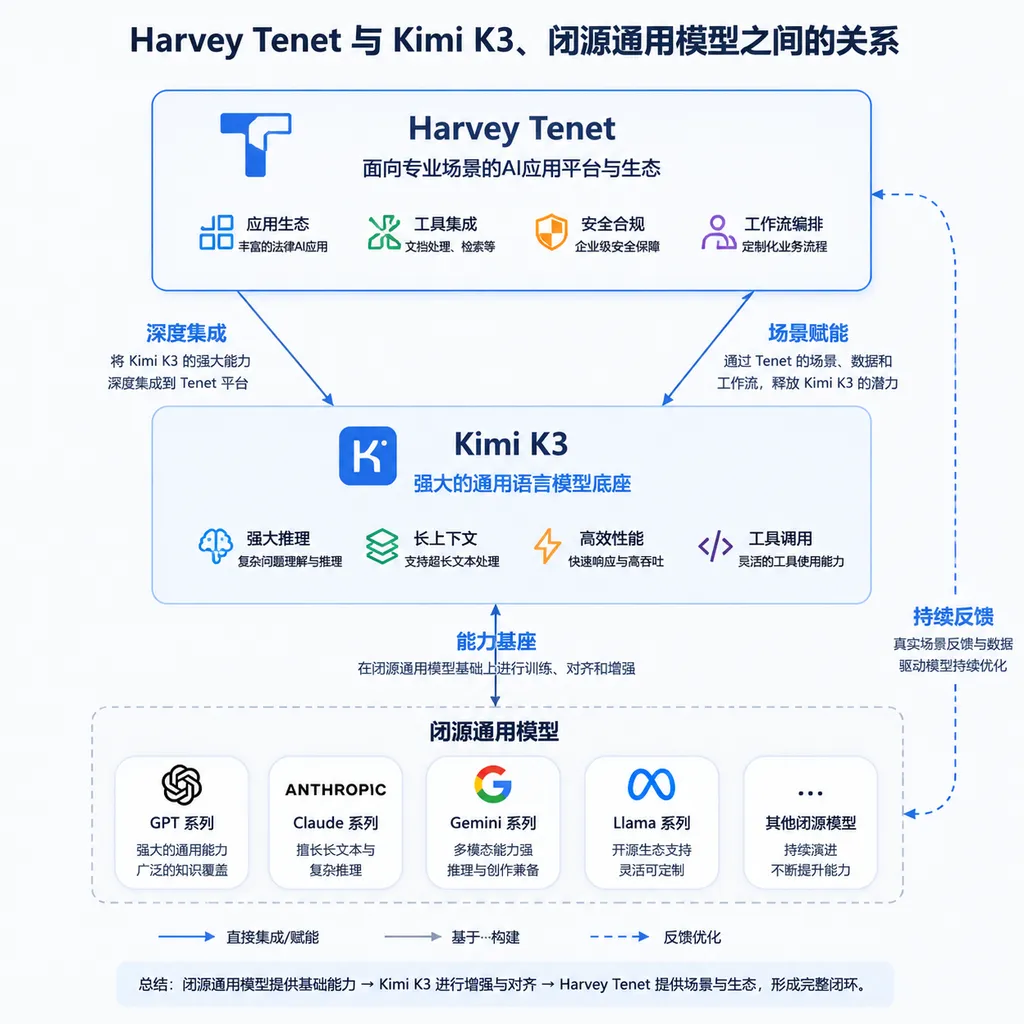
Harvey says Tenet underwent post-training on a complete legal dataset. On complex, long-horizon legal agent tasks, it not only outperformed its underlying model, Kimi K3, but also surpassed leading U.S. systems, including Fable 5 and GPT-5.6 Sol. The training process lasted approximately two months and used around 150 NVIDIA B300 GPUs.
It is important to emphasize that these performance claims currently come primarily from Harvey’s own disclosures. The company has not yet provided sufficiently comprehensive public information on the composition of its test sets, scoring criteria, inference budgets, human-review procedures, or reproducible experiments. Therefore, “industry-leading” is better understood as a vendor claim rather than an industry consensus that has been independently verified.
Even setting the leaderboard discussion aside, Harvey’s choice of Kimi K3 is itself significant.
Tenet Is Not a Wrapper; It Represents a Transfer of Model Ownership
Founded in 2022, Harvey primarily serves large law firms and corporate legal departments. Its typical approach in the past was to call closed-source models from leading U.S. providers, then layer on retrieval-augmented generation, prompting, workflows, access-control systems, and legal data.
This approach is well suited to rapid deployment, but it has an increasingly obvious ceiling: application companies can mainly adjust what lies outside the model, rather than the model itself.
Prompts can make a model “answer like a lawyer,” and RAG can place contracts and case law into the context window. But these techniques are unlikely to fundamentally change how a model behaves in legal reasoning, evidence citation, document structure, or long-horizon decision-making. Especially for tasks involving dozens of documents, multiple jurisdictions, and successive tool calls, every additional step or repeated retrieval by the base model becomes a real token bill and a source of latency.
Open-weight models give Harvey another option: conducting post-training directly on the base model.
This technical path can be roughly represented as follows:
Kimi K3 open weights
        ↓
Legal-corpus and task-data preparation
        ↓
Supervised fine-tuning, preference optimization, and calibration of reasoning behavior
        ↓
Training for legal-agent tool use and long-horizon tasks
        ↓
Safety, access-control, citation, and compliance evaluations
        ↓
Harvey Tenet
This is not the same as “connecting a legal knowledge base to a general-purpose model.” A knowledge base addresses whether the model can see the relevant materials. Post-training addresses how the model thinks after receiving those materials, how it cites them, when it calls tools, and how it produces results consistent with lawyers’ working practices.
For example, during M&A due diligence, a general-purpose model may need to repeatedly read contracts, generate lengthy intermediate analyses, and then determine whether a change-of-control clause constitutes a risk. An industry model trained for the task may identify the clause type earlier and directly extract the trigger conditions, exceptions, and notice obligations. It may not possess more general knowledge, but it may be able to complete the task in fewer reasoning steps.
Harvey emphasizes that Tenet’s cost advantage comes not only from the lower per-token cost of an open-weight model, but also from reduced token consumption during inference. This detail is more important than simply comparing API prices: for long-chain agents, the real expense often lies not in a single input, but in the intermediate tokens repeatedly generated during planning, retrieval, error correction, and review.
Why the Legal Industry in Particular?
Legal AI is one of the areas where industry-specific models have the greatest chance of succeeding.
The reason is not simply that lawyers’ questions are more “specialized.” Rather, the value distribution of legal work is highly uneven: basic question answering has already been covered by general-purpose models, while high-value tasks are concentrated in long-running workflows such as contract review, litigation-material analysis, regulatory research, due diligence, and cross-jurisdictional comparison.
These tasks typically share several characteristics:
- Low tolerance for error. Citing the wrong precedent or missing a limiting condition can directly result in legal liability;
- Extremely long contexts. A single project may involve hundreds of contracts, emails, and regulatory documents;
- Relatively stable formats. Legal opinions, risk lists, and contract clauses all follow clear professional conventions;
- Highly private data. Clients are generally unwilling to place sensitive materials into uncontrollable external model services;
- Need for traceability. The model must not only provide an answer, but also explain which document and which clause support it.
This means that the model with the strongest general capabilities is not necessarily always the most suitable model for legal production environments. Enterprises care more about whether a model is stable on fixed tasks, whether errors can be traced, whether data can be isolated, and how much it costs to review each contract.
Closed-source frontier models remain well suited to open-ended research, complex generalization, and rare, difficult problems. But a large amount of structured, repetitive legal work does not necessarily require calling the most expensive flagship model every time. Harvey can have Tenet handle high-frequency tasks and route a small number of difficult requests to external models, creating a combination similar to the “specialized engine plus general-purpose engine” model in databases.
This is far more practical than betting on a single model.
The Value of Kimi K3 Lies in More Than Parameters and Leaderboards
For Harvey, the key to choosing Kimi K3 may not be how many more points it scores than U.S. models on a particular general benchmark. Rather, it is that the model satisfies three conditions simultaneously: sufficiently strong capabilities, weights that can be used for post-training, and manageable overall costs.
It is also necessary to distinguish between “open weight” and “open source.” Open weight generally means that developers can obtain and deploy a model’s parameters. It does not automatically mean that the training data, training code, and complete construction process are all public, nor does it mean the model can be used commercially without regard to licensing restrictions. What Harvey has obtained is greater control over the model—not a completely unrestricted public asset.
For enterprise AI companies, however, access to the weights changes many things:
- They can use private legal data for deep post-training rather than merely adjusting prompts;
- They can control deployment regions, inference hardware, and data-retention policies;
- They can quantize, distill, or prune the model to optimize costs for specific tasks;
- They can lock in a model version and avoid sudden product-behavior drift caused by upstream API updates;
- They can train different versions for individual clients or jurisdictions instead of forcing all requirements to share one general-purpose model.
This is also the genuine competitive strength now emerging among Chinese open-weight models. In the past, the market tended to interpret the low prices of Chinese models as API promotions. But when a leading U.S. industry AI company directly uses a Chinese model as the foundation for post-training, the basis of competition has shifted from “whose interface is cheaper” to “who can become modifiable infrastructure for software companies worldwide.”
Once a base model enters an enterprise training pipeline, switching costs also rise quickly. Data cleaning, preference samples, evaluation sets, inference engines, and deployment optimizations all accumulate around that foundation. For model providers, this developer investment is stickier than a temporary lead on a leaderboard.
What Two Months of Training on 150 B300s Reveals About the Economics
Training on 150 B300 GPUs for two months is not a fine-tuning project that an individual developer can casually reproduce, but it is still far less than the investment required to pretrain a frontier foundation model from scratch.
That is precisely what makes the open-weight model attractive to industry companies: Harvey does not have to bear the enormous cost of foundation-model pretraining, yet it can concentrate its compute and data on legal capabilities. It is like buying a completed shell of a house and redesigning its interior around one’s own business, rather than beginning by making the bricks, cement, and steel and constructing the building from the ground up.
Of course, post-training does not produce an expert model simply by throwing private documents onto GPUs. The real challenges include:
- Converting lawyers’ work processes into high-quality training trajectories;
- Cleaning up legal materials that conflict with one another, are outdated, or vary by jurisdiction;
- Designing an evaluation system that covers long-horizon agent tasks;
- Handling client-data authorization, isolation, and deletion requirements;
- Preventing the model from fabricating citations or making unauthorized tool calls in an attempt to complete a task;
- Revalidating output stability across jurisdictions after model updates.
Harvey’s advantage lies precisely here. After years of serving large law firms and corporate clients, it has access to real workflows, user feedback, and professional evaluation capabilities. Kimi K3 provides the general-purpose intelligence infrastructure, but Harvey’s legal-task data and delivery system are what determine whether Tenet can build a moat.
This Does Not Mean OpenAI Has “Lost to” Moonshot AI
Because Harvey is backed by OpenAI, the release carries considerable symbolic weight. But interpreting it as evidence that OpenAI’s portfolio companies are collectively turning toward Chinese models would still be an overstatement.
An investment relationship does not imply a technology-exclusivity agreement. Harvey was already using models from OpenAI, Anthropic, and Google simultaneously, and it will most likely continue to maintain a multi-model architecture. The rational choice for an industry AI company is not to pick sides, but to route requests according to task quality, latency, cost, compliance, and controllability.
What truly puts pressure on closed-source model providers is that application-layer companies are beginning to move downward in the stack.
In the past, model companies controlled the core capabilities while application companies handled packaging and distribution. Now, sufficiently capable open-weight models allow application companies to own model assets as well. Harvey is no longer merely a major API customer; it is becoming a vertical model developer.
This will redistribute profits across the AI industry:
- General-purpose closed-source models will continue to charge a premium for difficult reasoning and frontier capabilities;
- Open-weight models will become the foundation for enterprise post-training and private deployment;
- Industry companies will use proprietary data, evaluation systems, and workflows to build their own models;
- Customers will no longer interact with a single model, but with a business system that automatically selects among models.
A similar trend has already emerged within large enterprises. According to the cited report, approximately 40% of AT&T employees’ AI queries are now handled by open models, including NVIDIA’s Nemotron series. AT&T has not yet formally adopted a Chinese model, but it is evaluating options such as DeepSeek and Moonshot AI. This suggests that open-weight models entering U.S. enterprises are not merely an experiment within the developer community; they are gradually taking on real production traffic.
What Harvey Is Really Validating Is the “Industry Post-Training” Approach
At this stage, Harvey Tenet cannot prove that Kimi K3 comprehensively outperforms U.S. closed-source models. The lack of public, reproducible legal evaluation data also means that outsiders cannot yet determine how much of the result comes from the base model and how much comes from the training data, inference budget, or adaptation to the test set.
But it has at least validated something more important: once the capabilities of open-weight foundation models cross the threshold of practical usability, the value of industry-specific data will rapidly increase.
In the past, the main question for enterprises using large models was “How do we connect to the strongest model?” Going forward, the question will become “Which tasks are worth assigning to a general-purpose flagship model, and which tasks should we train our own model for?”
For developers, the lesson from Tenet is not to immediately replicate a legal large model, but to reassess their application architectures:
- If a task is high-frequency, stable, and supported by sufficient data, post-training may be more effective than continually piling on prompts;
- If an agent’s reasoning chain is long, developers should track not only the cost of the final output but also the token cost of intermediate reasoning;
- If a business is subject to compliance constraints, model weights, deployment location, and version control may matter more than general-purpose benchmarks;
- If there is no high-quality task data or evaluation set, access to open weights will not automatically create a competitive advantage.
Our assessment is that Harvey’s shift is not simply a model replacement, but a sign that the business model for industry AI is beginning to mature. Closed-source models will continue exploring the upper limits of capability, open-weight models will serve as the foundation for entering the enterprise core, and vertical companies will turn specialized data into deployable, monetizable model assets.
What Kimi K3 has gained is not merely another U.S. customer. It has entered the core training pipeline of an OpenAI-backed company and become the foundation of that company’s first in-house model. For Chinese models expanding overseas, this carries more weight than simply adding a few more API calls.
Sources
- IT Home: OpenAI-backed U.S. AI company switches to a Chinese open-weight model—compiled information on Harvey Tenet’s model foundation, training investment, performance claims, and company background.