HiPHI Open-Source 617.5-Hour Motion Capture Dataset
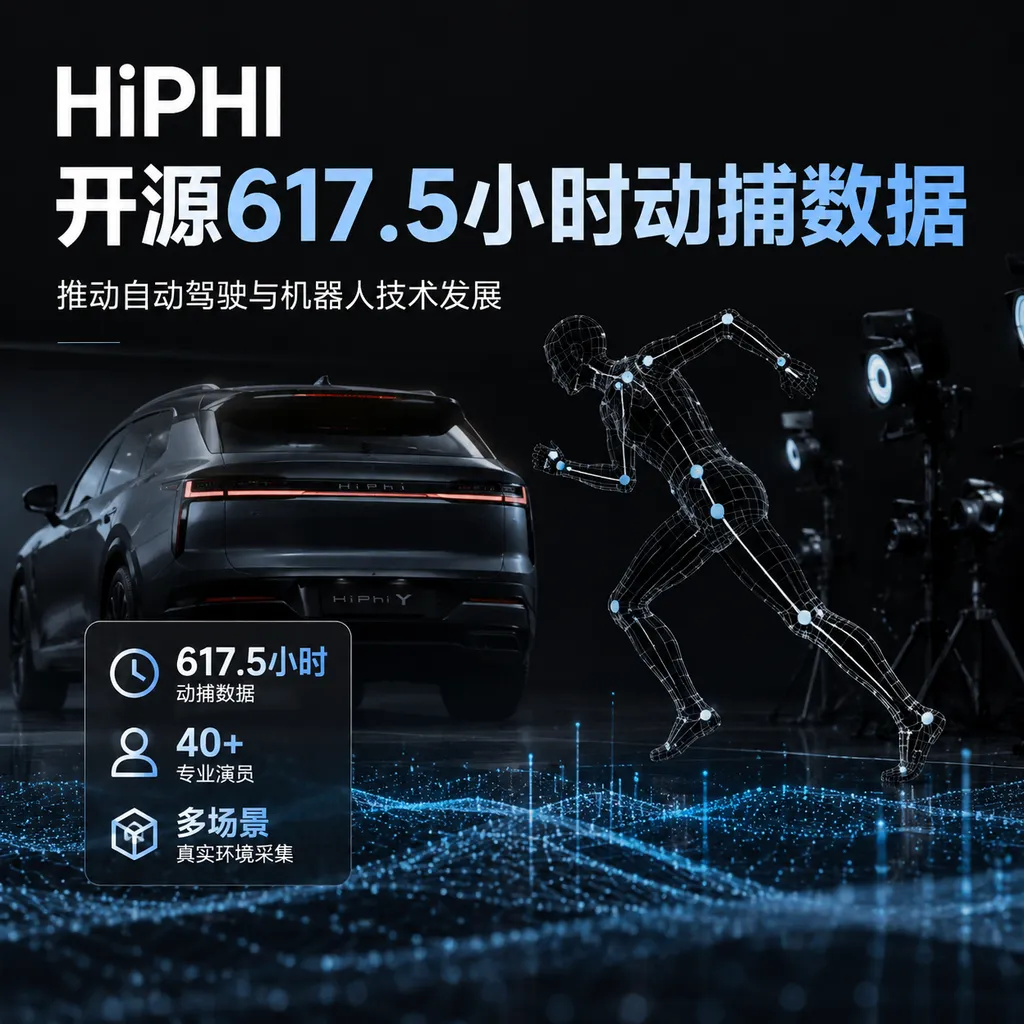
During the 2026 World Robot Conference, Noitom Robotics released HiPHI and made publicly available 617.5 hours of high-precision human-motion and human–object interaction data, which has been used to train the Unitree G1 real robot to perform actions such as running, crawling, and carrying.
HiPHI Open-Sources 617.5 Hours of Motion-Capture Data, Filling a Gap in the Training Foundation for Humanoid Robots
Noitom Robotics released the high-precision human motion dataset HiPHI during the 2026 World Robot Conference and made it publicly available on Hugging Face. The dataset totals 617.5 hours, comprising two major components: full-body human motion and human–object interaction. Policies trained on the dataset have already been deployed on the Unitree G1 humanoid robot to perform actions such as running, sitting down, crawling, carrying boxes, and pulling suitcases.
This is not just another dataset that “throws human videos at a model.” The real value of HiPHI lies in its attempt to convert human actions from visual material into high-precision motion trajectories that robots can learn, replay, and transfer. For the embodied-intelligence industry, which is still struggling with data collection, action coverage, and real-robot deployment, this is more important than simply adding a few more hours of video.
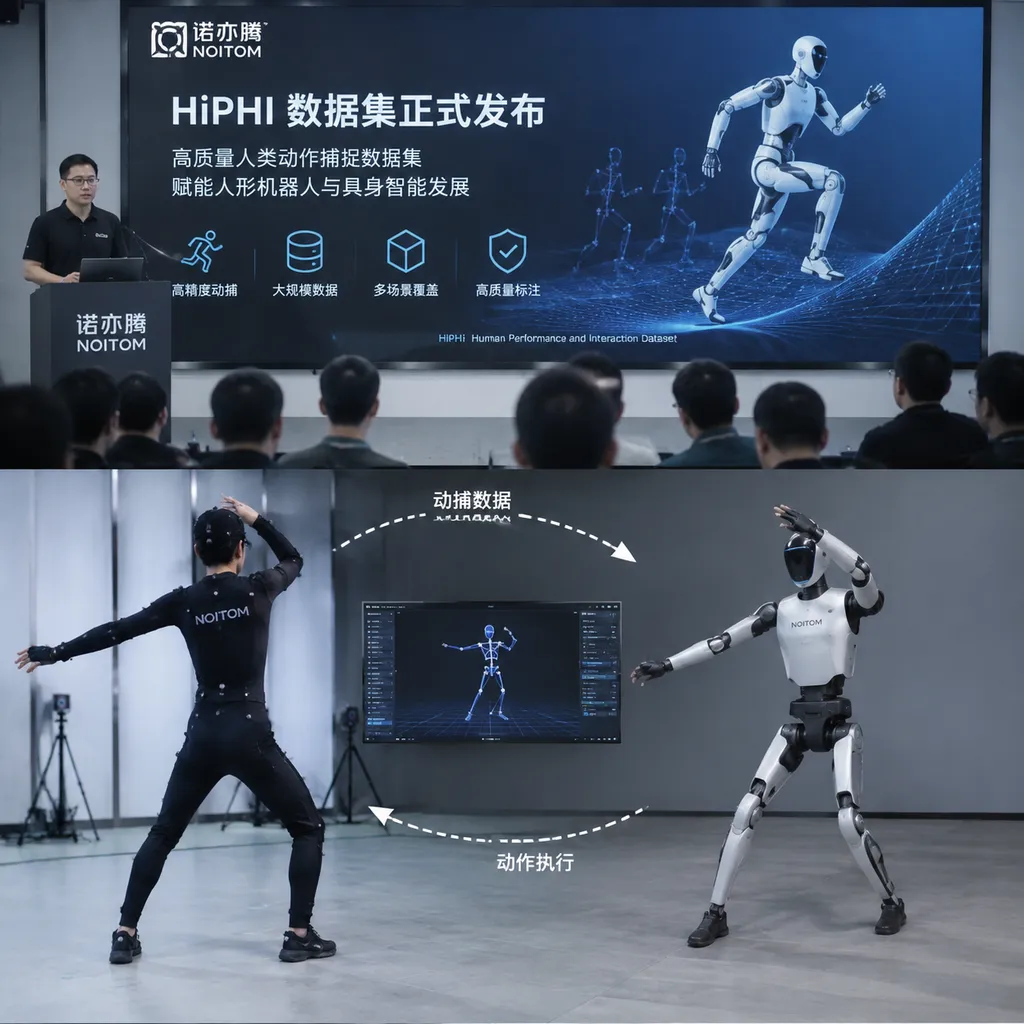
617.5 Hours: The Core Value Is More Than Just “Duration”
According to publicly available information, HiPHI includes:
- 371.8 hours of full-body human motion data;
- 245.7 hours of human–object interaction data;
- Data from 132 motion-capture actors;
- A capture frequency of 90 Hz;
- Submillimeter-precision optical motion capture;
- Left-right mirrored versions of the data;
- Data provided in BVH format, corresponding to approximately 200.1 million frames of motion data;
- Synchronized object motion trajectories and 3D mesh models in the human–object interaction portion.
One easily overlooked detail is that HiPHI does not treat “the person moves while the object remains stationary” as the default scenario. In tasks such as carrying boxes, pulling suitcases, and pushing or pulling objects, the robot’s control targets include not only the human skeleton but also the object’s position, orientation, and changes in motion. The inclusion of synchronized object capture means that models at least have the opportunity to learn the relationships among contact, motion constraints, and action outcomes.
This is fundamentally different from common human-video datasets. Internet videos can provide a huge number of action categories, but depth, joint angles, velocities, contact points, and object states in the footage are typically incomplete. For a humanoid robot, there is a substantial gap between “looking like it is carrying a box” and “being able to generate a carrying trajectory that does not cause the robot to lose balance.” Bridging that gap requires complete state estimation, dynamic constraints, and control policies.
The optical motion-capture approach chosen by HiPHI addresses part of this problem. A 90 Hz sampling rate provides fine temporal resolution, while submillimeter precision helps preserve the continuous motion details of joints and body extremities. In other words, it records not only the starting and ending points of an action, but also the changes in every frame throughout the action.
From “Action Videos” to “Action Units”
HiPHI also organizes the data at the action-unit level according to FrameNet’s framework for structuring human-action semantics.
The significance is that the dataset is no longer merely a repository of actions piled together according to file names. For robot learning, actions often need to be broken down into more composable units: approaching a target, bending down, grasping, lifting, turning around, and placing an object—or, in a pulling task, gripping, applying force, changing direction, and completing the action.
If action data consists only of continuous trajectories, researchers need to perform segmentation, annotation, and semantic alignment separately. If an action-organization framework is established during data collection, model training, retrieval, and composition become easier. In particular, structured labels can reduce data-engineering costs in imitation learning, action generation, skill-library construction, and multitask policy training.
Of course, FrameNet-style semantic organization does not mean that the robot already understands the action. Semantic labels answer “What is this segment of data doing?” rather than “Under what state should the robot perform it, with how much force and along what path?” A genuine robot policy still needs to account for its own mechanical structure, joint limits, contact sensors, visual inputs, and environmental feedback.
HiPHI is therefore more like a high-quality action-prior library than a general-purpose robot controller that works out of the box.
Humanoid Robots Really Are Missing This Type of Data
Over the past few years, public datasets for embodied intelligence have primarily come from three sources.
The first consists of internet videos and game-engine data. These sources are large-scale and inexpensive, making them suitable for action recognition, video prediction, and vision-language pretraining. However, they often lack precise three-dimensional human-body states and rarely include the contact information required for robot execution.
The second consists of data collected in laboratories. This data is highly accurate and finely annotated, making it useful for imitation learning and motion planning. However, collection is expensive, action coverage is generally limited, and it is difficult to support humanoid robots operating in complex everyday scenarios.
The third consists of teleoperation or demonstration data collected on the robots themselves. This type of data is closest to the target platform, but it depends heavily on specific equipment, operators, and environments. It is also difficult to reuse directly across different robots.
HiPHI sits between the first and third categories. Rather than being collected directly from robot joints, it first establishes foundational data on human actions and human–object interactions through high-precision human motion capture, and then maps those actions onto humanoid robots. Its advantages include a broad action space, flexible capture subjects, and independence from any single robot’s hardware. The trade-off is that a significant morphological gap still exists between humans and robots.
Human arm lengths, leg proportions, degrees of freedom, and approaches to maintaining balance are not identical to those of humanoid robots such as the Unitree G1. A squatting motion performed naturally by an adult could cause a robot’s knee joints to exceed their limits, its feet to lose stability, or its center of gravity to shift if copied directly. In other words, high-precision human data can record a “demonstration action” more accurately, but it cannot automatically eliminate the morphological gap between humans and robots.
This is also the key to whether HiPHI can be widely adopted: subsequent researchers will need to convert the data into motion representations suitable for different robot platforms, or train policy models capable of handling morphological differences.
Already Deployed on the Unitree G1, but Do Not Mistake a Demonstration for General-Purpose Capability
Noitom says that models trained on HiPHI have already enabled the Unitree G1 to perform actions including running, sitting down, crawling, carrying boxes, and pulling suitcases in the real world.
This demonstrates at least two things.
First, the data does not remain limited to offline evaluation or simulation environments. The ability to run on a real G1 means that the basic pipeline connecting data preprocessing, motion retargeting, policy training, and control execution has been established. This step is important for embodied-intelligence research because actions that run stably in simulation are often affected on real robots by friction, latency, joint errors, floor materials, and load variations.
Second, HiPHI’s coverage is not limited to single-person movements without objects. Running and sitting can test whole-body coordination; crawling involves multi-limb contact and shifts in the center of gravity; and carrying boxes and pulling suitcases add interaction constraints between people and objects. These tasks are closer to the actions humanoid robots will need to perform in real environments than simple waving or leg lifting.
However, “deployed” still does not mean “generalization has been achieved.” Public information currently mainly demonstrates task categories and real-robot operation results. It is not yet possible to determine from this alone whether the model can operate reliably with boxes of different weights, on different floors, in environments with occlusion, or with previously unseen objects. Whether actions can be executed continuously, the failure rate, whether human intervention is required, and the transfer performance across different robot platforms are the more rigorous indicators of the dataset’s engineering value.
What HiPHI Means for Developers
For researchers and robotics development teams, HiPHI provides at least four practical directions.
1. Use It as Action-Pretraining Data
Researchers can first use large-scale human motion trajectories to train action encoders, motion-generation models, or skill representations, and then fine-tune them with a small amount of robot data. This is similar to first teaching a model “how humans move,” and then teaching it “how a particular robot performs those movements.” Compared with relying entirely on robot teleoperation, this approach could significantly reduce the initial data cost.
2. Build Composable Skill Libraries
Data organized by action units is suitable for skill retrieval and composition. For example, “approach–grasp–lift–turn–place” can be divided into different stages and then recombined according to the target object and environmental state. For humanoid robots that need to handle long-horizon tasks, this is more practical than training every task from scratch.
3. Study Human–Object Contact and Manipulation
The 245.7 hours of human–object interaction data are what distinguish HiPHI from ordinary human-motion datasets. Object trajectories and 3D meshes can provide a foundation for contact prediction, manipulation-action generation, learning physical constraints, and vision–motion alignment.
4. Use It as a Cross-Platform Motion-Retargeting Benchmark
If the same set of human actions can be reliably retargeted to robots with different heights, degrees of freedom, and hand structures, it can be used to evaluate motion-transfer algorithms. HiPHI is therefore not only training data, but may also become a public benchmark for humanoid-robot motion generation and imitation learning.
The Greatest Value Is Turning a “Data Asset” into Public Infrastructure
High-quality motion-capture data is typically regarded by companies as a core asset. Collection requires facilities, equipment, actors, action design, cleaning, and annotation. Human–object interaction data is especially demanding, as it also requires object modeling, synchronization-error handling, and safety management. A company’s willingness to open-source 617.5 hours of data indicates that the industry is moving from treating data as a competitive barrier toward a phase of competition focused first on building an ecosystem and then expanding applications.
For developers, the value of an open dataset does not lie solely in downloading it and training a model. More importantly, it allows different teams to compare action representations, retargeting algorithms, and policy-learning methods on the same data foundation. This reduces the cost of repeatedly collecting data and makes research results easier to reproduce.
However, users still need to read the dataset documentation and license terms carefully to confirm whether the data may be used for commercial training, redistribution, and model release. Motion-capture data involves human subjects and scene assets. The fact that data has been uploaded to a public platform does not mean that all uses are automatically unrestricted.
This Is a Foundation, Not the End Point of Embodied Intelligence
The release of HiPHI fills a long-standing gap in the humanoid-robot training pipeline: a public data foundation that is sufficiently large and precise, while covering both human motion and object interaction.
Its most practical contribution is not to immediately teach robots every household task, but to lower the initial cost of going from human demonstrations to robot actions. In the past, many teams had to spend considerable time building motion-capture systems, designing actions, collecting data, and organizing labels. Now, at least one public dataset can be used directly for baseline training, algorithm validation, and motion-transfer research.
What will ultimately determine HiPHI’s influence, however, are three things: first, whether its documentation and benchmark tasks are sufficiently complete; second, whether the community can reproduce experiments across different robot platforms; and third, whether the data can be further aligned with vision, tactile sensing, force control, and robot-body trajectories.
If these areas can be completed, HiPHI could become a foundational component for humanoid robots, similar to “general-purpose pretraining corpora” in other fields. If not, it may ultimately remain merely a very large repository of motion materials. For today’s embodied-intelligence industry, 617.5 hours is a noteworthy starting point, but the real competition has already shifted from “Who has data?” to “Who can turn data into transferable, verifiable, and deployable policies?”
Dataset Access
HiPHI is currently publicly available on Hugging Face, where the page provides information about the dataset, documentation, and related papers. Developers can begin by examining the motion formats, data splits, label structure, and licensing information, then parse and visualize the data before assessing whether it is suitable for their own robot platforms.
References
- IT Home: Noitom Robotics Releases HiPHI, Open-Sourcing 617.5 Hours of High-Precision Human Motion Data — Introduces HiPHI’s release during the 2026 World Robot Conference, as well as its data scale, capture accuracy, and deployment on the real G1 robot.
- Hugging Face: noitomrobotics/HiPHI Dataset — The public access point for the HiPHI dataset, where users can view data files, documentation, and usage instructions.