Wan 3.0 Is Live: Generate 30-Second Videos and Documents Directly
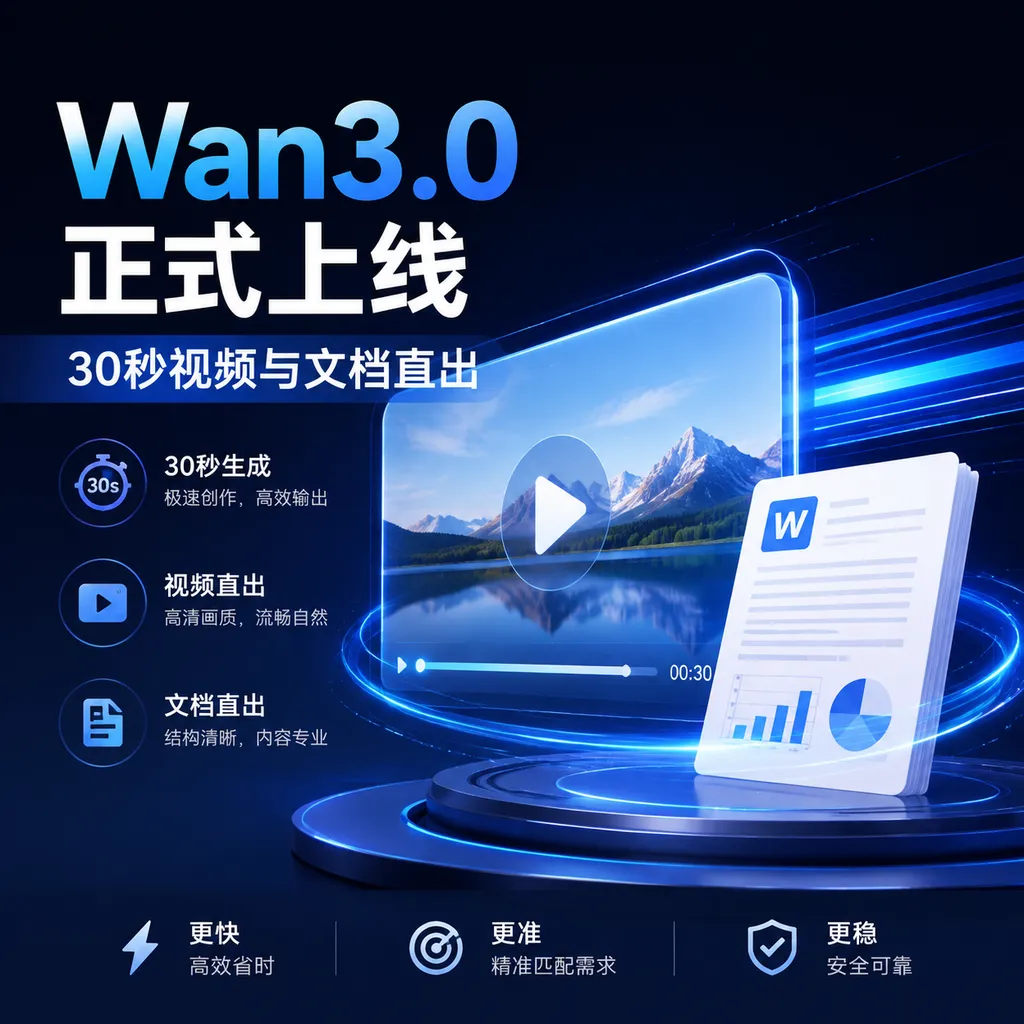
Alibaba Cloud’s Wan3.0 video generation model officially launched today. It can generate videos up to 30 seconds long in a single run and supports DOC, XLS, PPT, PDF, MD, and other document formats as inputs for the first time. API pricing for 480p, 720p, and 1080p is RMB 0.3, RMB 0.6, and RMB 1.2 per second, respectively.
Wan3.0 Officially Launched: Videos Up to 30 Seconds Long, with Direct Document Input
Alibaba Cloud has released the official version of Wan3.0 following its public beta.
On August 24, Alibaba Cloud announced the official launch of its video generation model Wan3.0. Compared with the version made available for public beta on August 6, the officially released Wan3.0 continues to focus on four areas: longer video generation, more comprehensive multimodal creation, more stable cross-shot reference consistency, and more accurate rendering of real-world details.
The change most noticeable to developers is that the maximum duration for a single generation has been increased to 30 seconds, and DOC, XLS, PPT, PDF, MD, and other document formats are supported as inputs for the first time.
This means Wan3.0 is no longer limited to taking a text prompt and generating a stylized short clip. Enterprises can provide product manuals, training materials, business presentations, spreadsheets, and even Markdown content directly to the model, and attempt to convert structured or semi-structured information into video.
From “a Few-Second Shot” to “a Complete Piece of Content”
For some time, the core experience of video generation models has remained “generate a single shot”: users enter a text prompt, and the model outputs a video lasting anywhere from a few seconds to more than ten seconds. When longer content is needed, users typically generate multiple clips first, then combine them using video extension, first-and-last-frame transitions, or external editing tools.
The problem with this workflow is not that it cannot be done, but that consistency is difficult to maintain. A character may have a different face in the next shot, clothing and props may drift, and camera movement may suddenly change. For advertisements, narrative shorts, and product demonstrations, continuity between clips is often more important than the visual quality of any individual frame.
Wan3.0 raises the maximum duration for a single generation to 30 seconds. At least in terms of product design, it is beginning to shift from “generating an image” toward “expressing a relatively complete creative intent.” Thirty seconds cannot yet be considered long-form video, but it already covers common scenarios such as short-video openings, product feature demonstrations, educational explanations, advertising assets, and social media content.
Alibaba Cloud also stated that Wan3.0 supports an intelligent duration feature that can recommend an appropriate length based on the prompt, as well as a video extension feature for continuing and expanding the story. For developers, the value of such capabilities is not simply the ability to generate a dozen additional seconds, but also a reduced reliance at the application layer on video slicing, stitching, and repeated generation attempts.
However, 30 seconds does not mean that the model has solved long-term temporal consistency. For complex actions, multi-person dialogue, continuous narratives, and precise product operations, developers still need to break tasks down into shots and use reference images, reference videos, first and last frames, or post-production editing to control the result. It is more like extending the length of a “usable continuous clip” than directly replacing a complete video production pipeline.
Document Input Is the More Significant Upgrade This Time
Text-to-video and image-to-video generation are nothing new. What offers greater product potential is document input.
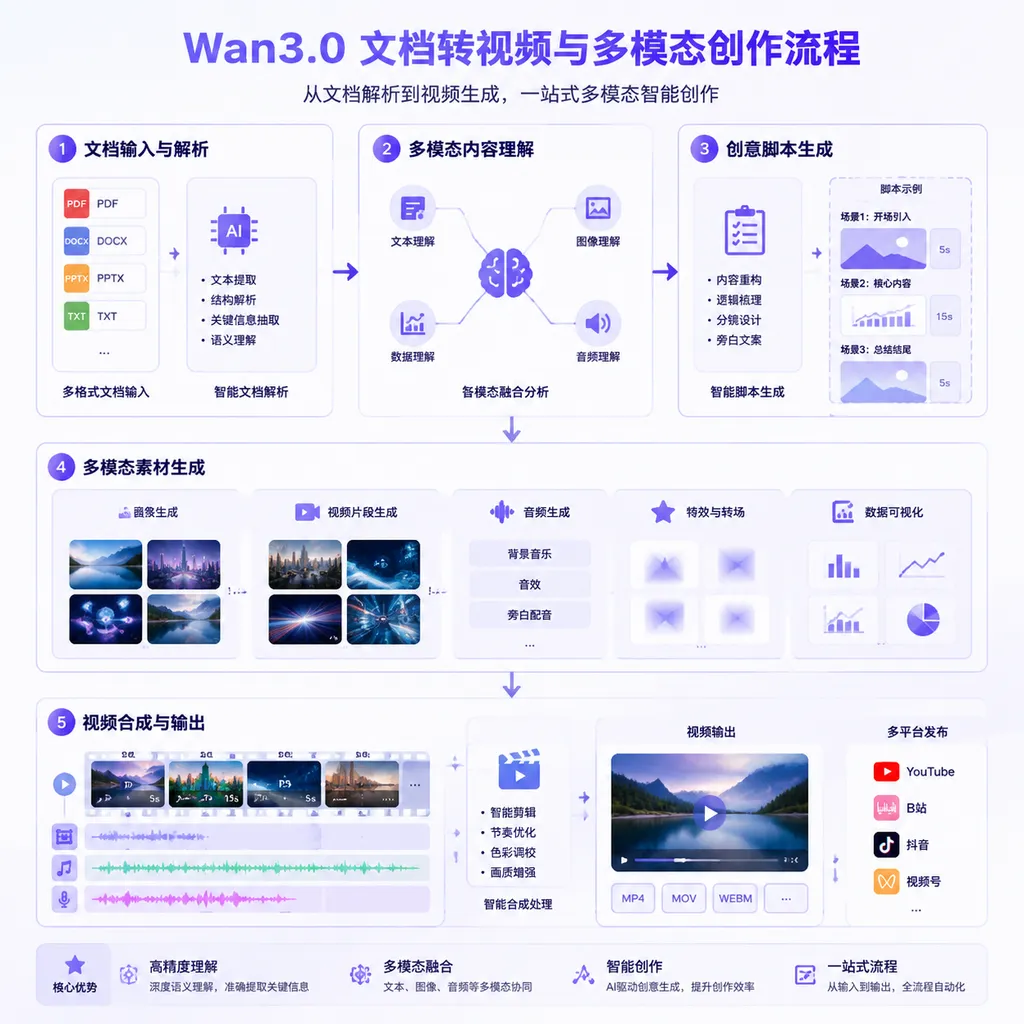
Wan3.0 supports DOC, XLS, PPT, PDF, MD, and other formats for the first time. According to the direction announced by Alibaba Cloud, teaching materials can be converted into instructional videos, product demonstration documents can become marketing assets, and animated charts and business presentations can be given a video-based form of expression.
The key to this capability is not whether the model can “read a file,” but whether it can understand the structure behind the file:
- Which pages in a PPT are titles, which present conclusions, and which are merely supplementary material;
- How charts, paragraphs, and images in a PDF should be organized into shots;
- What kind of animation or visual emphasis should be used to represent changes in XLS data;
- How Markdown heading levels should correspond to narration, subtitles, and shot transitions;
- For a document dozens of pages long, which content should be retained and which can be condensed.
If the model merely extracts text from a document roughly and applies a generic animation, the value of the generated result will be fairly limited. Truly useful document-to-video generation requires a process of “content direction”: first understanding the material, then deciding on the narrative order, visual format, narration rhythm, and key information.
This is also where Wan3.0 differs from ordinary text-to-video products. It attempts to move video generation beyond pure visual creation and into content production workflows. For education, corporate training, e-commerce operations, and sales support teams, this is closer to their actual needs than simply adding another artistic style option.
Of course, document input also introduces new engineering challenges. Enterprise materials often contain tables, headers and footers, scanned images, complex layouts, internal data, and access-control information. When integrating the capability, developers need to pay attention to whether files are parsed completely, whether data may be misunderstood, and whether the facts in the generated video remain consistent with the source document. In fields such as finance, healthcare, and legal services, a video looking realistic does not mean that the information it contains is accurate.
“All-Purpose Reference” Targets Controllability
Alibaba Cloud positions Wan3.0 as an all-purpose reference video generation model. It supports text, images, video, audio, files, links, and other inputs, while covering text-to-video, image-to-video, and reference-based video generation tasks in a unified manner.
Here, “reference” can be understood as providing the model with a set of reusable visual constraints. Users not only tell the model what to generate, but can also specify what a character should look like, what props are involved, where the scene takes place, and what style should be used. They can even use video or audio as references.
The official announcement emphasized that Wan3.0 strives to achieve “a unique face for every person” in portrait generation, with detailed rendering of facial features and skin texture, while presenting complex and distinct emotions among different characters in group scenes. In all-purpose reference tasks, the model can reproduce consistency across key dimensions such as characters, props, settings, and styles.
This is particularly important for commercial videos. An e-commerce team may need the same product to appear in multiple settings; a game development team may need a character’s clothing, hairstyle, and weapon to remain consistent across different shots; and an advertising production workflow may require brand colors, product form, and camera style to remain stable across multiple generations.
However, “supporting consistency” is not the same as “achieving stable consistency every time.” The more reference conditions there are, the more complex the constraints the model must handle. The longer the shots, the more characters involved, and the faster the actions, the greater the likelihood of generation failure. In practical deployments, users still need to prepare clear reference materials and obtain usable results through multiple rounds of generation and selection.
After More Than Ten Days of Public Beta, Alibaba Emphasizes Continued Iteration
Alibaba Cloud stated that Wan3.0 has continued to evolve on a daily basis during the more than ten days since the start of its public beta, with further improvements in instruction following, cross-shot consistency, audio quality, and video editing.
This reveals a reality: competition among video models is no longer limited to comparing model capabilities on launch day, but also involves the speed of iteration after launch.
For developers, the performance of video generation is usually difficult to summarize with a static leaderboard. The same model may perform completely differently on people, products, natural landscapes, mechanical structures, and chart animations. The same prompt may also produce significantly different results at different resolutions and durations, or with different reference materials. As a result, rapid post-launch corrections, the feedback loop for failed samples, and workflow adaptation are often more important than any individual demo shown at a launch event.
The four improvements Wan3.0 highlights this time also correspond broadly to the most common pain points in current video generation products:
- Instruction following: Reducing instances in which key actions, shots, and styles specified in prompts are ignored;
- Cross-shot consistency: Reducing the drift of characters, clothing, props, and settings across consecutive shots;
- Audio quality: Making ambient sounds, action sounds, and the overall sonic atmosphere more natural;
- Video editing: Allowing generated results to be modified further instead of requiring every version to be generated from scratch.
These capabilities determine whether a model can move from being a creative tool into a production workflow. Generating a single video that “looks good” is not particularly difficult. The challenge is enabling teams to repeatedly modify and generate content in batches, while integrating the results into review, publishing, and asset management systems.
The Price Is Reasonable, but Long-Video Costs Still Require Careful Calculation
Wan3.0’s API is priced by video duration and resolution. The currently announced prices are:
| Output Resolution | Price | |---|---:| | 480P | RMB 0.3/second | | 720P | RMB 0.6/second | | 1080P | RMB 1.2/second |
Based on a single 30-second generation, the original prices are approximately RMB 9, RMB 18, and RMB 36, respectively. From August 24 to September 23, Alibaba Cloud Bailian and the Qwen AI platform are offering a limited-time 30% discount on API usage.
For a single video, these prices are not particularly high, especially for prototype validation, marketing asset generation, and internal tool testing. However, the actual cost of a video application cannot be calculated based solely on the price of one successful generation. Developers also need to account for failed retries, version selection, audio processing, subtitle generation, content moderation, storage, and distribution.
For example, if an e-commerce platform generates five scenarios for each product and makes four attempts per scenario before selecting one 30-second 720P video, the video generation cost alone could reach RMB 360, excluding the costs of preparing source materials and post-processing. In batch production, controlling the number of retries and screening at a lower resolution before upgrading selected videos to 1080P will directly affect the unit cost of content.
Wan3.0 should therefore be treated more as an orchestral video generation capability than as an unlimited “video printer.” From an engineering perspective, it is advisable to record prompts, reference materials, model versions, generation parameters, and review results in full, and establish a traceable asset production pipeline.
More Access Points, with Competition Shifting from Models to Workflows
Following today’s official launch, users can experience Wan3.0 through Alibaba Cloud Bailian, the Wanxiang official website, Wanjing Yike, the Qwen AI platform, the Qwen Creation PC client, the Qwen app, Duiyou, and IF STUDIO. Products including Jumping Vision under Maiya, Deevid, Juhuo, JD Lingjing, Meitu, and Jingmeng have also integrated the model.
The growing number of access points indicates that Alibaba Cloud does not intend to treat Wan3.0 merely as a cloud API. It is simultaneously targeting three scenarios: creation by ordinary users, professional content production, and developer access. Front-end products lower the barrier to use, platforms host templates and workflows, and APIs allow enterprises to embed the capability into their own systems.
This will also be a key area of competition in China’s video generation market. Differences in image quality between models will continue to narrow, but the companies that can connect document parsing, asset management, character consistency, batch generation, review, and publishing into a unified workflow are more likely to secure stable enterprise orders.
The significance of Wan3.0 goes beyond a single upgrade to a video model. By bringing single-generation duration, document understanding, and multimodal reference into one product, it is clearly moving closer to becoming “content production infrastructure.” The most important questions to watch are not whether it can generate an impressive demo, but whether document-to-video generation can reduce the need for manual content direction in real business scenarios, and whether cross-shot consistency is sufficient to support batch production.
Developers can begin testing three types of tasks today:
- Use PPT or PDF files to generate product introductions, course explanations, and sales demonstration videos;
- Use reference images and reference videos to verify the consistency of characters and products across multiple shots;
- Conduct low-cost batch experimentation at 480P, then upgrade versions that pass review to 720P or 1080P.
If all three types of tasks can be completed reliably with limited human intervention, Wan3.0 will have truly moved beyond “being able to generate video” to “being able to participate in production.”
References
- IT Home: Alibaba Cloud’s Wan3.0 Video Generation Model Officially Launched — Includes information on the official launch date, supported formats, available access points, integrated platforms, and API pricing.
- Zhihu: Wan3.0 Enters Public Beta — Introduces the main capabilities announced during Wan3.0’s public beta, including 30-second generation, document input, and intelligent duration.