World Model, Now Running in Real Time
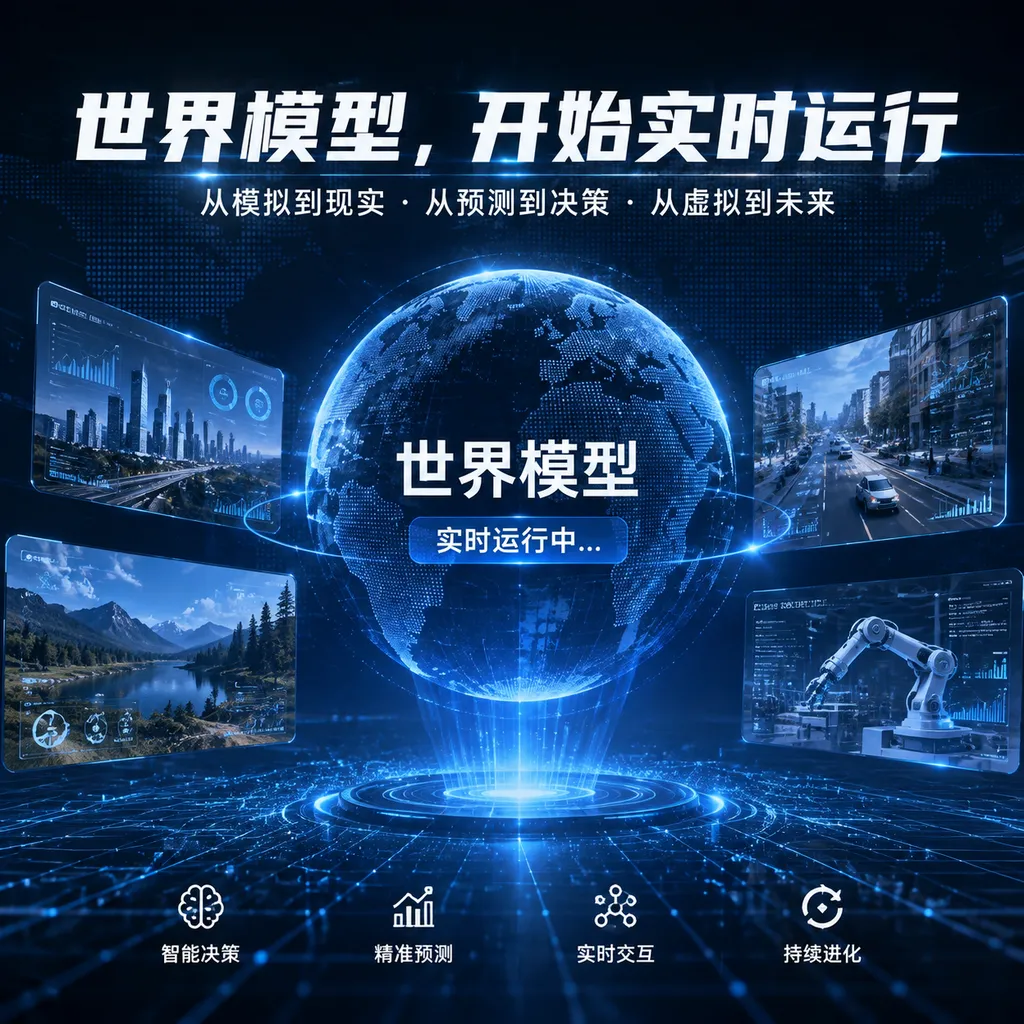
Z.ai has released HiDream-O1-World, a native, fully multimodal interactive world model that transforms generated content from a video clip into a dynamic environment that can be continuously explored, edited, and manipulated in real time. Competition among world models is also shifting from visual quality to memory, physical consistency, and real-time interaction.
In an AI-Generated World, It’s Finally About More Than Just Watching
Over the past week, another Chinese player has entered the world-model arena.
On August 17, Zhixiang Future released its natively multimodal interactive world model, HiDream-O1-World, and further demonstrated its capabilities at WRC 2026 recently. Users can start with a piece of text or an image to generate a dynamic environment that can be continuously explored, edited, and interacted with: controlling a character’s movement, changing the camera angle, switching the weather, or adjusting the state of objects in the scene. The model continues generating the world as it evolves, rather than playing back a pre-rendered video.
Zhixiang Future calls it “the world’s first natively multimodal interactive world model.” The claim of being the “first” is clearly a vendor-defined one, given that projects such as Google Genie, World Labs, Tencent Hunyuan WorldPlay, and Kunlun Tech Matrix-Game have already been exploring similar directions. Even so, HiDream-O1-World remains worth watching: it puts text, images, action inputs, spatial memory, and dynamic scene generation into a single system. Its goal is no longer to make videos longer, but to enable a model to maintain a world state that can continue running.
These are two entirely different problems.

It Is Not “A Video You Can Control”
The question video models are good at answering is: What should appear to happen over the next few seconds?
An interactive world model, by contrast, needs to answer: Given the current state, what will the world become after an action is performed?
Both may output frames through next-frame prediction, but the underlying tasks are different. Ordinary video generation places greater emphasis on visual continuity, camera movement, and aesthetics. An interactive world model must also handle the causal relationship between actions and outcomes. For example, when a user pushes open a door, the model must not only generate the door-opening animation, but also remember that the door is now open. If the user walks around to the back of a building and then returns, the building’s structure must not change, and an object that was just placed on the table must not disappear out of nowhere.
The difference can be summarized as follows:
Video generation: Prompt → A fixed sequence of frames → Playback ends

World model: Current state + user action + historical memory
                                      ↓
                              Predict next state
                                      ↓
                      Update the world and wait for the next action
The real threshold, then, is not merely whether the output “looks realistic,” but whether the model can continuously maintain state.
HiDream-O1-World currently offers three core capabilities: exploration, editing, and interaction. Users can enter a scene from either a first-person or third-person perspective, controlling movement and the camera. They can also modify the weather, object states, and local structures. Compared with traditional text-to-video generation, this product form is closer to a game engine driven in real time by a neural network.
Yet it is not a traditional game engine. Conventional engines require developers to prepare maps, models, materials, colliders, and interaction logic in advance; players can act only within predefined rules. A generative world model attempts to fill in both the visuals and the rules during runtime. The former is deterministic, stable, and debuggable; the latter is flexible and open, but also more prone to failure.
What Does “Natively Multimodal” Actually Need to Solve?
HiDream-O1-World uses Zhixiang’s self-developed native multimodal UiT architecture. Here, “native” does not simply mean connecting several models: first using a large language model to understand text, then calling an image model to draw the first frame, and finally having a video model extend it. Such a pipeline can also produce impressive demos, but the different modules do not share a unified representation of space, objects, and actions, making information loss between modules highly likely.
The native multimodal approach aims to process the following within a single model or unified representation space:
- Text descriptions and user instructions;
- Images, videos, and continuous visual states;
- Control signals such as keyboard input, camera movement, and character actions;
- Object positions, occlusion relationships, and spatial structures;
- The state of the world as it changes over time.
This is equivalent to having text, visuals, and actions use the same “world ledger.” When a user inputs “turn left,” the model must not only understand the language, but also know the current camera orientation, which objects are on the left, and which areas should enter the field of view after the turn.
Compared with chaining together multiple generative models, unified modeling is primarily valuable for long-term consistency and action responsiveness. However, Zhixiang Future has not yet disclosed sufficiently complete details about the architecture, training-data composition, or inference costs. To what extent UiT implements unified parameter modeling, and whether it still retains multiple specialized modules, will require further clarification through papers, model cards, or developer interfaces.
“Native multimodality” is currently a valuable technical direction, but it is also a term that can easily be diluted by marketing. Whether it genuinely applies should ultimately be judged not by the architecture’s name, but by whether cross-modal states can truly be shared.
Writing 3D Information into Memory and Letting the Model Learn as It Runs
One of the most common problems faced by interactive world models is that scenes gradually drift during continuous generation.
At first, there may be a table and four chairs in a room. After turning around a few times, the table may change size and one chair may disappear. Walk farther away and return, and the position of the door may have changed as well. The reason is that frame-by-frame generation models typically care more about whether the immediate image looks plausible than whether the entire world remains coherent.
HiDream-O1-World’s approach is to write 3D spatial information into a Memory context, preserving a continuously updated representation of the environment during generation. At the same time, the model introduces Test-Time Training, or TTT, which continues adapting itself during inference based on newly generated interaction trajectories, rather than generating everything from start to finish using one completely fixed set of parameters.
Put simply, Memory is like a continuously updated map, while TTT is like the model constantly correcting that map as it explores. Together, they are intended to help the system remember:
- Which objects have appeared and where they are located;
- What operations the user has performed on those objects;
- The relationship between the current camera and the historical space;
- Which physical outcomes have already occurred and therefore cannot be arbitrarily rewritten later.
The advantage of this approach is that it can adapt to the current scene during long-term interaction. The cost is a more complex inference process. Test-time training involves online parameter updates or state adaptation. How to control latency, GPU memory consumption, error accumulation, and session isolation will directly determine whether the technology can move from demos into products.
This is especially important in multi-user scenarios, where each user has a different world state. If the model must maintain an independent Memory and online-update result for every session, the server will face not only the cost of video generation, but also an engineering challenge that is roughly equivalent to maintaining “a separate running model state for each user.”
It Tops the Leaderboard With 80.9, but the Benchmarks Are Far From Unified
On the third-party interactive world-model evaluation benchmark WBench, HiDream-O1-World achieved an average score of 80.9 on the Navi navigation leaderboard, including 73.3 for physics and 88.0 for consistency. These results at least indicate a degree of competitiveness in camera movement, spatial preservation, and object relationships.
For example, as the camera pushes, pulls, pans, or tracks, the scene’s geometric structure needs to remain stable. When an occluded object reappears, its appearance and position must not change noticeably. Collision, gravity, and front-to-back occlusion must also follow basic causal logic, rather than being “guessed” anew in every frame.
However, evaluation of world models is still at an early stage. A single leaderboard can hardly cover the problems that arise in real deployments:
- Can the state remain consistent after ten minutes of continuous user interaction?
- Will unseen combinations of actions cause the world to collapse?
- When the input frequency increases, can the model respond quickly enough?
- Does physical consistency come from genuine causal modeling or from visual statistical patterns?
- Can the same initial state and action produce reproducible results?
- Can the generated world be exported, edited, and integrated with existing engines?
In an ordinary video model, an occasionally distorted cup may affect only visual quality. In a robot-training environment, the same error can contaminate the learned policy. If an agent learns to act under incorrect physical rules, it may produce entirely opposite results when transferred to the real world.
Thus, image quality is merely the admission ticket for a world model; reliability is what determines its ceiling.
In 2026, the Industry Is Moving From “Video” Toward “Environments”
HiDream-O1-World is not an isolated event. Since the beginning of this year, interactive world models have clearly been accelerating both in China and abroad.
Kunlun Tech’s Matrix-Game 3.0 has demonstrated real-time generation at up to 40 FPS in 720p using a 5B-parameter model. Tencent Hunyuan WorldPlay supports real-time interactive visuals at 720p and 24 FPS, and uses action control, Memory, reinforcement learning, and distillation to address long-term consistency and inference speed. The Google Genie approach emphasizes generating explorable environments from prompts, while World Labs focuses more on persistent 3D world representations.
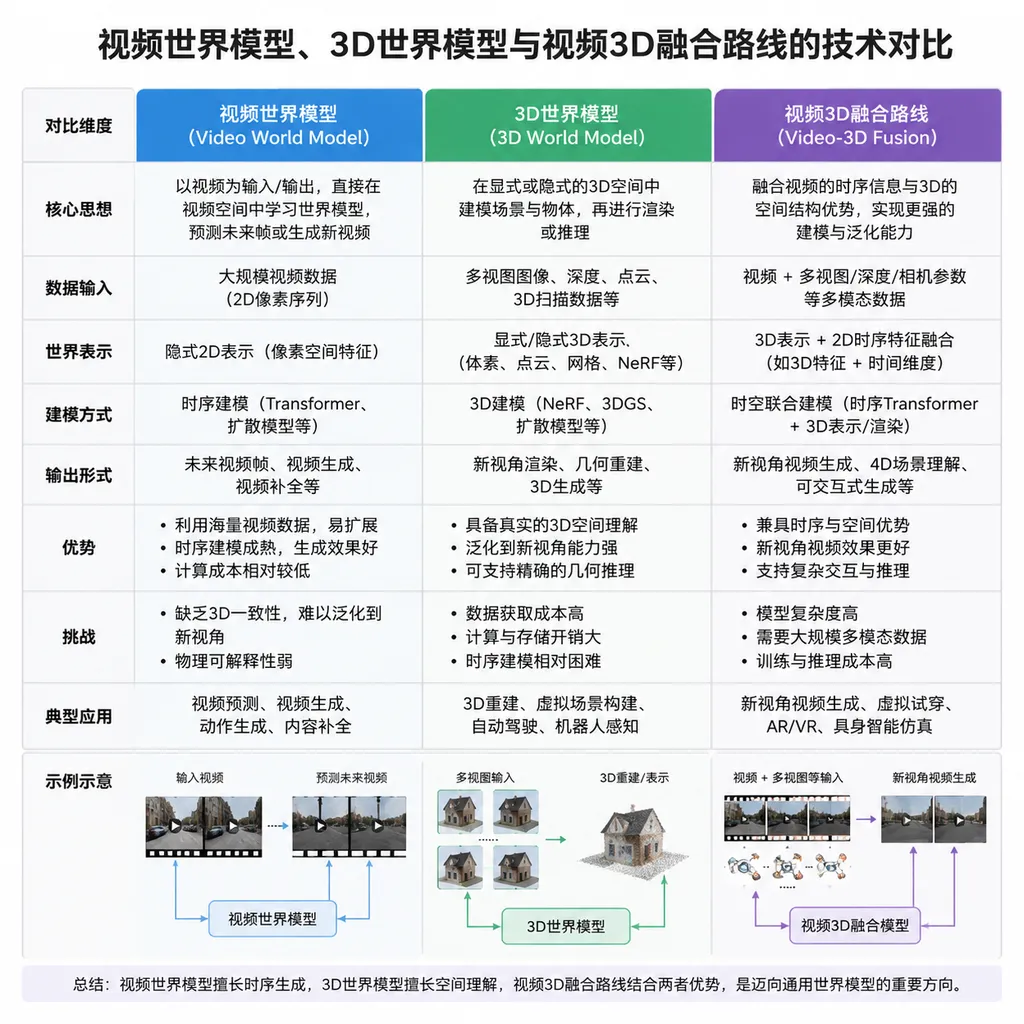
Although all of these projects are called world models, their technical approaches differ. They can be broadly divided into three categories:
1. The Video-Generation Approach
This approach turns future-frame prediction into real-time, controllable frame-by-frame generation. Its advantage is natural visual output that can be presented directly to users. Its problem is the lack of explicit 3D structure, which makes long-running generation prone to drift.
2. The 3D-Representation Approach
This approach first generates or reconstructs a structured 3D scene, then outputs visuals through a renderer. It is better suited to editing, collision detection, and integration with traditional engines, but asset-generation speed, visual realism, and dynamic content remain challenging.
3. The Video–3D Fusion Approach
This approach uses 3D representations to maintain spatial and physical frameworks, while relying on generative video models for final rendering. It is the more complete direction and the one most similar to a “neural world engine,” but it also has the highest system complexity.
HiDream-O1-World places 3D spatial information into Memory while using generated visuals as its primary interaction interface. It represents a video-based world-model approach moving toward structured spatial representations. Whether it can eventually output editable meshes, 3D Gaussians, scene graphs, or physical parameters will determine its value to professional developers.
Games Are Only the Most Obvious Entry Point; Robot Training May Matter More
The easiest application of world models to demonstrate is interactive film and gaming. Users no longer need to follow fixed paths preset by developers; they can directly change the story through actions or natural language. Scenes, characters, and plots can continue to be generated at runtime, and each playthrough may lead to a different branch.
From an industry perspective, however, embodied-intelligence simulation may be more important than AI games.
Robots and autonomous-driving systems depend on vast amounts of environmental interaction data. Real-world collection is not only expensive, but also makes it difficult to cover rare, dangerous, and extreme situations. A factory robot arm can repeatedly attempt to grasp objects on a virtual production line; an autonomous-driving system can train on scenarios in which obstacles suddenly appear during heavy rain; and service robots can learn navigation in a large number of generated indoor environments.
What a world model provides is not more video, but a training ground where trial and error can be performed at low cost.
The problem is that this training ground must be sufficiently trustworthy. For entertainment content, “looks plausible” may be good enough. For robots, friction, collision boundaries, object mass, and action latency can all affect the final policy. Therefore, in the short term, generative world models are more likely to be combined with traditional simulators than to completely replace Unity, Unreal, Isaac Sim, or autonomous-driving simulation systems.
In content production, they can also serve as tools for 3D scene sketching and previsualization. A designer can input a concept image, first generate an explorable space, then adjust its structure, style, and lighting before exporting it to professional tools for further production. What is truly useful here is not “generating a world from one sentence,” but whether the result is controllable, editable, and reusable.
The Real Dividing Line Is Whether It Can Become a Development Platform
Most world models are still primarily at the capability-demonstration stage: users enter a website, input a prompt, and experience a limited period of interaction. To become infrastructure that developers can genuinely use, several critical layers of capability are still missing:
- Stable action and state interfaces, rather than merely accepting keyboard input;
- The ability to read world states, so that agents know what is happening in the environment;
- Snapshot, rollback, and branching mechanisms for training and debugging;
- Controllable random seeds and deterministic execution;
- Import and export of assets, scene graphs, and physical parameters;
- Acceptable latency, concurrency costs, and deployment options;
- Safety boundaries for harmful content, copyrighted materials, and real people.
If these interfaces remain closed, a world model is still just a novel content product. Only if it can be programmed like a game engine or simulator can it potentially become the environment layer for agents and robots.
This is also our assessment of HiDream-O1-World: It has crossed the boundary of ordinary video generation, but it is still clearly some distance from becoming a truly general-purpose world engine.
Its significance does not lie in proving that AI already understands the physical world. Rather, it shows that the industry is beginning to shift its evaluation criteria away from single-frame quality and video length, toward spatial memory, action causality, real-time responsiveness, and long-term consistency. Compared with continuing to make videos higher in resolution, this direction is more valuable for the next generation of agents.
Over the past two years, models have primarily been solving the problem of “how to generate content.” Now, they are beginning to tackle “how to make content continue running.” From film to games, from results to processes, and from offline generation to real-time feedback, this is the real change taking place in the current competition over world models.
Developers should nevertheless remain cautious about the phrase “world model.” A video model that accepts keyboard controls does not mean it has mastered the laws of the world; a smooth demonstration does not mean it can serve as a reliable training environment. What matters most next is not who is first to attach the label “first,” but who can first turn an interactive world into a stable, open, and verifiable system.
Sources
- The World’s First Natively Multimodal Interactive World Model Has Arrived—AI Videos Can Finally Be “Played”: An introduction to the release background, core capabilities, and application areas of Zhixiang Future’s interactive world model.