Thomson Reuters Bets on In-House Models

Thomson Reuters has unveiled its first large language model, Thomson, which was extensively trained based on Qwen3.5-397B. With approximately $40 million in cumulative R&D investment, it primarily targets high-frequency, quantifiable use cases such as legal document review.
Thomson Reuters Bets on Its Own Model, Deeply Training Thomson on Qwen3.5-397B
On August 24, Thomson Reuters, the parent company of Reuters, officially announced its first large language model, Thomson. Rather than directly calling GPT, Claude, or Gemini, it uses Alibaba’s Qwen3.5-397B as its base model and has undergone retraining, domain pretraining, post-training, and internal reinforcement learning before ultimately being deployed in legal professional services products.
This is not a simple model rebranding. Thomson Reuters disclosed that Thomson’s cumulative R&D costs were approximately $40 million, or about RMB 269 million. The $450,000 figure previously circulating online represented only the cost of the final training run and did not reflect the project’s total investment.
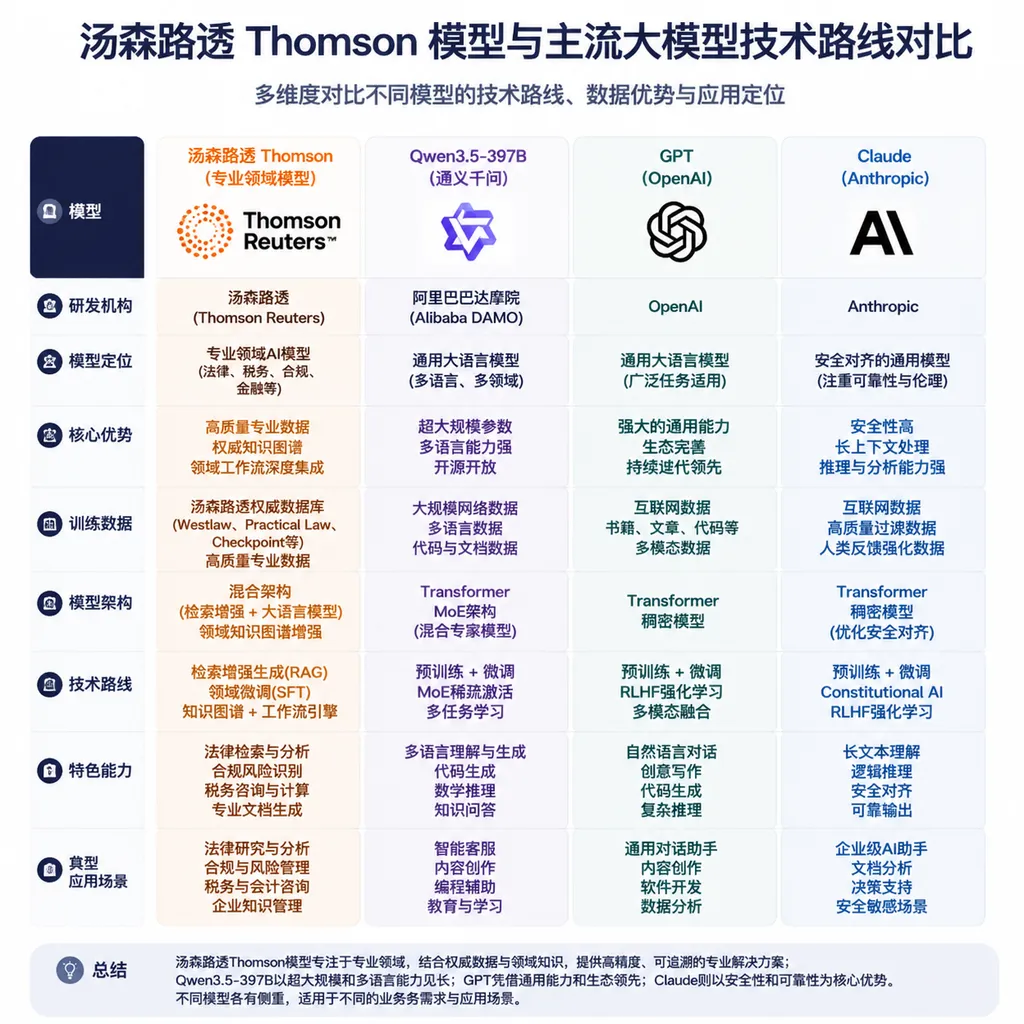
The strategy behind Thomson is clear: rather than trying to build a general-purpose chatbot for everyone, Thomson Reuters is embedding the model into its existing legal content, review processes, and professional tools. What it really wants to capture is not the top spot on model leaderboards, but the massive volume of contracts, financial spreadsheets, and legal documents that enterprise customers process every day.
Not Starting from Scratch, but Deeply Modifying Qwen3.5
Thomson Reuters has not disclosed Thomson’s complete parameter count, training corpus size, or architectural details, but it has confirmed that the base model comes from Alibaba’s Qwen family and that the current version is based on Qwen3.5-397B.
Qwen3.5-397B-A17B is a sparse mixture-of-experts model with approximately 397 billion total parameters and about 17 billion activated parameters per forward pass. It uses a hybrid attention architecture that combines Gated Delta Networks with Gated Attention, striking a balance between a large parameter count and practical inference costs. Put simply, it resembles a company with 397 billion employees, but whenever it receives a task, it mobilizes only around 17 billion of them; the other experts do not need to participate simultaneously.
This design gives Thomson Reuters important room to work: the base model handles general language understanding, reasoning, and generation, while Thomson Reuters can devote more resources to legal expertise, enterprise document formats, compliance boundaries, and business processes.
According to publicly available information, Thomson Reuters collaborated with Imperial College London to retrain the base model so that it would meet the company’s requirements for safety, ethical standards, and political neutrality. The team then continued with pretraining and post-training using Thomson Reuters’ proprietary content, as well as reinforcement learning in an internal environment.
The key is not simply stuffing legal texts into the model’s context. In legal applications, the model must also learn several things that general-purpose models often handle with insufficient consistency:
- Distinguish between obligations, exceptions, conditions, and definitions in legal provisions;
- Process non-textual information such as tables, footnotes, attachments, and cross-references;
- Provide verifiable supporting evidence after reaching a conclusion, rather than merely generating a passage that sounds plausible;
- Remain restrained when dealing with uncertain content and avoid presenting speculation as a definitive conclusion;
- Adapt to the review processes already used by law firms and corporate legal departments, rather than requiring users to learn an entirely new interaction model.
This is also why Thomson Reuters emphasizes developing its own model. For ordinary question answering, calling a leading closed-source model is usually sufficient. But in contract review, due diligence, and legal research, model outputs need to enter established workflows and may even influence client decisions. Whether a model can output information in the required format, consistently cite the original text, and behave consistently when handling sensitive questions is often more important than occasional high scores in open-domain conversations.
Spending $40 Million to Buy More Than a Leaderboard Ranking
Thomson Reuters says that Thomson has already joined the ranks of the world’s best AI models. However, based on the test results disclosed so far, this statement needs a qualification: Thomson has frontier-model-level competitiveness on specialized legal tasks, but that does not mean it leads across all tasks.
On Stanford LegalBench, Thomson scored 0.823, below Gemini 3.1 Pro and GPT-5.5. On the Harvey Legal Agent Benchmark, Thomson scored only slightly below Claude Opus 4.8, placing it close to the leading models in the legal-agent field.
However, the testing conditions were not entirely equivalent. Thomson’s score used test-time scaling, meaning that the model was allowed to spend more computational resources before generating its final answer. GPT-5.5 did not have reasoning mode enabled when participating in the relevant tests. This difference cannot be ignored for legal tasks, because complex contract analysis is inherently better suited to trading additional time for greater accuracy.
In deep-search testing, Thomson scored 0.53, while GPT-5.4 reached 0.65. This suggests that Thomson’s strengths are more likely to lie in structured-document understanding, legal judgment, and the processing of professional content, rather than in open-ended, multi-turn, multi-source information search.
In other words, Thomson has not demonstrated that smaller models can comprehensively replace GPT or Claude. What it has demonstrated is something more practical: when a model has sufficiently strong foundational capabilities and is placed within high-quality domain data and clearly defined business processes, enterprises can use a smaller, more controllable model to achieve results on specific tasks that approach those of general-purpose frontier models.
That is the real value of the $40 million investment. The money was not spent only on GPUs for the final training run. It also covered data cleaning, expert annotation, evaluation systems, alignment strategies, inference infrastructure, risk controls, and integration with existing products. For legal AI, these efforts often have a greater impact on the final user experience than simply doubling the model’s parameter count.
Why Not Use OpenAI or Anthropic Directly?
Thomson Reuters has publicly explained that the company chose not to adopt closed-source models from OpenAI, Anthropic, and others mainly because of long-term cost and adjustability considerations.
The first is cost. Legal professional services products can generate substantial usage. Features such as Tabular Analysis need to process large volumes of structured documents, and a single task may involve long contexts, complex reasoning, and multiple rounds of tool calls. If every analysis depends on expensive closed-source frontier models, costs can rise rapidly with the scale of customers and document volumes.
The second is control. With closed-source models, the model weights, training details, release cadence, and safety policies are determined by the vendor. Enterprises can adjust some behavior through system prompts, fine-tuning interfaces, or retrieval augmentation, but they cannot fundamentally change the model’s refusal boundaries, output formats, reasoning preferences, or evolution across versions.
For a legal software company, this uncertainty directly affects product delivery. Customers need a review system that continues to follow the same rules months later, rather than one whose answer style, citation habits, or risk preferences suddenly change after a model vendor upgrades its system.
The third is data boundaries. Thomson Reuters owns a large amount of professional legal, tax, news, and business content. These materials constitute a unique asset that distinguishes it from general-purpose models. Using this data to train its own model can reduce dependence on external APIs for critical knowledge and make it easier to establish a traceable chain from data sources to model outputs.
But developing a model in-house also comes at a cost. Model training requires sustained investment; the company must bear responsibility for data rights and compliance issues; and inference clusters and model operations do not disappear. If the model serves only a small number of scenarios, in-house development is unlikely to be economically viable. The investment may pay off only if the model can be embedded into multiple high-frequency products and continuously reduce the cost per task.
Therefore, Thomson Reuters’ approach should not be simplistically summarized as “all enterprises should develop their own large models.” A more accurate conclusion is that only companies with high-value vertical data, stable customer demand, and sufficient usage volume have a chance of turning a base model into a long-term asset.
Thomson’s First Deployment: Legal Document and Spreadsheet Analysis
Thomson’s first integration will launch in August through the Tabular Analysis feature of CoCounsel Legal, where it will serve as the default model.
This choice is highly representative. Spreadsheet analysis may not be the AI scenario most likely to attract public attention, but it is one of the easiest areas in which to measure return on investment. Users can submit multiple financial documents, contract lists, or due diligence materials to the system and ask the model to extract information according to consistent standards, compare differences, identify anomalies, and generate conclusions.
These tasks share several characteristics: large document volumes, relatively structured formats, quantifiable accuracy, and clearly defined human review processes. The model does not need to be particularly creative in every conversation; it needs to complete repetitive work consistently.
For lawyers, the greatest value may not be that the model can write a more polished legal opinion, but that it can complete within hours an initial screening process that previously required multiple people to check repeatedly, while accurately flagging high-risk clauses, missing fields, and anomalous data. As long as the model can reduce the time spent on manual searching and organization while leaving the final decision-making authority to professionals, its commercial value is already established.
By making Thomson the default model, Thomson Reuters is willing to expose its in-house model to real production traffic rather than treating it merely as an internal experiment. This will also quickly reveal its practical weaknesses: long-document stability, table-parsing quality, citation accuracy, handling of edge cases, and error-recovery capabilities will all matter more than a single benchmark score.
What This Means for the Model Market
The release of Thomson may push enterprise model competition away from “whose general capabilities are stronger” and toward “who can perform specific tasks more cheaply and reliably.”
Over the past two years, enterprises have often selected models based on parameter counts, context-window sizes, and leaderboard rankings. But in real-world deployments, the factors that determine whether a project can go live are usually more specific: cost per million tokens, peak throughput, whether data can remain on-premises, how controllable the output is, whether versions remain stable, and whether errors can be audited.
On these dimensions, a vertical model does not necessarily need to outperform GPT, Claude, or Gemini. It only needs to achieve three things within a sufficiently large workflow: approach general-purpose frontier models in accuracy, offer significantly lower inference costs, and behave in a way that the enterprise can continuously control.
The open-weight nature of Qwen3.5-397B provides an infrastructure foundation for this approach. Enterprises do not need to train a model with hundreds of billions of parameters from scratch. Instead, they can start with a relatively strong base model and conduct continued training, post-training, and evaluation using their own data and business environments. For companies capable of building GPU clusters and model teams, this provides an additional degree of control compared with relying entirely on external APIs.
Of course, open weights do not mean low costs. A total parameter count of 397 billion still entails a very high deployment threshold. The MoE sparsity can reduce the amount of computation required per pass, but it does not eliminate the engineering complexity of weight storage, concurrent serving, quantization adaptation, and context management. Thomson Reuters is able to pursue this approach partly because it has large enterprise customers, professional content assets, and mature software products.
For ordinary developers and small and medium-sized businesses, the more practical path remains to call hosted models or choose smaller open-source models with lower deployment costs. The truly instructive part of Thomson’s case is not “spend $40 million training a model,” but rather to first identify high-frequency tasks that can be measured, and then determine whether in-house development can deliver sufficient benefits in cost, data, and product control.
Conclusion: A Model’s Destination Is Not the Leaderboard
Public information about Thomson remains limited, and external observers still cannot fully assess its training recipe, inference costs, model scale, or long-term stability. What can be confirmed at this stage is that Thomson Reuters has chosen a path distinct from that of the major model companies: starting with Qwen3.5-397B and focusing on professional data, industry standards, and integration with production systems.
This approach does not mean that general-purpose large models have lost their value. On the contrary, Thomson’s current performance first depends on the foundational capabilities provided by Qwen3.5. What is changing is that enterprises are no longer treating a base model merely as an API. They are beginning to view it as infrastructure that can be retrained, constrained, and repackaged.
If Thomson can demonstrate within CoCounsel Legal that it is cheaper and more stable than external closed-source models on high-frequency document tasks, while maintaining sufficiently high accuracy, it will serve as a meaningful validation of enterprise-developed vertical models. Conversely, if model maintenance costs, data governance, and deployment complexity exceed expectations, the $40 million may turn out to have been nothing more than an expensive customization experiment.
For now, the more prudent assessment is that Thomson is not a comprehensive replacement for GPT or Claude. But it may signal that legal AI is moving from “calling a model” toward “owning model capabilities.” What is truly worth watching next is not where Thomson ranks on the day of its release, but whether it can turn its model advantages into a productivity tool that lawyers are willing to use every day.
References
-
ITHome: Thomson Reuters, Parent Company of Reuters, Spends $40 Million Developing an AI Model Based on Alibaba’s Qwen — Information on Thomson’s R&D investment, base model, training process, and publicly disclosed benchmark results.
-
Public Materials on Alibaba’s Qwen3.5 Series — Background information on the hybrid architecture, MoE activated parameters, and multimodal capabilities of Qwen3.5-397B-A17B.
-
Introduction to Qwen3.5-397B-A17B — Used to supplement the technical background of the open-weight Qwen3.5 model.