Kimi K3 Max Breaks into the Top Ten for the First Time
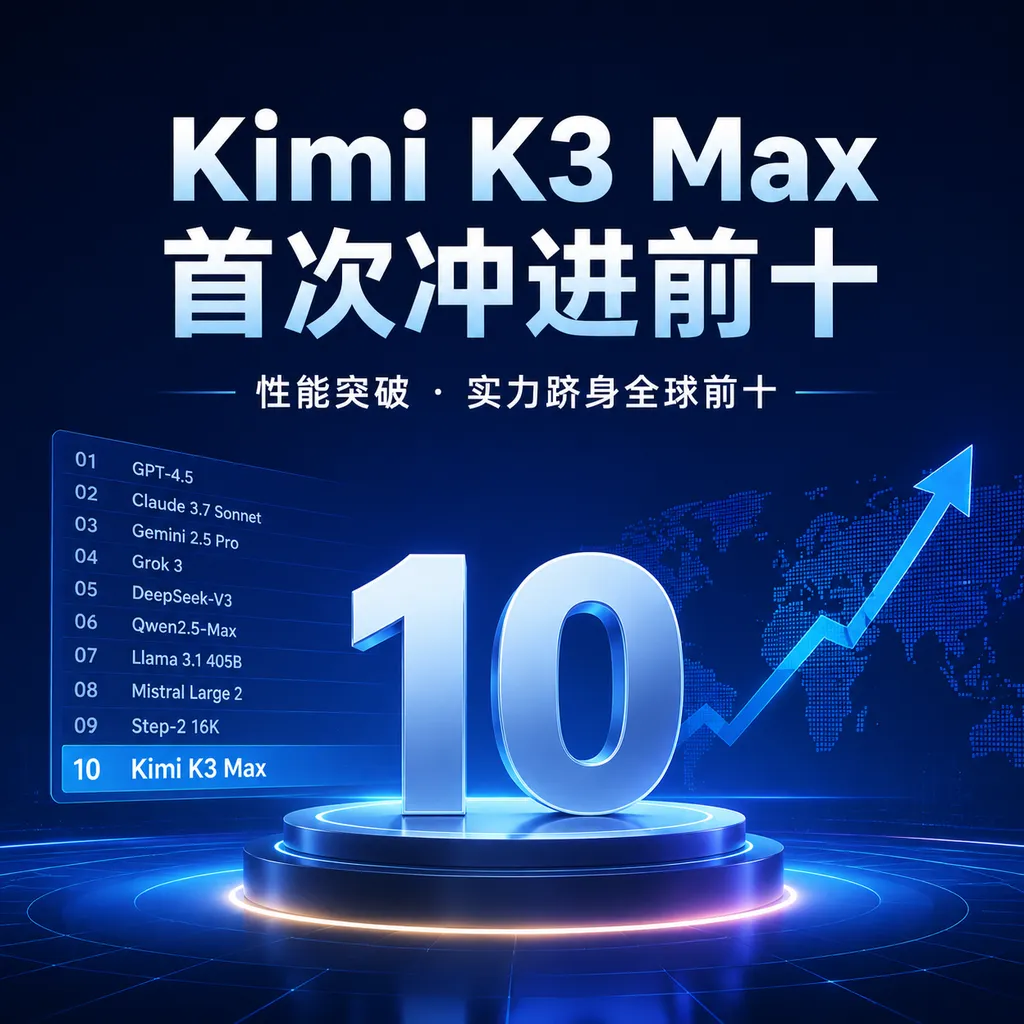
In Arena’s latest weekly rankings, Kimi K3 Max climbed to 10th place overall, while GLM-5.3-Max debuted at 13th. Chinese AI models are closing in on the top performers, but leaderboard positions still cannot be directly equated with capabilities in production environments.
Kimi K3 Max Breaks into the Top Ten for the First Time
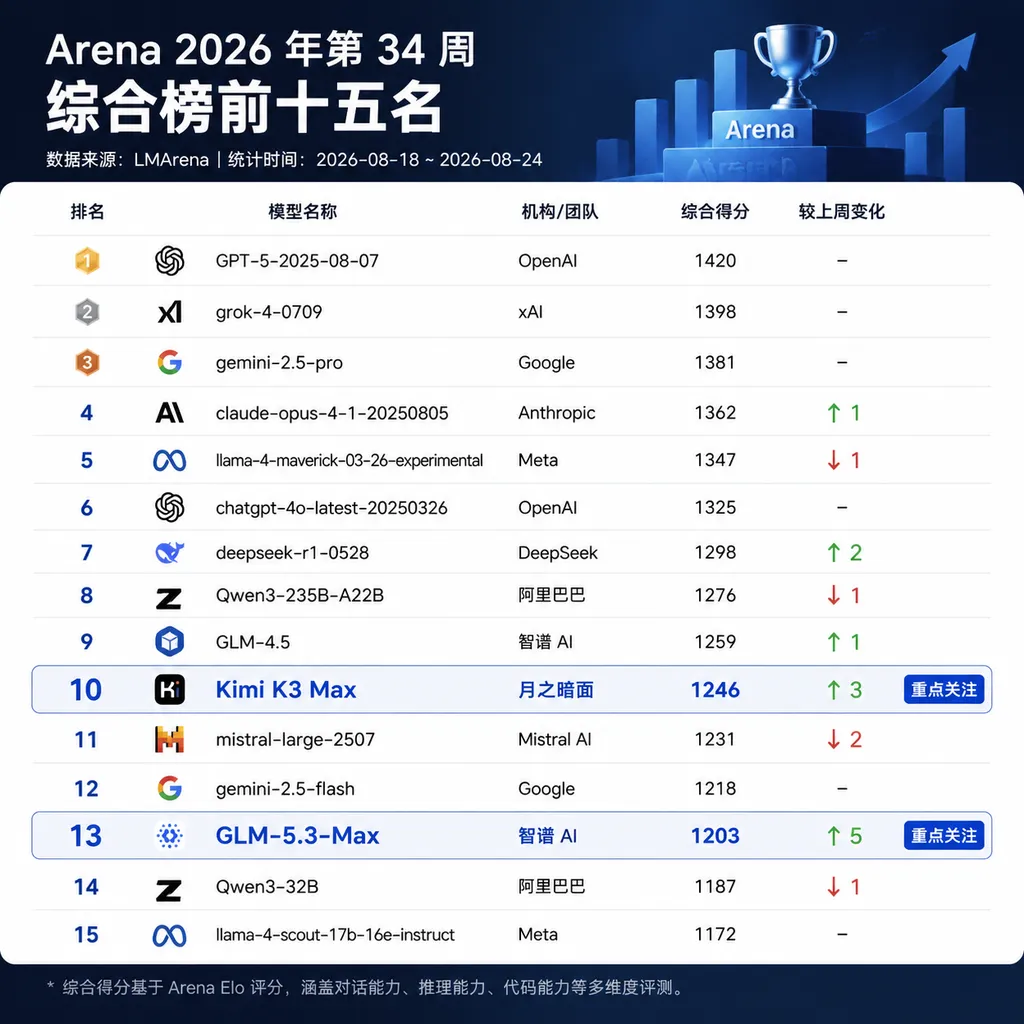
Arena released its blind-test rankings for large language models for Week 34 of 2026 today. Covering the period from August 17 to August 23, Moonshot AI’s Kimi K3 Max climbed from 12th place last week to 10th in the overall rankings, entering the top ten in its Max version for the first time. Zhipu’s newly released GLM-5.3-Max made its debut on the list and went straight to 13th place.
Viewed together, these two rankings are more significant than simply emphasizing that “Chinese models have taken another step forward.” Kimi K3 Max has reached the edge of the first tier, while GLM-5.3-Max demonstrates that a new model does not need to spend several weeks climbing the rankings to enter the upper-middle tier directly. However, there are only 2 ELO points between 10th and 13th place on Arena, so the gap is far less substantial than the rankings suggest.
The top three positions in this week’s overall rankings are still occupied by Anthropic models: claude-fable-5 ranked first with 1,508 points, while claude-opus-4-6-high and claude-opus-4-7-high ranked second and third with 1,504 and 1,502 points, respectively. The differences among the three models are minimal and, according to Arena’s statistical methodology, they remain part of a closely matched leading group.
K3 Has Been in the Top Ten, but This Is the First Time for K3 Max
A point of potential confusion needs to be clarified first.
In July this year, the base version, Kimi K3, had already entered Arena’s overall top ten and ranked first in the frontend development category. This week’s development is not that “the Kimi K3 series has entered the top ten for the first time,” but that kimi-k3-max, this specific model version, has entered the overall top ten for the first time.
Arena ranks individual model entries rather than vendors or product families. The base, Max, and Preview versions, as well as different reasoning configurations, are all treated as separate participants. Therefore, K3’s historical results cannot be directly attributed to K3 Max. This distinction is also important for developers: different versions within the same model family may use different reasoning budgets, context configurations, and service strategies, meaning their actual latency and costs may differ as well.
Kimi K3 Max received 1,489 points this week, moving up two places from last week, while its score remained essentially unchanged from the data published last week. This indicates that its entry into the top ten was not simply the result of a sudden, substantial improvement in capability over the course of one week. More likely, it resulted from the combined effects of new votes, changes in competitors’ scores, and a reshuffling of the rankings.
In other words, this is a noteworthy instance of “holding its ground,” rather than a breakthrough involving a dramatic separation from the pack.
In terms of absolute score difference, Kimi K3 Max is 19 points behind the leader, claude-fable-5, and only 2 points ahead of GLM-5.3-Max, which appeared on the list for the first time. ELO scores are highly concentrated in Arena’s top tier, and a difference of just a few points can be magnified into several positions in the rankings. It would be inaccurate to view “10th place” as a capability dividing line. It is more like the UEFA Champions League qualification line in a sports league: the position matters, but it does not mean that the player in 11th place is suddenly in an entirely lower tier.
GLM-5.3-Max Makes a More Aggressive Debut
Compared with Kimi’s steady rise, GLM-5.3-Max’s arrival at 13th place in its first appearance is even more striking.
The model earned 1,487 points this week, just 2 points fewer than Kimi K3 Max. For a model that has only just accumulated enough votes to enter the official rankings, this is a very high starting point. At the very least, it indicates that in the open-ended questions, writing, reasoning, and coding tasks frequently submitted by Arena users, GLM-5.3-Max has no obvious weaknesses in terms of response style or quality of execution.
However, a debut at 13th place still leaves two issues to be observed.
The first is stability after more votes have accumulated. When a new model initially enters the rankings, both the sample size and the distribution of opponents involved in comparisons are still changing. As more users submit complex tasks, issues involving long contexts, tool use, and maintaining instructions across multiple turns will gradually emerge. A high first-week ranking does not guarantee that the model will hold its position several weeks later.
The second is productization. Arena measures anonymous response preferences; it does not measure API timeout rates, throughput, rate limits, pricing, or version stability. A model may produce more popular answers in blind tests without necessarily being suitable for an online service handling hundreds of requests per second. For Zhipu, 13th place demonstrates the model’s capability ceiling. The more important task now is to turn that ceiling into stable, callable engineering capabilities.
The Top Ten Are Becoming More Crowded—and More “Fragile”
The most significant feature of this week’s overall rankings is not merely Kimi’s rise or GLM’s debut, but the continued narrowing of the gap among leading models.
Apart from the continued dominance of the top three positions by Claude models, muse-spark-1.1 climbed three places to 8th, while Kimi K3 Max rose to 10th. At the same time, Alibaba’s qwen3.8-max fell from 8th to 19th, with an ELO score of 1,481; qwen3.7-max-preview ranked 27th with 1,474 points, showing little overall change in position.
The main positions held by Chinese models in this week’s overall rankings are as follows:
- Kimi K3 Max: 10th place, 1,489 points, up 2 places from last week;
- GLM-5.3-Max: 13th place, 1,487 points, entering the rankings for the first time;
- Qwen3.8-Max: 19th place, 1,481 points, down 11 places from last week;
- Qwen3.7-Max-Preview: 27th place, 1,474 points, with little change in ranking.
The movement of Qwen3.8-Max is particularly illustrative. It fell 11 places, yet it is only 8 ELO points behind Kimi K3 Max. Looking only at the rankings, one might think the model had dropped from the top ten into the second tier. Looking at the scores, however, it appears more like a reshuffling within a highly congested range.
This week also saw two new entries, gpt-5.5-instant and claude-opus-4-8, enter the overall rankings in 28th and 29th place, respectively. The continued arrival of new models will constantly alter existing models’ matchups and relative positions. Arena is not a frozen exam score sheet, but a round-robin competition in which new contestants enter every week.
Therefore, the more reasonable conclusion at this stage is that leading Chinese models have established a stable presence in the upper-middle tier of the overall rankings and are beginning to consistently reach the top ten. However, leading overseas models such as Claude still form a dense matrix at the top. The difference between the two sides is no longer whether they can complete tasks, but rather the small cumulative differences in success rates on complex tasks, response stability, and product experience.
What Does Arena Actually Measure?
Arena’s core mechanism is anonymous, two-model competition. A user enters the same prompt, and the platform returns two responses with the model identities hidden. The user then selects which response is better or indicates that the two are tied. The system calculates ELO scores based on a large number of head-to-head results.
The advantage of this mechanism is straightforward: it does not rely on a fixed question set and is closer to the subjective choice users make when faced with two answers in real life. Fixed benchmarks can be contaminated by training data and may also be subject to targeted optimization by vendors. Anonymous blind testing at least reduces brand preference and makes “whether this answer is more useful” the primary criterion.
However, it also has clear limitations:
- It measures user preference, not absolute accuracy. A more comprehensive, polite, and better-formatted answer may defeat a shorter but more accurate one.
- The task distribution is determined by users. If users on the leaderboard favor writing, coding, or brainteasers, this will affect the final rankings, which cannot represent every enterprise workload.
- ELO is a relative score. Even if a model’s score remains unchanged, its ranking may change when other models enter or leave the list.
- Scores from different sub-rankings cannot be compared horizontally. The overall, coding, frontend development, and agent rankings are independent, and their scores do not share a unified scale.
- Error margins cannot be ignored. When two models differ by only a few points, declaring that one side has “comprehensively surpassed” the other often has no statistical significance.
Arena’s most valuable use is to help developers narrow down their candidate pool, not to make the final selection on their behalf. It is like the number of stars on a code-hosting platform: it can reflect popularity and a degree of real-world approval, but it cannot tell you whether a particular dependency is suitable for your production system.
For Developers, the Top Ten Is Only the Candidate Pool
Kimi K3 Max’s entry into the top ten will increase confidence in its use for general assistance, content generation, and coding tasks. In particular, for teams that previously chose only among GPT, Claude, and Gemini, it is now qualified to enter the next round of internal evaluation.
However, production selection requires at least four additional categories of testing.
1. Run Regression Tests Using Your Own Failure Cases
Do not prepare only a set of standard questions that “the model should be able to answer correctly.” A more effective approach is to extract real failure cases from production logs, such as:
- Customer-service questions containing internal terminology and incomplete context;
- Structured tasks requiring strict output in JSON, SQL, or function-parameter formats;
- Workflows in which the model tends to forget initial constraints after multiple rounds of dialogue;
- Scenarios involving conflicting evidence that require clear refusal or an explicit expression of uncertainty;
- Requests in which the code runs but may introduce security vulnerabilities or hallucinated dependencies.
The model’s stability on these tasks is usually more important than a difference of several positions in the overall rankings.
2. Measure Latency and Throughput Together
A Max model generally implies a higher capability ceiling, but not necessarily greater suitability for real-time business applications. Chat products focus on time to first token, batch processing focuses on throughput, and agents focus on the cumulative waiting time after multiple serial calls.
An additional two seconds for a single response may not seem significant. If an agent needs to call the model ten times to complete a task, however, the extra latency can quickly accumulate to an unacceptable level.
3. Evaluate Tool Use Separately
Arena’s natural-language responses receive the most attention, but models in production environments increasingly function like orchestrators: they need to select tools, fill in parameters, read results, and then decide what to do next. The key metrics here are not writing style, but parameter accuracy, tool-selection accuracy, and the ability to recover from failures.
A model that ranks slightly lower overall but has reliable function calling is often less costly to engineer with than a model that produces more polished responses but frequently generates invalid parameters.
4. Calculate the Full Cost of Completing a Task
API list prices are only one part of the cost. The real comparison should include the total number of tokens consumed to complete a task, the number of retries, cache-hit rates, and the proportion requiring human review.
A cheaper model may ultimately cost more if it requires repeated corrections. An expensive model may be more economical if it completes a task in one attempt and reduces human intervention. Developers should calculate the “cost per successful task” rather than comparing only the price per million tokens.
Competition Among Chinese Models Has Entered the Stability Stage
Over the past period, Chinese models breaking into the upper ranks of Arena were often viewed as isolated events: a particular version would suddenly rise and then quickly fall back because of model updates or voting fluctuations. This week’s signal is somewhat different.
Kimi K3 Max did not suddenly leap from the middle of the rankings. Instead, it continued moving forward from 12th place; GLM-5.3-Max debuted at 13th; and even though Qwen’s ranking dropped significantly, its ELO score remained within the compact upper-middle range. This suggests that Chinese models have formed multiple closely matched candidates, rather than relying on a single star model to carry the field.
This is good news for developers. As the capability gap narrows, selection criteria will shift away from rankings alone and toward pricing, latency, context length, data compliance, and API stability. The convenience of accessing models domestically will also become a real variable, rather than merely an additional procurement consideration.
For mainstream models including Kimi, GLM, and Qwen, development teams can use aggregation platforms such as OpenAI Hub, which provide OpenAI-compatible interfaces, for unified access and cross-model testing. This reduces the need to repeatedly modify SDKs for different vendors. However, whether using an aggregated interface or a vendor’s native API, teams should lock in a specific model version and retain regression evaluations and fallback routing to prevent ranking updates or silent server-side upgrades from directly affecting production performance.
Conclusion: Eligibility for Consideration, Not Proof of Final Victory
Kimi K3 Max’s first entry into the overall top ten is a clear product signal: Moonshot AI’s latest high-end model has earned sufficient real-user preference and now qualifies for direct comparison with leading models worldwide. GLM-5.3-Max’s debut at 13th place gives Chinese models another competitive option near the top of the rankings.
At the same time, this week’s rankings remind developers not to overinterpret positions. There are only 2 points between 10th and 13th place, and Kimi is just 19 points behind the leader. Although Qwen3.8-Max appears to have fallen 11 places, it remains within a highly concentrated score range. The top twenty in Arena now look more like a group of competitors racing closely together: the arrival of any new model, changes in voting patterns, or version adjustments could reshuffle the order.
Therefore, Kimi K3 Max’s entry into the top ten is worth celebrating, but what ultimately determines whether it remains part of a developer’s technology stack is its success rate on internal tasks, API stability, speed, and cost. The rankings have given it a ticket into the candidate pool; the production environment is the final blind test.
References
- ITHome: Weekly AI Large Model Rankings: GLM-5.3-Max Debuts in the Top 15, Kimi K3 Max Breaks into the Top Ten — Includes Arena’s Week 34, 2026 overall rankings, ELO scores, and changes in the positions of Chinese models.